We often associate the latter with highly conceptual, minimalist artworks, but the field is so much broader than that. Xiaoming Ai is one of those artists preserving the traditional art of Thangka painting and bringing it into contemporary life, giving its deities new meanings and associations for tackling modern issues. In One (2026), she has chosen to portray Ekajati (‘one braid’ in Sanskrit), one of the most powerful protectors of the Dharma in the Nyingma school of Vajrayana Buddhism.
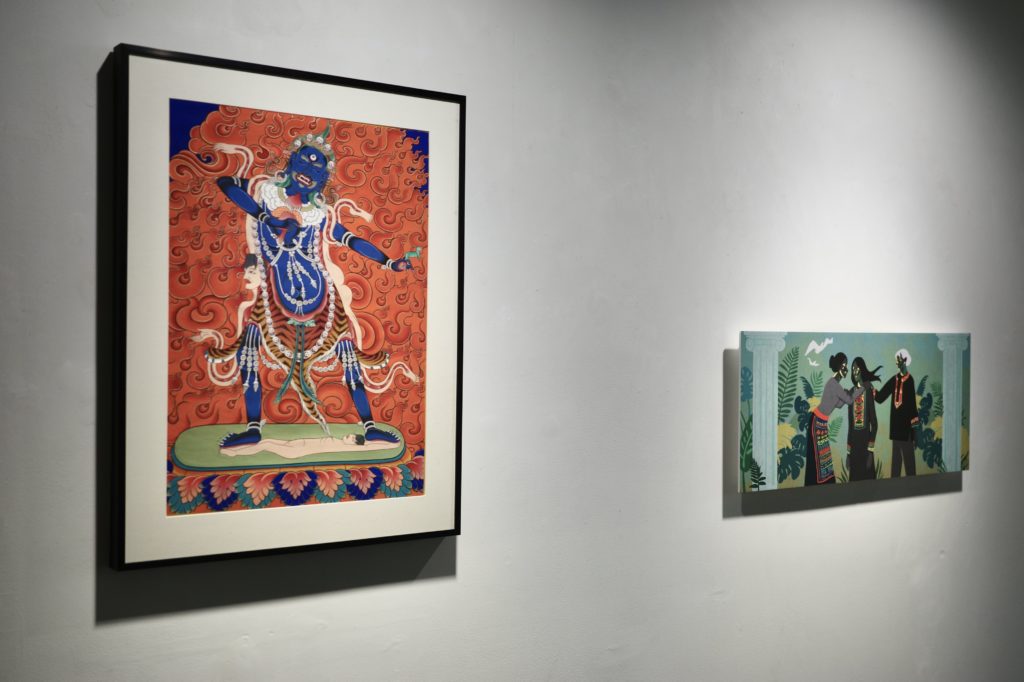
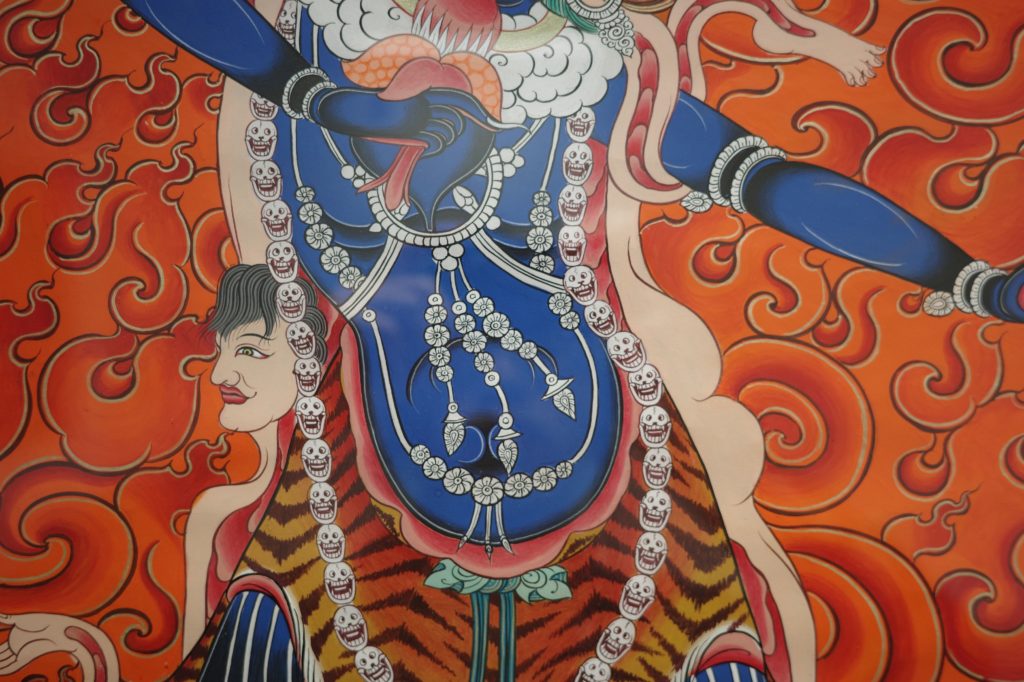
For Ai, One is a visual interpretation of consciousness, fear, and spiritual strength. As one of the 21 Taras – emanations of the goddess Arya Tara – Ekajati is known for her fierce and powerful nature, typically depicted with blue skin as a nod to her supremacy. In Ai’s painting, the deity’s perceptive ability to transcend binary dichotomies in order to uncover the essence of underlying experiences is symbolised by Ekajati’s single eye, single breast, and single braid of hair. These unique features reflect the non-dualistic nature of Buddha’s wisdom and, by extension, the ultimate state of enlightenment.
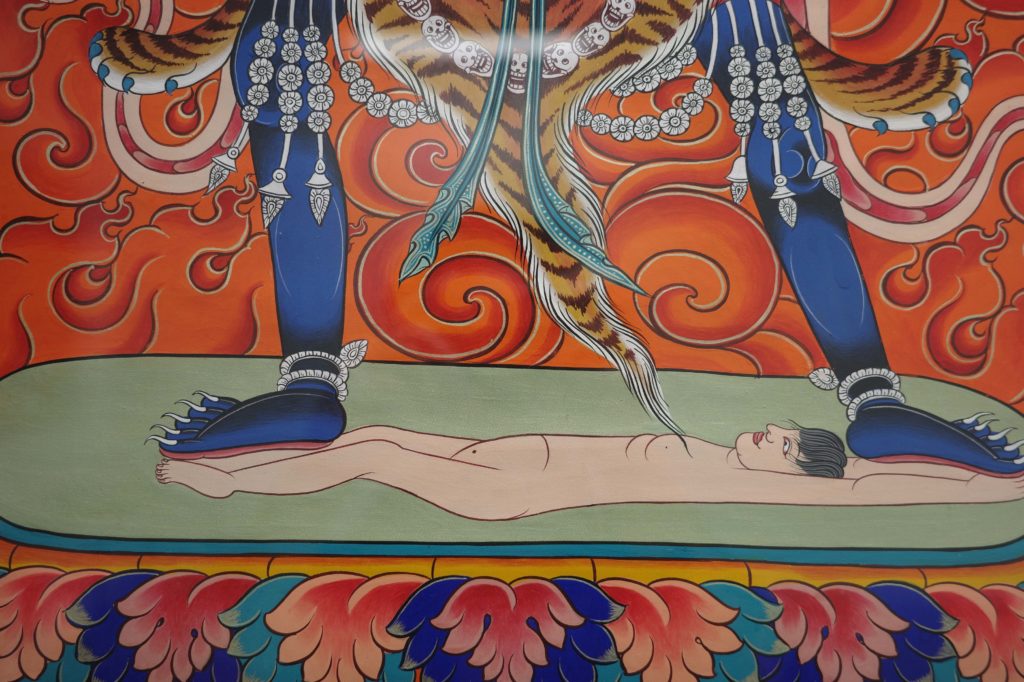
Donning a tiger’s pelt, and severed skull ornaments, she overcomes her barriers by trampling over her enemies’ corpses, sometimes even ripping out their hearts which releases a dog symbolising corrupting black magic. We might also speculate whether the human figure in One is in fact a self-portrait of the artist, whose skin now wraps around Ekajati like a trophy; Michelangelo did the same in the Last Judgment, his skin gruesomely held by a terrifying St Bartholomew. Collectively, these act as metaphors for transformation during one’s spiritual life and through ritual practice, ideally in accordance with the Dzogchen teachings that Ekajati upholds.
However, Ekajati is also believed to provide protection against illness and emotional distress, while manifesting the wisdom of all Buddhas to guide her followers on their spiritual journey, represented by the intense backdrop of orange-red flames. Ai observes a contrast between the flames and the deity’s blue skin, which she sees as symbolising the infinite and immeasurable realm of a grounded consciousness. In doing so, the composition recognises the fluid relationship between solid, spiritual foundations and the active dismantling of boundaries and obstacles. This symbiosis equally applies to the preservation of traditional art forms while the rest of contemporary art bickers.

As an influential female deity entrusted with the highest forms of Buddhist teaching, Ekajati also seems to be an appropriately relevant role model for navigating modern patriarchal society. If she were reincarnated now, we might consider her an icon and a ‘girlboss’.
Therefore, with One, Ai offers a spiritual proposition for individuals in today’s world: can an immutable inner order still exist when faced with an external world intent on distracting us with its desires, knowledge, and the overwhelming anxiety that comes with them? How can we shield ourselves from this constant barrage? Is self-awareness and spiritual renewal even enough anymore?
For Ai, Ekajati is not just a religious protector; she is a universal symbol of awareness, focus, and mental stability. In a world increasingly filled with shallowness and superficiality, finding one’s authentic self is more important than ever.