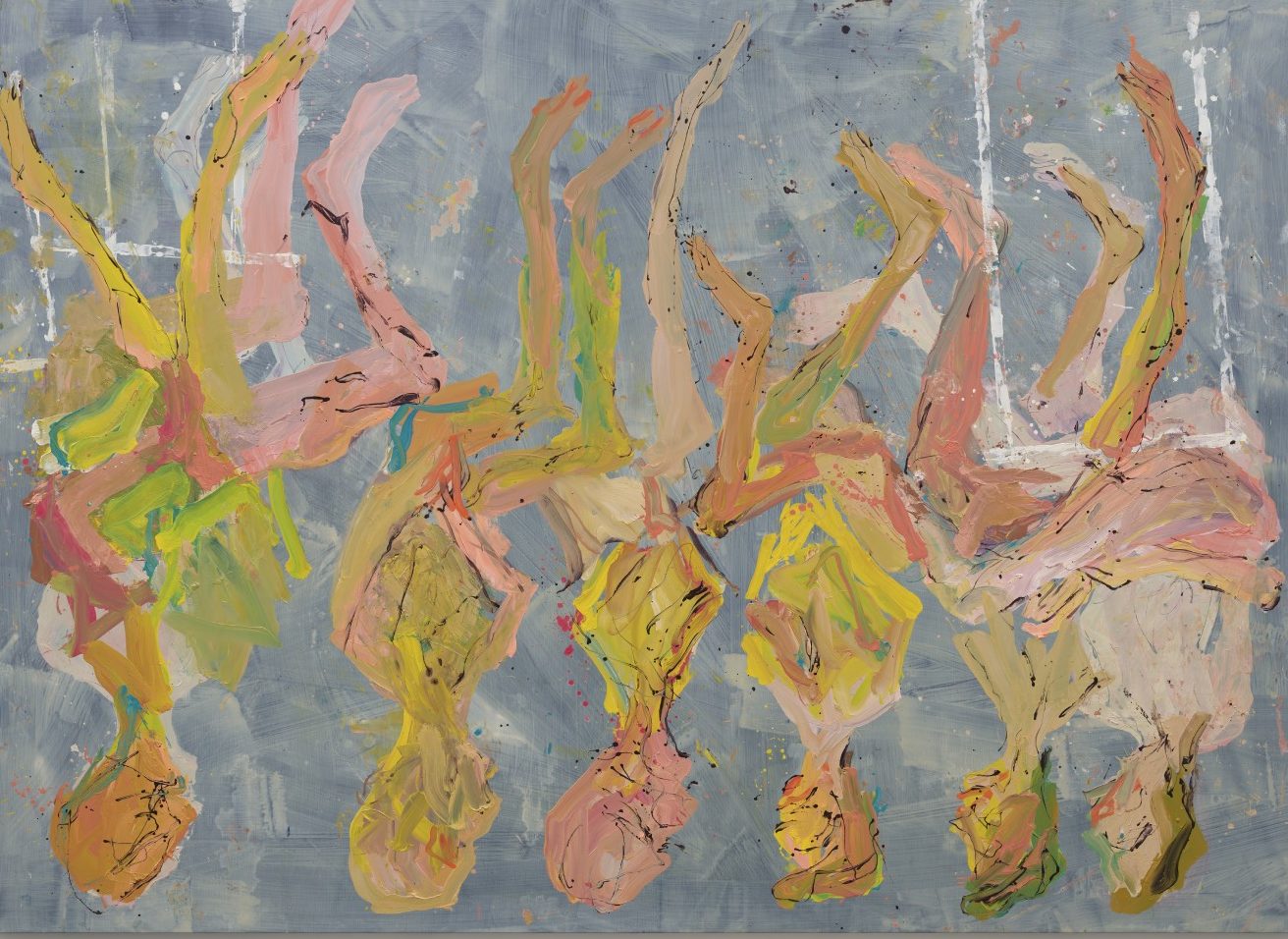
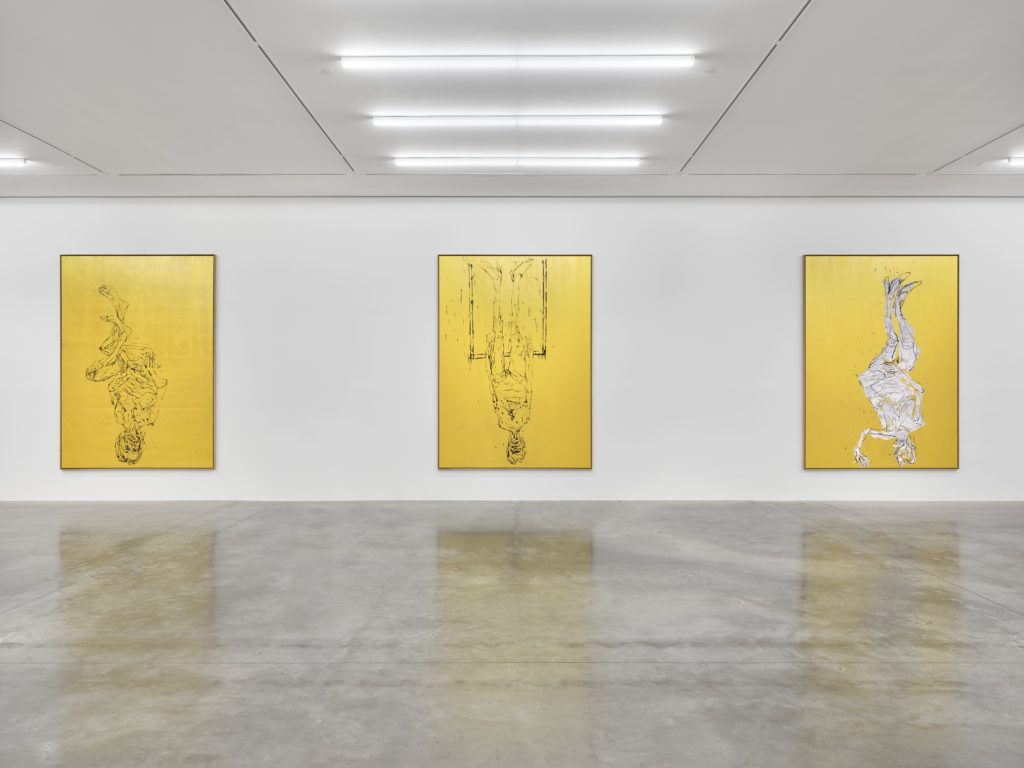
“I wanted to construct my connection to the world, to myself, and to my wife. The means for this should be as simple and ordinary as possible,” Baselitz reflects in an interview accompanying “Back Again,” White Cube’s exhibition billed as a summation of the artist’s sixty-year career, and, one of the final exhibitions he conceived before his death in April 2026, at the age of eighty-eight. Inside, his usual upended figures are rendered in an unfamiliar explosion of color; most of the colossal canvases have a gold ground, a striking departure for an artist whose sixty-year palette has largely stayed within blacks, grays, and muted earth tones.
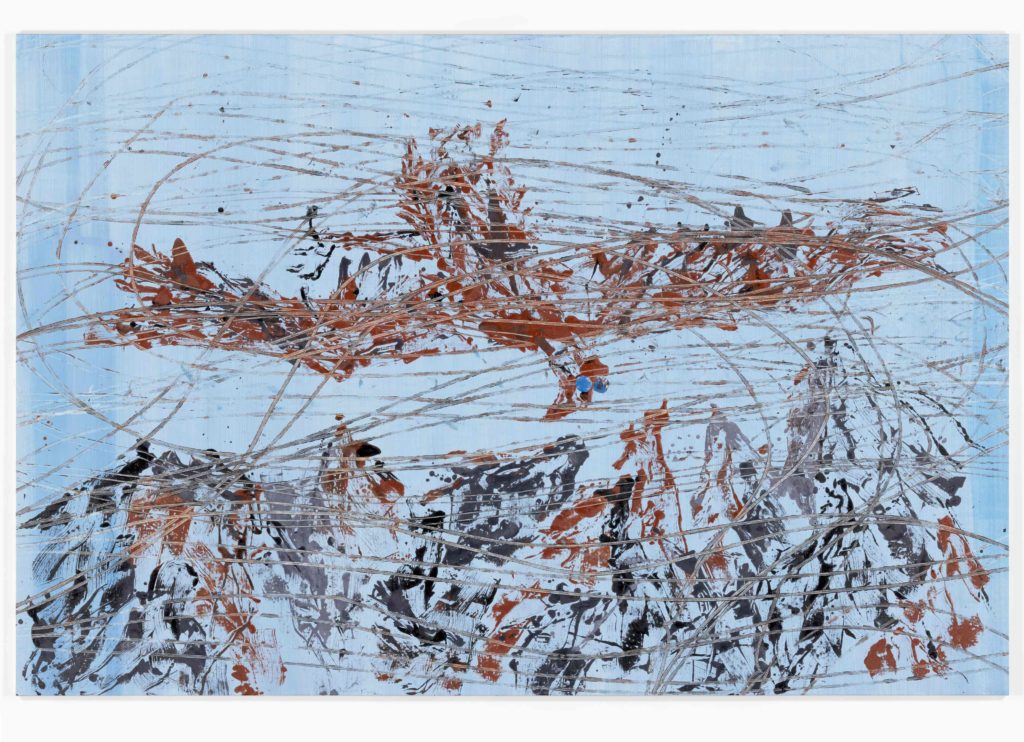
What is striking across the canvases is how consistently the abstraction resolves into something legible. A limb reads as a river system, then as a constellation chart, then as the ragged coastline of a map, with the same passage of black line serving as nature, cosmology, and topology depending on how long you look. There is no delicacy in the forms themselves; scaled almost to the size of a gallery wall, they are overbearing, almost aggressive in their physical presence. And yet something more intimate sits underneath that scale, a subtlety that never quite matches the size of the gesture holding it.
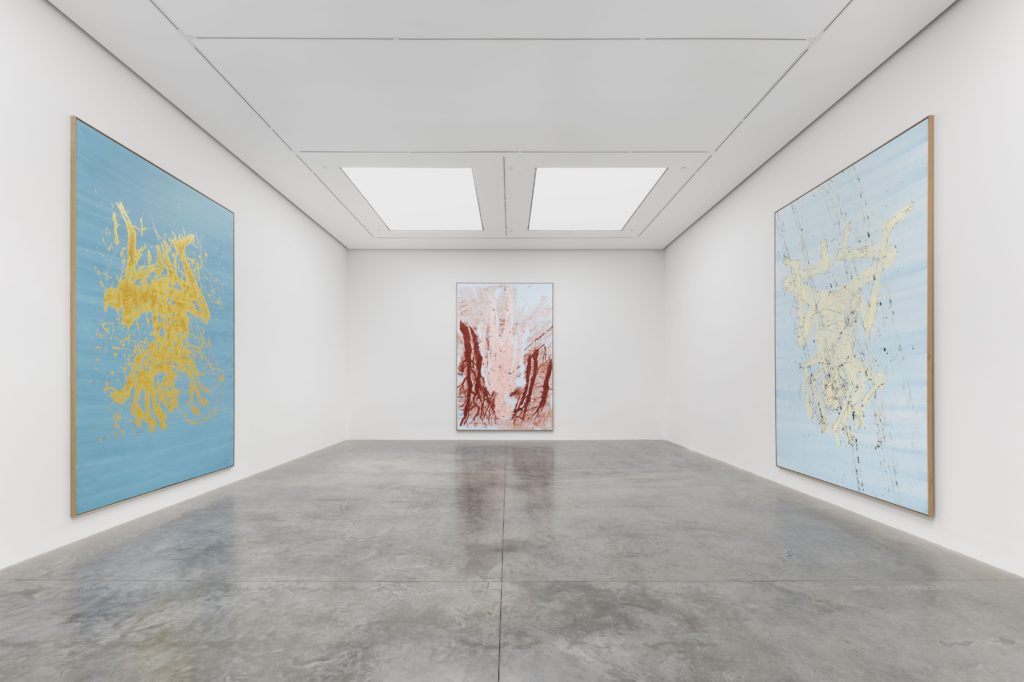
Baselitz has spoken in previous interviews about wanting the inverted figure to irritate the viewer, and the device still generates real friction. I find my head tilting to the side as I look at them. But the eye learns to live with the irregularity and adjusts. Something like an acceptance sets in. That shift feels closer to what Baselitz intends. As writer and curator Matthew Holman notes in the exhibition text, Baselitz has put it more plainly himself: “The hierarchy of sky above and ground down below is in any case only a pact that we have admittedly got used to but that one absolutely doesn’t have to believe in. For me, every kind of artistic pact is a fallacy.”
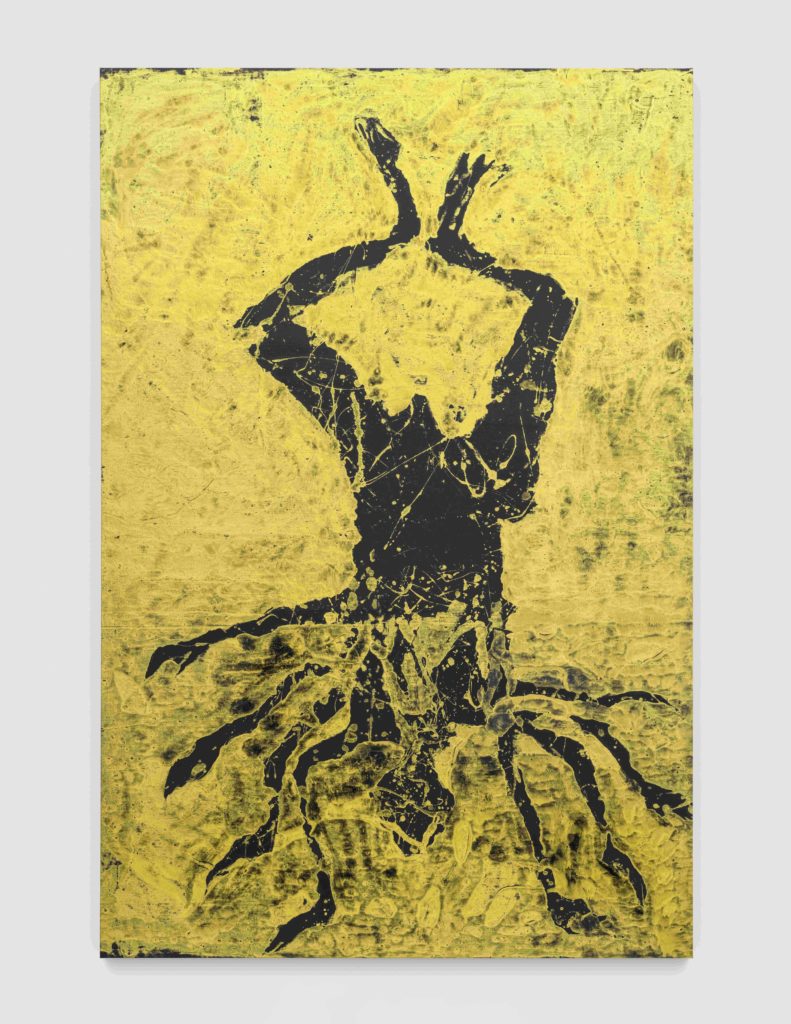
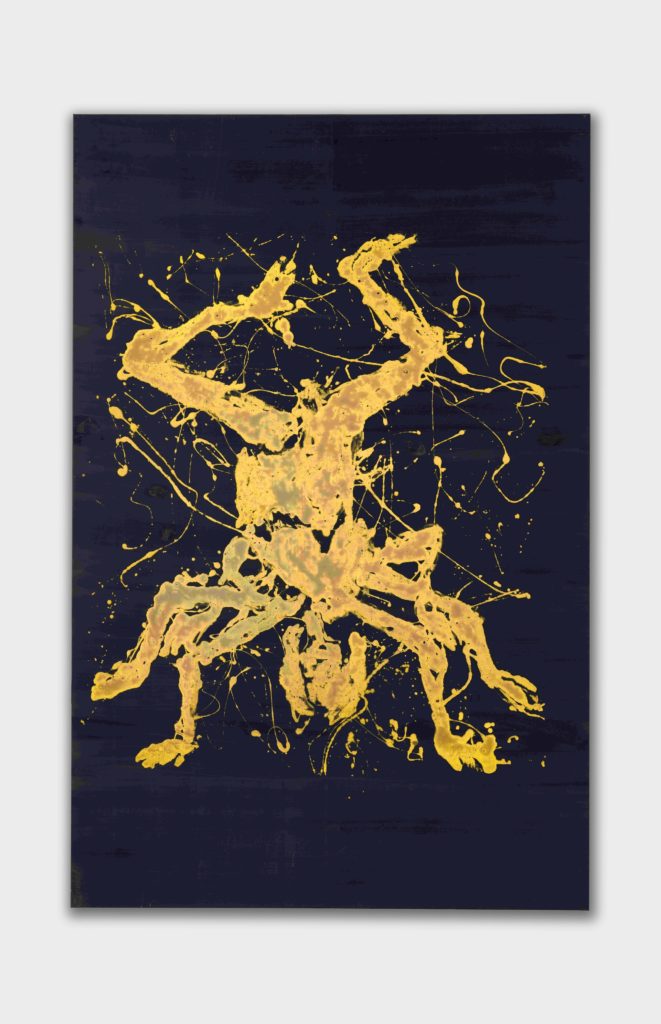
But there is another tension the show never quite resolves, and it is one Baselitz names against himself, whether he means to or not. “Now that I’m more or less at the end of my painting activity,” he is recorded saying, “I thought I should draw some kind of conclusion, a summation of the paintings I’ve done over the years […] The final conclusion remains simple, in fact it has nothing to do with painting, or with paint and brushes and so on except in small quotations, which I like to call ‘de Kooning’ and ‘de Kooning-in-the-wrong-place,’ an arbitrary, sudden action with a brush and a palette knife in de Kooning colors somewhere in or next to the figure.” Here is an artist admitting that the only mark he can still make with any conviction is not his own. In these paintings, Baselitz is reaching for de Kooning’s hand to finish the sentence his own can no longer complete. Whether that is a late breakthrough or simply exhaustion dressed up as a painterly strategy is hard to know. The titles of the smaller works suggest he knew it could be read either way: Versuch eines Anzugs (Attempt at a Suit) (2025) names a garment that never quite comes together, and Gold ohne Hemd (Gold Without Shirt) (2025) strips it away entirely. It is no longer clear whether that collapse is the point or just what happens at the very end of a life spent painting.
The eagle painting carries a heavier historical charge. As Holman reminds us, “for a wild and nature-loving child in Nazi Germany the eagle was still a symbol of fascist authority, and Baselitz never made his peace with the political systems that formed him.” Baselitz’s father fought in the war, and Baselitz’s own early paintings dealt in dismembered bodies, bloodied and fractured, strewn apart and mashed together, the trauma rendered almost literally in paint. Set against that history, the simplicity of the line in these final works reads closer to something like relief. This is an artist who spent decades painting the body coming apart finally allowing it to hold together, however precariously, in a single unbroken stroke.
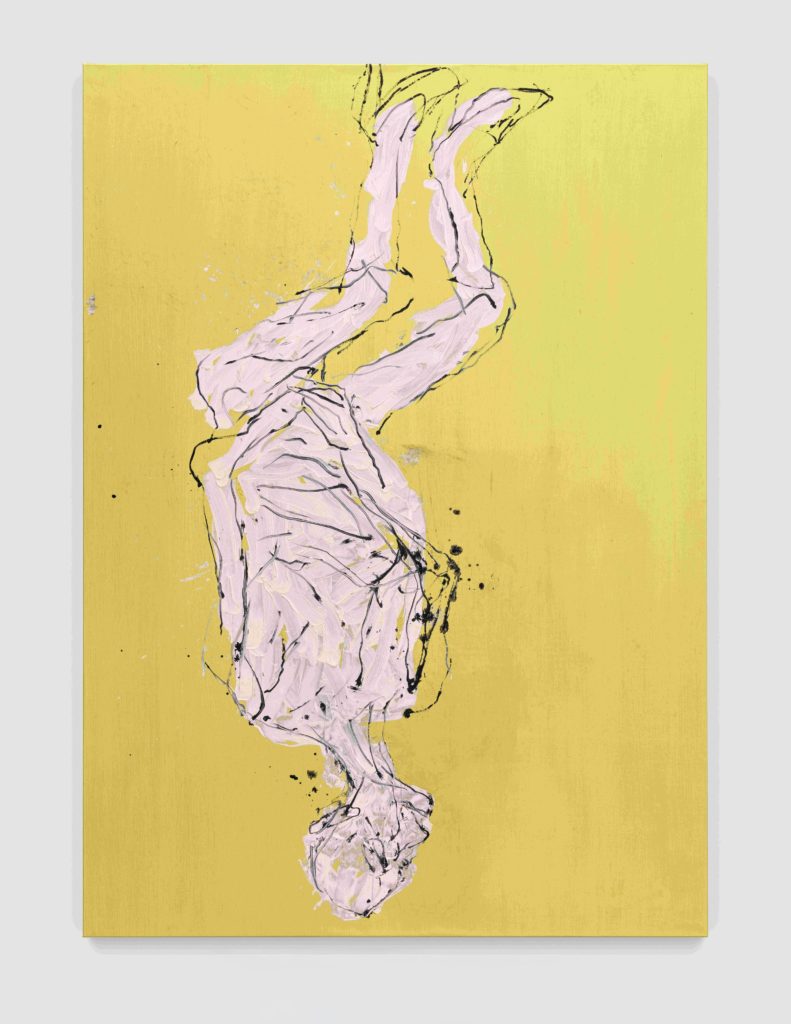
If there is an explanation for that gap between scale and subtlety, it may be his wife, Elke Kretzschmar. Present here as she has been for sixty-odd years of Baselitz’s work without ever being depicted, she seems to account for whatever tenderness survives the sheer size of these canvases. “Elke comes in and out of the picture,” Baselitz has said. “I don’t illustrate her. If anything, I try to remove her, but I usually can’t. She comes into the process whether I want it or not, through the back of my mind. The point of portraiture is to leave the portrait behind so that you can go forward.” That ambivalence is legible in the paintings themselves, and even in their titles: Als wäre es in Berlin gewesen (As If It Had Been in Berlin) (2025) places a memory in the subjunctive mood, unmoored from any fixed place or date, which is exactly how memory of a sixty-year marriage should behave on canvas.
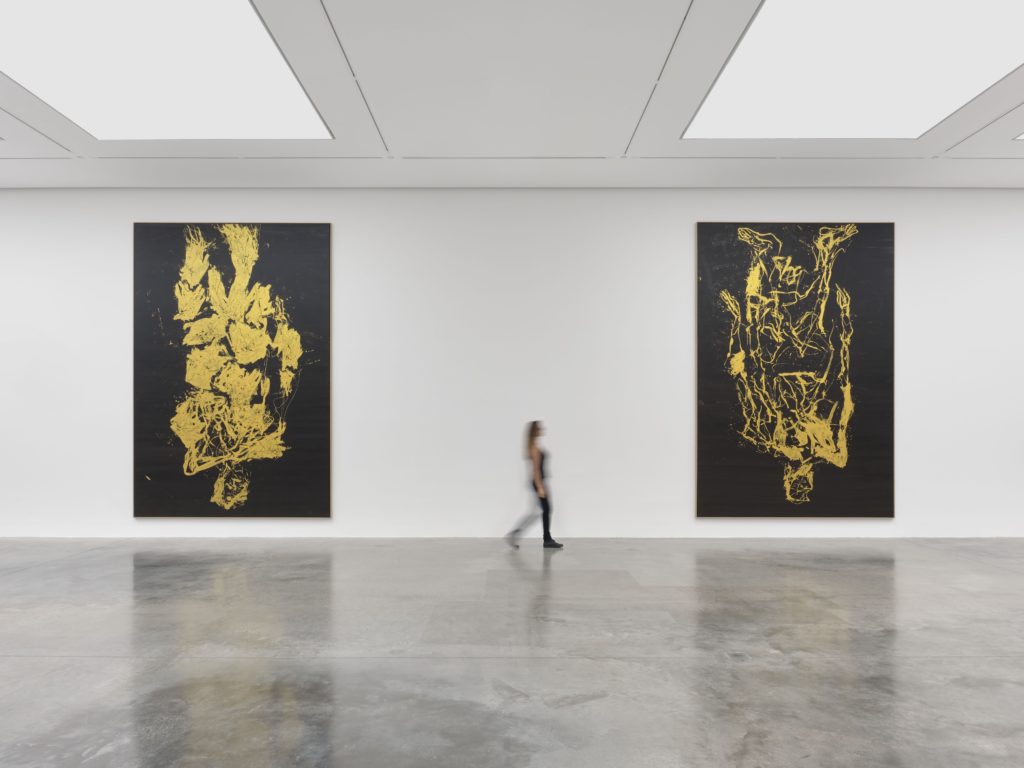
Walking out of the exhibition, what stays is Baselitz’s own framing of his paintings: that there is no single key picture anymore, that the whole accumulated body of work has become the key picture. It is a tidy thing for an artist facing the end of a sixty-year practice to say, and its worth resisting as his actual achievement was never tidy. He inverted the figure in 1969 and, in doing so, gave two generations of painters permission to treat the body as raw material, in a single formal decision that rewired how figuration could survive after abstraction had supposedly made it obsolete, which is no minor legacy. It sits alongside Kiefer and Richter as one of the defining answers to the question of what German painting does with a ruined national imagination, and “Back Again” is at its best precisely where it refuses to resolve that inheritance: the eagle that is both childhood memory and fascist emblem, the body that is both his and Elke’s and neither, the line that holds together a figure his own earlier work spent decades tearing apart.