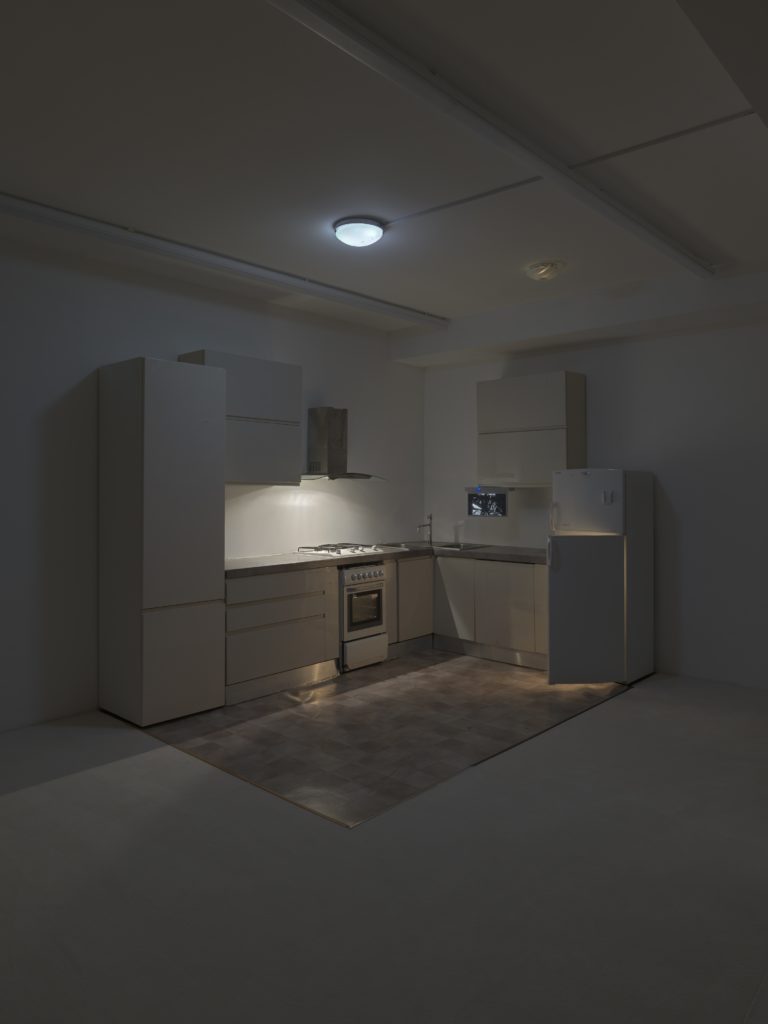
At Bernheim, I feel like I have noclipped into some influencer’s YouTube cooking video haunted by the ghost of human life. In video games, noclipping is the act of glitching through things such as walls, props, and other players; just like that, I shapeshift into the gallery space. Like an IKEA-induced lucid nightmare, a kitchen has spawned into the space: it is tangible but also strangely covered in a digital gloss, now emptied out and rendered alien. The objects in the room — stoves, refrigerator, oven, sink — might as well be from a spaceship. Vladislav Markov’s solo exhibition in Zurich continues the artist’s investigation into how digital technologies have reshaped human cognition and perception, moving within a field that looks at the internet not as an infrastructure, but as an affective-hallucinatory fabric haunting the mind.
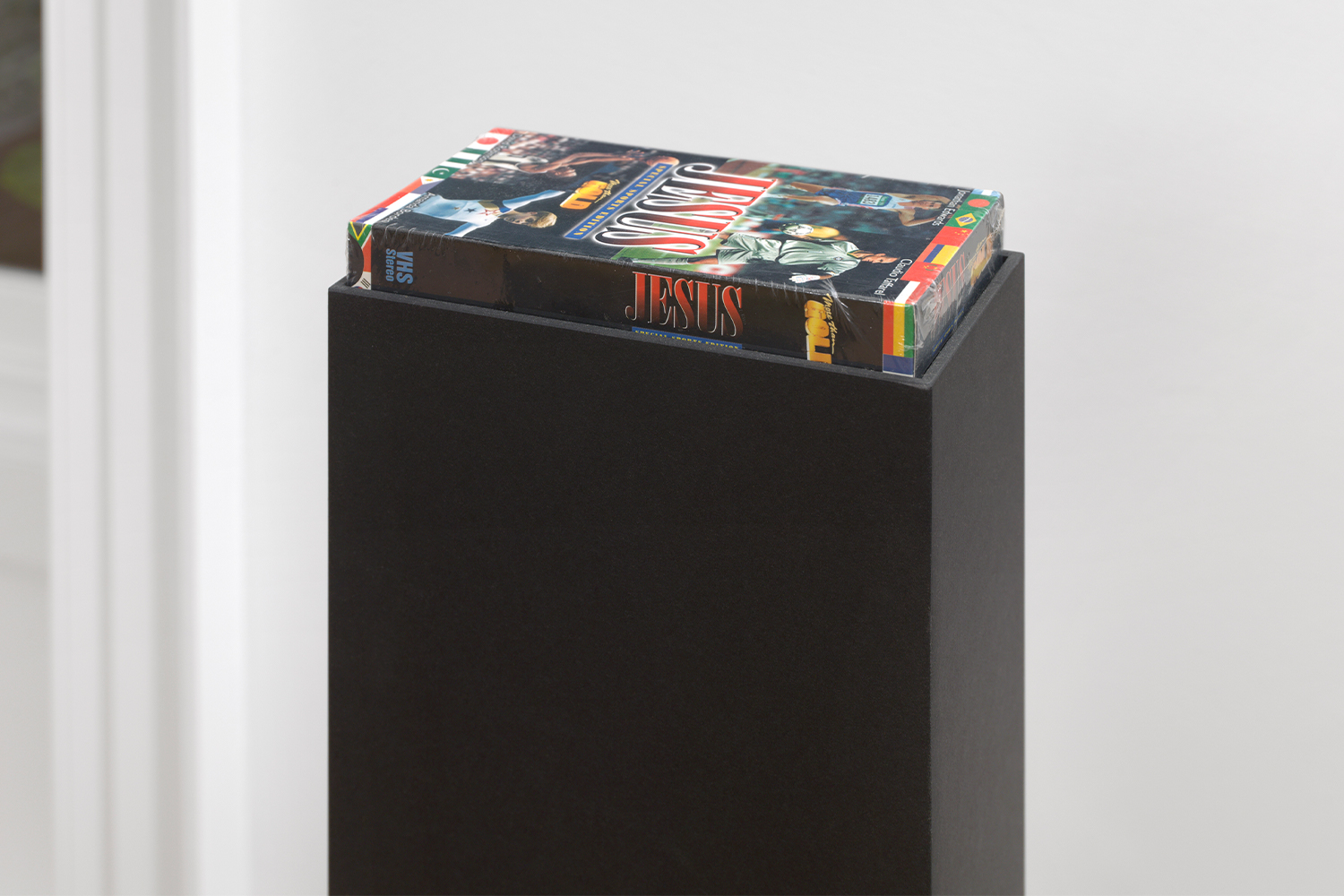
The exhibition title, “LOCATION.LOCATION.LOCATION,” frames repetition and loops as defining features of our contemporary hyper-mediated realm (from TikTok sounds to the creepy nursery rhymes of online children’s content) — perceptual modes suggesting that we already embody the logic of automatons without realizing it. For the occasion, the gallery is reconfigured and split into two parts: in the narrow entrance corridor, four paintings anticipate elements of the video shown in the next space. These works are made via a process for which the artist is known: printing a 3D-scanned image with a pigment printer and transferring it onto canvas with acrylic paint, thus creating images that resemble mnemonic fragments disturbed by interference. Here, the space between the two corridor walls is so narrow that it allows no view of the works other than from extreme proximity. The viewer is left to physically confront the paintings, experiencing them as image-spaces instead of two-dimensional surfaces.
In the next room, covered in a gray moquette and bathed in a soft, flattening light, a disused kitchen and a small monitor are relegated to a corner. The way the installation is arranged suggests that you might find yourself inside a human-scale, three-dimensional render. The installation evokes a sensation similar to digital experience: instead of inhabiting a dollhouse, one becomes a virtual presence haunting a simulation.
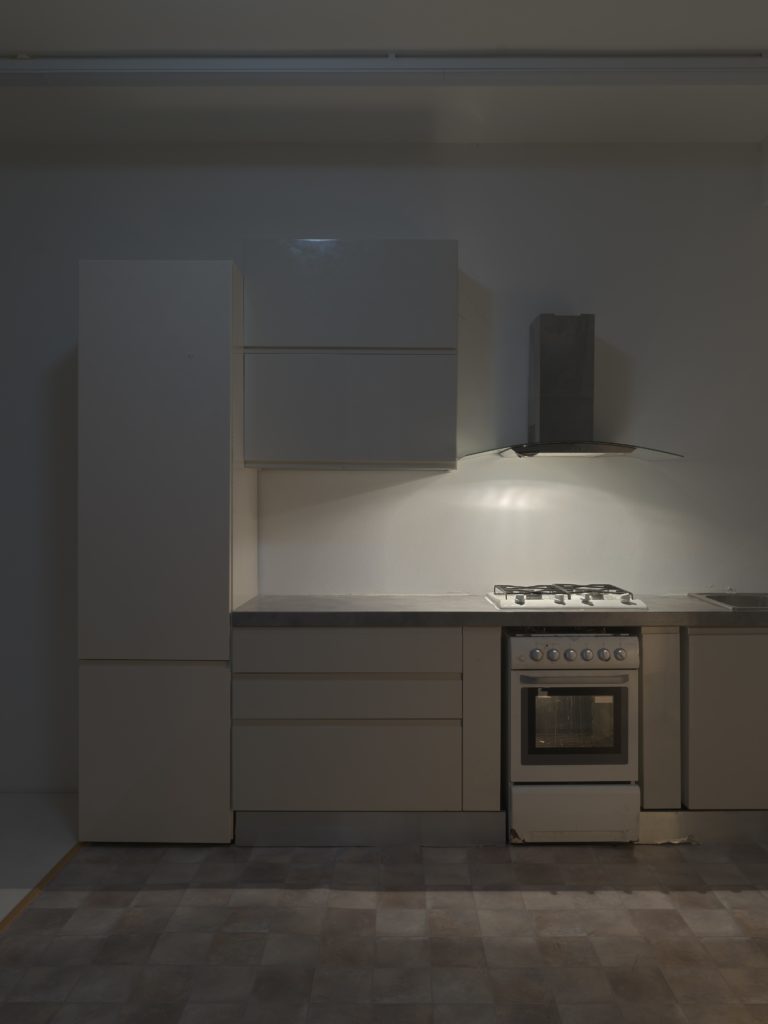
The space resembles something familiar, but appears trapped within computational code and subject to shifting volumetric constraints, as if still processing through a 3D rendering engine. You are either looking too close or too far, unable to establish whether you are the last human left inside the gray cube or an extraterrestrial entity infesting it.
In Markov’s exhibition, the “render” is a crucial device in the negotiation, and therefore the invention, of the “real.” It is a simulation, and thus a form seeking to become another form, living off the spectral potentiality of being more real than reality itself. It is a space where perception ceases to be human and starts becoming something “other.”

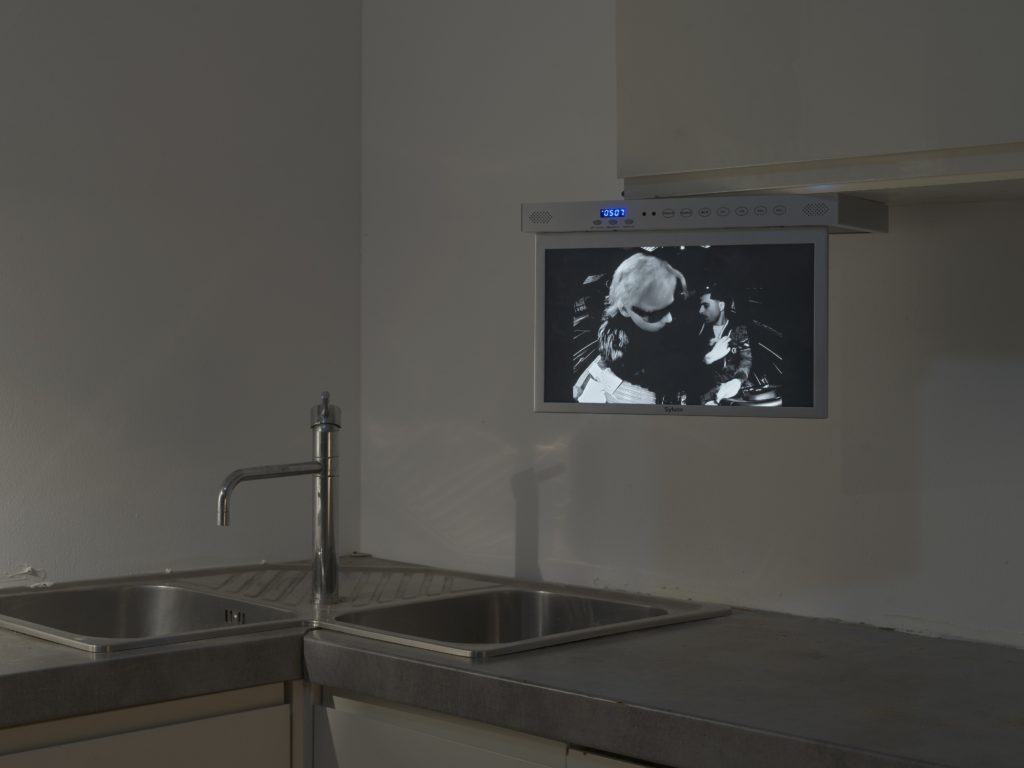
A small monitor close to the sink shows a forty-three-minute-long video where four people, stuck in an electric car during the time needed to charge it, are trying to reach someone’s funeral. Their conversations are stuck in a continuous invocation of someone who no longer exists — a deceased person named Alex — while ads from a radio station reverberate inside the car: a nod to the in-game radio of Grand Theft Auto, already present in Markov’s previous exhibition, “OBJECTS IN MIRROR MAY BE CLOSER THAN THEY APPEAR ” at Management, New York.
Alone in the cold of an almost-human room, the video functions as a crack, a fissure, a window, a surveillance camera inside what’s left of humanity outside that space. In which dimension is the story in the video unfolding? Am I watching something I should not be able to see? Are these people being surveilled from another dimension? As I move through the empty space and listen to the characters’ conversations, I begin to think I might be visiting the abandoned home of the disappeared friend mentioned in the video. The surroundings are definitely closer to the otherworldly dimension one reaches after death than to the location inhabited by the characters.
In today’s digital folklore — shaped by hyperstitions, reality shifts, and endless descents into the Backrooms and collectively invoked egregores, one begins to wonder whether we still inhabit the place where our bodies physically exist, or whether we have already found a way to tap into infinite parallel dimensions increasingly detached from the world as we once knew it.
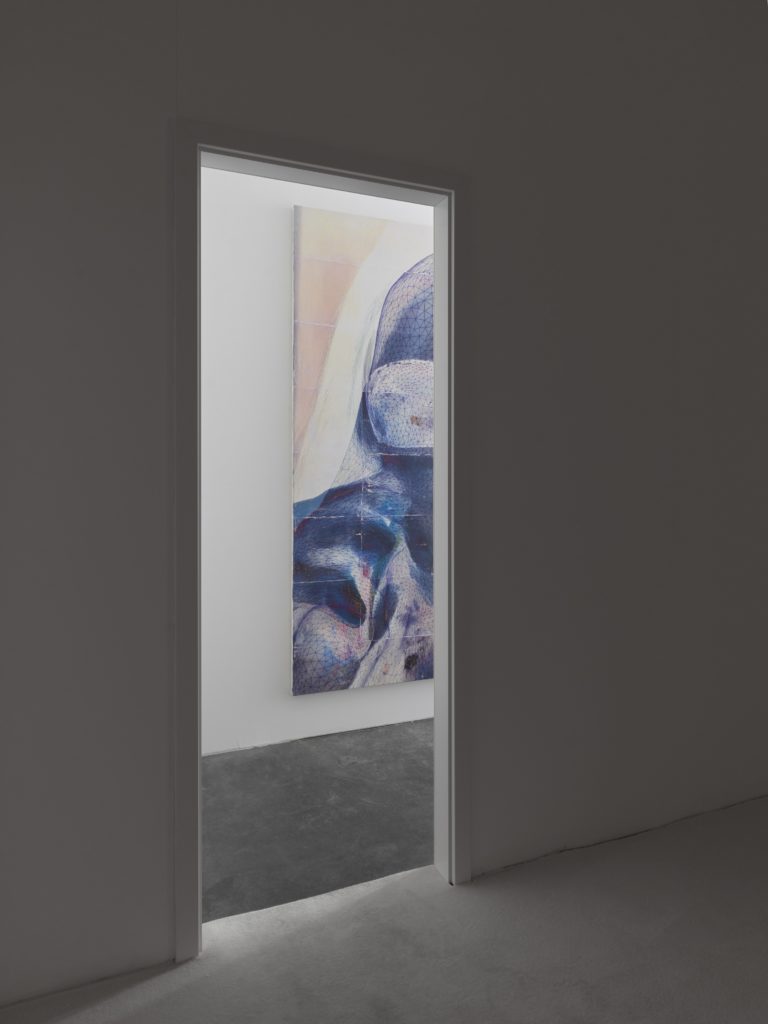
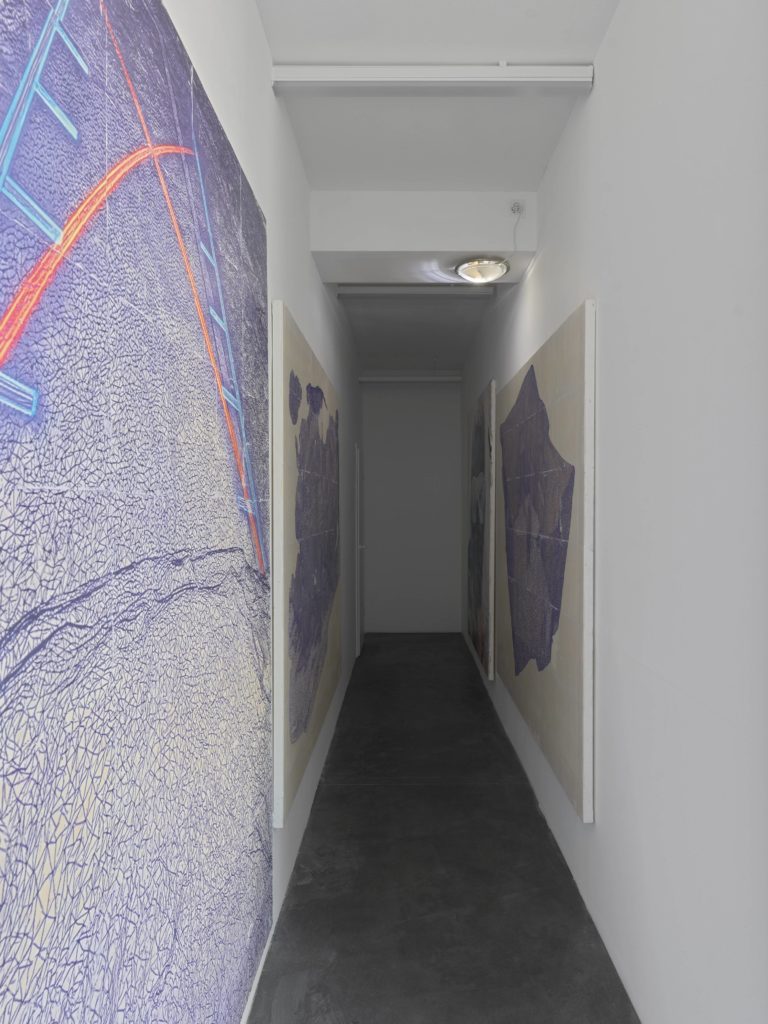
Shanghai-based theorist Bogna Konior, who has long argued that there is little difference between internet theory and ufology, recalls how the French astronomer Jacques Vallée does not consider “alien encounters to be necessarily extraterrestrial in origin, nor does he think of them as discrete things or beings. Rather, he proposes that they are temporary openings and shifts in our sensory and mental experiences, like perceptual windows.”[1] Markov’s show conjures one of these portals.
[1] Bogna Konior, The Dark Forest Theory of the Internet (Theory Redux), (Polity Press, 2026).