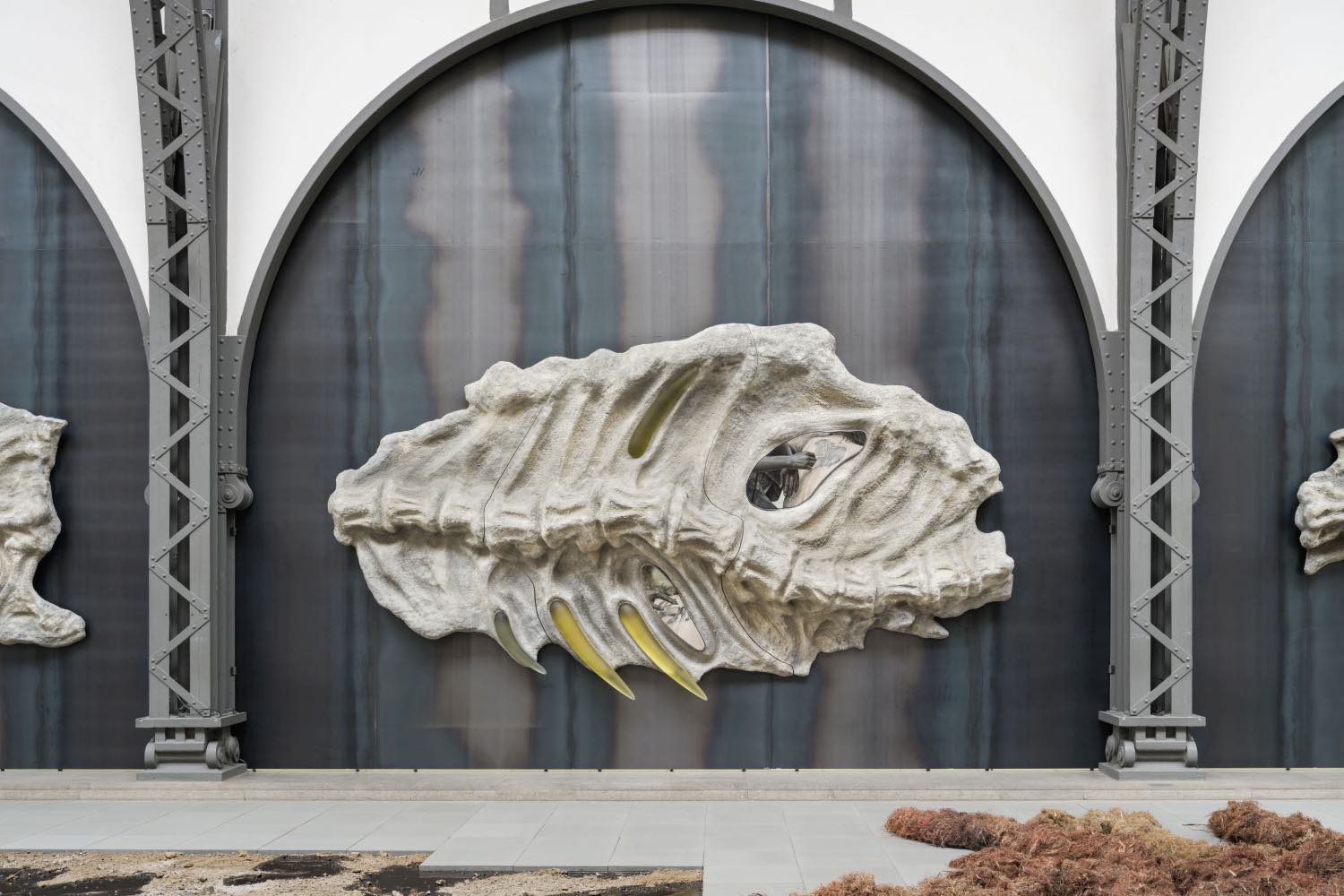
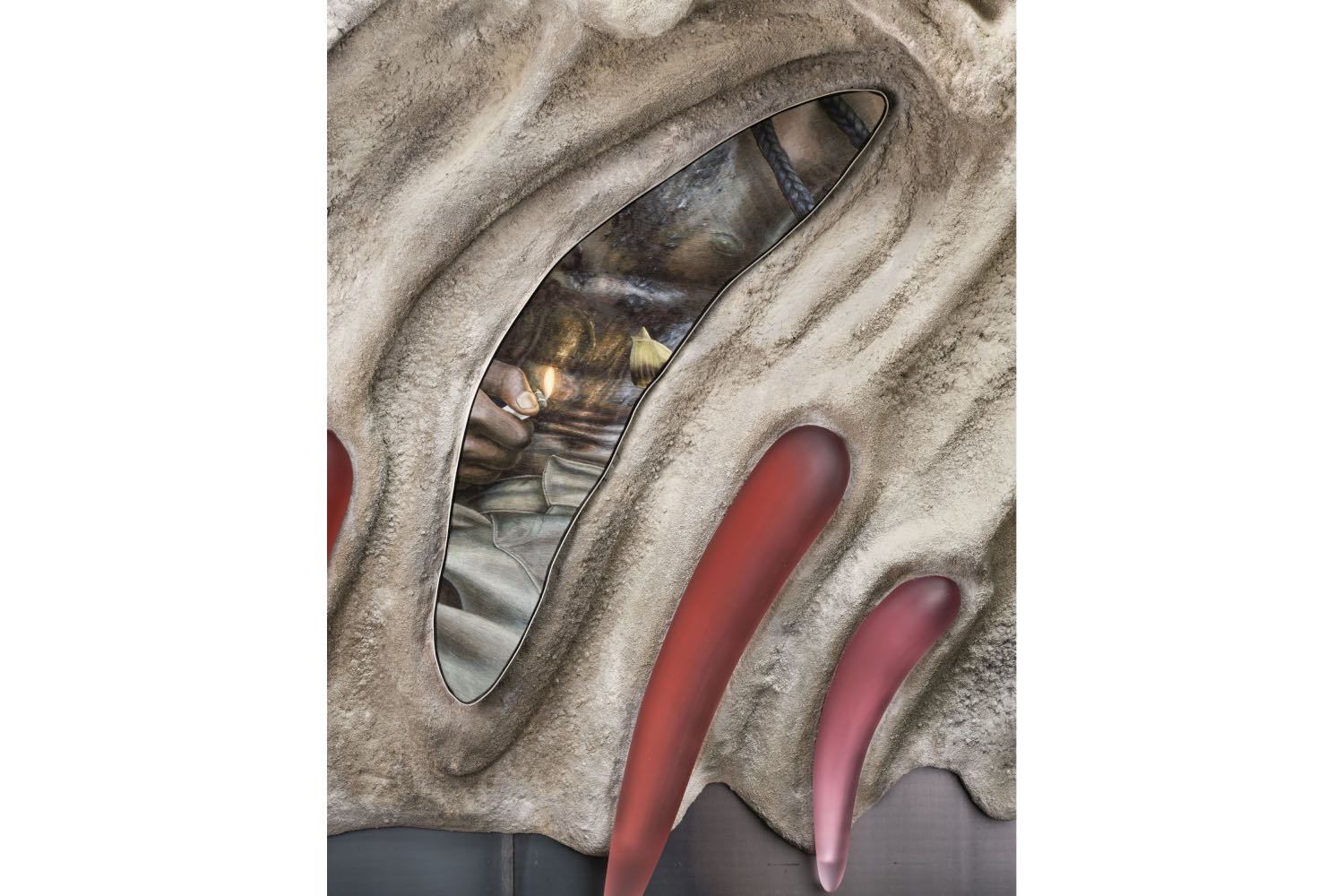
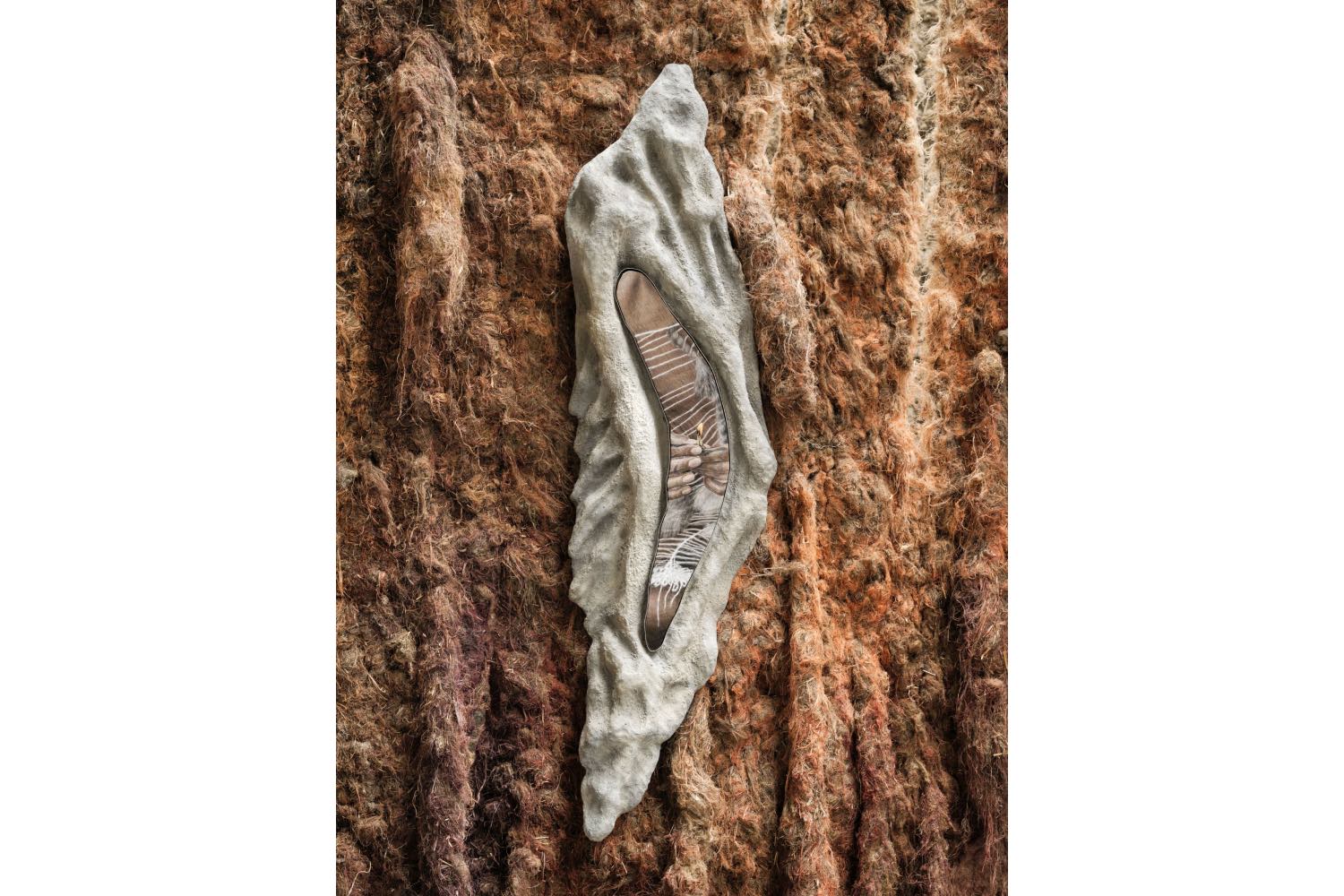
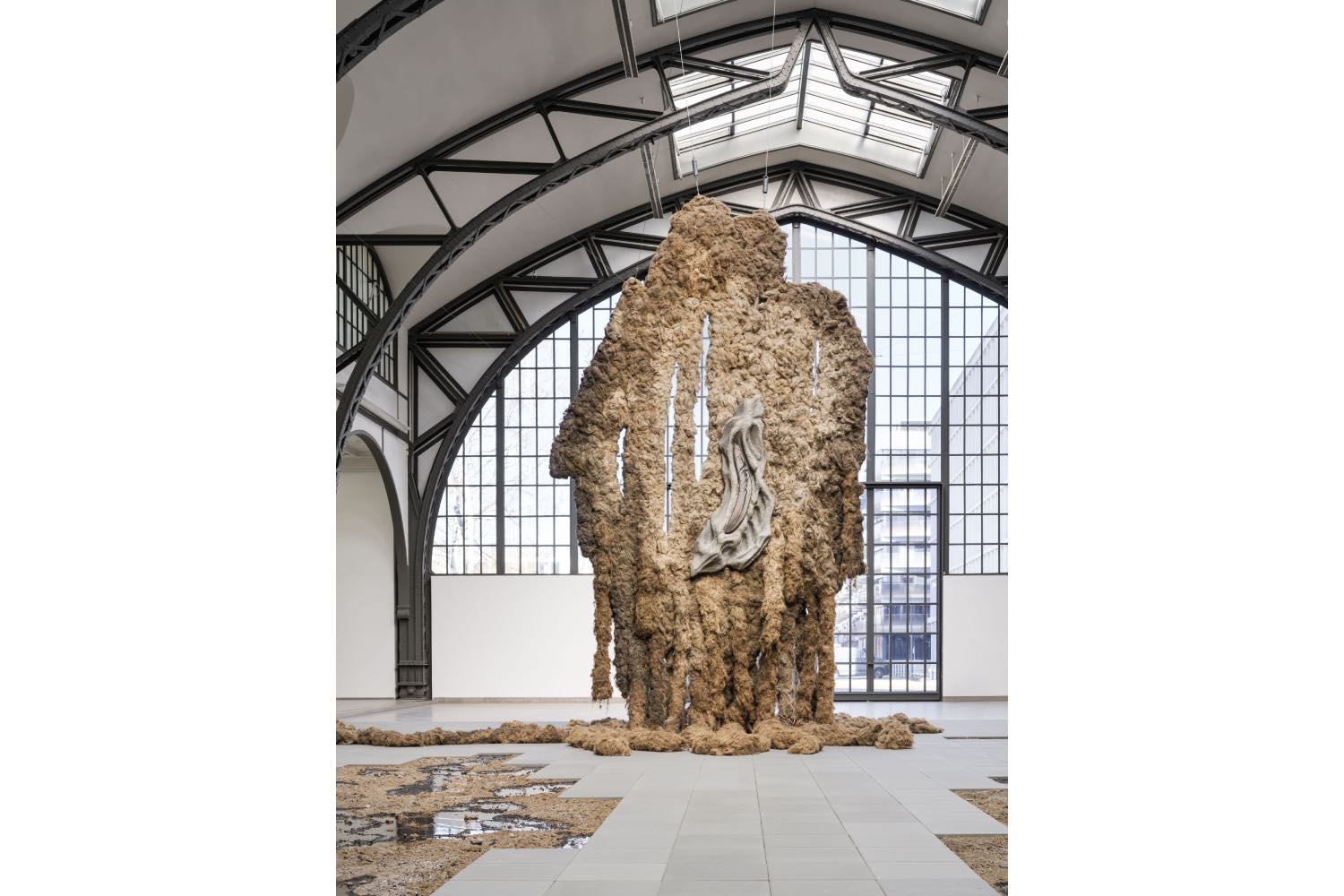
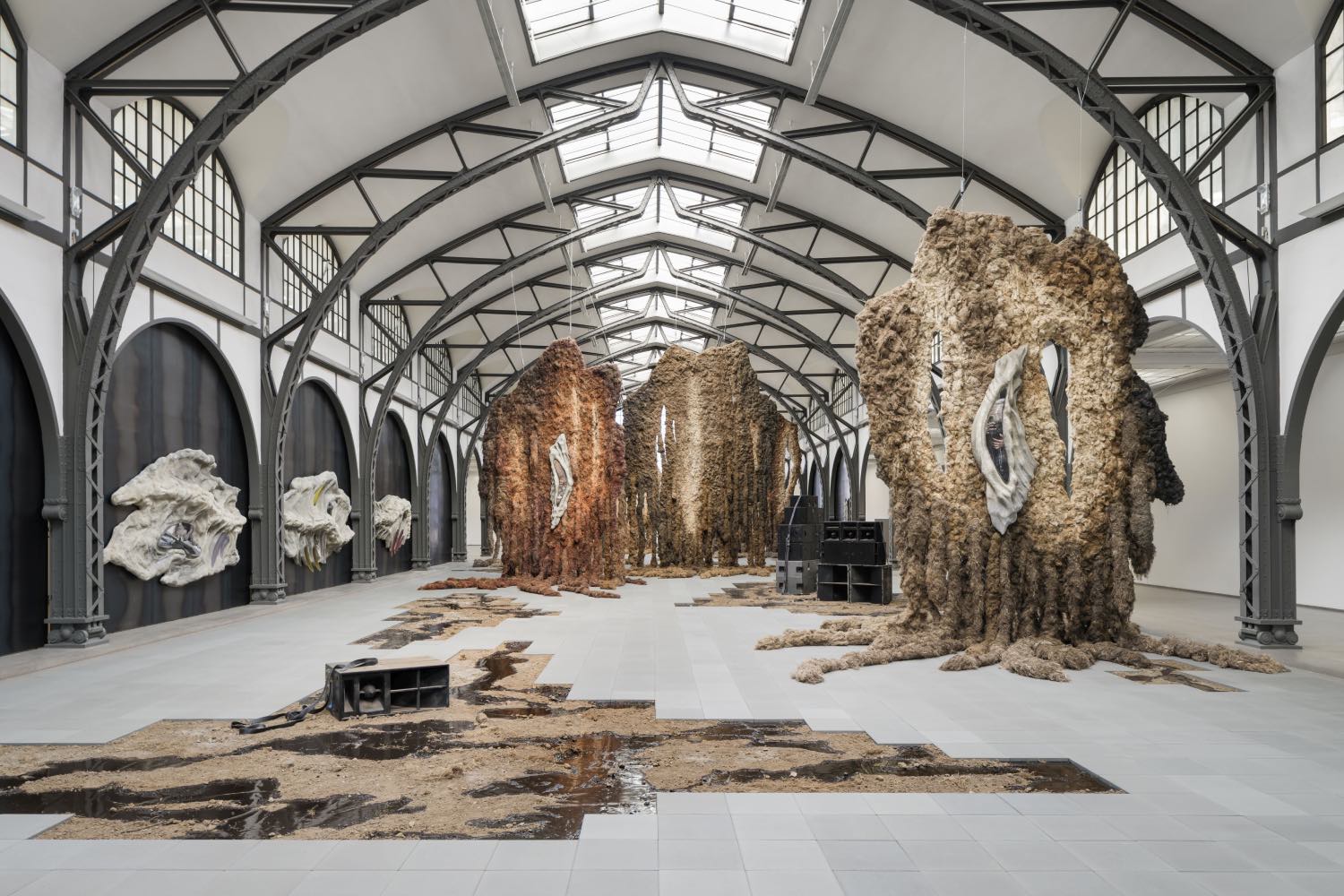
Klára Hosnedlová’s “embrace,” which inaugurates three years’ worth of Chanel-sponsored programming in the Hamburger Bahnhof’s main hall, foxes formal categorizing at every turn. Technically, I guess you’d call the fast-rising, Czech Republic–born artist’s grandest gesture to date a sculptural installation, but moves in and classifications quickly break down. Suspended from the ceiling, facing the viewer like sentinels, are six huge knotted and woven hangings made from hemp and flax. Resembling brownish pelts, these are studded with sand-coated wall reliefs, resembling giant stony fossils as imagined by H. R. Giger, and inset with incisor-like glass elements and figurative embroideries that, in turn, draw on private performances held in Hosnedlová’s previous shows. Got all that? Good. Further reliefs-plus-embroideries hang on the walls; the floor is tiled, with gaps revealing a raw, dirty, puddled underfloor and repurposed speakers from Berlin techno clubs, some now defunct, offer a changeable ambient soundtrack. We hear church bells, the voices of a women’s choir who sing in Moravian “micro-dialects,” and Czech rapper Yzomandias.
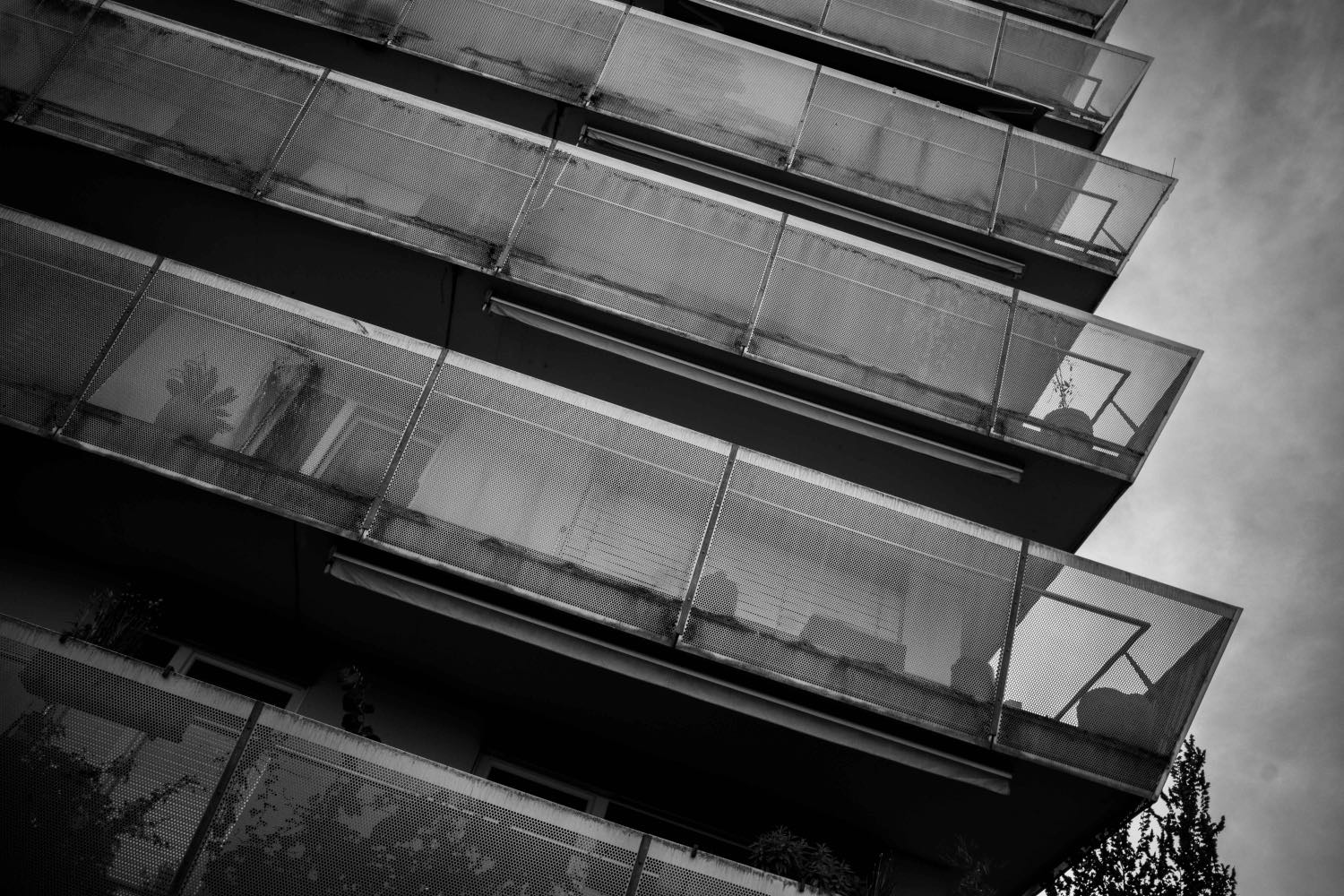
Equally resistant to easy definition is the show’s implicit temporality. As with many of the artist’s previous exhibitions, it suggests a near-future after some kind of societal breakdown, in which aspects of the past — like, maybe, hunter-gathering — have begun to return, and, in any case, the world is not ruled by strongmen. Hosnedlová was born in 1990 — the year that the Soviet Union unraveled — and totalitarian modernity has been a longstanding foil in her work, though it often functions as a broad metaphor for a harsh form of social organization that deservedly falls apart. Here, the paved floor, contrasting against the soft organic matter “under” it, is — so we’re told by one of numerous didactic texts that appear throughout the show — intended to recall the brutalist architecture of East-Central Europe. The fossil-like wall reliefs reference friezes on communist buildings, here undercut with the artist’s humane, delicate embroideries. (We also learn that she collected fossils as a child, and the wild shift of scale is intended to generate “endless possibilities for the imagination.”)
Hosnedlová tends to use Soviet architecture as a shorthand for a cold, impersonal, masculine environment, and to counter it with softness, femininity and, not infrequently, a refusal of clear logic or sense. The embroideries are derived from photographs of enigmatic ritualistic actions around Hosnedlová’s previous sculptures, thus emphasizing the virtues of continuity with the past, show people — mostly women of color — performing actions like burning things (a presumably dead moth, some kind of knitted object) with lit matches, or reaching out to touch someone’s back. Human behavior in this afterworld is differently coded, evidently, but often delicate, implicitly tender; it seems like the spectral inhabitants are learning how to live anew. Another thread, if you will, is a valorization of the human hand, and of craft customs that are at risk of dying out. The toothlike glass elements in Hosnedlová’s glass reliefs were handblown by artisans and “[draw] on regional traditions”; the flax and hemp hangings were produced with the last remaining artisans of the material in the local area.
Within the artist’s system of contrasts, such patient and knowledge-respecting handiwork — some of it traditionally considered “women’s work” — is the opposite of a speeding technocratic reality that might well be headed toward societal collapse. What “embrace” stages or models, then, is a world where the worst has already happened, and a kind of tentative, exploratory rebuilding has begun. In handling such a large, hangar-like space, Hosnedlová needfully resorts to repetition — by the time you’re halfway through the show, you’ve basically seen its moves, and are left only with variations — but that’s forgivable since she’s asking you to learn and get comfortable with an alien vocabulary. Once you’ve done so, and while you’re temporarily held in the show’s, yes, embrace, it is momentarily possible to imagine that in the long run humankind will be okay, either through changing course or by resourcefully playing in the coming ruins. Then you wake up, but it was transporting while it lasted.