Alice Maher is one of several Irish artists exhibiting at the 61st Venice Biennale. Maher appears in “In Minor Keys,” curated by the late Koyo Kouoh, alongside her collaborator Rachel Fallon. Also exhibiting as part of “In Minor Keys” is Alan Phelan, while Isabel Nolan represents Ireland in the Irish National Pavilion, curated by Georgina Jackson.
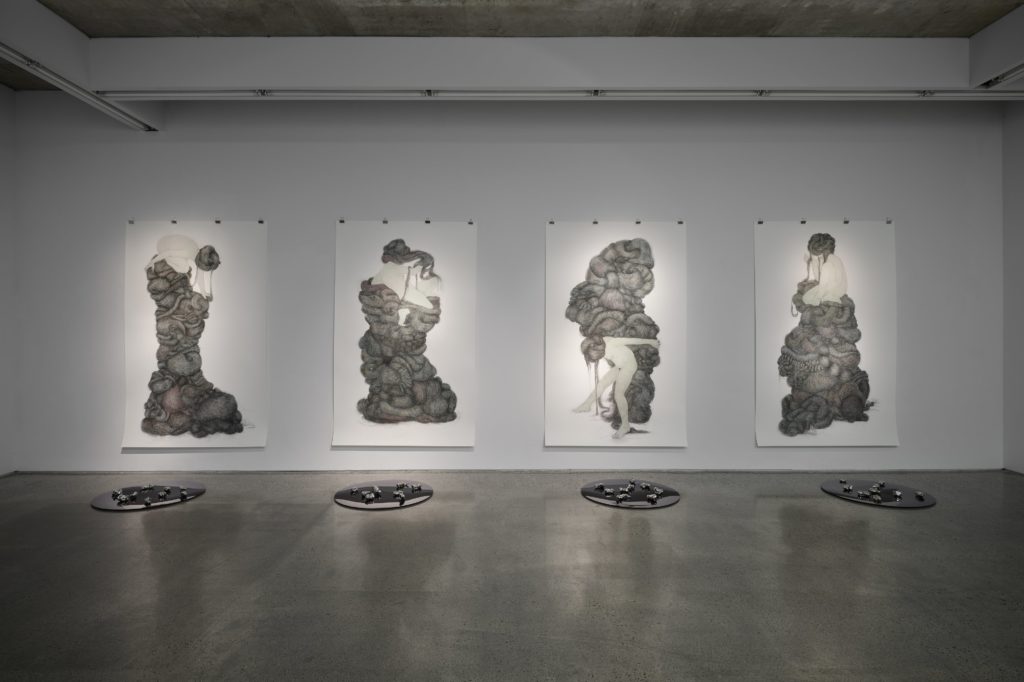
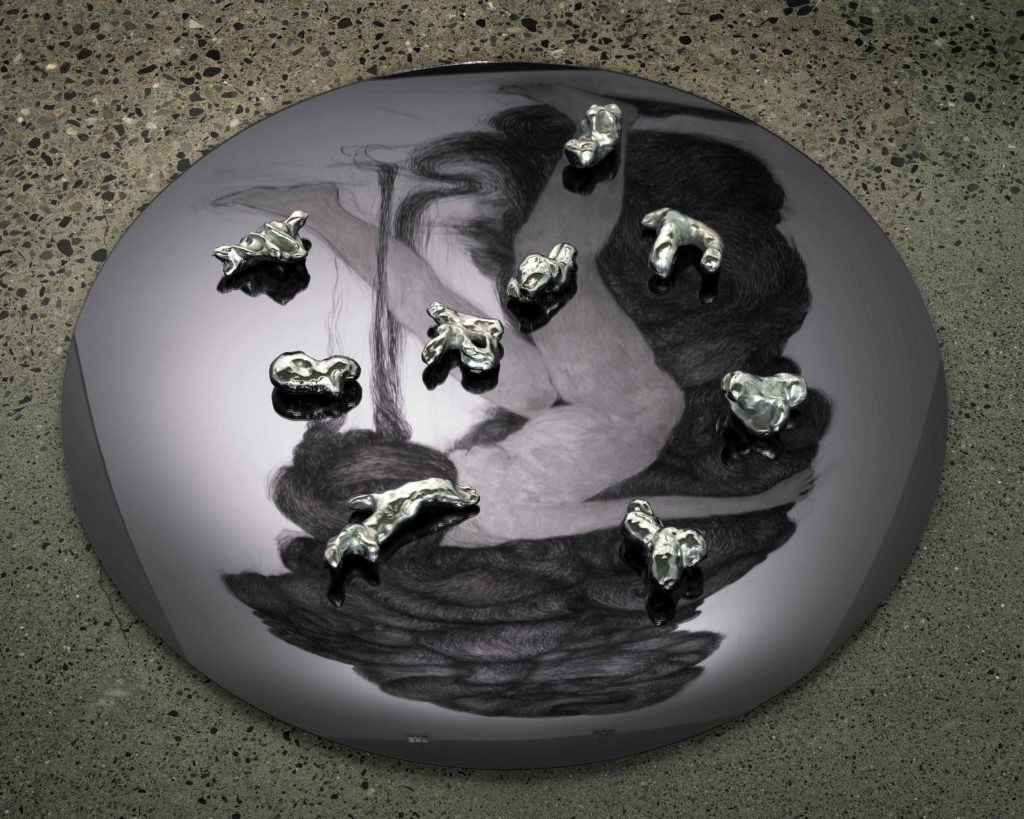
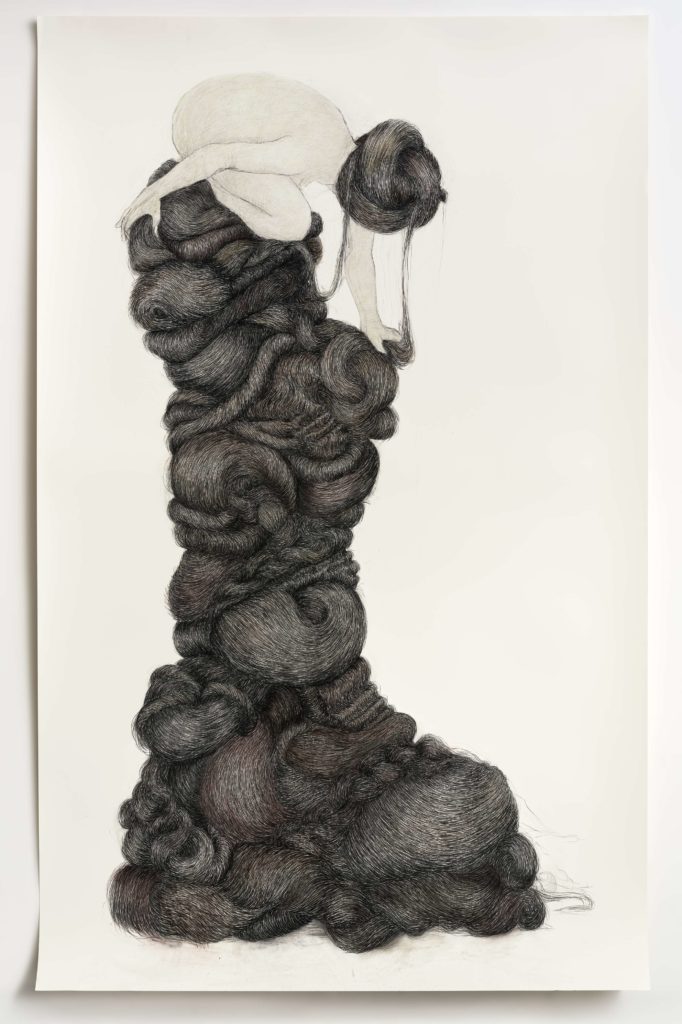
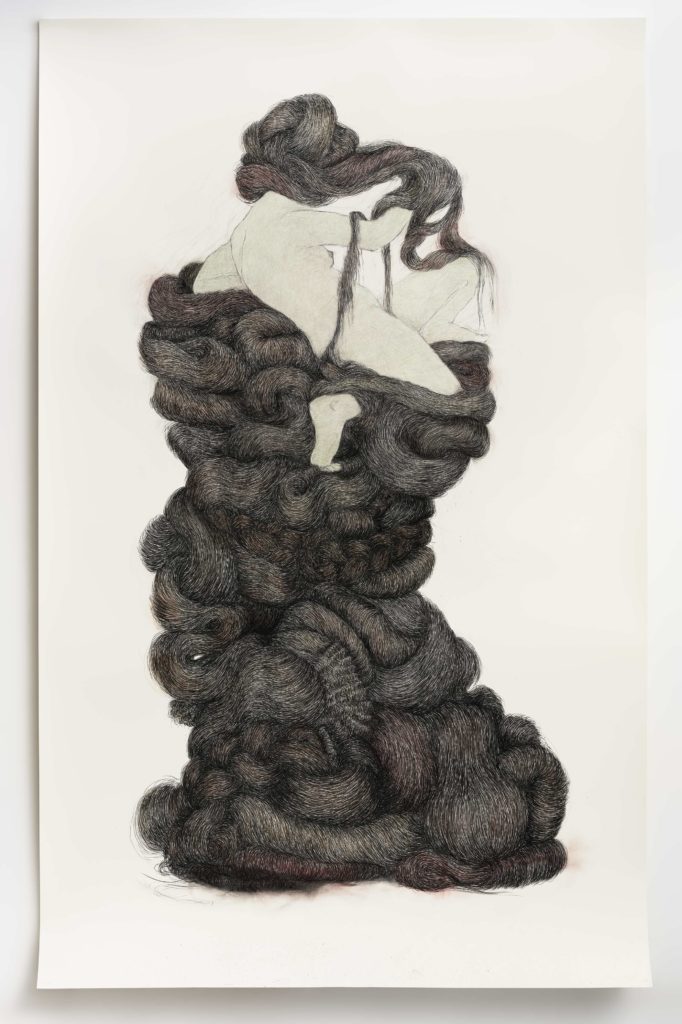
Myth, transformation, and ritual have long shaped Maher’s practice, and these concerns connect the three works she presents at the Arsenale during this year’s Biennale. Her 1996 water-based installation Les Filles d’Ouranos (1996) has been specially reconstructed within the Gaggiandre, the monumental covered docks of the Arsenale, originally designed for the construction and repair of Venetian naval ships. That work appears alongside “The Sibyls” (2025), a new series of monumental drawings and sculptural installations. Completing the presentation is The Map (2021), a large-scale collaborative textile work produced with Fallon.
The following conversation took place shortly before the opening of the Biennale. When discussing the questions, Maher repeatedly returned to the political conditions surrounding this year’s exhibition, drawing attention to the contradictions and controversies shaping the event itself. In a Biennale marked by institutional resignations, debates surrounding national representation, the inclusion of the Israeli and Russian pavilions, and the continued absence of official Palestinian state recognition within the Italian framework, Maher insists on foregrounding the political realities that structure the exhibition environment. Rather than treating art as separate from these conditions, she continues to frame cultural production as inseparable from the wider violences, solidarities, and systems of power unfolding beyond the exhibition walls.
Frank Wasser: Your participation in the Venice Biennale situates your work within a structure where questions of national representation, institutional visibility, and cultural authority are already built into the exhibition form itself. Audre Lorde wrote that “there is no such thing as a single-issue struggle because we do not live single-issue lives,”[1] a formulation that insists on the inseparability of cultural production from broader political and social conditions. Across your practice, there has been a sustained responsiveness to the political and social climates in which it emerges, and a long-standing commitment to articulating how art can register, and intervene in, those conditions. For many viewers and artists, encountering your work has also functioned as an opening to the idea that art is not separate from politics, but structurally implicated in it.
In relation to this year’s Biennale, how do you understand your work’s positioning within an institution that amplifies critical and political discourse, while at the same time operating through systems of selection, display, and national framing that will inevitably shape how that discourse is read and contained?
Alice Maher: There is no separation for me really between cultural and political life; they have always walked hand in hand, though sometimes one may obscure the other, and we are not always aware of how close they are. I try to allow the reality of the human situation, as experienced in the present, to emerge in the work as it is being made and shown. I would have had, like many artists, no real understanding at first of the politics of the Biennale, imagining it as some kind of neutral zone, but of course it is not. It is deeply structured by political forces, from governance to the organization of national pavilions, and these dynamics continue to shift in response to global events. The whole thing is constantly unfolding around us.
Within that context, we work as a group with shared commitments to human rights, finding ways to respond that align with the curatorial vision of “In Minor Keys” while also making space for acts of visibility and resistance. For example, through collaboration with Palestinian colleagues, we have developed gestures that use the body as a site of expression, wearing the names and images of Palestinian artists who cannot be represented within the Biennale’s official structures, and performing a daily sound work based on the hum of drones. These are modest acts, but they insist on presence and visibility where there is otherwise enforced absence.
Exhibiting in a vast structure like the Biennale is like being set adrift on a huge body of water. The current pulls you in different directions, and meaning shifts depending on where one stands. I don’t have control over that, but I trust that a certain “minor key” intention in the work will carry through the surface spectacle. There is a kind of freedom in the undertow. When a political position emerges from lived reality, it is no longer simply a position — it becomes something unbreakable. At the same time, the format of the Biennale, with its competing national pavilions, becomes increasingly problematic as repressive regimes use cultural platforms to mask or legitimize their actions. So one is always working within and against the structure simultaneously.
FW: You’ve spoken before about growing up in a conservative Catholic Ireland and confronting its structures. In your work, myth and folklore often feel like tools for both excavation and resistance. How do you negotiate that tension between inherited narratives and rewriting them?
AM: I try to enter myth and folklore as an imaginative space where “timeless” narratives can be unraveled, where time can move back and forth, up and down, like weaving. All those archaic and vernacular narratives find parallels for me in contemporary debates on social and sexual control. I use humor and wit to subvert the violence sometimes inherent in church teaching and state law.
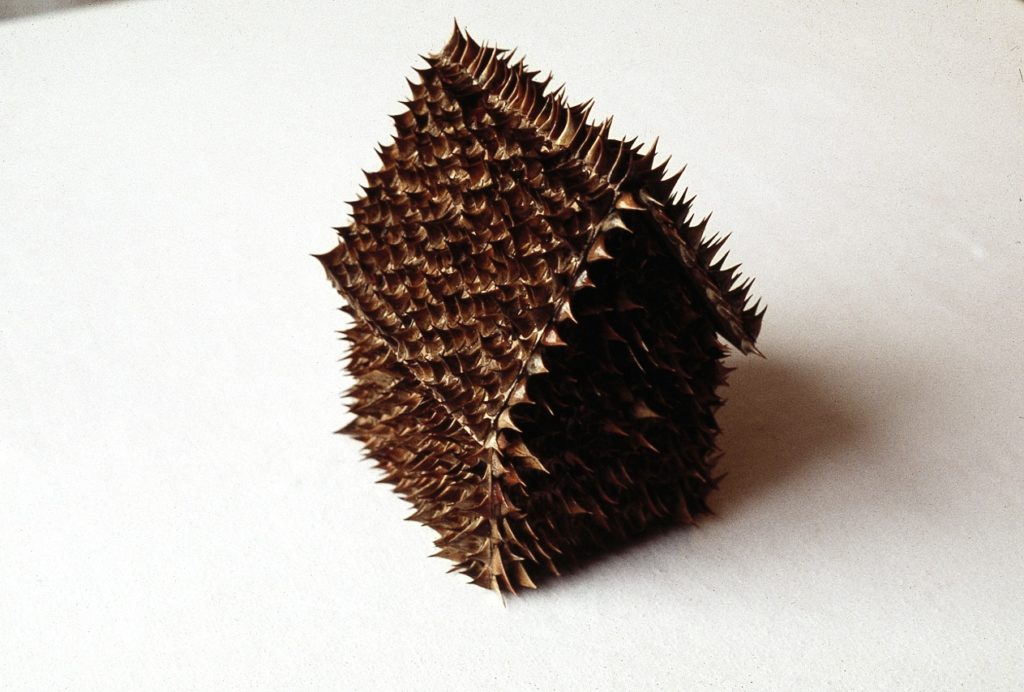
FW: There’s always a very striking and affective physicality to your materials — rose thorns, hair, frost, berries — things that are at once fragile and charged. What draws you to these substances, and how do they operate beyond their immediate tactile presence?
AM: I believe that those materials already carry meaning within them, but that meaning can also adhere to them in time from without. Each viewer brings their own associations to an artwork, and that object in turn becomes the repository of those personal thoughts as well as absorbing the changing atmosphere around it. I’m not trying to make work that lasts forever. Meaning swells and re-branches through time in these objects. They are temporal bodies, as are we. Time and weather, disease and struggle, unite us, and then we die.
FW: Your vital engagement with activism, particularly around reproductive rights in Ireland, suggests a direct relationship between art and civic life. How do you position your studio practice alongside that more collective, public form of action?
AM: I’m an artist, and I’m a citizen. Sometimes both overlap tightly in a political campaign like the Artists’ Campaign to Repeal the Eight Amendment of our constitution (the clause that absolutely forbade abortion). I was a founding member of that campaign along with Cecily Brennan, Eithne Jordan and Paula Meehan, in 2016. But I wouldn’t be considered a true activist, simply someone who gets involved when there is no other way. There was nothing else for it at that time but to fight that discriminatory and unjust law with every means available to us. Sometimes I am just working away alone in my studio, but life is never left at the door. It is a space full of trouble and strife, a porous kind of a place. I see the studio as a kind of reservoir; stuff flows in, stuff flows out, but there is always a body of thought present that contains concerns for reality as well as for the imaginative.
FW: Collaboration appears across your work. What does working with others allow you to access that a solitary studio practice cannot? What can’t be done alone?
AM: Real dialogue can’t be achieved alone. You can read all you want, research in every corner, but nothing replaces the vitality of a live debate. When Rachel Fallon and I were working on the Artists’ Campaign for reproductive rights, and subsequently on The Map around the legacy of Mary Magdalene, we had a continuous conversation back and forth on history, on hearsay, on books, on social media, as the live political situation unfolded around us. As well as the in-the-moment dialogue and reaction, you also have the intergenerational sharing of knowledge when you work collaboratively. It can be very intense but very rewarding.
FW: In your presentation at the Venice Biennale, you’re revisiting earlier works alongside new ones. What does it mean for you to return to a work decades later and re-situate it in a new context? What draws you back to these works?
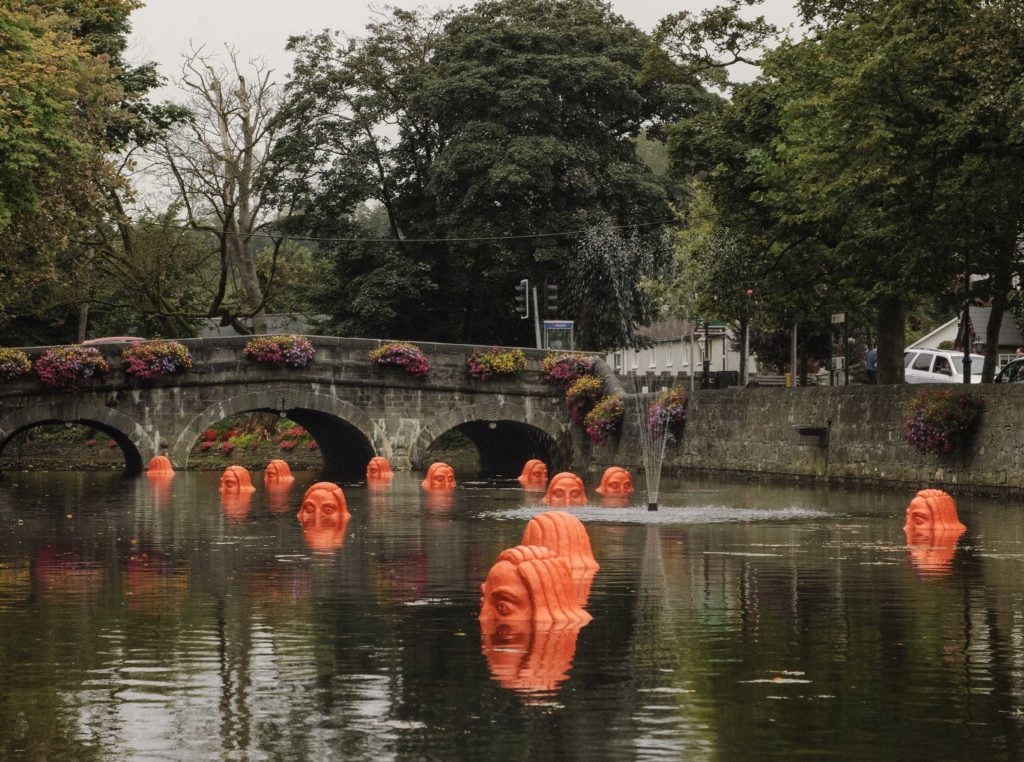
AM: It is amazing to see how a work made thirty years ago in a totally different set of circumstances can re-emerge with an expanded meaning through its passage in time. Les Filles d’Ouranos, for instance, was first commissioned by Le Conseil General Seine St. Denis in Paris for a temporary outdoor exhibition on a lake there in 1996. At that time, Les Filles were read solely through a feminist lens as the daughters of patriarchy who refused the traditional narrative of beauty incarnate as presented in the birth of Venus. Today they can re-surface in the waters of the Arsenale, like little orange subversives in the naval dock from which so many ships went out to conquer and to claim. The violence of the origin myth of Les Filles d’Ouranos takes on a new meaning in this present time of uncertainty and chaos. Their heads emerge from the oily green surface of the lagoon as reminders of the power of endurance in the face of endless and ongoing repression.
FW: The Map draws on the visual and epistemic structures of cartography, grids, routes, symbolic ordering, while also attempting to rework them through a feminist and materially embodied lens. As Donna Haraway writes, “feminist objectivity means quite simply situated knowledges,”[2] foregrounding partial, located perspectives over universal claims to vision. In this light, your reimagined Mappa Mundi seems to operate between inhabiting and displacing the authority of the map. Could you speak to how you navigate this dual operation? Specifically, how does The Map hold together its investment in legibility, orientation, and symbolic structure while simultaneously opening onto more diffuse, affective, or unresolvable ways of knowing — particularly in relation to the figure of Mary Magdalene as both a mapped and unmappable subject?
AM: The Map is a collaboration, and as such it already inhabits a space of dialogue and shared knowledge. Rachel Fallon and I worked through three COVID-19 lockdowns, building on our previous activist work to create this monumental textile sculpture. The Map was commissioned by Maoliosa Boyle of Rua Red in Dublin. It is sewn almost entirely by hand, using wit and vernacular language, cultural references and re-naming to counter the authority of mapping as a world view. There is no north, south, east, or west; you may enter The Map from any position. When you first encounter this textile you approach from the obverse, where the piece is lit through and looking like a transparency or X-ray of its own body map. Then you must navigate your way around to where the features and topography denote the different iconographies, narratives, and systems connected to the Magdalene as a person and as a myth or as an associative trope. Newly named islands, continents, seas, and constellations spread across the cloth using embroidery, crochet, felting, embellishment, painting, and stitching. For us in Ireland the legacy associated with the incarceration and forced labor in Magdalene laundries of so-called fallen women has left a psychic wound that is still raw. The Map bears witness to this but also to the enduring power of resistance and the ability to transform. We hope we have articulated the silences as well as the truths of Mary Magdalene’s legacy. Because no map tells a universal truth. That is why there is no key to The Map, so it can be read in part or full, depending on your position, your time, your history, your knowledge, and your mood.
FW: It’s perhaps too early to ask this question, never mind answer it, but what comes next for the work after Venice?
AM: The first thing that happens directly after the Venice Biennale is that The Map goes straight to the National Gallery of London for its travelling show “Mary Magdalene: Woman and Myth,” opening at the Walker Gallery Liverpool in January 2027.
[1] Audre Lorde, “Learning from the 60s,” in Sister Outsider: Essays and Speeches (Berkeley, CA: Crossing Press, 1984), 138.
[2] Donna Haraway, “Situated Knowledges: The Science Question in Feminism and the Privilege of Partial Perspective,” Feminist Studies 14, no. 3 (Autumn 1988): 581