Tokyo is a city of fascinating contradictions. Ancient traditions coexist with technological fantasies; the handmade sits alongside the artificial, while boundaries between physical and virtual worlds seem increasingly fluid. During Tokyo Art Week, these tensions found an unexpected expression inside Our Legacy’s new space in the heart of Daikanyama, a stylish and culturally vibrant neighborhood. To mark its opening, the brand invited Swedish-American artist Tobias Bradford to bring his work into dialogue with its own cultural universe.
The store is an exploration of cultural references and material relationships. Swedish cultural objects, artworks, and publications sit alongside elements of punk and subculture. Traditional Scandinavian folk costumes have been reworked with patches, pins, studs, and fabrics, creating a dialogue between heritage and contemporary disruption. The space retains the original Brutalist character of the building, dating back to 1969. Located on the second floor, its labyrinthine layout blurs the boundaries between private residence, gallery, and retail environment. A recreated lavatory within one of the fitting rooms, complete with a collection of vintage perfume bottles, further reinforces its intimate, almost residential atmosphere.
I hope we can carve out a small but meaningful role in this amazing and inspiring city,” explains Cristopher Nying, Our Legacy’s creative director. His ambition is reflected in the way the space brings together references to Swedish and Japanese craftsmanship, alongside the visual language of punk. Drawing on the atmosphere of a museum shop, a dedicated gallery area houses an extensive collection of Scandinavian utilitarian folk objects and furniture from the seventeenth and eighteenth centuries, known as allmoge. Recognizing the affinities between these traditions and Japanese craftsmanship, Nying has made them central to the interior, setting them against references to the punk movements of the 1970s and 1980s. The same spirit of reinterpretation informs a specially curated selection of Scandinavian folk costumes, reworked with punk details and hardware. There is also a dedicated section for OUR LEGACY WORK SHOP, where pieces from past collections are taken back to the atelier and upcycled into something new. The opening during Tokyo Art Week was a natural extension of the brand’s ongoing relationship with culture. For Nying, art, music, food, and film have always been part of the conversation surrounding Our Legacy, beyond the traditional boundaries of fashion. “We like to be present at different cultural happenings outside the fashion schedule. It’s something we’ve always done and will continue to do,” he says.
I first encountered Bradford’s work a few months ago, during a studio visit in Stockholm. Spending time there gave me a much deeper understanding of his practice and, more importantly, allowed me to feel the energy behind it. There was something unexpectedly intimate about the work, a subtle tension between the mechanical and the emotional, control and vulnerability.
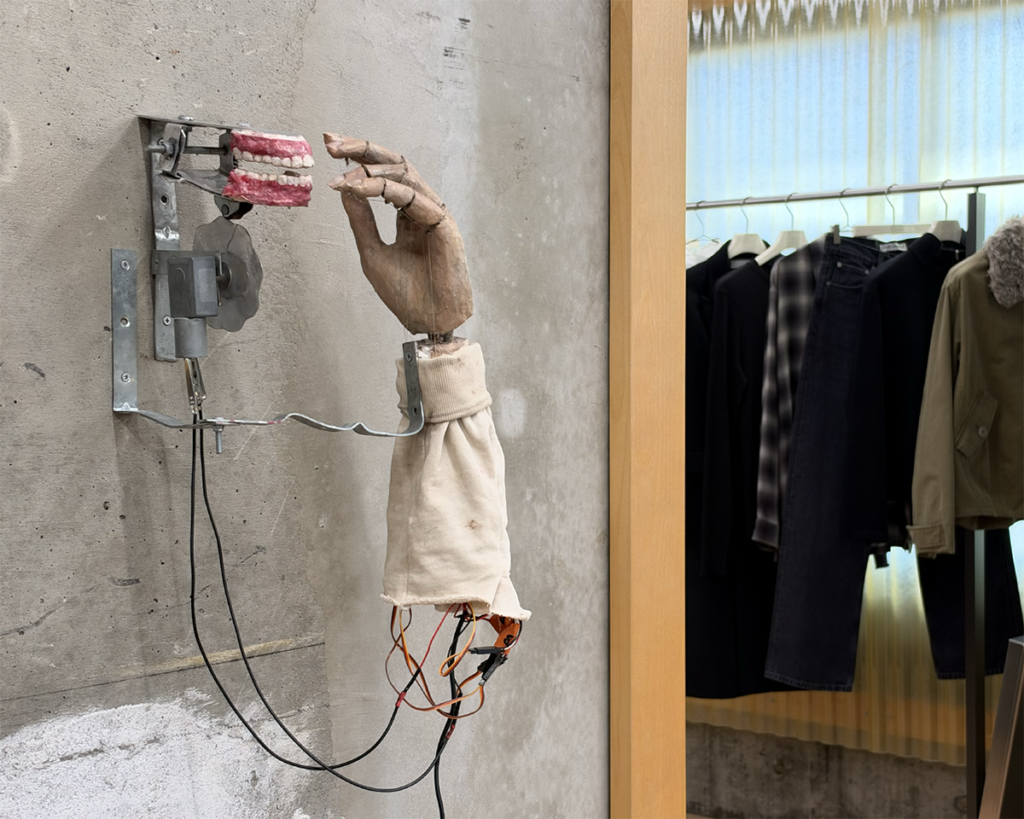
In the main room, Bradford disrupts the visitor’s attention with Oro // worry (2026), a pair of dentures that continuously and silently bite at fingernails. The gesture is unsettling and strangely amusing, capturing a familiar yet uncomfortable expression of anxiety.
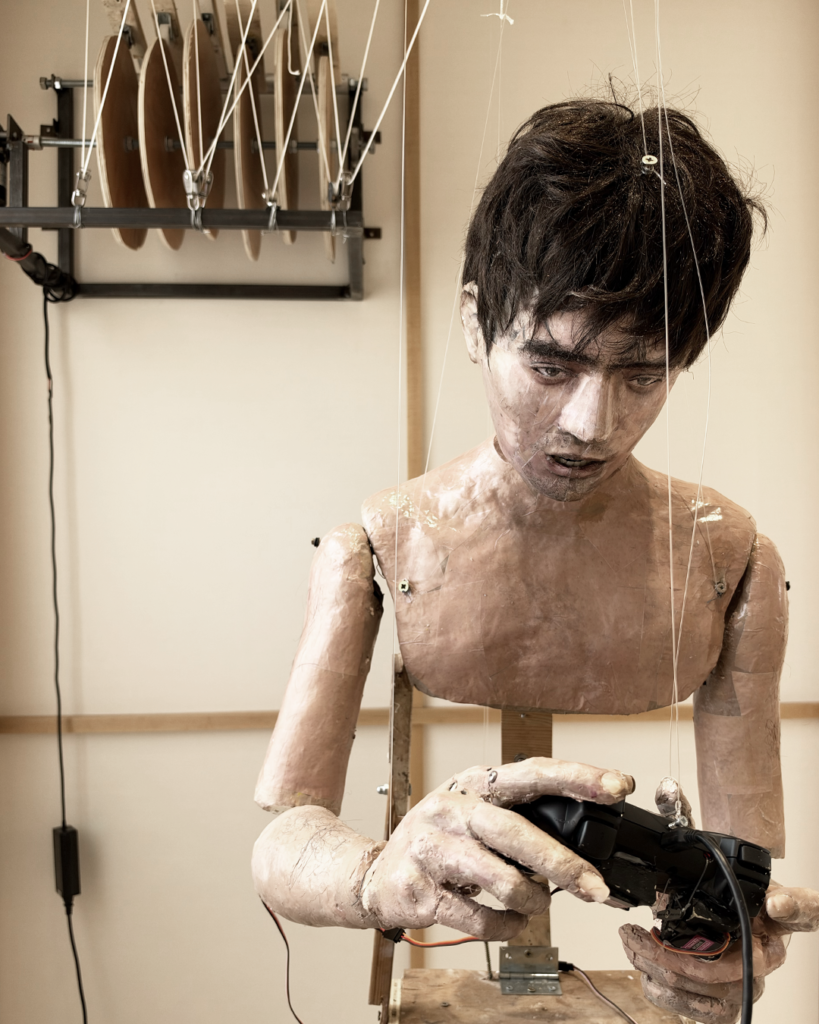
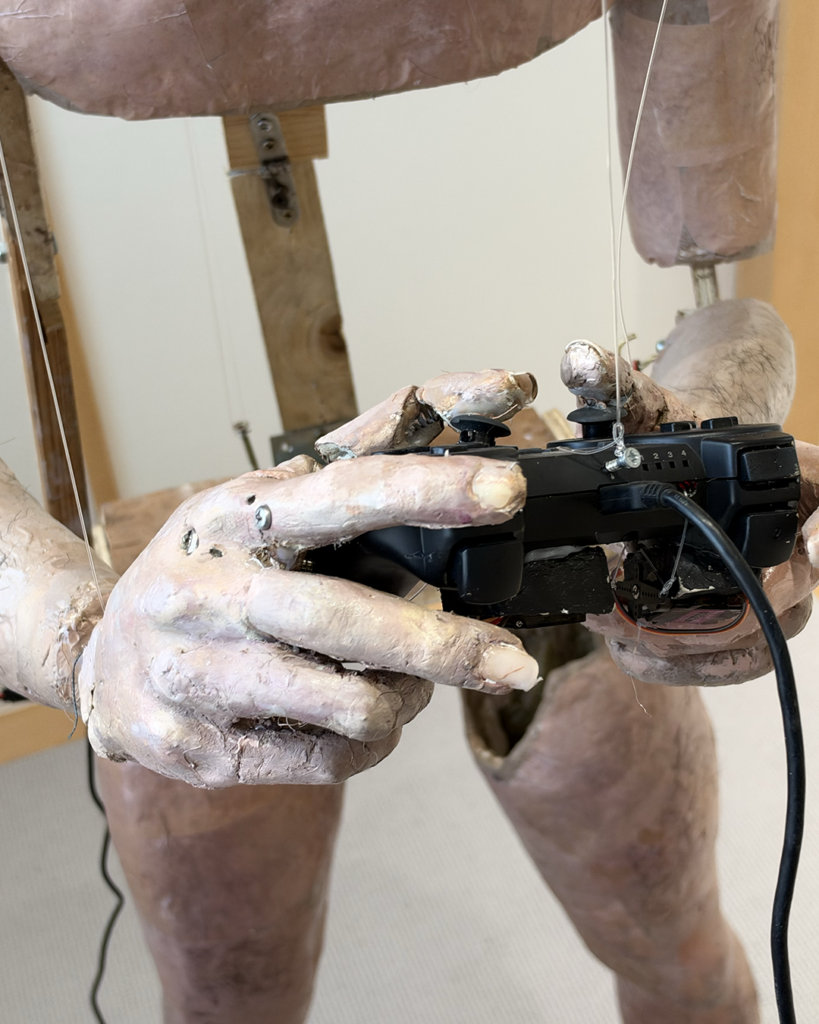
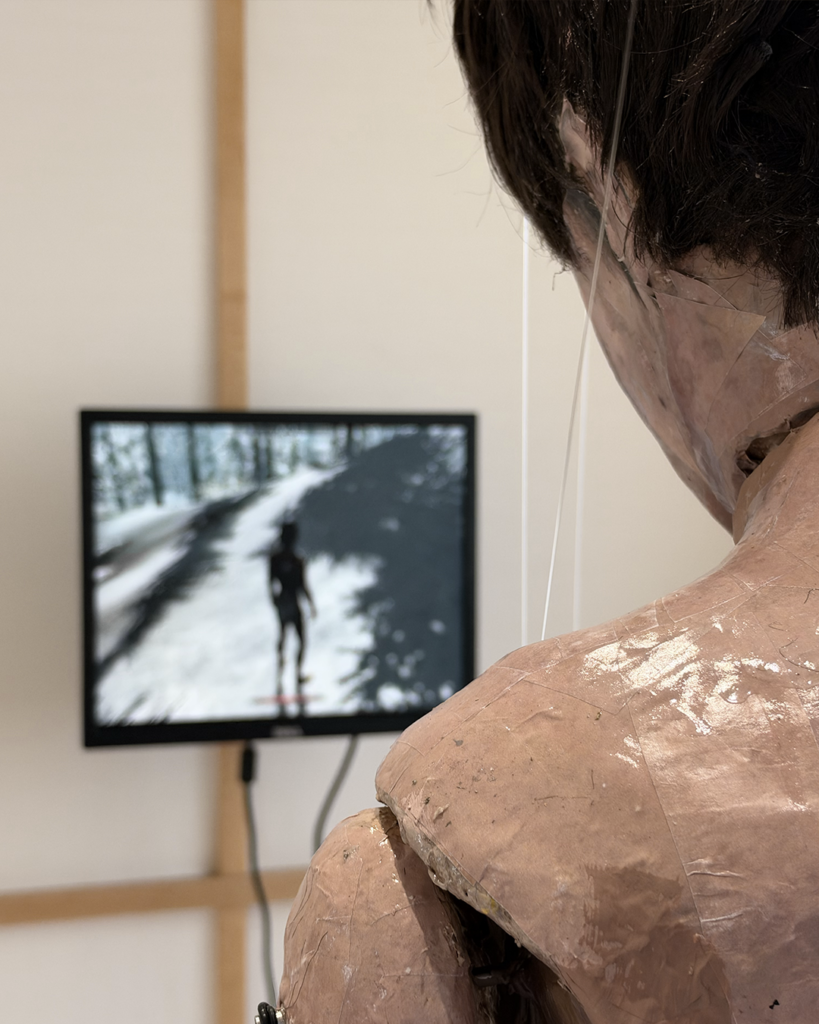
It is within this context that Bradford’s largest work, Third Person (2026), finds its place. Installed in a small, makeshift room connected to one of the changing rooms, the work initially appears almost incidental, as though one has wandered into a private environment rather than encountered an artwork. A figure sits playing a video game, absorbed in a world that exists somewhere between reality and simulation. Through the act of playing, the figure inhabits a virtual environment, attempting to transcend the limitations of its physical body. Bradford sees an underlying melancholy in this relationship: a mechanical being seeking escape through another constructed reality.
The placement of the work was central to Nying’s original idea for the space. Inspired by Kyoichi Tsuzuki’s Happy Victims (2025), he had initially imagined a small, intimate environment reminiscent of a Japanese bedroom, where the relationship between personal space, objects, and identity could unfold. After encountering Bradford’s work at one of his exhibitions, the connection became clear. The artist’s makeshift bedroom, with its solitary figure absorbed in a video game, seemed to capture something distinctly Tokyo, while fitting naturally into Our Legacy’s own visual language.
“Playing video games in a tiny room felt very much like Tokyo to me, but presented in our way,” Nying explains.
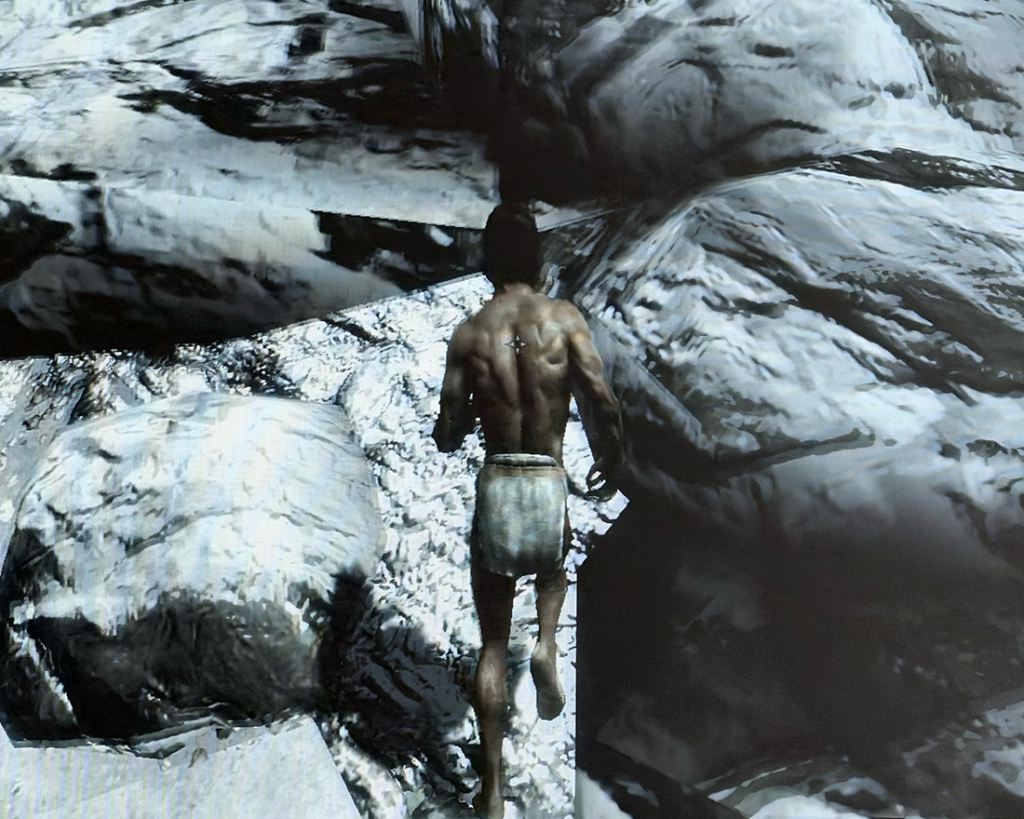
Bradford’s installation brings together several technological histories. The figure is an animatronic puppet whose body moves through a system of ropes and cams, drawing inspiration from eighteenth-century clockwork automata. Its thumbs, however, are controlled by digitally programmed servo motors. The character is playing Skyrim, a video game originally released in 2011.
The result is an unusual combination of mechanical ingenuity and digital escapism. Different generations of technology come together around an activity that, on the surface, seems entirely ordinary. But the longer you watch the figure, the harder it becomes to read its presence. Its movements suggest intention, maybe even desire, while its mechanical construction serves as a constant reminder that it cannot experience the world in the same way we do.
For Bradford, the distinction between craftsmanship and technology is ultimately an artificial one. “Craftsmanship is technology and vice versa: to me, it’s all applied knowledge in the pursuit of willing something into form,” he explains.
I remember being struck by a similar contradiction during my visit to his studio in Stockholm. Beneath the technical intricacy, there was something unexpectedly vulnerable, almost melancholic. His sculptures seemed to carry a sense of anxiety, as if their mechanical bodies were struggling against forces they could neither understand nor control.
“There’s a desperation to it. You don’t expect a machine to have unfulfilled desires, and whether it can long for anything at all, I honestly don’t know anymore.”
Bradford often draws parallels between the behavior of machines and the involuntary movements of the human body: restless legs, trembling hands, uncontrollable sweating. These are small, everyday gestures that remind us what little control we sometimes have over our own bodies. Something as familiar as a physical reaction can suddenly feel strange, almost mechanical.
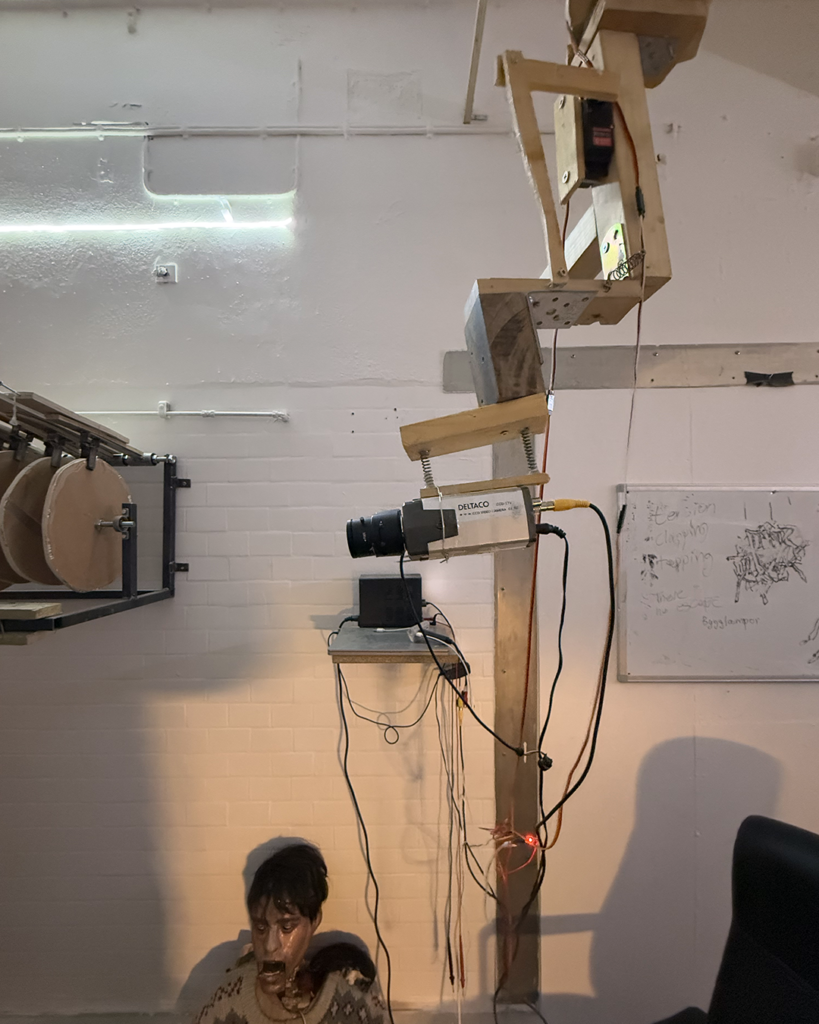
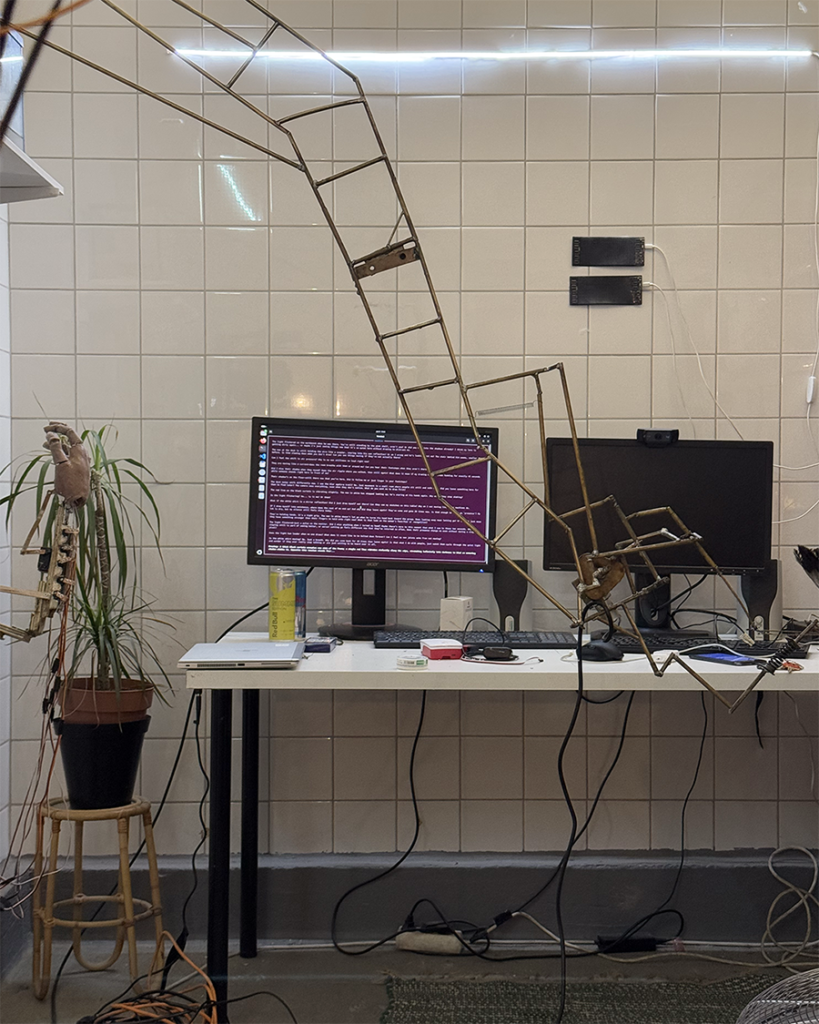
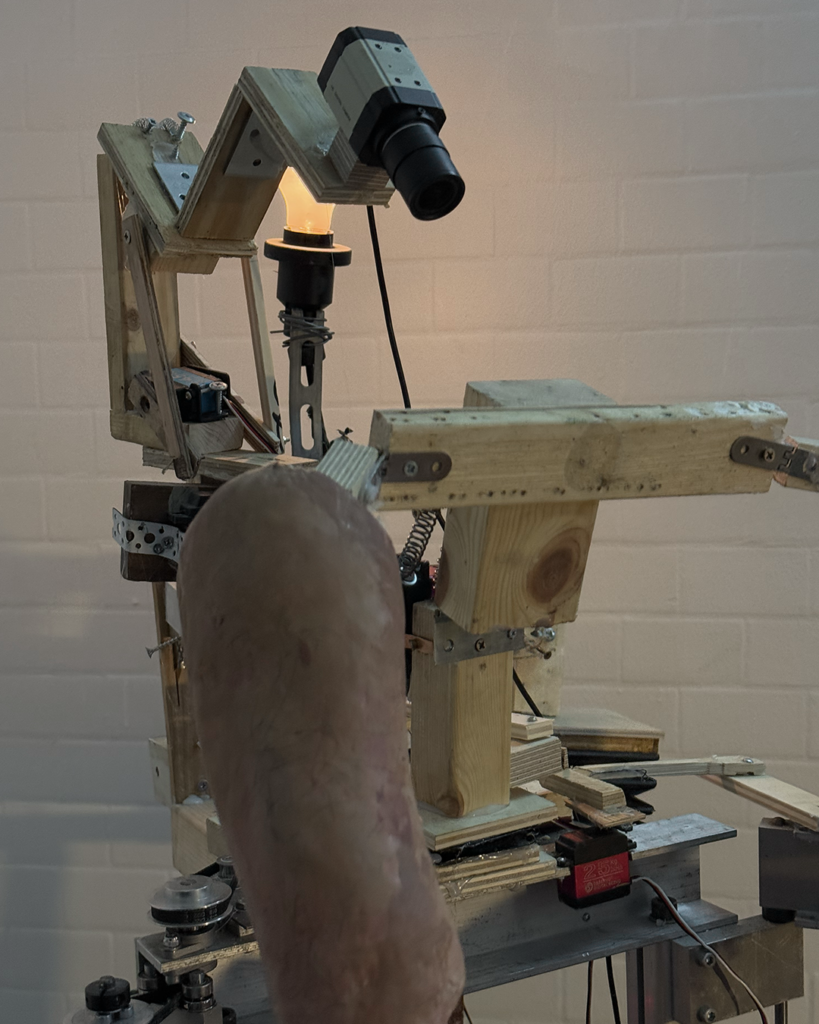
This tension between the familiar and the unfamiliar runs through much of his work. Bradford approaches it through the language of shame, fear, and longing, while also finding a certain beauty in discomfort, something close to a melancholic form of sublimity.
“A machine shouldn’t feel anything at all, yet it feels as if it does. That says something about both the observer and the object,” Bradford says.
Showing the installation in a store rather than a gallery also changes the way it is encountered. Removed from the institutional language and conventions of a gallery, the work can be approached without the usual expectation that comes with looking at something labelled as art. Bradford is particularly interested in this absence of hierarchy between object and viewer. For him, sculptural installation is partly about bringing the two closer together and questioning the distance we tend to assume between them.
“A non-traditional space like a retail environment is exciting for this reason: it’s free of that particular power imbalance between object and subject,” he explains. “That allows the work to be met on its own terms, as a ‘thing’ in real life instead of a ‘piece of art.’”
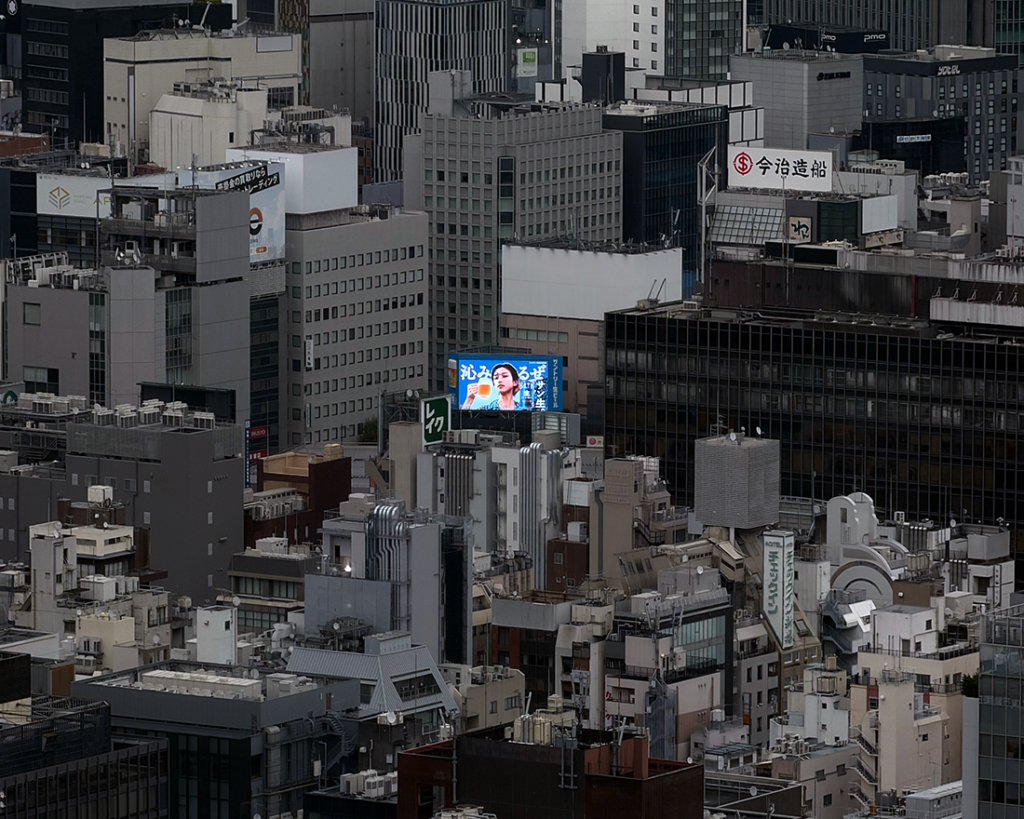
In Tokyo, where art, design, technology, and everyday life often intersect, this approach feels particularly relevant. Within Our Legacy’s space, Bradford’s work doesn’t stand apart from its surroundings. Instead, it sits among a larger constellation of objects, references, and cultural histories. It belongs to the environment as much as it interrupts it.
Back in the small bedroom, the figure continues to play, caught between the physical and the virtual, the mechanical and the emotional. It’s tempting to imagine it’s trying to escape its own existence; although perhaps that desire only belongs entirely to us, projected onto something that cannot feel it. Either way, Third Person leaves us with interesting questions about the relationship between technology and human experience: How much of what we recognize as emotion comes from the object itself, and how much do we bring to it?