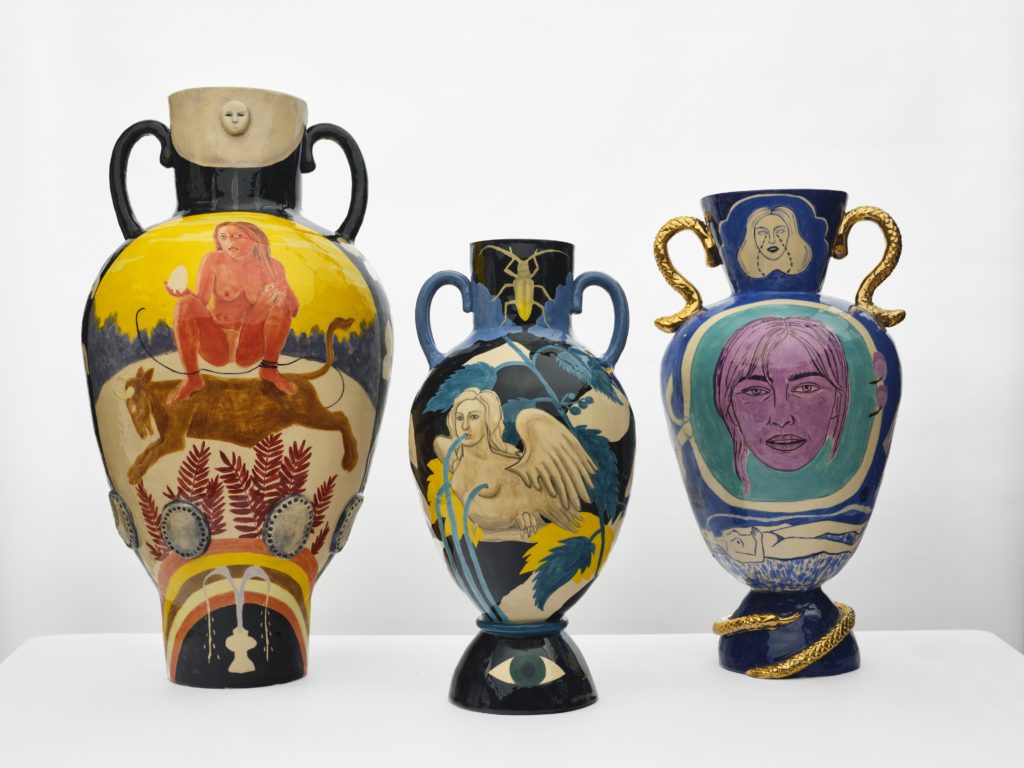
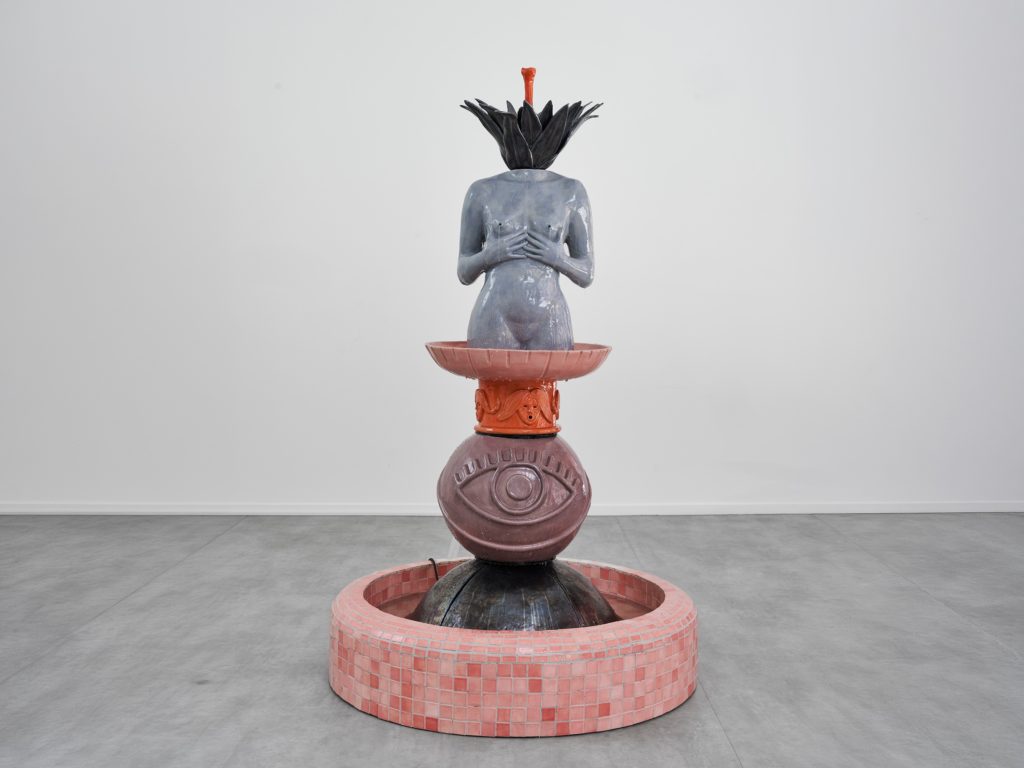
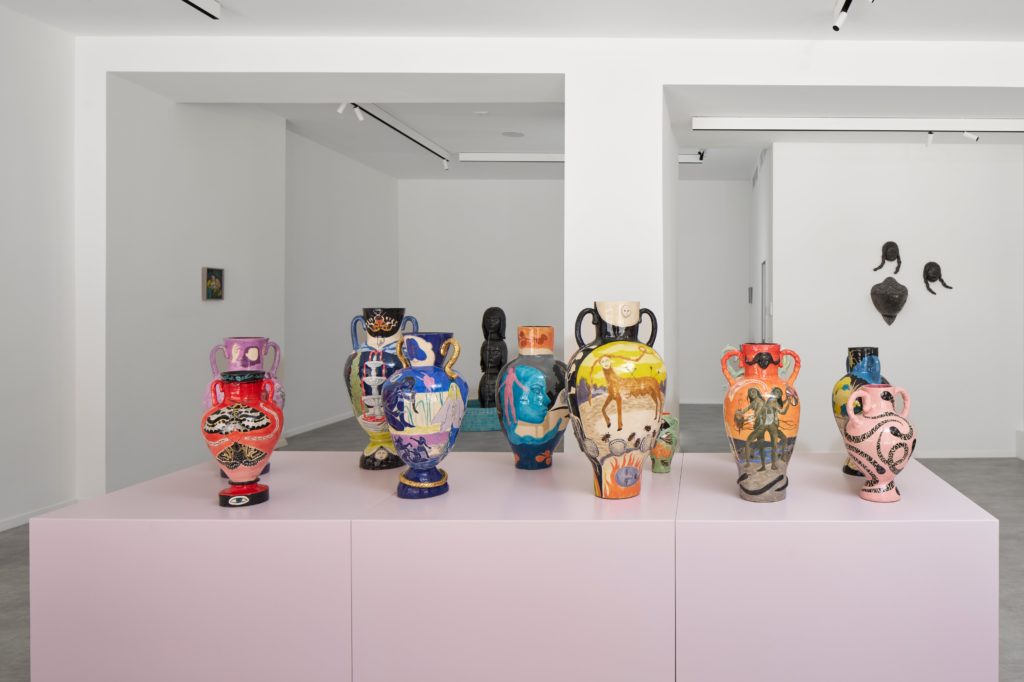
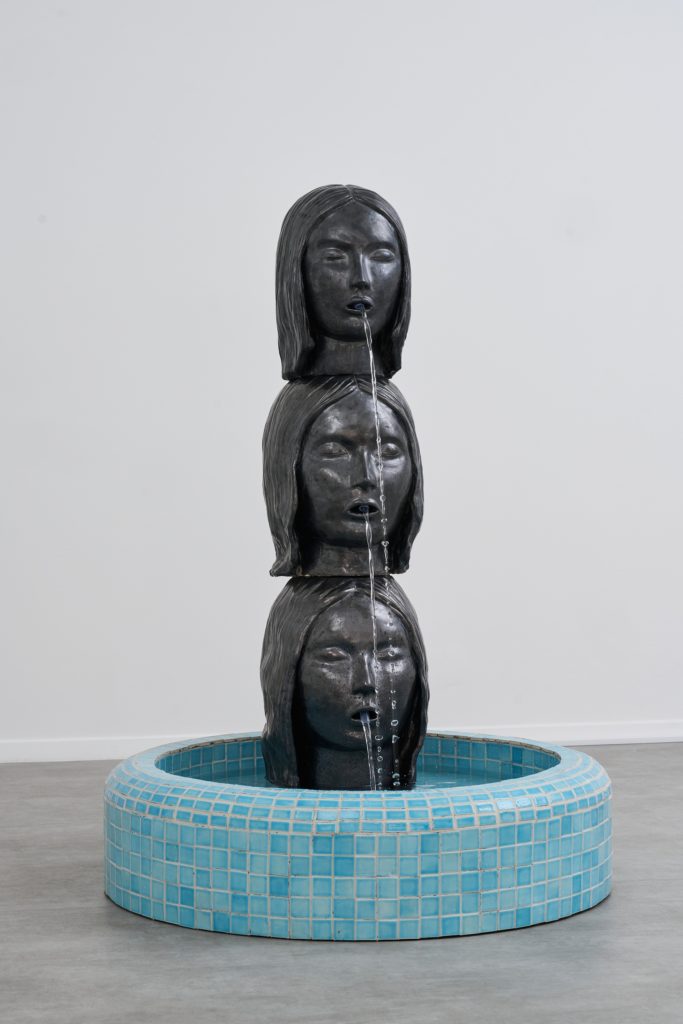
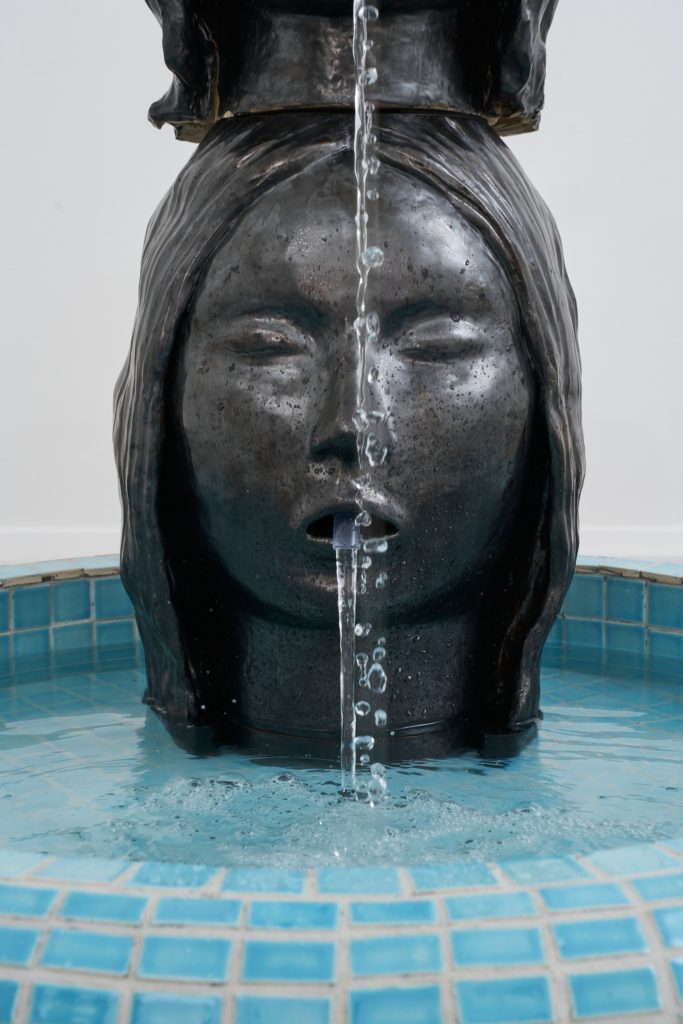
Near the entrance to Mia Akrap’s “Stronger Than Bone” (2026) at Trotoar gallery in Zagreb, Croatia, a small crop of ceramic vessels creates a kind of parapet to the exhibition. They are reminiscent of the Greek amphorae, with their characteristic footed bases, dual handles, and plump, belly-like bodies bearing narratives in foliage, landscapes, and anthropomorphic figures. Beyond this border stands a running fountain, Spring of Phantoms (2026), where three stacked, near-identical female heads open their mouths to release three trickling streams, the sound of which fills the gallery.
The water pours into a basin lined with carefully laid aquamarine tiles. Though the heads do not speak, they create a bath of white noise that removes the gallery from the grounding sounds of speech and the cars beyond its windows. In the soft static produced by these calm streams, Akrap’s female figures tell a story of three generations of Croatian women within her family.
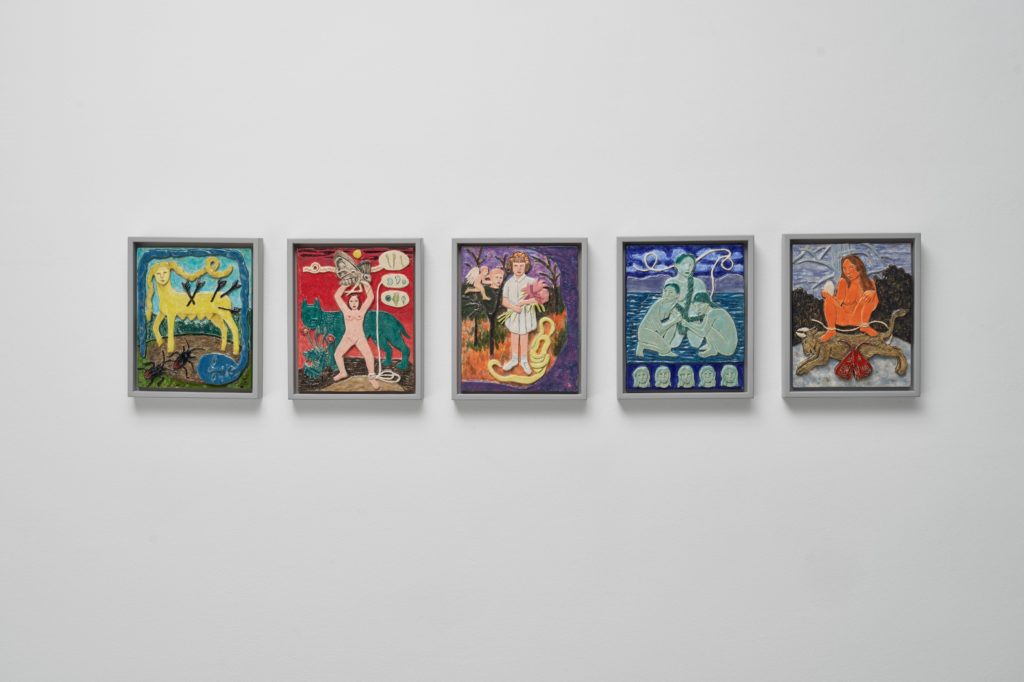
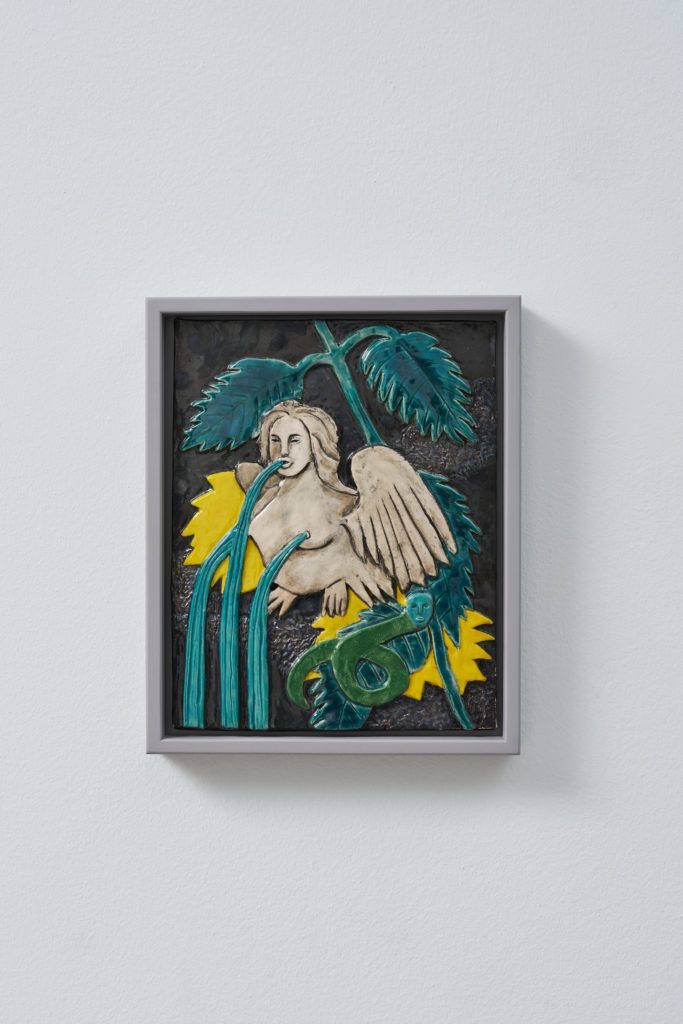
In preparing the exhibition, Akrap spent hours interviewing her grandmother, who was born in eastern Croatia in the middle of the twentieth century. Through this exchange, the artist confirmed something she had long known: the women in her family witnessed monumental political shifts throughout their lifetimes and, with them, carried memories and trauma that would flow into Akrap’s generation. When asked about the particulars of her family history, Akrap politely declines to reveal them. Instead, she points to the images in her work as a form of preserving these memories in a language she feels does the stories justice.
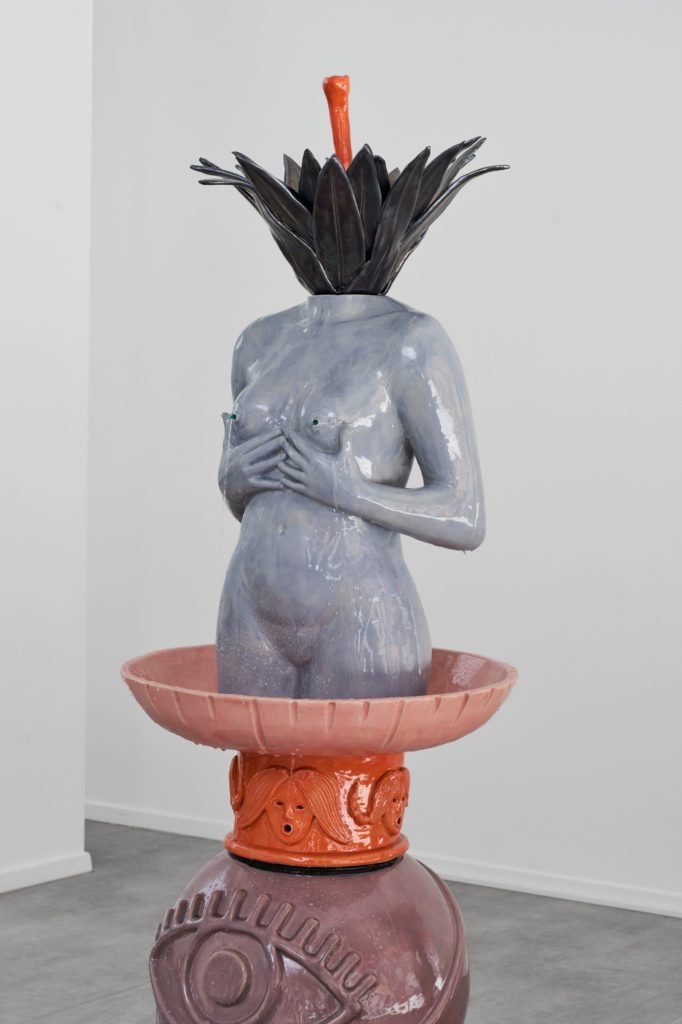
One could think of Akrap’s containers as lidless urns, vessels that contain the remains of a life lived. Rather than containing physical remains inside their cavities, the artist’s genealogical memories are depicted upon their surfaces. Pulling from a wealth of visual references, the story she paints is at once extremely literal — able to be read not from left to right like words on a page but cyclically as the vase rotates into view.
On the vessel titled Stronger Than Bone #5, or Metamorphosis (2026), a bride stands on a lawn holding a bouquet of white flowers. Her veil cascades behind her head, and she looks into the distance with her mouth slightly agape. A green grasshopper-like insect, almost the size of the bride herself, buzzes just above her head. It acts as both guardian and harbinger of the weather that advances across the sky. In a frame of clouds near the vase’s lip, two hands holding a pair of scissors hover over a red thread. The image evokes the thread spun by the three Fates from Greek mythology, its very texture and quality embodying the details of a mortal’s life. When cut, it signifies death.
The filament is also reminiscent of an umbilical cord that, when broken, severs the child from the mother. With its separation looming above the bride, this red line, poised on the verge of breakage, foreshadows her near future. The destiny of the soon-to-be-wed is at once divine, ordained by some higher power, and predetermined and inescapable. It echoes like the cry of a grasshopper in the humidity that precedes a storm.
Akrap’s visual language also pulls heavily from Surrealist tradition in which figuration subverts the logic of the real. In Stronger Than Bone #6, the vessel bears the image of a woman’s face atop the body of a deer whose back is pierced with arrows. It references Frida Kahlo’s The Wounded Deer (1946), in which the Mexican artist’s face appears on the same injured animal. In Akrap’s version, the creature has four hanging breasts that invoke the she-wolf from the tale of Romulus and Remus. The twin founders of the Roman Empire were said to have been nourished by the animal after being saved from a death sentence.
There is a wildness in this depiction of motherhood. Framed by encroaching parasites, heavy with breasts but without mouths to suckle from them, and gravely wounded, the creature upon the urn still stands tall with her two braids splayed in the wind. A woman’s face burns in hellfire below, yet this human-deer figure persists. Here, the female body, with all its capacity for creation, birth, and sustenance, is a persistent site of violence, yet it remains resilient in the face of strife.
In “Stronger Than Bone,” the artist suggests that while women are often subjected to extreme pain — whether inflicted by birth, violence, or historical circumstance — they also possess a profound capacity to produce and protect life. In her ceramic-bound images of women in the throes of life, Akrap preserves their memory in something that can transcend the fragile limits of the body.