The 11th edition of Performa coincided with the biennial’s twentieth anniversary, offering a rare chance to view contemporary performance not as isolated events but as a complex and evolving field. Despite growing interest from the public and institutions, media coverage of performance art remains limited, while critical discourse is still sporadic, leaving much of the field underexamined. In this context, Performa provided a temporary yet crucial platform for experiencing, reflecting on, and engaging with contemporary practice. While each of the eight new commissions would merit close analysis — if only for their experimental foundations — their value becomes even clearer when considered within a broader interpretive frame. Staged over a month and hosted in largely non-traditional venues, the program sketched an unusually integrated view of the contemporary performance landscape.
Significantly, this unfolds across uptown and downtown New York, a city that since the 1960s has served as a historical, theoretical, and experimental nexus for performance art — from Judson Church to The Kitchen, La MaMa, and the Performing Garage, alongside a constellation of off-Broadway spaces.
Equally important is the role of Performa’s founder, RoseLee Goldberg, a pioneering curator and theorist who, since the 1970s, has often stood in productive counterpoint to Richard Schechner. If Schechner, an influential figure in experimental theater, established the anthropological and theoretical framework of performance, Goldberg constructed its historical and art-critical foundation, decisively contributing to its legitimacy as an autonomous field of practice and study. Their texts — Schechner’s Environmental Theater (1973) and Goldberg’s Performance Art: From Futurism to the Present (1979) — remain essential references for anyone working in performance criticism.
At the heart of Performa are its new commissions. The invitation to develop new works extends not only to artists already working within performance, but also to practitioners from other fields exploring this language for the first time. This year’s contributors include Ayoung Kim with Body^n, Camille Henrot with a piece inspired by the traditions of commedia dell’arte, Tau Lewis with No One Ascends from the Underworld Unmarked, and Pakui Hardware with Spores. Goldberg’s intention is clear: to position artists slightly out of focus relative to their habitual contexts — a shift that encourages new lines of inquiry, challenges familiar boundaries, and opens space for the unexpected.
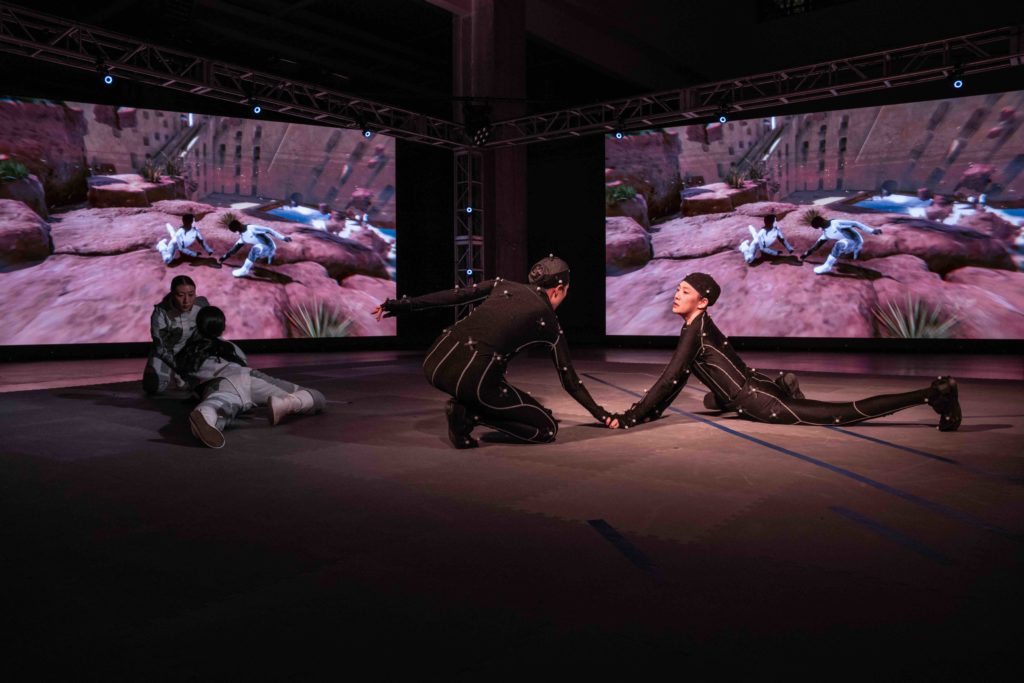
Many of the most compelling works emerge precisely from this zone of displacement. Their intermedial strategies are not merely additive; they arise from the friction between media. Video, sculpture, theater, AI, game engines, and sound interact through difference, generating configurations where the relationship between discipline, space, and audience is continuously renegotiated. The resulting performances offer a broad, often surprising view of contemporary practice — revealing connections and tensions that might remain invisible when considered individually.
Several commissions encourage a shift in perspective: no longer asking “what is performance?” (an ontological question), but “how does it operate, and what effects does it produce on its audience?” (a processual one). Aria Dean’s The Color Scheme exemplifies this shift. Her own description — “a play that is a movie, a movie that is a play” — captures the work’s categorical ambiguity. Presented at the Abrons Arts Center, the piece resists easy alignment with conventional theater forms and expectations of performance. Its interplay of live music and real-time projection across three large screens — arranged like theatrical wings — is not simply a technical layer but a signifying structure of the work.
Dean extends this destabilization of categories to an imagined dialogue between Alain Locke, philosopher and cultural critic central to the Harlem Renaissance, and Claude McKay, a poet whose radical voice defined the same period. Their encounter becomes a discursive device, juxtaposing Locke’s theoretical reflections on Black culture with McKay’s provocative engagement with racial politics. At its core, the performance interrogates the construction and effects of a “racial schema,” articulated across space, media, and live action.
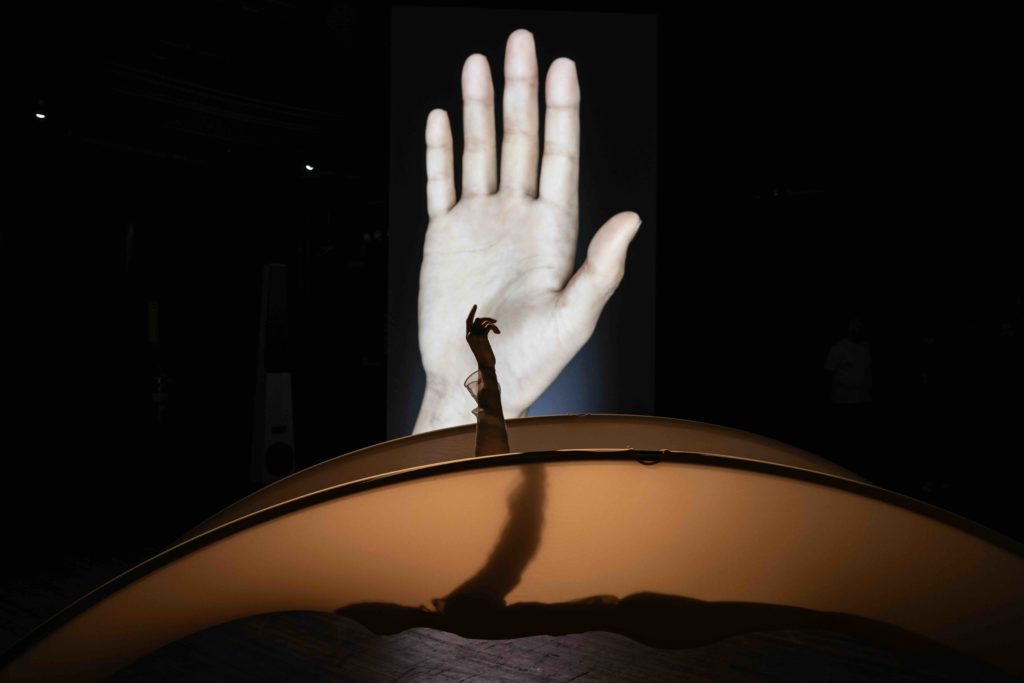
The piece’s strength lies in its coherence of form and content. Intermedial layering, temporal delays, rhythmic shifts, and dense imagery are not technical flourishes, but the very grammar through which Dean communicates. Form enacts content: every image is a construction, and every construction is inevitably political. The question remains how clearly this conceptual architecture communicates itself to the audience. The work’s intermediality offers a partial answer: where dialogue cannot speak directly, the friction between media produces ambiguous revelations — fleeting truths that never fully settle. It is in this space of tension, more than in narrative, that The Color Scheme finds its power.
If Performa demonstrates anything, it is that context does not predetermine a piece’s aesthetic nature. Can Pakui Hardware’s Spores truly be called “theater” simply because it was staged at the Cornell Theater? Like The Color Scheme, Spores disrupts established categories and reflects the increasingly hybrid nature of contemporary performance, in part through collaboration with Operomanija, a Lithuanian production house for contemporary and interdisciplinary practice. Nothing here is entirely new: performance emerges as a language of rupture prior to being codified as a genre. Yet today, its definition matters less. The field is elastic, porous, and traversed by tensions and contradictions, rather than oriented toward the totalizing synthesis envisioned by Wagner’s Gesamtkunstwerk.
Spores evolved under practical constraints — space, logistics, exhibition conditions — that transformed an installation with live elements into a durational performance. The collaboration with Operomanija emphasized its musical dimension, aligning the structure with a model inspired by Greek tragedy: a protagonist undergoes therapeutic sessions with an AI whose script regenerates with each iteration, accompanied by a chorus of non-professional singers selected through an open call. The work interlaces body, voice, technology, and collectivity, imagining modes of care beyond Western therapeutic paradigms. For Pakui Hardware, relationality is central: “building bonds between people is as important as the singing itself; the process matters more than the outcome.” The AI becomes a “technological mirror,” reflecting and distorting the protagonist’s emotions and generating a transformation affecting both her and the chorus in a shared process of resonance.
This edition of Performa suggests that performance is not a genre to define, but a device in constant transformation — manifesting through shifting practices, methods, activation strategies, and modes of reception. Its value lies not in what it is, but in how it generates relations, produces effects, and structures experiences. Space plays a central role in this ecology: it shapes a renewed condition of presence, where we perceive ourselves not only through immediate experience but also as part of a broader system of other bodies, objects, and environment. These are not “art spaces,” but borrowed environments activated for performative purposes, distinct from site-specific works, which operate under different premises.
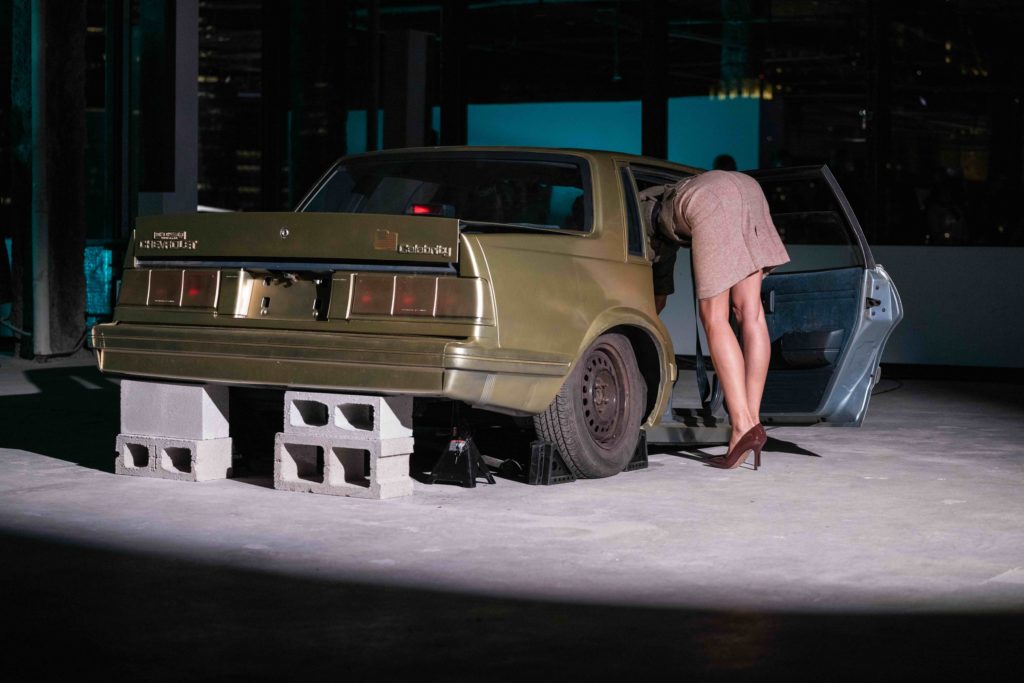
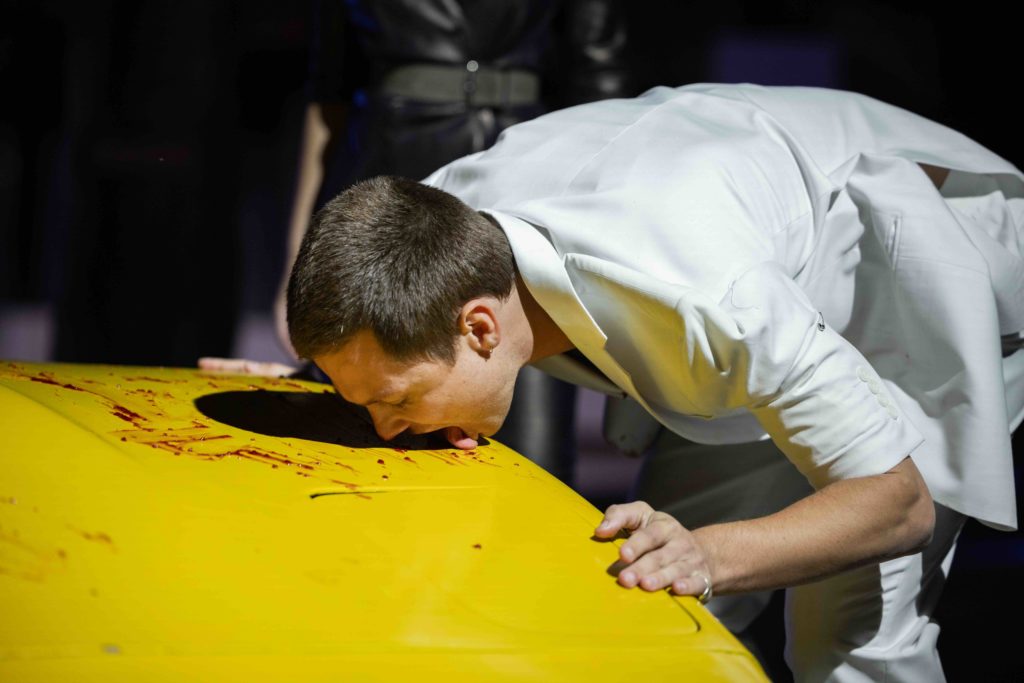
Space itself acts as an aesthetic agent, shaping perception and linking personal experience to the overall “temperature” of the performance. Sylvie Fleury’s Instructions for Twilight exemplifies this: her performance reassembles historical gestures into a living score. Set among dissected cars and reflective surfaces, Fleury revisits iconic reversals of gendered and consumerist codes — from walking on Carl Andre’s floor pieces to inverting Allan Kaprow’s Women Licking Jam off a Car. References to Fluxus and Happenings become a grammar rewritten through a feminist lens, while JG Thirlwell’s live sound amplifies footsteps, frictions, and subtle movements, turning sound into the performance’s driving force.
Space primes the audience, as one tunes an instrument. After a brief wait in the lobby, small groups ascend to the 39th floor of the WSA building in the Financial District, entering an unfinished open space. The entrance coincides with a sunset view of the skyline — a transitional moment creating a specific atmosphere, one that Gernot Böhme calls an interrelational phenomenon: a spatial effect linking bodies, gazes, and attention to the surroundings and to each other. This “tuning” prepares the audience for the rhythms, tensions, and physicality of the performance across nearly three hundred square meters.
My time at Performa concluded during the final week, with the reenactment of Lucinda Childs’s Street Dance (1964) at the Douglas Dunn Studio, where the audience was deliberately held small. Childs’s voice invited us to look out the window. With a casual, almost playful tone, she guided our attention to details we might have otherwise missed. Below, we observed her moving along the sidewalk opposite the building, echoing the instructions she gave us. David Thomson, dressed eccentrically, moved in the same area as a visual counterpoint, reminding us that we choose how to relate to space while the city continues at its own relentless pace. Looking became a deliberate act, requiring posture, rhythm, and attentional choice.This experience captures the spirit of Performa — and, even more, what RoseLee Goldberg identifies as the heart of the biennial and of performance art itself: offering each spectator the chance to step outside habitual frames and reclaim a renewed gaze on the city, on others, and on themselves. Ambitious, certainly — but unmistakably achieved.