In a cornered-off area of Luxembourg Art Week, David Claerbout threads his way through the chairs lined up for his talk with curator Ory Dessau and Konschthal Esch’s director, Christian Moser. “Five Hours, Fifty Days, Fifty Years” has opened only days ago, and is Claerbout’s first exhibition in Luxembourg, featuring a new work, The woodcarver and the forest (2025), alongside several earlier works from 1996 onward. Touching on The woodcarver and the forest, describing the lead character as an “ASMR dude,” Claerbout struggles with the term ASMR, encouraging slowing down as an alternative to consuming online content that encourages relaxation. As their conversation carries over the surrounding din, one thing becomes unmistakable: from animated films to AI-generated projections, the Belgian artist’s true medium is time. “The Konschthal has a lot of space, and my works [have] a lot of time,” he says, continuing by comparing his work to the rhythm of breathing or a beating heart.
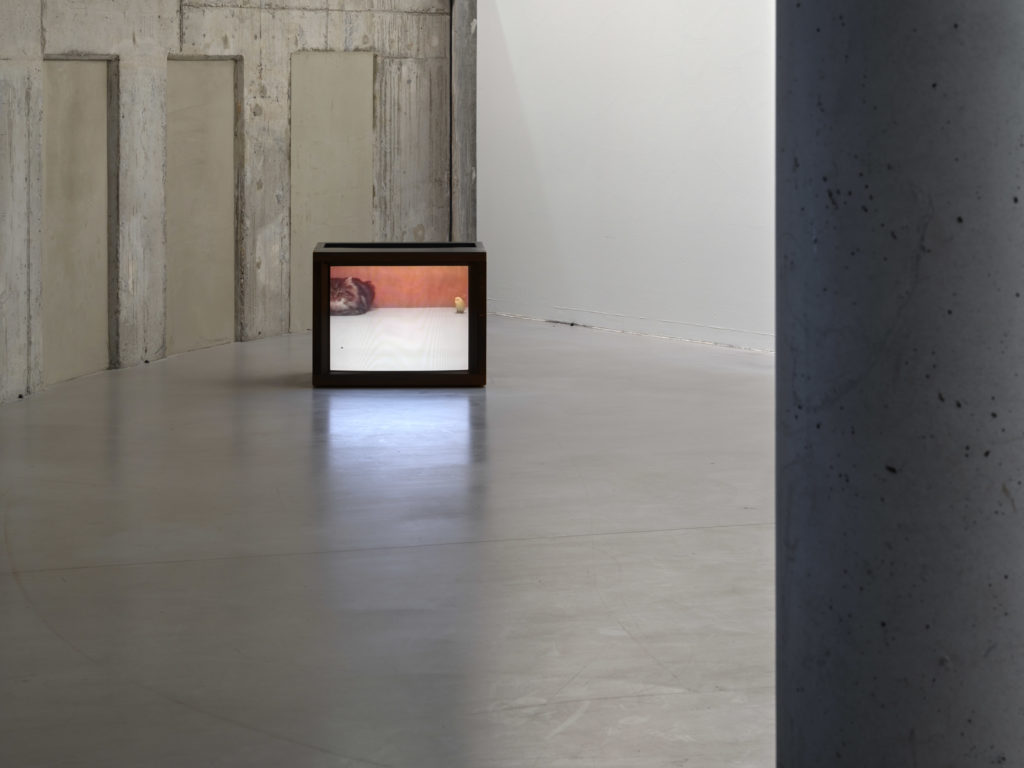
Welcoming viewers into the Konschthal is Claerbout’s 3D rendering of an inferno titled Wildfire (meditation on fire) (2019–20), its vast silence and absence of human presence both disarming and strangely candid. Several works throughout the show emphasize the passage of time without human intervention. In The pure necessity (2016), an animation based on Disney’s 1967 film The Jungle Book, Claerbout removes Mowgli entirely. Hand-drawn by a group of animators, staying true to the original film’s style, The pure necessity features beloved characters Baloo and Bagheera simply existing as animals — lapping at rivers, sleeping, scratching their ears with their hind legs. The tempo is slowed to the point of plausibility, to a pace that feels unfamiliar and yet welcome. Here, an uncanny echo of a classic film becomes something more than homage.
As the maze-like Konschthal leads you up a flight of stairs to see The woodcarver and the forest (2025) or Olympia (2016), it brings you down another set, revealing the same film again. This film, however, plays at a different rate than the first one, allowing time to progress at a much faster pace than in our reality. In Olympia, Claerbout has created a computer-based reconstruction of Berlin’s Olympic Stadium, with each brick rendered and local weather, humidity, lighting, and vegetation accurate to real-time conditions. Programmed to last a thousand years, the work continues even when not on display, creating a speculative film that tracks the stadium’s demise, its ongoing erosion indifferent to spectatorship. Abandoned and overgrown on the third floor of the Konschthal, the stadium appears shiny and new on the second floor, presented as how it looked before the 1936 Olympic Games it was built to host.
Back in the present day, The woodcarver and the forest tackles the contemporary paradox of wanting to “return to nature.” Claerbout depicts a woodcarver, a young man wearing a docker cap and flannel, whittling away at a wooden spoon. The gentle, close-up sounds of the blade against the wood recall ASMR videos. The woodcarver relentlessly carves spoon after spoon — what Claerbout would refer to as a “micro event,” the act of doing something with your hands for the sake of slowing down. Taking place over three days — twenty hours in our timeline — the woodcarver whittles away the entire forest outside of his villa. Never seen leaving the safe indoors, he approaches “nature” only by carving the felled wood, his intimacy with the material masking a profound distance from its source. What Claerbout criticizes he also consciously creates, as the self-soothing act of whittling for the modern millennial is crucified in a video that itself elicits an ASMR-like response. Rather than shying away from contradiction, the artist seeks it out as a part of his continuous research.
While Claerbout’s primary subject is time, the works in “Five Hours, Fifty Days, Fifty Years” are more specifically about what time shows us. Change, stillness, destruction, and growth break down the concept of time, discussing it not as a process of aging but as a process of existing. Our environment — the ultimate clock we so often refuse to read — is burning, eroding, and being carved into wooden spoons, here in the Konschthal and outside its walls. The show doesn’t ask us merely to witness this, but to recognize our own role in its unfolding.