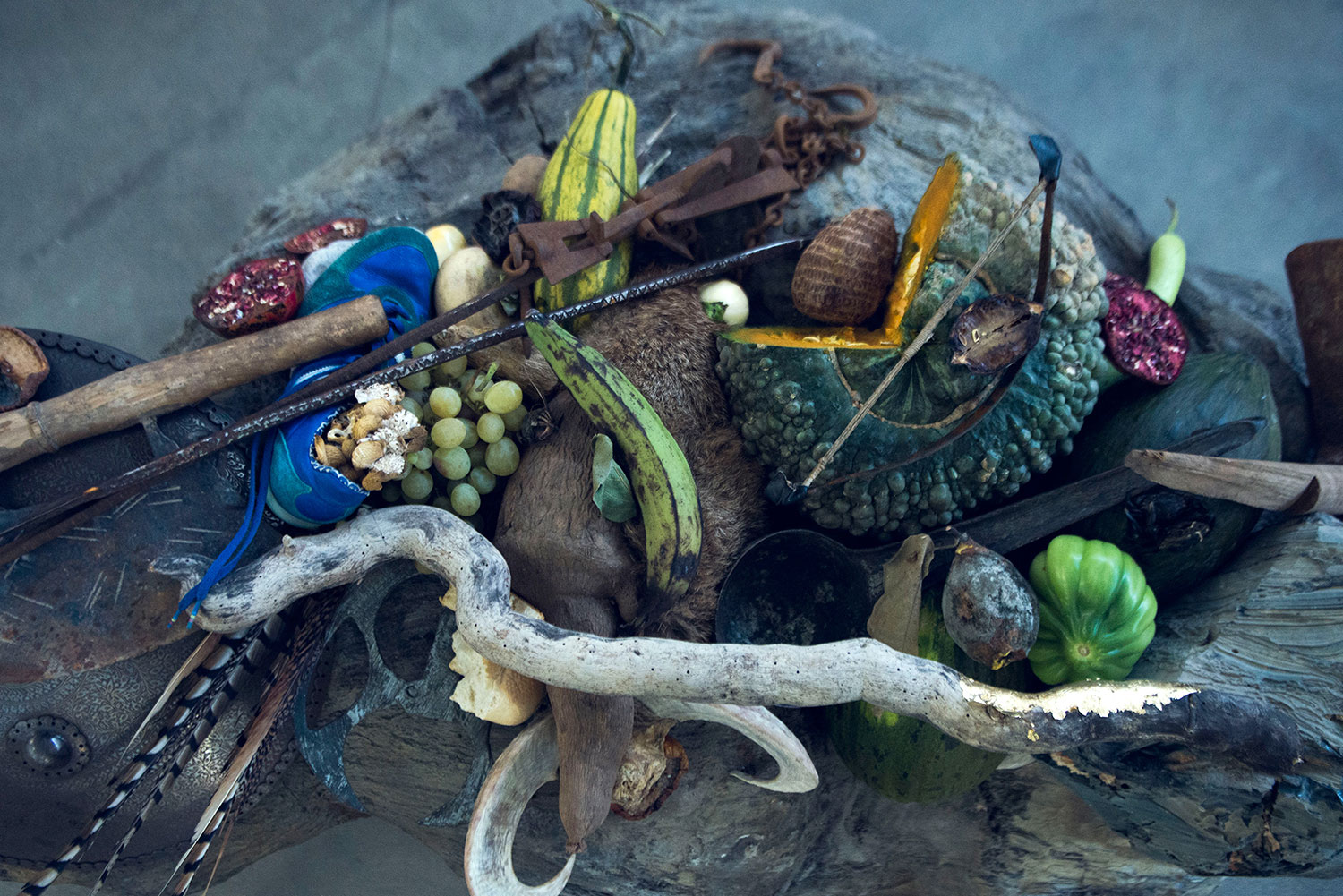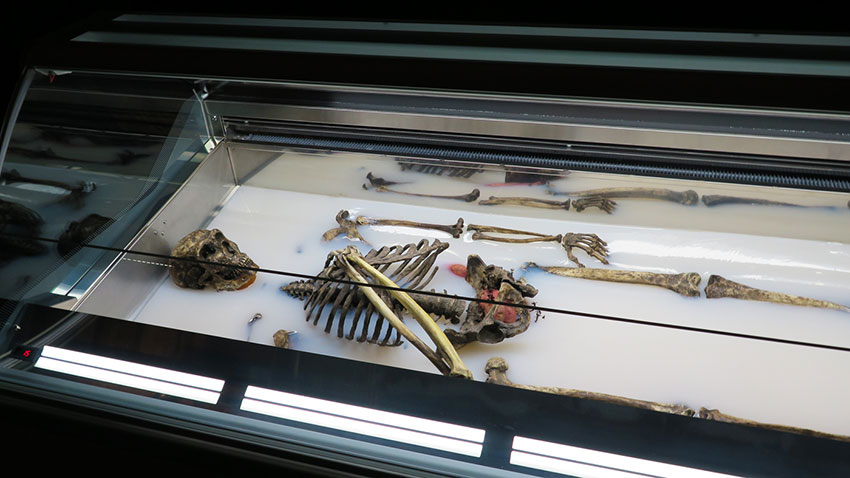
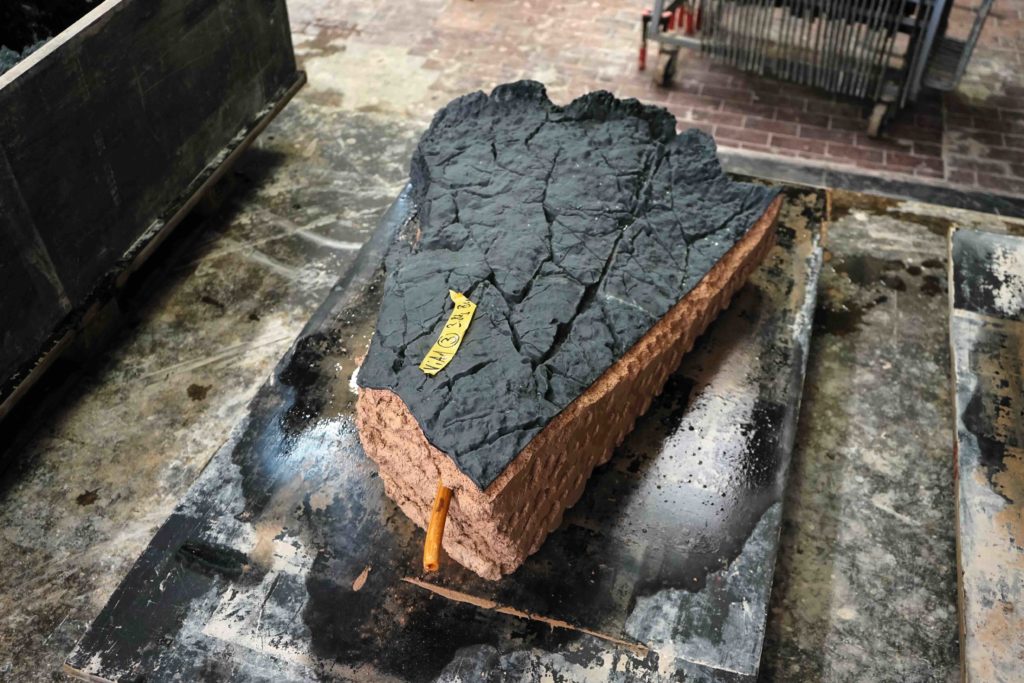
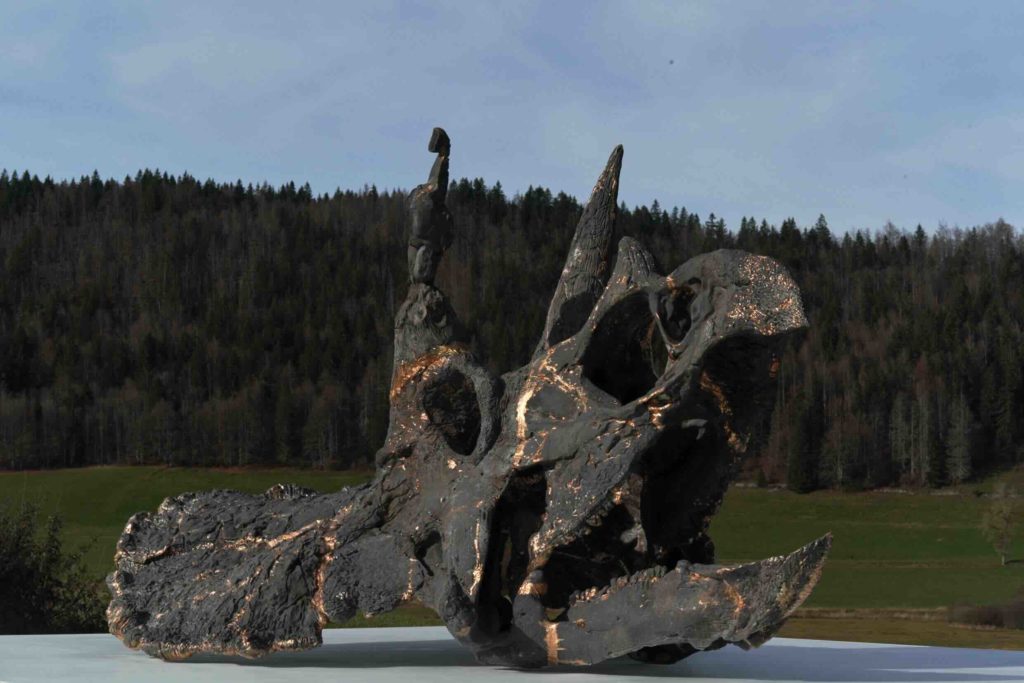
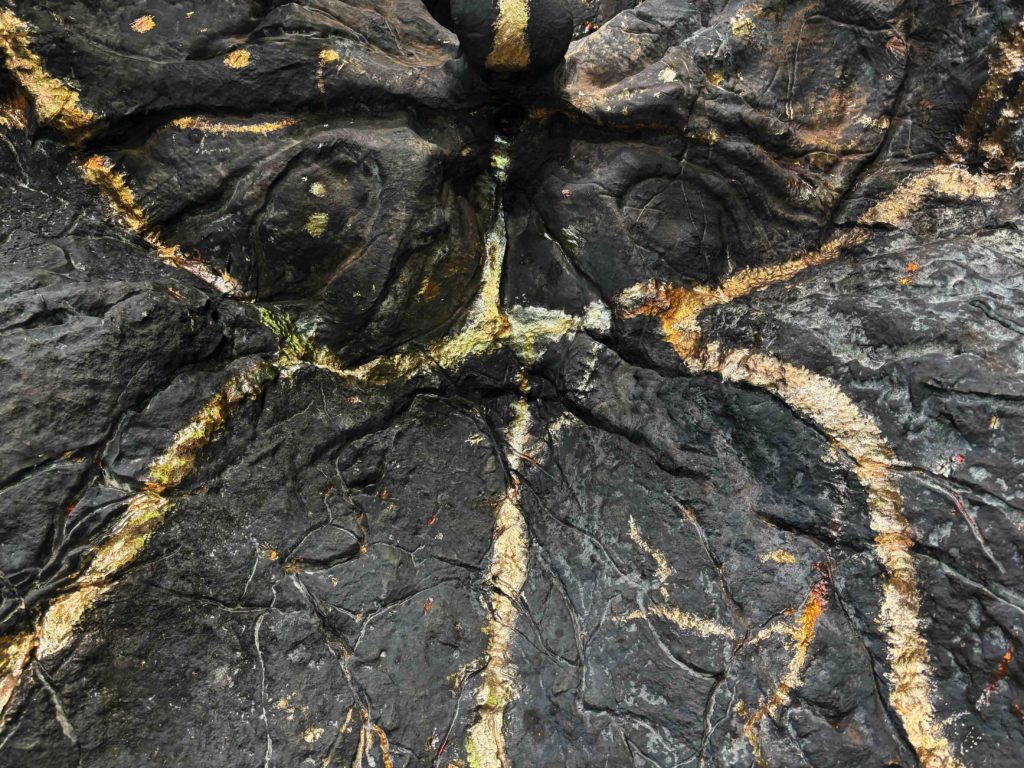
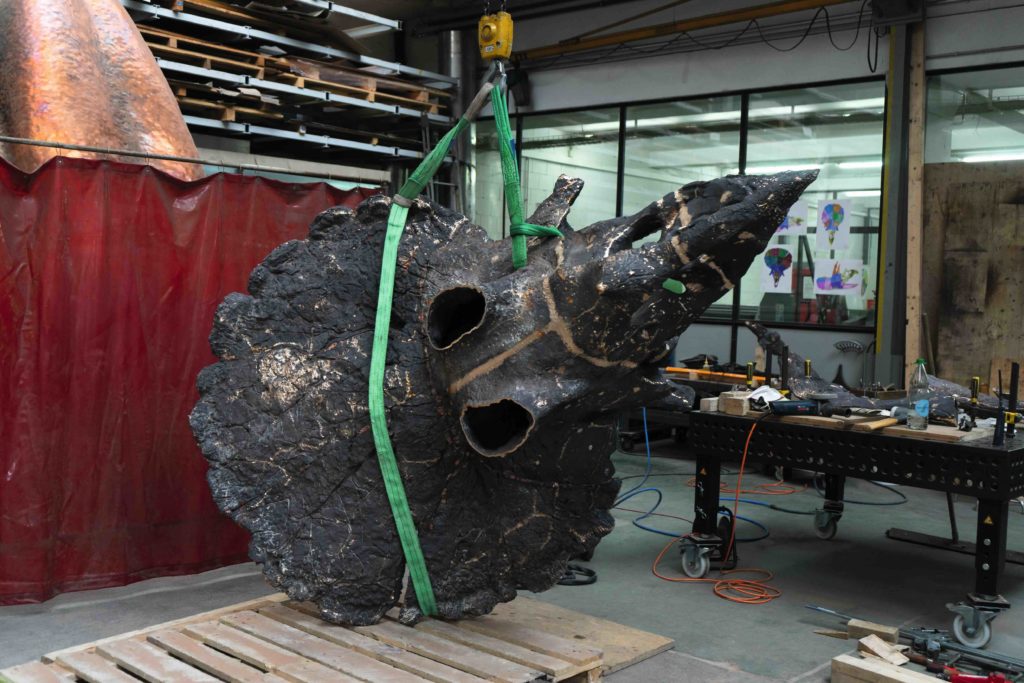
Adrián Villar Rojas’s Untitled (From the Series “The Language of the Enemy”) arrives at Le Brassus like a remembered apparition — something unearthed rather than installed, as if coaxed from the valley’s deep geological memory. Set just outside Musée Atelier Audemars Piguet, on the ground where Jules-Louis Audemars and Edward August Piguet first tethered time to craft in 1875, the sculpture feels uncannily at home, in conversation with the mineral quiet of the Vallée de Joux. Cast in bronze from digital models and finished with a dark, earthen patina, the work reaches upward with its slender, irregular vertical mass, its surface like sediment or petrified bark — a figure seemingly grown rather than made. This is a landscape that once loaned its name to the Jurassic era, a place where the earth has yielded more fossils than almost anywhere else, and where the past seems to breathe through stone. Commissioned by Audemars Piguet Contemporary and realized in collaboration with the Aspen Art Museum — an inaugural one shaped by curators Audrey Teichmann and Claude Adjil — the work stands as the first of the organization’s over twenty-five commissions to take root here in the valley. In June, it will travel on to Aspen, where a two-floor exhibition will open around it. For now, however, it feels inseparable from this terrain, as if it had been waiting beneath the surface all along.
A question lies at the heart of this commission, one that feels especially charged in a place like Le Brassus: What do you do with the landscape that surrounds you? Villar Rojas’s response unfolds through “The Language of the Enemy,” a project that is less a series in the conventional sense than a conceptual expanse — a long, roving inquiry into the origins of meaning itself. Rather than aligning with the familiar narrative of Homo sapiens as the sole architect of symbols and language, Villar Rojas imagines a deeper, more entangled lineage, one in which our early ancestors lived alongside Neanderthals and co-created the rituals, songs, and shared structures of understanding that would eventually be claimed as our own. His work inhabits this speculative prehistory, tens of thousands of years ago, where collaboration — not conquest — was the engine of human becoming. In this vision, the symbolic order is not an invention but an inheritance, passed from another human branch now extinct, its traces still lingering like faint geological strata beneath the stories that we tell about ourselves.
There are, as Rojas often reflects, many ways to approach a project – none of them linear. Narrative itself is an artifact of hindsight, not a truthful account of how ideas form, collapse, and reform again. Nearly twenty years ago, as a student confronting the legacy of the readymade, he found himself paralyzed by Duchamp’s provocation: If anything in the world could be art, then what remained to be done? Where could an artist go when modernism had already flattened the horizon of possibility? The sensation was not theoretical but existential. The only place left, he realized, was not spatial but temporal: into a time before the human, into deep time, where imagination might originate anew.
A visit to New York in 1991 left an early imprint. At the American Museum of Natural History, he was captivated by Charles R. Knight’s small, vivid paintings of dinosaurs — images made in collaboration with scientists to give form to epochs no eye had ever witnessed. Knight worked during the same years as Duchamp, yet his case was anchored not in modernity but in the prehistoric, in a temporal immensity indifferent to human consequence. This tension between the radical openness of the readymade and the radical remoteness of deep time continues to structure Villar Rojas’s own speculative method. What does it mean to build an artwork from a vantage point millions of years before the audience who will one day encounter it?
The Valleé de Joux is a natural stage for such questions. Its strata hold the memory of vanished worlds; its silence accommodates the long durée that exceeds human history. Working here inevitably invokes the problem of the museum — a machine that both preserve and neutralizes, fixing works into a chronology that can repel the messiness of reality. Much of Villar Rojas’s practice has wrestled with this condition, asking what becomes of an artwork once it enters institutional time. His answer is typically to push against legibility itself: to destabilize categories, unsettle expectations, and resist the ease of conceptual containment.
Deep time, for him, is a tool of disorientation – a way of resetting perspective by stepping outside the frame of the human. Posthuman discourse usually imagines how we will be perceived in a future where we no longer exist. Villar Rojas pivots instead toward a past that never belonged to us, a vantage from which humans appear as a species among many, shaped not by superiority but by co-creation. This speculative impulse is, of course, not new: in 2009, at the far southern edge of Argentina, he presented Mi Familia Muerta, a monumental clay whale set within the forest for the End of the World Biennial. When organizers marked the path with signs for visitors to find the sculpture, he removed them: the work had to be encountered without preconception, without the guideposts of narrative expectation. It had to be found in the same way one might find a fossil: unexpectedly, and without permission.
Speculation, for Villar Rojas, is not fantasy but a mode of knowledge. It allows him to rewrite histories, probe materials, and move fluently between extinction and emergence. The questions behind Untitled in Le Brassus — Why prehistory, and why now? — become a means of returning to our origin when the present feels exhausted. If the end offers no clarity, perhaps we must travel back to the initial rupture, the first seed from which meaning sprouted. Everything we know, he reminds us, is recent. A plant, by contrast, thinks in terms of millions of years. To reconnect with this temporal scale is also to reconnect with a particular kind of existential anxiety: the awareness that our systems, languages, and histories are fleeting amid the surrounding vastness.
This is where “The Language of the Enemy” derives its name. Language is our primary tool, yet it is also a trap, a structure that can confine thought as much as it articulates it. At times, language becomes the enemy — especially the colonial languages that overwrite other worlds and other ways of knowing. And perhaps the greatest enemy of all is the failure of imagination: our inability to envision systems of meaning not centered on ourselves. Villar Rojas’s work, emerging from deep times into the thin air of the Vallée de Joux, insists on the opposite — that imagination, when stretched across epochs and species, might allow us to see ourselves anew, not as masters of the symbolic order but as its inheritors, its temporary custodians, its fragile and astonished witness.