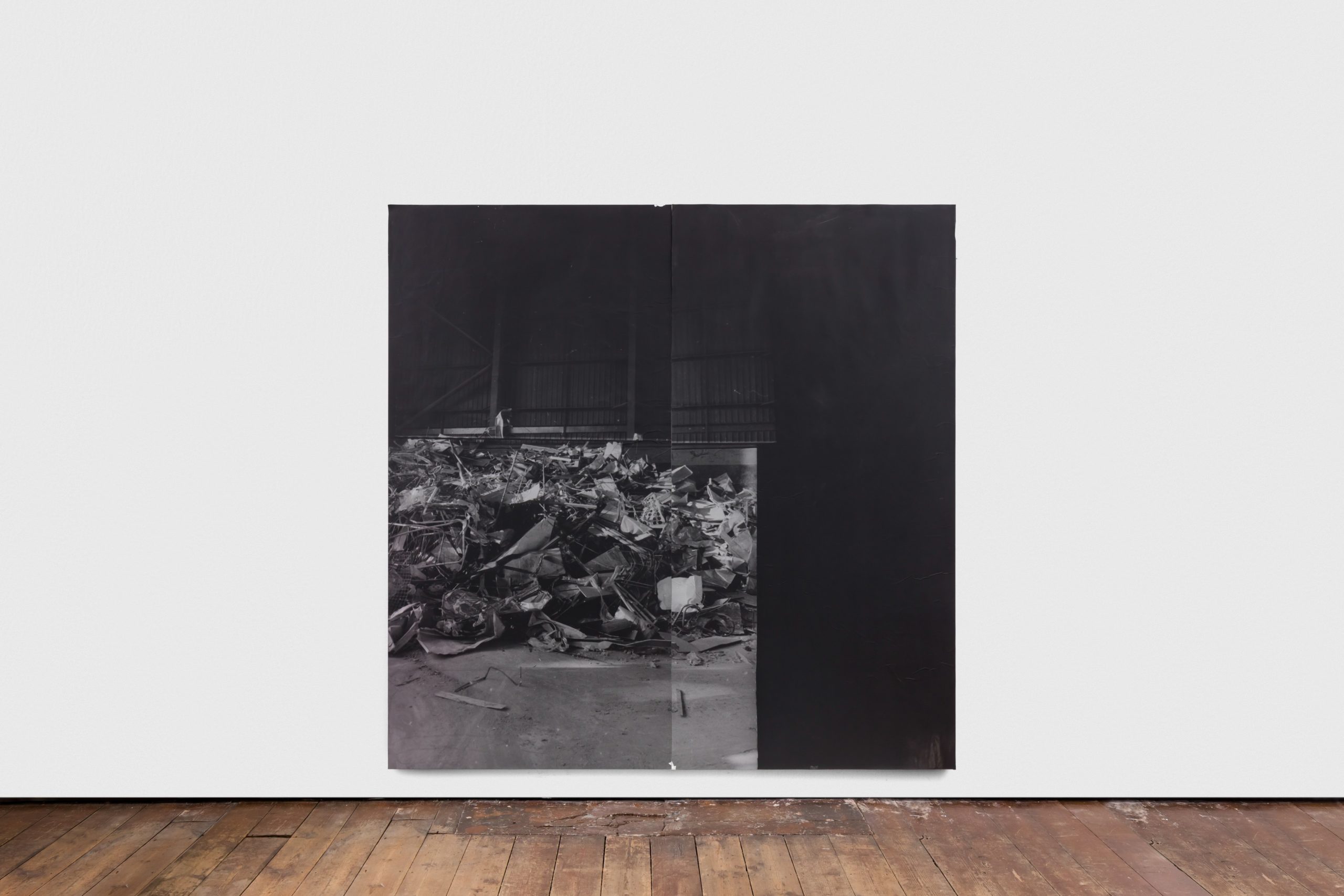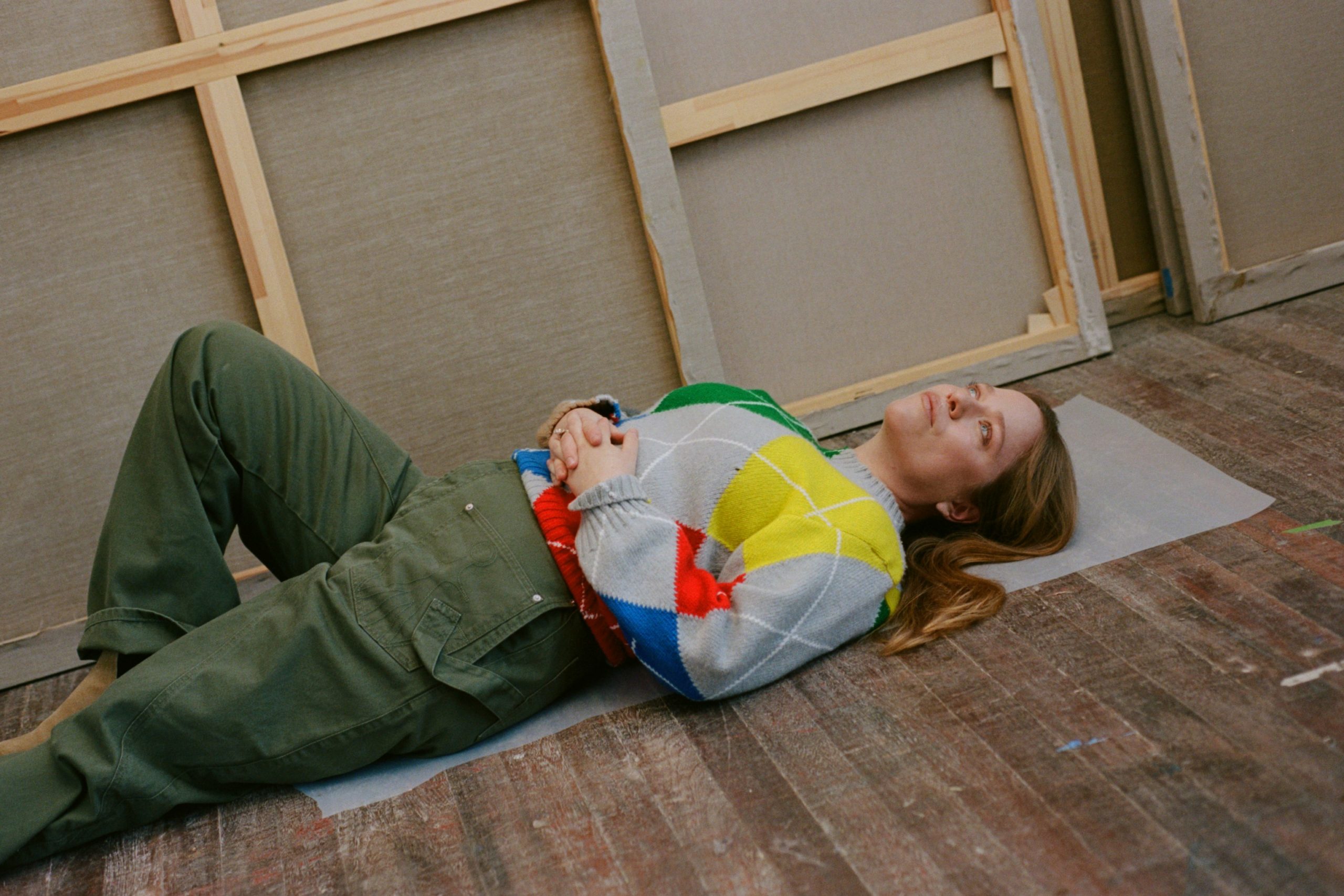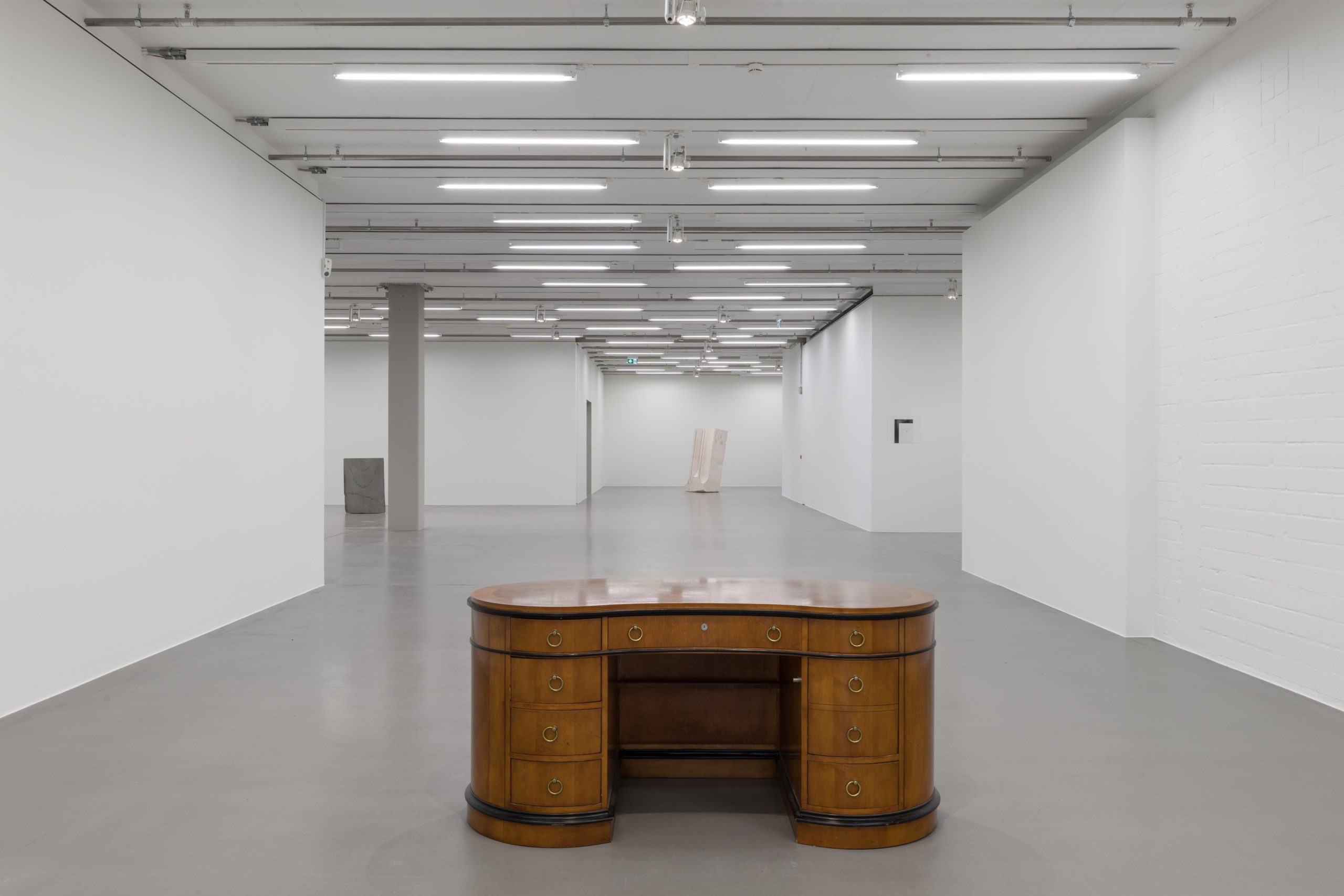
In the HBO series The Leftovers (2014–17), two percent of the world’s population vanishes without warning or explanation. The event, later named the “Sudden Departure,” is never resolved; instead, the series dwells on the lives of the remaining ninety-eight percent — those left to absorb the shock. In a 2015 essay on the show, Mark Fisher writes that because the disappearance cannot be explained, mourning never properly begins.[1]There is no closure to move toward, no account to settle. The characters remain suspended, endlessly searching for answers that never arrive, even by the series’ end. What they inhabit is an ongoing, existential trauma — what Fisher describes as “an unfathomable puncturing of meaning, a senseless spasm of sheer contingency.”[2]
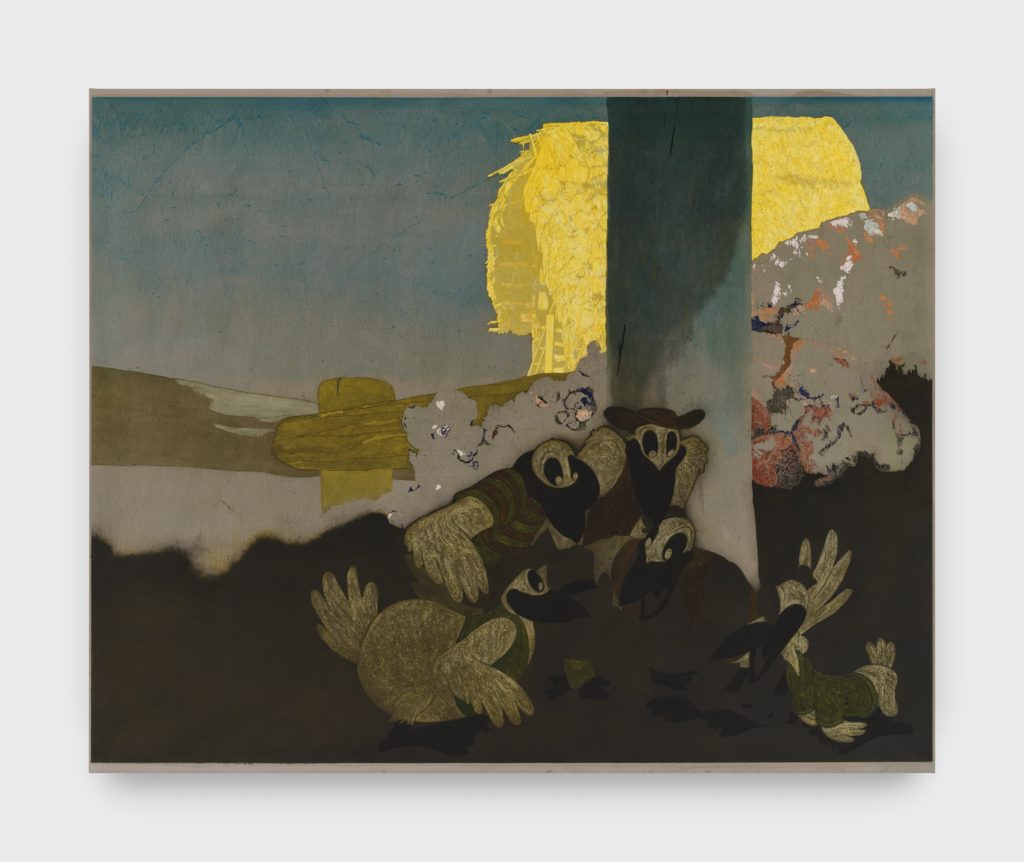
For Dustin Hodges, this feeling is relatable. Born in the 1980s, he belongs to a cohort of early millennials who remember a world before digital saturation. His work carries an awareness of that in-between era when kids still ate cereal in front of an antenna television while watching network cartoons on Saturday mornings. His nostalgia emerges through the superimposition of cartoon motifs — such as the black crow and, in earlier works, the character Francine from the “Arthur” series. These images do not function as simple retrospection; they register a historical threshold, marking the moment when one era has ended and another has begun, without offering clarity about what comes next. The result is not comfort but unease — a sense of temporal dislocation in which the future remains opaque and unresolved.
If Hodges’s paintings attempt to say something about the world, that is their secondary purpose. Upon even a cursory inspection, it becomes evident that his concerns extend far beyond painting for painting’s sake, gesturing toward something far deeper. There is a central lucidity, hidden within their depths, that one must dig to access. It is not a message or a didactic impulse that draws the viewer in. Of course, his material decisions and moments throughout, both deliberate and contingent, grasp one’s attention. The thin layers of pigment he stretches across the linen grid establish a powerful underpinning onto which subsequent layers are built. His use of color glazing to superimpose and reconfigure images across layers creates a subtle complexity that generates a quiet tension between what is visible and what remains withheld. His process feels cyclical and iterative — studied, refined, extracted, and returned — arriving at a careful balance between instinct and calculation. Each layer is developed in relation to the others, producing compositions that feel equally as choreographed as they do visceral.
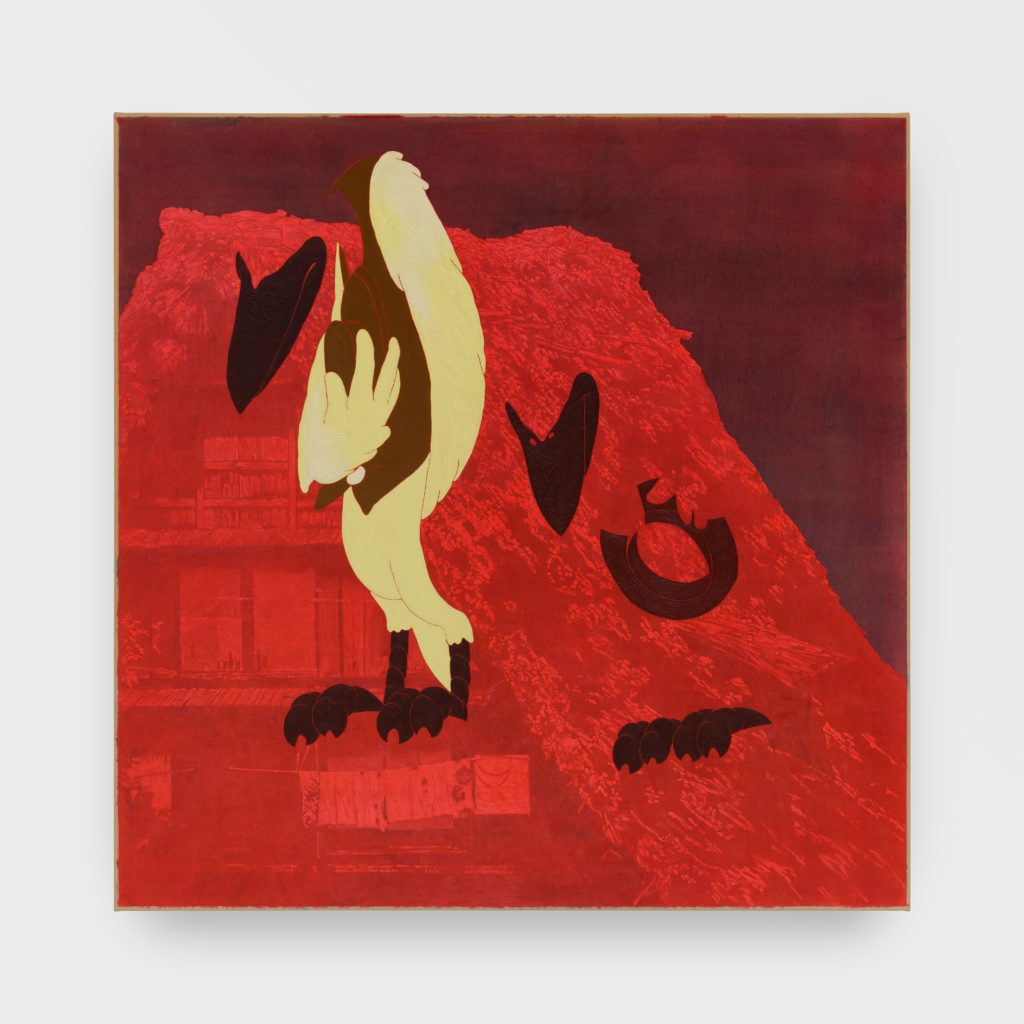
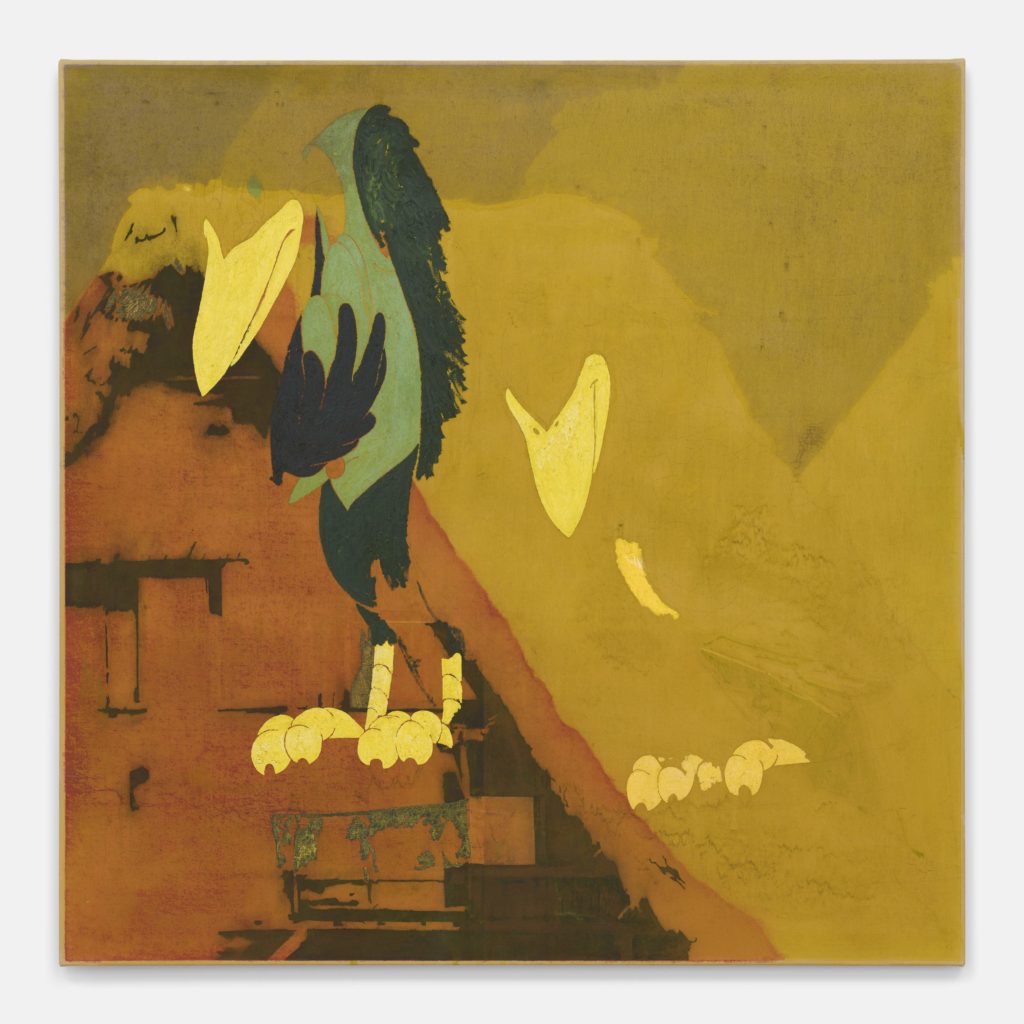
But one feeling cuts deeper than the rest, offering not so much an explanation as a way in — a tool heavy enough to start digging through the trenches of Hodges’s mind. It is an unresolvable melancholia: a stillness in time held within the paintings, suspended between dreaminess and dread, fantasy and reality, carrying with it a low, persistent yearning for a “simpler” time — whether it be childhood, an analog television set, or some indistinct overlap of the two. In Hodges’s newest body of work, presented across two exhibitions — “Barley Patch” at 15 Orient, New York (2025) and culminating with “Barley Patch 2” (2026) at Sebastian Gladstone, Los Angeles.
At a recent talk at the Akademie der Bildenden Künste in Munich, Hodges remarked, “I would like to drive a wedge between image and painting as I see the space between the two, where painting exceeds the logic of the image as my chosen terrain of research.”[3]In “Barley Patch 2,” the paintings are filled with moments of reconfiguration and obfuscation: images remain legible but unsettled, never quite resolving into a single register. Vivid cartoon figures and fragments of landscape — drawn from a painting by Odilon Redon that Hodges has returned to for more than fifteen years — are superimposed onto abstracted renderings of site-specific architectures.
Together, these elements form what Hodges describes as a “third space” — a liminal zone where seemingly unrelated images collide, revealing hidden connections and new possibilities, some realistic, some fantastical, yet all beyond conventional narrative. To call these paintings conspiratorial would be a stretch. And yet, conspiracy often functions as a way of stitching meaning together when coherence fails — when disparate things appear linked but refuse explanation. What matters here is not suspicion but longing: a desire for resolution, for closure, for the possibility of mourning. When that resolution never arrives, we are left at an ontological impasse.
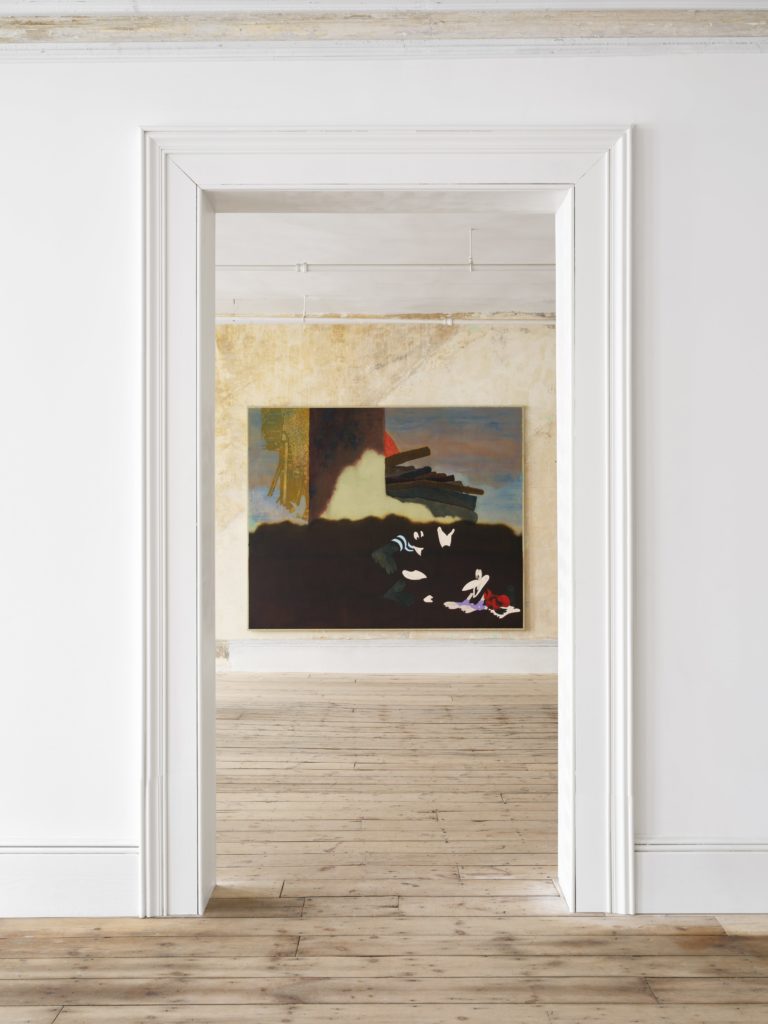
For Hodges, “Barley Patch 2” marks a milestone in both content and form — one point in an ongoing attempt to find resolution within the seemingly unresolvable. His painterly decisions operate in sync with his larger artistic concerns. Hodges’s practice has long pushed against the limitations of painting, probing what such pressure might reveal. One guiding principle in his work is the notion of expanded medium specificity. Deeply invested in how the materials, forms, and systems of painting operate, Hodges nevertheless understands painting as a “complex institution, or even a fiction, constantly renegotiated from each painter’s point of view.”[4] His use of architectural, cinematic, and animated motifs allows him to paint in analogy to other media while preserving the painterly tropes that give the work its affective charge. His finished works operate poetically while quietly carrying researched, ethnographic, and anthropological resonances. They prompt a feeling of the uncanny sublime in the Kantian sense, awe-inducing and simultaneously unsettling, drawing one in through an affective register of disturbed pleasure.[5] In the work titled LEP_79 (2025), images of two crows, painted a saturated, vibrant yellow, are superimposed onto a ground of murky imprimitura. Scattered across this layer are blobs and strokes of muted blues, browns, and reds, pushing forth an unsettled quality. The lower half of the painting is illuminated, while the upper dramatically darkens into shadow, moving diagonally downwards from left to right, as though a layer of dense, obscure fog overtakes the scene. The crows appear somber and defeated as the shadow advances over their shoulders. Also in the shadowed area appears a ladder or scaffold-type structure, with certain points that are missing or redacted. To the right, there is a blue-black vertical band, possibly a curtain, or maybe a void. This interruption heightens the painting’s sense of incompleteness and obstruction, as if part of the scene is withheld and, nonetheless, unresolved.
The notion of mediumship feels particularly relevant. His expanded approach to mediumship is significant not only for the trajectory of his practice but also for his viewers. Perhaps he is drawn to unsolvability as a means of reflecting on his own relationship to painting, again, as a complex institution with which he is in constant negotiation. Maybe the fiction of painting that he speaks of can be understood as a projection of the artist’s mind: the fleeting, convoluted, and chaotic phantasms that are subsequently woven into our perceptions of reality and then spilled onto the canvas. In an age in which the basic idea of reality has come into question, making these phantasms visible, neither resolved nor disguised, may be as honest as one can get.
Hodges’s work invokes a sense of honesty through an acute awareness of both process and aesthetic limitation. He understands that artworks have honest limits and capacities, and respects this notion with a mature and developed humility. He is not attempting to answer questions that an art object cannot. He realizes that there is a limit to the role of art in its placement in culture, and he is not insecure about existing in that space. There is a humility in this restraint, and a confidence in allowing the work to exist on its own terms. Hodges’s paintings model this separation — not as withdrawal, but as clarity — affirming what painting can do by refusing to ask it to do everything.
Just as honest, in a much less literal sense, is Hodges’s relationship to fiction. He cites the Australian writer Gerald Murnane as a guiding influence, particularly the theory of “true fiction,” which locates truth not in events but in perception, memory, and recurring images rather than in events themselves.[6] For Murnane, obsession and repetition are not flaws but evidence of deeper truths; consciousness itself functions geographically — as an unresolvable landscape of plains and horizons. A model distinctly concerned with ethics, it demands loyalty and meticulous attention to the inner workings of the mind, even if those thoughts and images seem austere, irrelevant, or useless. It demands strict documentation of unperturbed subjectivity and its influence from the outside world. This idea is most clearly encountered after seeing Hodges’s paintings. Each one can be understood as a moment of his own true fiction: the recording of images that insistently recur in his mind, no matter how useless, irrelevant, or austere they may seem. In painting them, he makes them relevant; he digs them up to see what they have to say. As Australian psychoanalyst Russell Grigg writes in his Lacanian reevaluation of Freud’s 1917 Mourning and Melancholia, “what makes melancholia so different from mourning is that the melancholic subject turns out to be defenseless against the object. The object cannot be memorialized, and instead remains forever there in the real.”[7] From this perspective, true fiction becomes a means of accessing and documenting melancholia in real time, or from Murnane’s account, “what did happen or what might have happened or what can never happen” in a narrator’s contemplation.[8]
Well beyond “Barley Patch 2,” Hodges has remained committed to an aesthetic of fragmentation — one that resists resolution and unfolds in real time — articulating a Murnanian sense of psychonautic possibility, and likely before he realized that he was doing so in the first place. In the “Francine” series (2020–23), cinematic devices such as the filmstrip establish a strong impression of temporal continuity, implying both what precedes the image and what lies beyond it. This logic extends across the series, conditioning the viewer to read each painting as part of an ongoing, incomplete sequence rather than as a self-contained scene. Throughout this body of work, clusters and partial renderings of cartoon figures drawn from “Arthur” function both as narrative agents and as structural markers, anchoring memory, repetition, and affect. Painting itself becomes the mechanism through which these relationships are articulated: its capacity for erasure, layering, and interruption destabilizes fixed meaning and keeps the imagery in a state of flux.
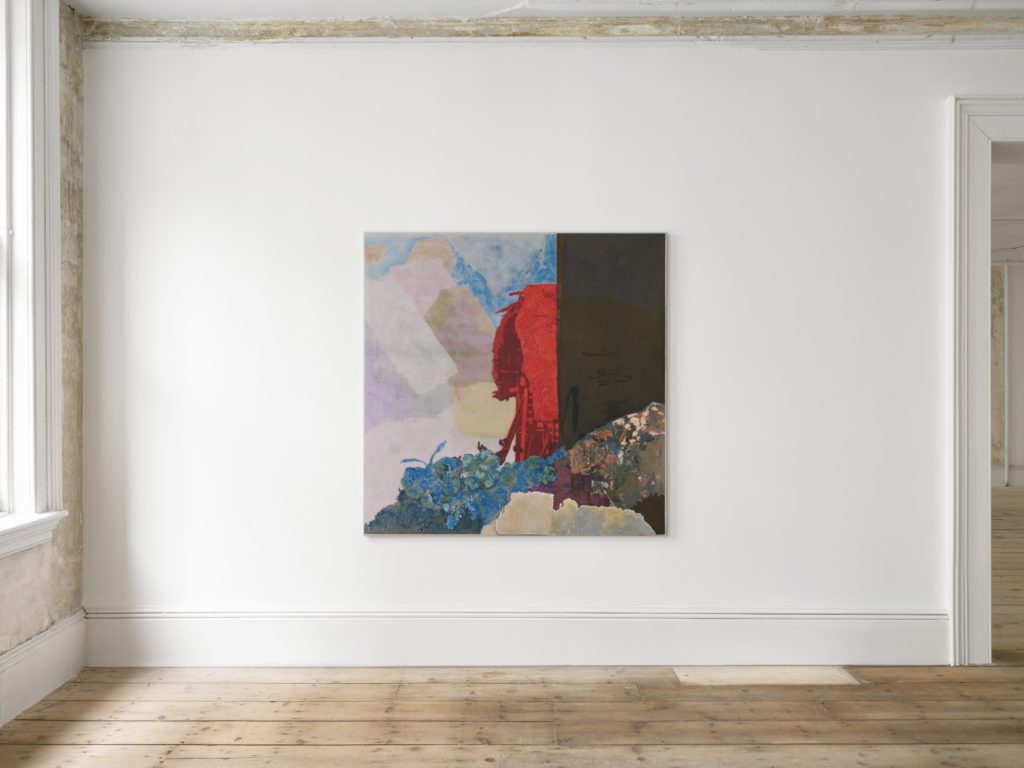
“The Barley Patch” series (2023–26) crystallizes these concerns in a new way, offering “true fiction” as a lens through which much of Hodges’s practice can be understood — paintings that privilege inner reality over event, and perception over resolution. While he draws on ideas and tropes present throughout his work, here he turns the page inward. The void-like vertical bands replace the film strips of his painted series, “Francine,” sharpening a sense of incompletion while deepening the work’s mystery. Distinct architectural references allude to the site-specific, providing a refined poetic framework through which Hodges’s historical signifiers and motifs can be reconsidered. It is therefore unsurprising that the prevailing affect is melancholia, shaped by a contemporary condition in which everyday life is saturated by news and media images that perpetuate existential uncertainty. If “true fiction” functions as a mode of documentation, these images are noted, extracted, and inscribed onto the canvas — finished works that nevertheless remain unresolved. “Barley Patch 2” offers a visual language that is unmemorialized, deliberately open-ended, and perpetually situated in the real.
Dustin Hodges (1984, Portland) lives and works in northern New Mexico. Hodges inhabits a singular space within the medium of painting: his constructed landscapes and fictitious worlds are hauntingly beautiful. His use and re-use of television-age cartoons, vernacular architectural motifs, and specific canonical references allude to the narrative, but only as proposition. Recent solo exhibitions include: 15 Orient, New York; Villa Atrata, Paris; Sebastian Gladstone, Los Angeles; and Soft Opening, London. His works have been included in group shows at Alexander Berggruen, New York; Venus Over Manhattan, New York; and Baader-Meinhof, Omaha. Hodges’s solo show “Barley Patch 2” is on view at Sebastian Gladstone, Los Angeles, through March 28, 2026.
Nick Angelo (1990, Los Angeles) lives and works in Los Angeles. His practice uses mapping, topography, and diagramming to explore American cultural and political power structures, often evoking an “end-times” atmosphere shaped by disinformation and dissent. By blending subjective and alternative histories, his work interrogates mental health, addiction, and power relations. Recent solo exhibitions include Sebastian Gladstone, Los Angeles and New York; Los Angeles Contemporary Archive; and F, Houston. His work has appeared in group shows at Otohime Gallery, Tokyo, and Château Shatto, Los Angeles, and has been written about in X-TRA, The Wall Street Journal, and The New York Times.
[1] Mark Fisher, “How to Let Go: The Leftovers, Broadchurch, and The Missing,” New Humanist, March 2, 2015, reprinted in K-punk: The Collected and Unpublished Writings of Mark Fisher, ed. Darren Ambrose (London: Repeater Books, 2018), 243.
[2] Fisher, “How to Let Go,” 244.
[3] Dustin Hodges, artist talk, Akademie der Bildenden Künste, Munich, 2026.
[4] Dustin Hodges, artist talk, Akademie der Bildenden Künste, Munich, 2026.
[5] Immanuel Kant, Critique of the Power of Judgment, trans. Paul Guyer and Eric Matthews (Cambridge: Cambridge University Press, 2000), originally published 1790.
[6] Gerald Murnane, The Plains (Melbourne: McPhee Gribble, 1992).
[7] Russell Griggs, “Melancholia and the Subject,” in Freud and Lacan: Mourning, Melancholia, and the Subject (London: Routledge, 2010), 153.
[8] Gerald Murnane, Border Districts: A Fiction (Melbourne: Text Publishing, 2018).