Throughout my conversation with Gili Tal, freshly landed back in London after opening her solo exhibition “Soft and Bouncy” (2026) at Galerie Buchholz in Berlin, there’s one word that the artist keeps using: she talks at length about “fracking” for images. This has the effect of sending my mind into overdrive. The high-pressure, highly contested form of extraction of oil and gas from fissures deep in the earth’s surface denotes an extractivist economy that won’t take “no” for an answer, hovering on the sidelines, ready to suck out the last drop of energy and its concomitant value.
Suffice it to say that it’s also a sign of an ecology teetering on the brink of exhaustion, and “exhaustion” is a term that comes up time and again in relation to Tal’s image-heavy practice, one that revolves mainly around photographic images that she manhandles into abstract-ish oil paintings, digital prints, and sculptures whose vocabulary is steeped in the empty rhetoric and branding of Planet Earth, Inc. But what happens to images when they — their symbolic and very real economic value — become exhausted? Does exhaustion lead to depletion, or do even the skeletal remains keep on giving?
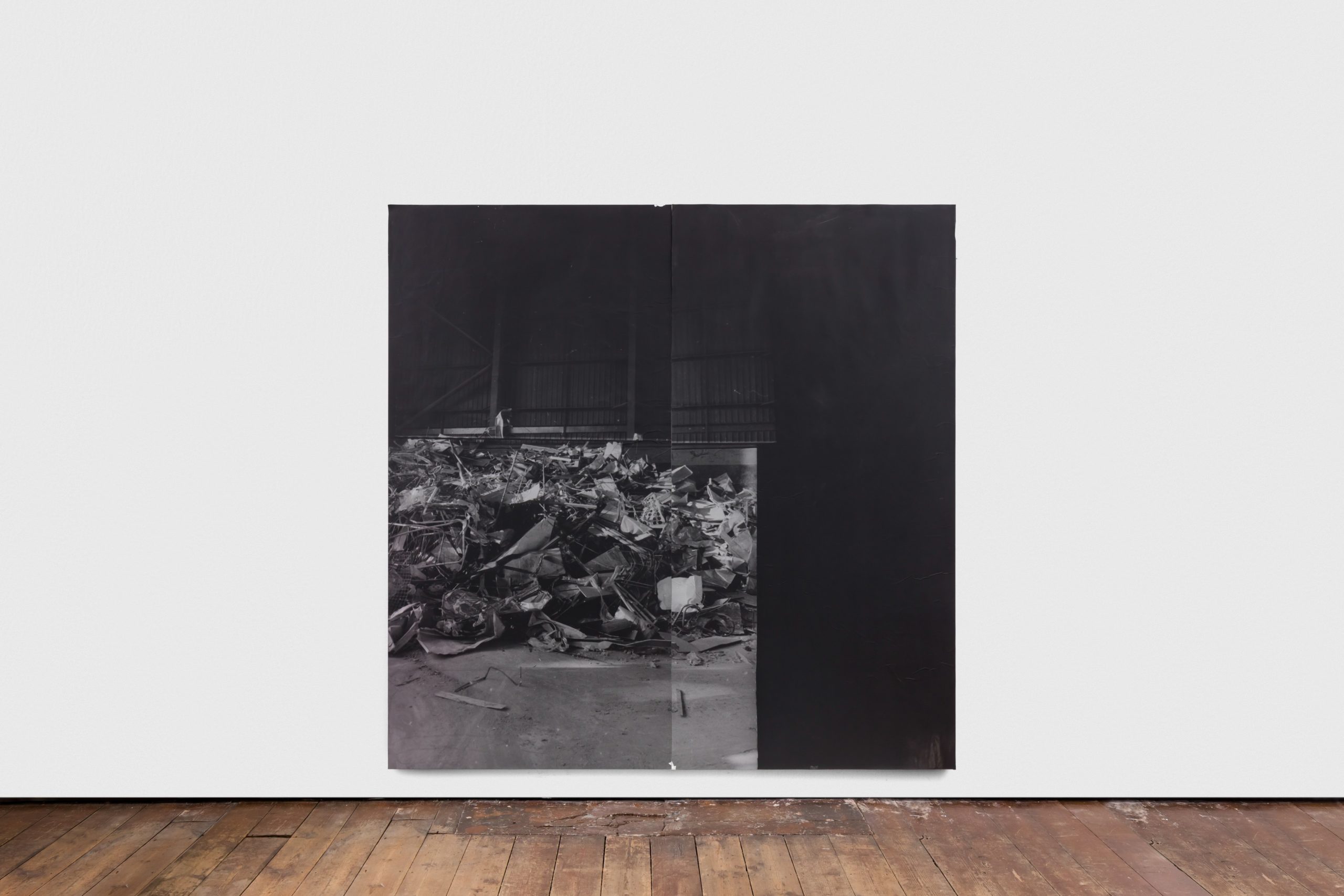
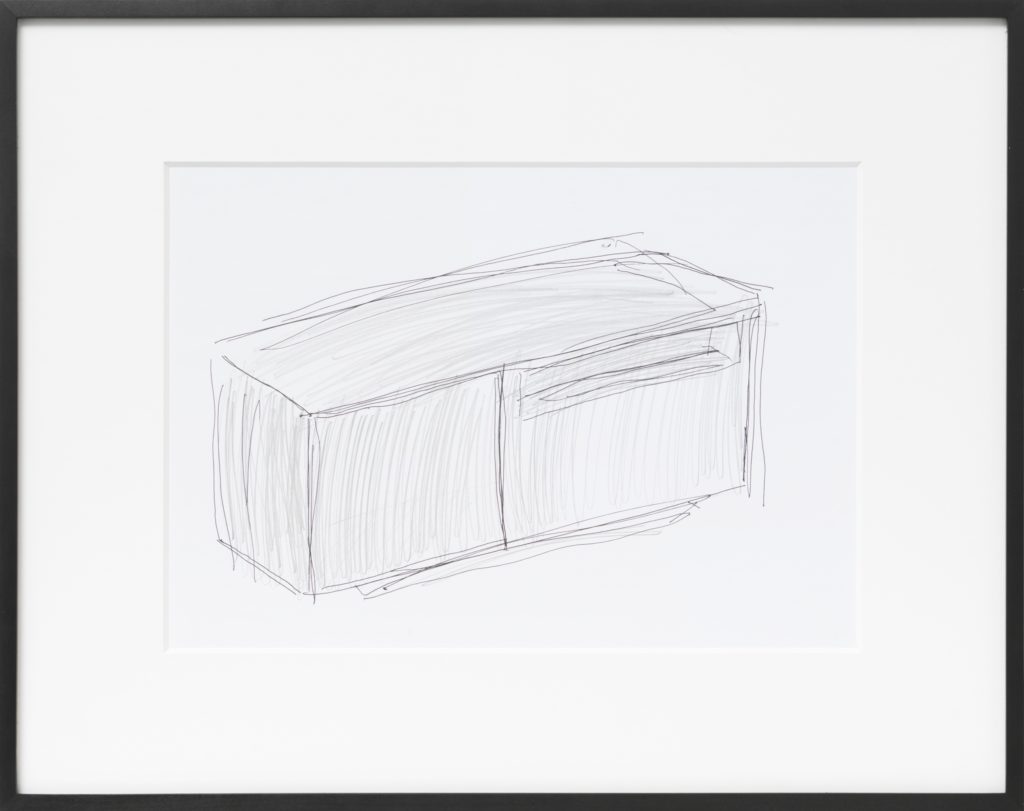
In Berlin, Tal is engaged in a game of smoke and mirrors. Her work is innately about structure, (im)material forms inhabited by ghosts, or, at the very least, filled with hot air, and it shows. One wrong move and the whole thing could deflate, go limp. The pre-opening announcement for “Soft and Bouncy” consisted of three cut-out photographs, set against a pristine white background, of transparent plastic cups — the ones with the corpulent domed lids — filled with iced coffee and whipped cream, in different stages of fullness. It’s a comforting dopamine hit packaged in the saccharine billows and curves of Global Corp marketing speak, ready to be slurped and sucked dry, but all that it actually offers are empty calories and the risk of Type 1 diabetes. The exhibition itself consists of a series of large-scale photographs of commercial refrigerators, printed mostly on clear film and applied to a Dibond support, as well as a small set of simple line drawings in pencil offering barely there, rudimentary views of stock consumer goods, such as drinking glasses and tables (Set of 6; Bureau; Light and Airy, all 2025). I’ll come back to the proliferation of fridges in Tal’s practice, but suffice it to say that here it feels as if we’ve finally stepped over the threshold and into a graveyard of sorts, or rather its waiting room, one inhabited by images in a limbo state, which have given up the ghost but nevertheless refuse to move on, leaving behind a sticky residue.
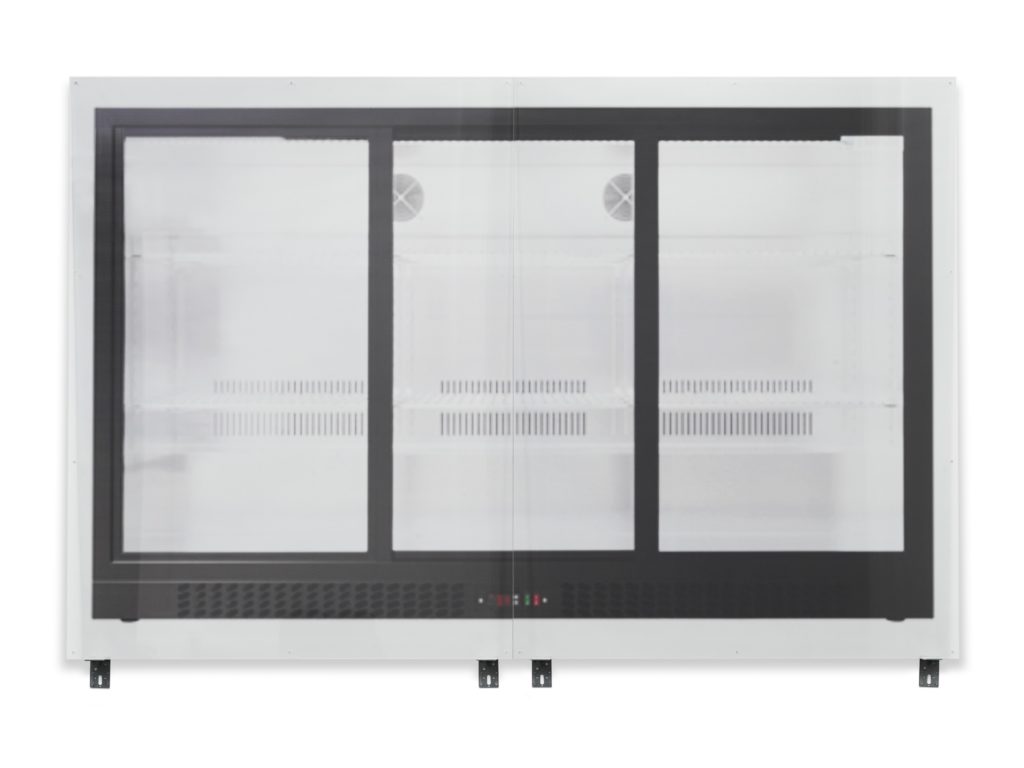
It is said that the oft-used idiom “full of hot air” originates in the latter half of the 1800s; an early citation can be found in Mark Twain’s and Charles Dudley Warner’s novel The Gilded Age (1873), a social commentary and satire on greed and corruption, in which the lies told by politicians are decried as “The most airy scheme inflated in the hot air of the capital only reached in magnitude some of his lesser fancies, the by-play of his constructive imagination.”[1] A verbose, pompous style acting as a red flag behind which lurks… nothing. Vaporous, boastful, pretentious and infinitely unsubstantial — in other words, BS. In “Soft and Bouncy,” it is the promise of fullness offered by our image saturated environments that is put to the test and shown to be what it is — full of hot air. The images of empty fridges seem to be devoid of any weight or gravitational pull, free floating in a loose hang across the walls, with nothing to anchor them down. The pretense of structure and form with nothing behind it. As if to underline this point further, Tal chooses to print these images onto clear film, creating a multilayered game of transparencies. In the case of the diptych Snowdome (2026), she has gone so far as to opt for perforated one-way window film, the material of choice found outside office rooms and buildings, where opacity is rendered void by the hundreds of tiny holes that form the skeletal structure of this film and allow the gaze here to penetrate directly through the surface of the image and onto the wall upon which the work is mounted.
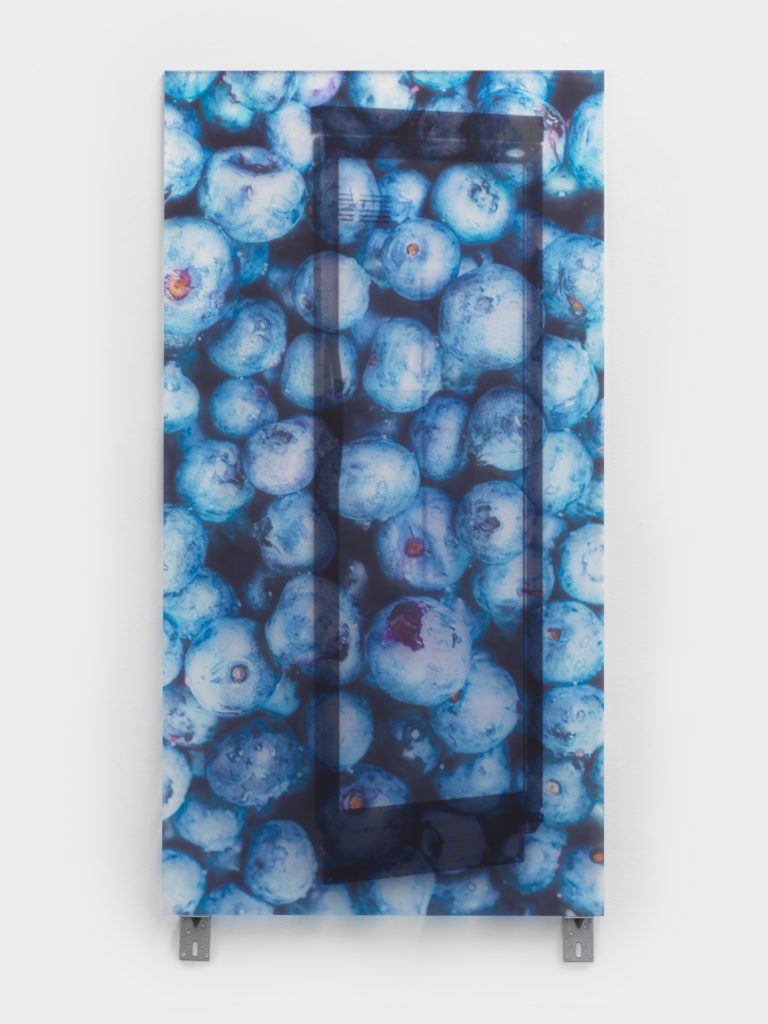
Designed for preservation and display, the empty cavities that we obligingly stare into in Pure Form I (2026) or Untitled, Silver Mirror (2026) beg the question of how far we are prepared to go and what we are willing to project in order to fill this aching hole. The allure emanating from Untitled, Gold Mirror (2026), for example, stems from the gold-mirrored Dibond which serves as the work’s surface and background and bathes the work in a warm, glowing aura, a clear-cut revelation of the alchemical power that lies behind any marketing strategy worth its salt. Elsewhere in the exhibition, Apparition, Blueberries and A State of Dreamy Association (both 2026) don’t even try to hide their bare-faced pretense of “fullness.” Clusters of blueberries dominate the one, while a sneaker, behind and through which we can glimpse a stuffed toy teddy bear, takes center stage in the other, but the titles of both works make clear that there’s no consolation to be had here. Tal has previously made clear her fascination with this brutal type of economics, where the idea of bounty is produced with the smallest of means, effort, and expense, and it is left up to the consumer, the consumers, to do the real leg work, to connect the dots and inject significance into nothingness. But there is also another concern that makes its presence felt. Often this is a rumination on just how easily we have been indoctrinated into investing the most rudimentary of signs, markings, and pixels with meaning, with value, with importance. But to what end?

Tal’s practice is peppered with banal images of objects, places, and things that often go unnoticed — because they are so ubiquitous, so unassuming, so ever-present — but which address the role that digital and urban intervention subliminally plays in our daily experience. If the flaneur was the protagonist of the nineteenth-century imaginary, an idler, a connoisseur of the street, leisurely floating without reason or mission through the public commercial arcades of the city, allowing himself to be observed as much as doing the observing, for Tal this figure has evolved into that of the real estate agent. Her images are stripped of all romance, of any and all possibility of falling head over heels, a twenty-first-century The Bride Stripped Bare by her Bachelors, Even (1915–23), if the non-eligible bachelors in question are commerce and the endless pursuit of profit. An earlier exhibition, “Mastering the Nikon D750,” held at ETH Zurich in 2019, consisted of photographs taken by Tal with a simple, cheap, point-and-shoot camera, snaps of ordinary moments, like a bustling flower market or people relaxing in a public square, awkwardly framed and often taken at asymmetrical, acute camera angles. Stretched across wide, freestanding billboard structures, these images proudly reveled in the literal distortion of the views that they offered of life on Planet Earth. Call it Tal’s version of corporate cosplay, as any of these photos — the reflection of a building in a fountain (Nordic People are Least Unhappy, 2019), the metallic curves of a playground (Secret Spots, 2019) — could just have easily made it on to the pages of real estate brochures, travel guides, or used as branding at construction sites that now are littered across every large-scale urban metropolis.
While potentially yawn-inducing because of their supposed ordinariness, these are also glaring instances of the promise of an attainable social mobility, comfort, and security, a communal dysphoria treated as the apex of the standardized cookie-cutter life that we are taught to aspire to. It’s an idea that Tal had explored earlier in her exhibition “Civic Virtues” (2018) at Cabinet in London, in which similarly humdrum but sweet “moments” were presented on individual roller blinds installed as a horizon line across the gallery’s walls. There is a certain tiredness inherent to these images, stemming from their ununiqueness, their meaning depleted so as to potentially only function as the type of stock placeholders used across internet sites to verify that you, the digital visitor, are indeed human, but therein lies the comfort.

In his theorization of “liquid modernity,” a state reliant on increased movement, flow, and software, the sociologist Zygmunt Bauman argued that consumer culture held a pivotal role in our post-post-modern society, in which individuals are encouraged to pursue self-expression through consumption. We are hard-wired to want. However, the sad (and obvious) reality that Tal consistently points out to us is that we’re all looking at, consuming, regurgitating the same thing over and over again, then repeating the cycle anew. In 2015 at Vilma Gold in London, Tal filled the gallery with commercial fridges of various sizes, all of them only partially stocked, mainly with consumer-friendly, instantly recognizable drinks: Peroni, Heineken, Red Bull, Evian, Diet Coke… More recently, in a duo show (“The Bubblegum Police”) with Alan Michael organized by the New York gallery Jenny’s at Hot Wheels, London, in 2024, she included prints of fridge interiors, filled with those same consumer items, but this time the fridge door replaced by a soft haze that instantly turned the compositions, with their flashes of color, into something reeking of an artificially induced nostalgia. Despite their initial seemingly inoffensive appearance, these are carefully staged compositions in which the optics and psychology behind display systems, consumer happiness and consumption, economic flows and exchange value, become all the more apparent. Again, the hint lies in the title. The spatial architecture of the fridge functions as a stand-in for the traditional picture frame, a window into a world of fantasy, as made crystal clear by the likes of Big Silver Fridge (Bucolic) (2024), a vision of two Red Bull cans standing proudly side by side among other libations.

Ephemeral as these images and objects appear, no matter whether virtual or not, detritus is what it ultimately comes down to. At the same show at Hot Wheels London, the wooden parquet floor was scattered with what could have easily been mistaken for autumn leaves blown in from the outside. Even the title, Autumn on Everything (2024), seemed to point to the same conclusion. However, apart from the seasonal incongruity (the exhibition took place during the summer), closer inspection revealed them to be digital images, not the real deal but frail renderings and cut-outs, fragments of the Shutterstock logo rearing its head here and there. A tug-of-war between image and form that had previously appeared in “You May See Butterflies: Elephant Springs” (2023) at Galerie Buchholz in New York as a series of small vector drawings of leaves, bits of street furniture and rubbish (False Autumn, 2023), clinical and cold in their precision, and completely unattached to any actual sense of place or belonging. Aspirations, exhausted, blown by the wind and left to be trampled upon.
[1] Mark Twain and Charles Dudley Warner, The Gilded Age: A Tale of Today (Penguin Publishing Group, 2001; originally published in 1873), Chapter XLIV.