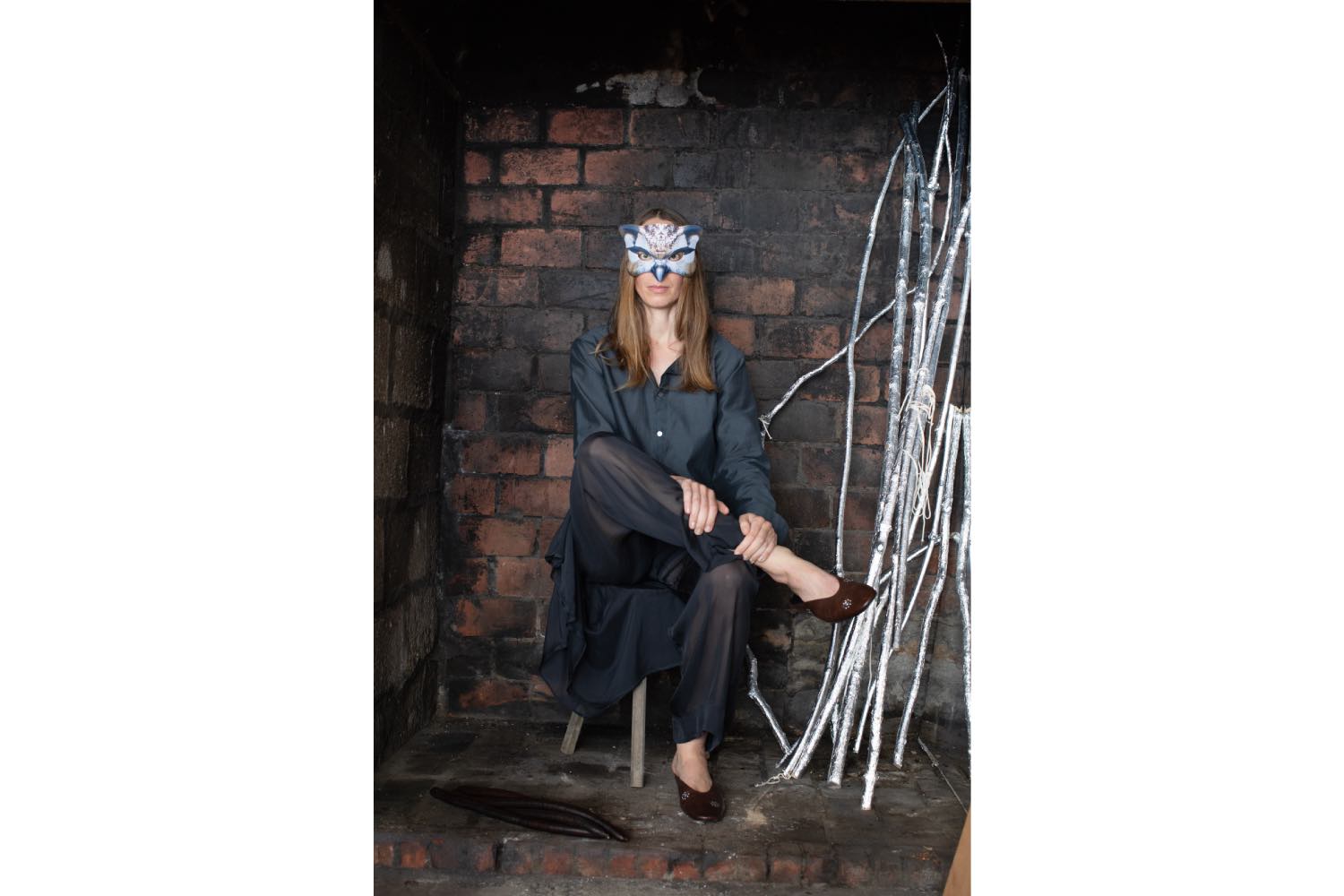
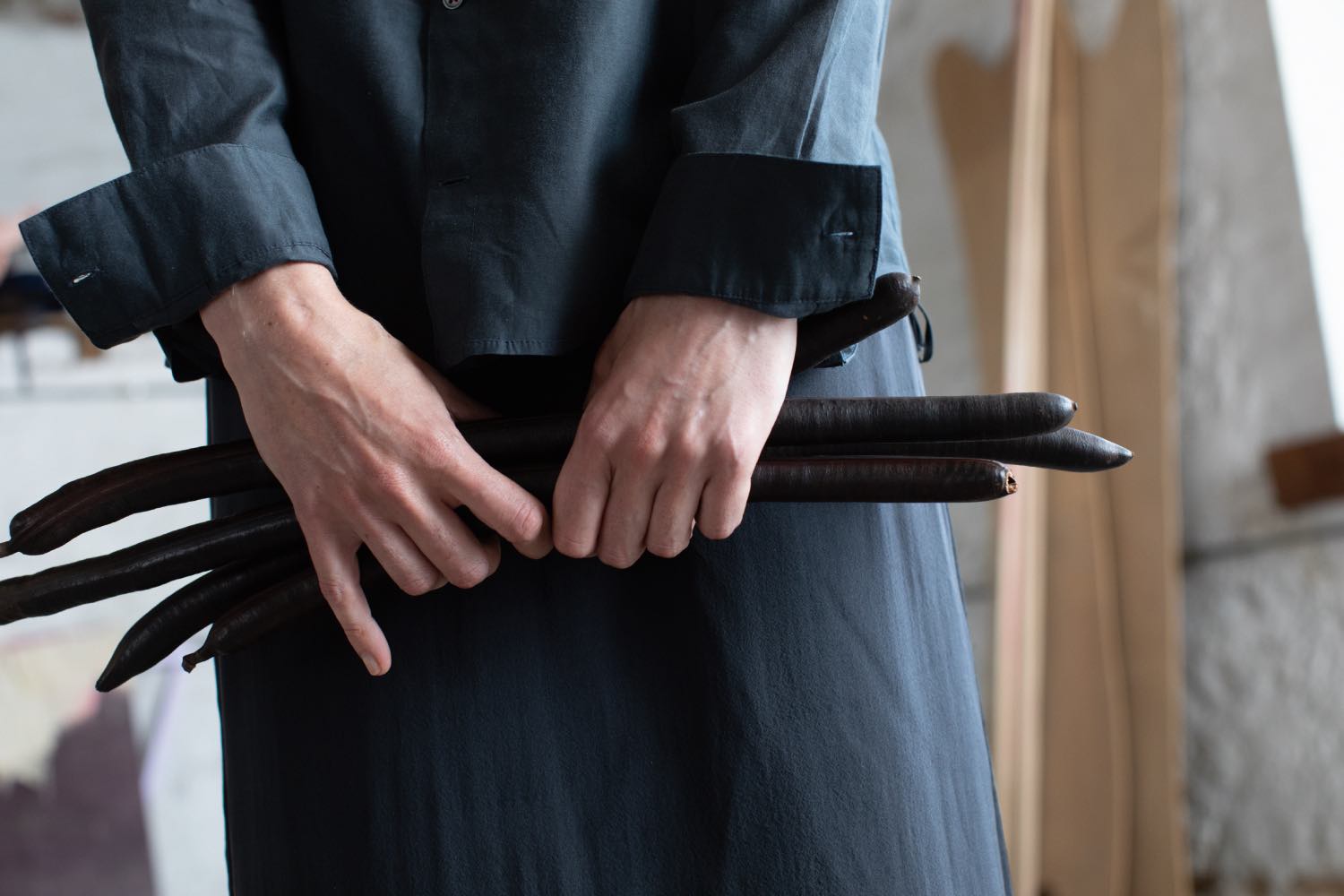
Daiga Grantina’s 2020 exhibition, “What Eats Around Itself,” at New Museum in New York — my first encounter with her work — was rooted in her interest in lichen. She was particularly drawn to its symbiotic composition: a living organism formed through the interdependence of fungus and algae, a byproduct of their mutual reliance for survival. This felt like a strikingly prescient preoccupation just months before the pandemic, when indigenous and anarchist principles of mutual aid entered the popular discourse as people responded to the crisis. Grantina’s amorphous forms seemed to at once grow in and out of each other as they stretched across the windowed ground-floor space. Each sculpture was punctuated by exclamations of red, orange, or purple in silicone, paint, and fabric. It was a riotous sweep of color and dramatic sculptural gesture.
A year later, I wrote about “Temples,” Grantina’s first London exhibition at Emalin, and one of the first shows to open after the lockdown. Whereas “What Eats Around Itself” expanded across the museum’s gallery, “Temples” felt more restrained: the work was confined to the walls. Here, her sculptural investigations appeared to have returned to their foundations, focusing on the relationship between light, color, volume, and form. The titular series “Temples” (2020–21) comprised seven small, triangular forms constructed largely from pieces of fabric, wood, and paint. Color was deployed sparingly, but with precision. Despite their size and sparse appearance, each was characteristic of Grantina’s larger sculptures. They were complex, interrelated forms that, with each movement, seemed to shift and collapse before your eyes: material, color, and form as questions yet to be answered.
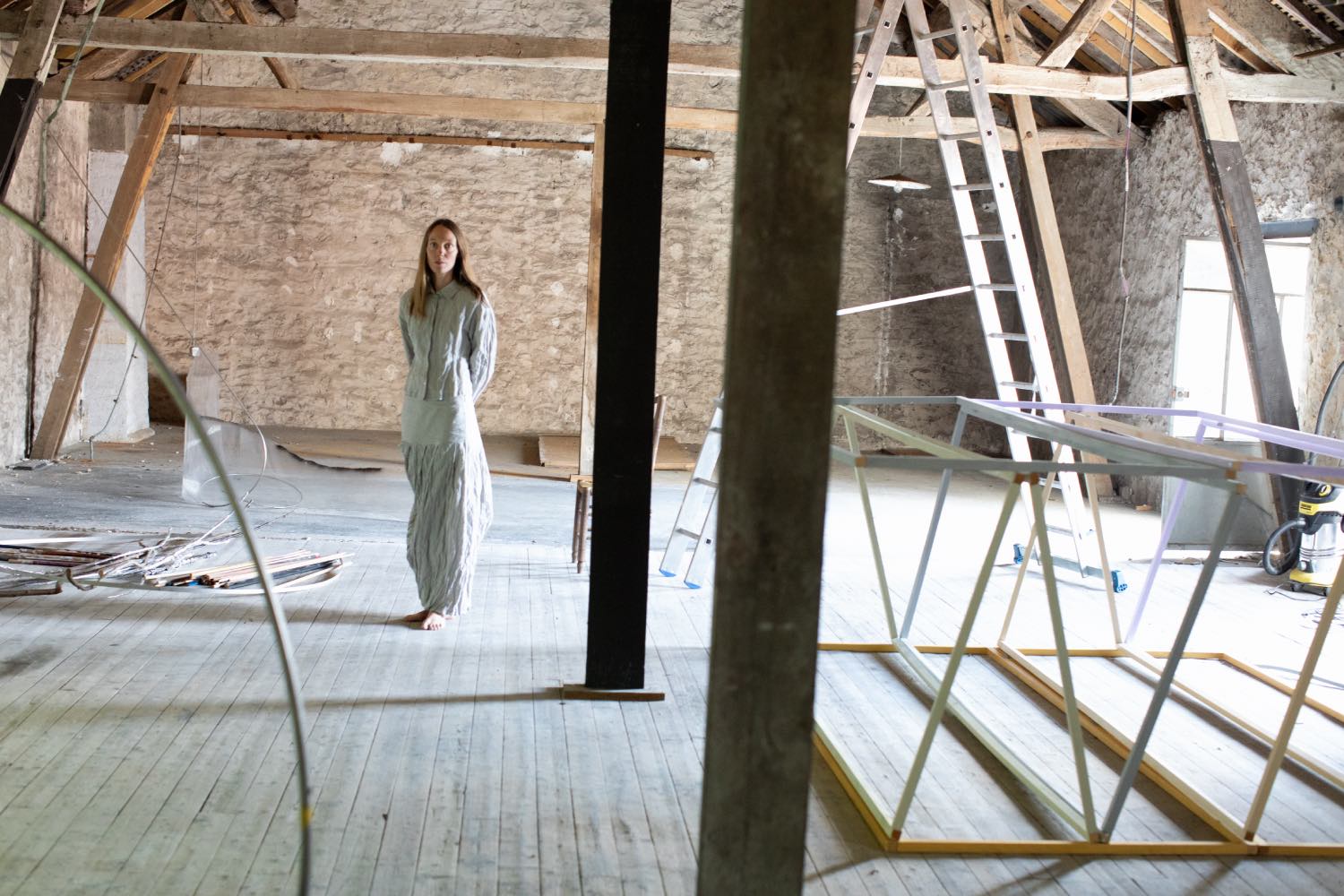
This conversation, which began in the back of a taxi in east London and continued over video from her studio in Paris, took place during Grantina’s second solo show in London and her return to Emalin’s space. If “Temples” felt confined and “What Eats Around Itself” expansive, the new show, “Leaves,” seemed to mark a shift into murkier territory. Viewers were confronted with muted grays and violets, as well as material shifts that included an expanded use of metal. Like her sculptures, which appear to oscillate between announcing and undoing themselves, we enter Grantina’s practice in its continual process of transformation and discovery.
Amy Jones: I wanted to start by talking about the triangulation of shows that frame our conversation: “What Eats Around Itself” at New Museum in 2020 and your two exhibitions at Emalin in London, in 2021 and 2025, respectively. There’s something about the shifts in color, material, and form that feels emblematic of a practice that’s in continual movement — destabilizing and reforming itself.
Daiga Grantina: That’s a particularly extreme triangulation, yes. The time period between the New Museum show and “Temples” was defined by COVID. “What Eats Around Itself” was closed for over a year during confinement, and then “Temples” was one of the first exhibitions to open in London afterwards. The New Museum show felt far out in my process’s spiral, and sometimes, after that moment, you then need to come close again and restart the spiral from the inside. That’s how “Temples” felt — the works were small, but concentrated. It got close to one element of the practice.
AJ: This image of the spiral is a central idea that underpins the way you work. Can you say more about it?
DG: The spiral is a way to position yourself. Much of my process is about proximity, sensitivity, and intuition: the detail of the everyday, how you feel about or what you see in small gestures. That counts so much. The spiral becomes a way to connect those small gestures and observations into something larger. When you can feel your heart slowly shrinking, the spiral is a space from which to grow.
It’s a daily practice. If you try to push right to the big feeling, you fall totally. Instead, when I come to the studio, I just look at what happened yesterday. Over time, I tend to forget what day of the week it is, and then that spirals out further, and I start to even lose my sense of the seasons. When that happens, it’s like it’s announcing something — a new direction I’ll eventually follow in the work. Then I’ll spiral inward, make again, and push forward. It’s about concentration and containment and being in touch with intuition and fear.
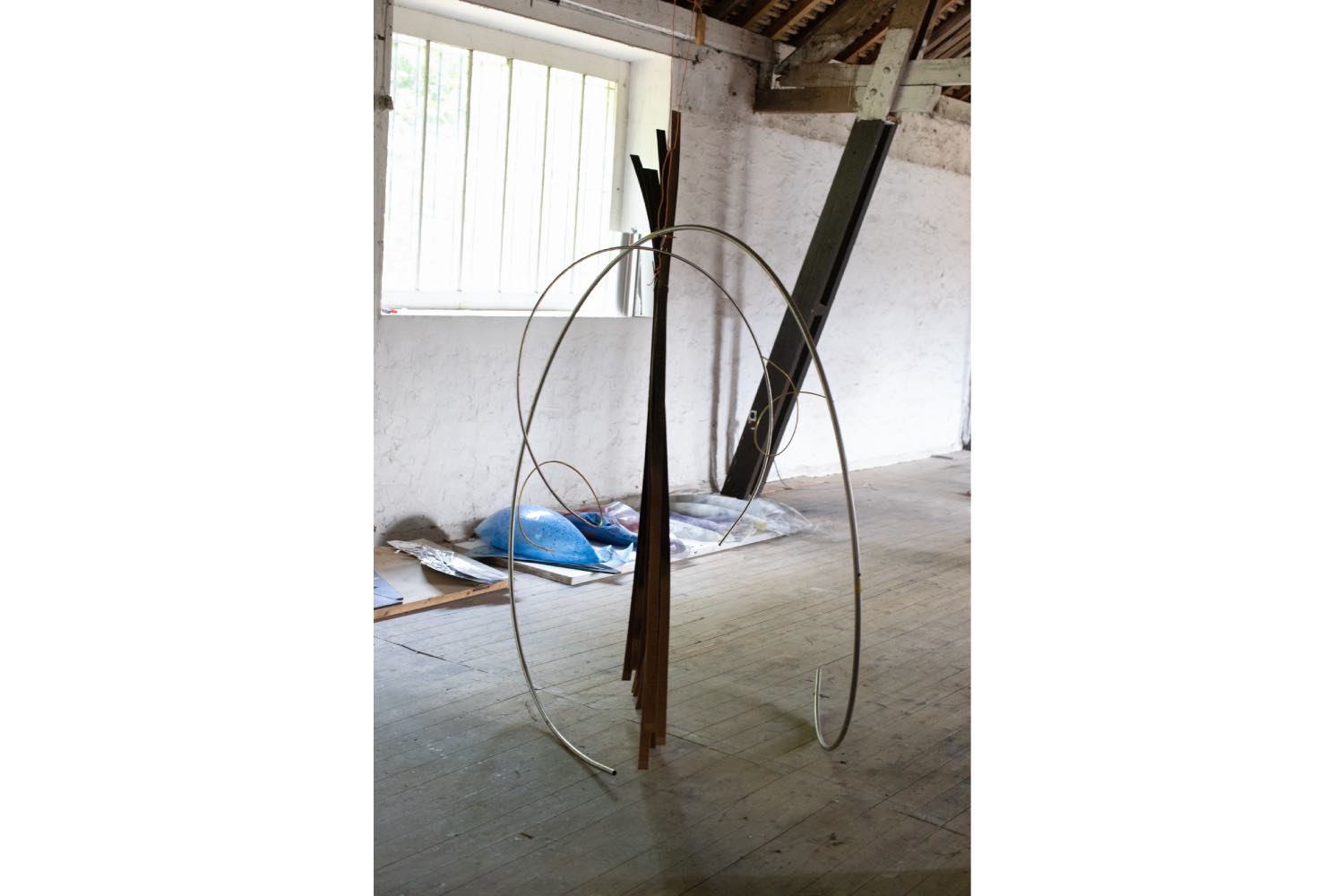
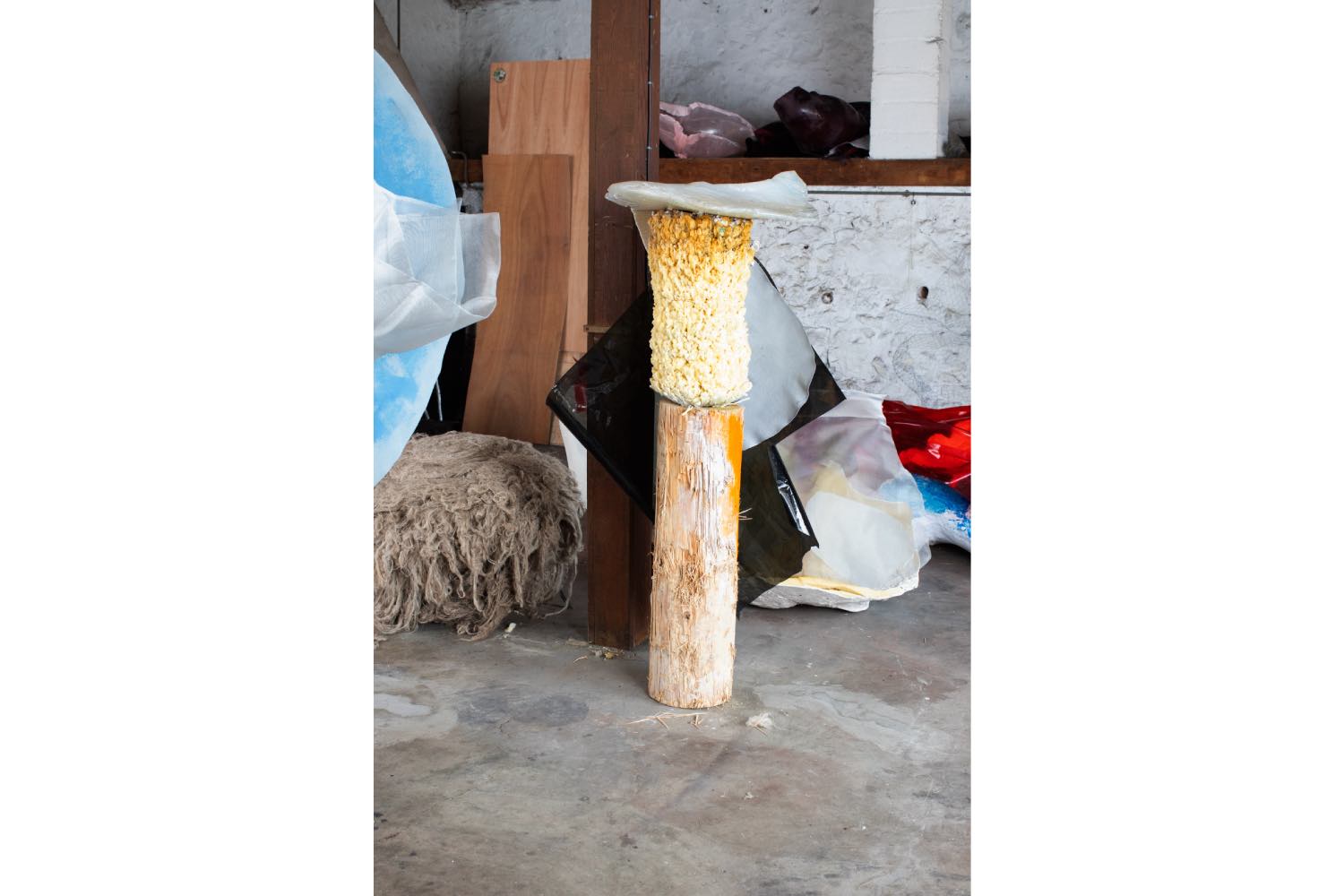
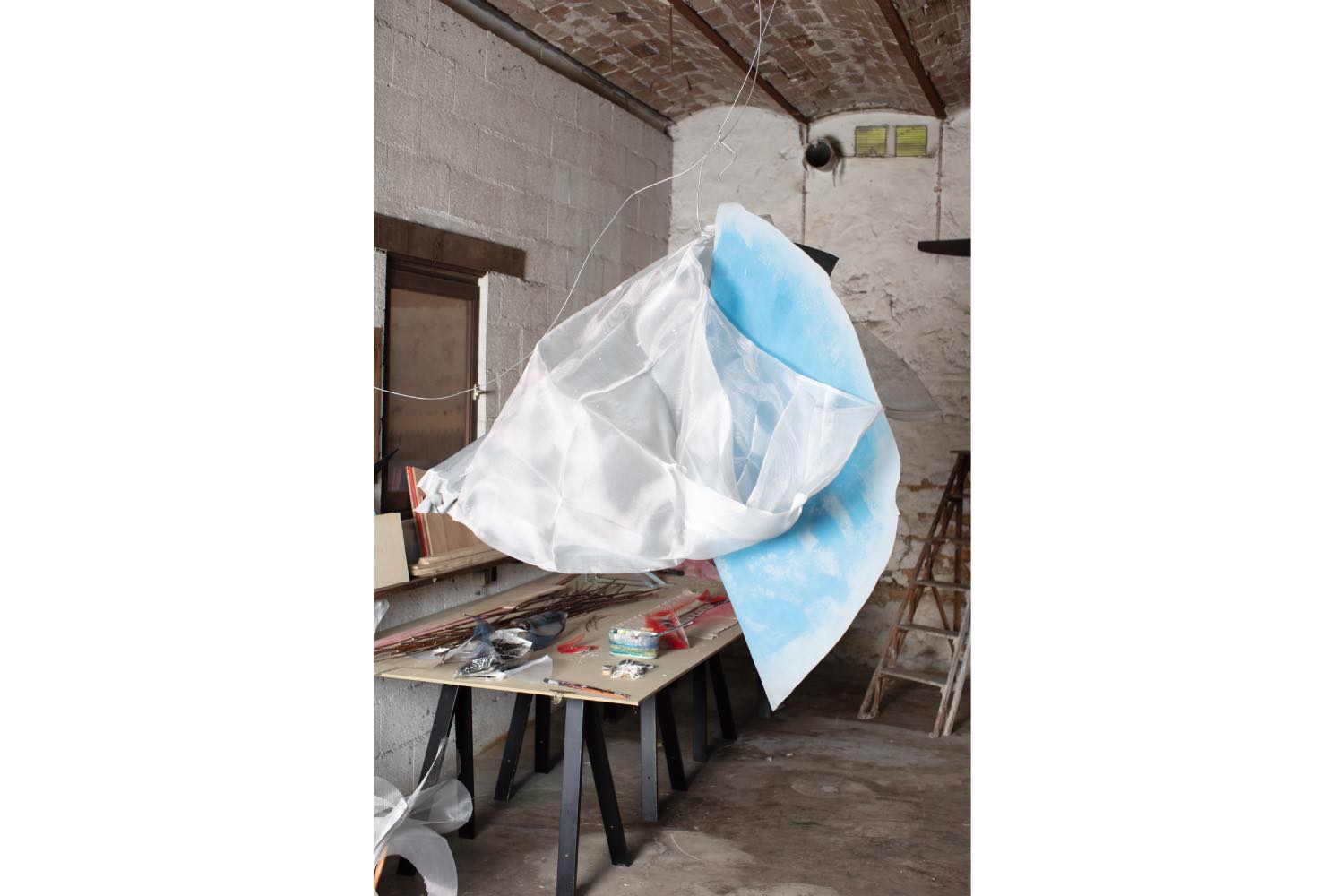
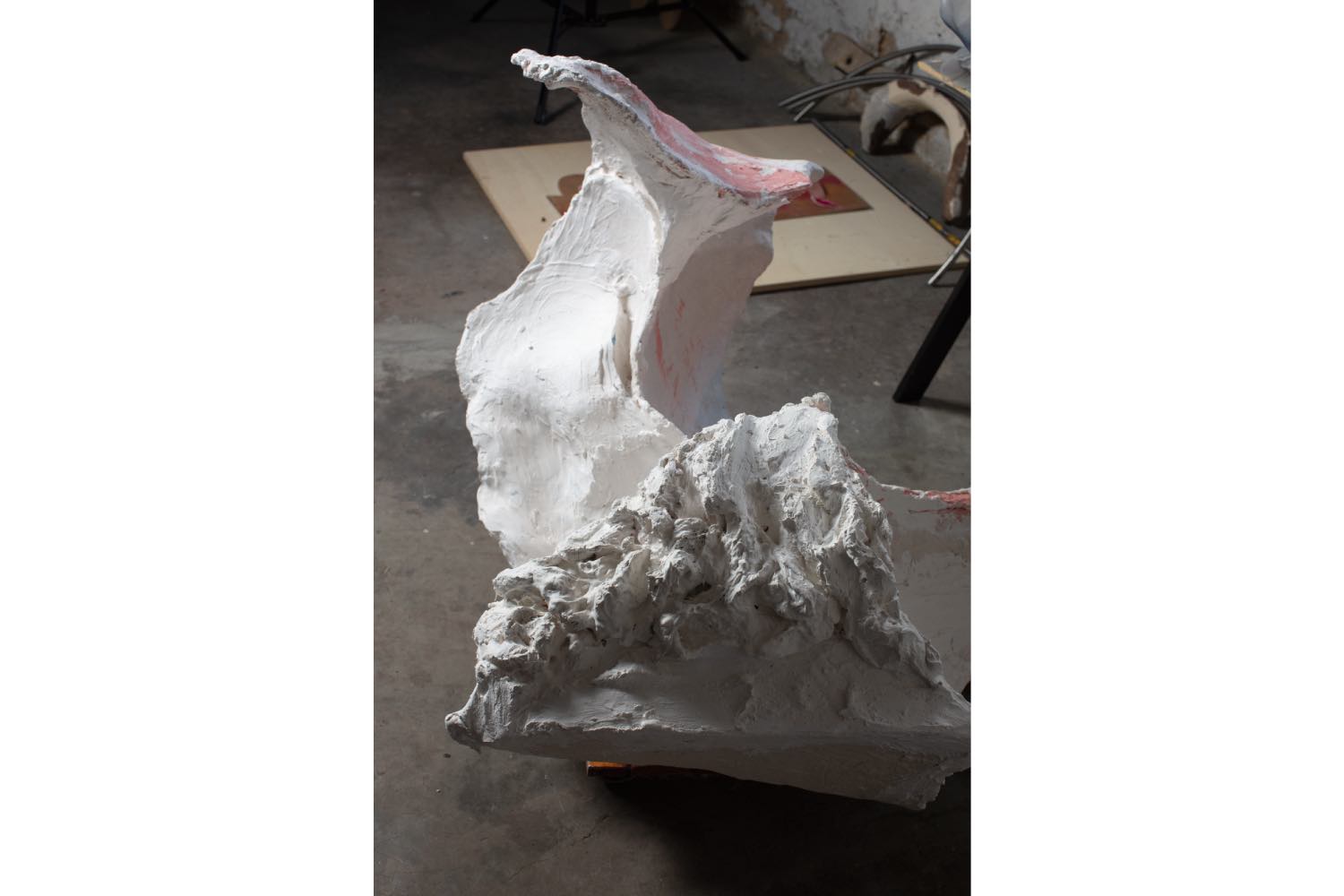
AJ: Your latest show, “Leaves,” encompassed a wide range of forms and materials, from large bent metal structures to small twig-like forms. It was scattered throughout Emalin’s space, escaping out of the gallery and into the stairwell. At moments, it almost crept into the gallery office too. The colors are mainly grays and other washed-out hues. Metal, such as aluminum sheets, mesh, and stainless steel, showed up in the work more prominently than ever before.
DG: When I use metal, I remind myself that the core of the planet is liquid iron. Materials have different tonalities that you can internalize and feel. Metal can be low and heavy, but it can also almost evaporate. It’s incredibly liquid and can be used in so many ways. I’m excited when a material opens up for me, when molecules become fog and I can go inside. It’s like exploring a new planet.
AJ: I’m interested in this image of fog. One of the works in “Leaves” also has the amazing title Fog Saw (2025), and the show was also accompanied by a chapter from Virginia Woolf’s To the Lighthouse (1927), where fog is used as a literary device. Can you say more about your interest in it?
DG: Fog is like a large membrane that you can walk inside. It’s incredible how it transforms a landscape, making everything feel like one unit. Like snow or night, it creates a sense of wholeness. When there’s fog, everything becomes possible. I don’t think in media-specific terms, like sculpture or painting. Being in the fog collapses that distance. Instead, it’s about how far you feel the resonance can take you. It’s similar to smoke. When you smoke a cigarette with someone — I am not a smoker, it’s not really my thing, but I like smoking with certain people — it seems to intensify the conversation. Through the smoke itself, you’re almost giving volume to the space that you share. There’s a lot of fog between all the shows we’re talking about, in the sense that they each helped me to grasp space differently.
AJ: The color gray feels connected to that too.
DG: It’s been so long since there was a lot of gray in my work. I link it to some memories and things I’m seeing, and it also feels like a necessity when you work with color to eventually find your way to gray. When I was in Rome recently, someone was talking about this technique, called grisaille,1 that has this interesting history and was particularly popular in the early Renaissance. It was used to depict a lot of demonic scenes during that period of painting. I think gray can be urgent. If you expose yourself so much to color, gray is almost a relief.
AJ: Like a pause.
DG: Something almost comforting, yeah.
AJ: Your interest in language continues to run through your work. Previous exhibitions have made reference to writers and poets like Ben Marcus, Rainer Maria Rilke, and Virginia Woolf. More recently, your own writing—specifically poetry—has been entering the practice too. This was the case in “Leaves,” which included a poem by you.
DG: Language is just so suspicious. I wrote that poem after I’d finished making the work, when everything was in boxes, ready to leave. I like writing, but it doesn’t substitute what materials can do. Words can be powerful, but they’re also easy to cling to. I am slowly finding my way into writing, but it’s not a ground I can walk on. There’s not a foundation for me in language.
For “Leaves,” the poem wasn’t created to explain something, but as a doorstep — something standing between you and the room where the work is waiting. It’s a threshold made of a different material. Writing is precious for finding a common way to discuss things, but it depends on the other person and how the conversation builds. I think poetry is an abstract way of talking to a group of people. I find that in one-to-one conversation, you make a poem in between two people somehow, but that’s harder in a group. I think that’s why I like doing it, because it’s still a space for my voice, but it’s also large enough for other people to enter into conversation. It’s the second show at Emalin, but there’s so much that has happened between the first and the second exhibition, so many conversations. It also brings these people and voices next to the work, and it changes the feeling of an exhibition for me. It holds everything together.
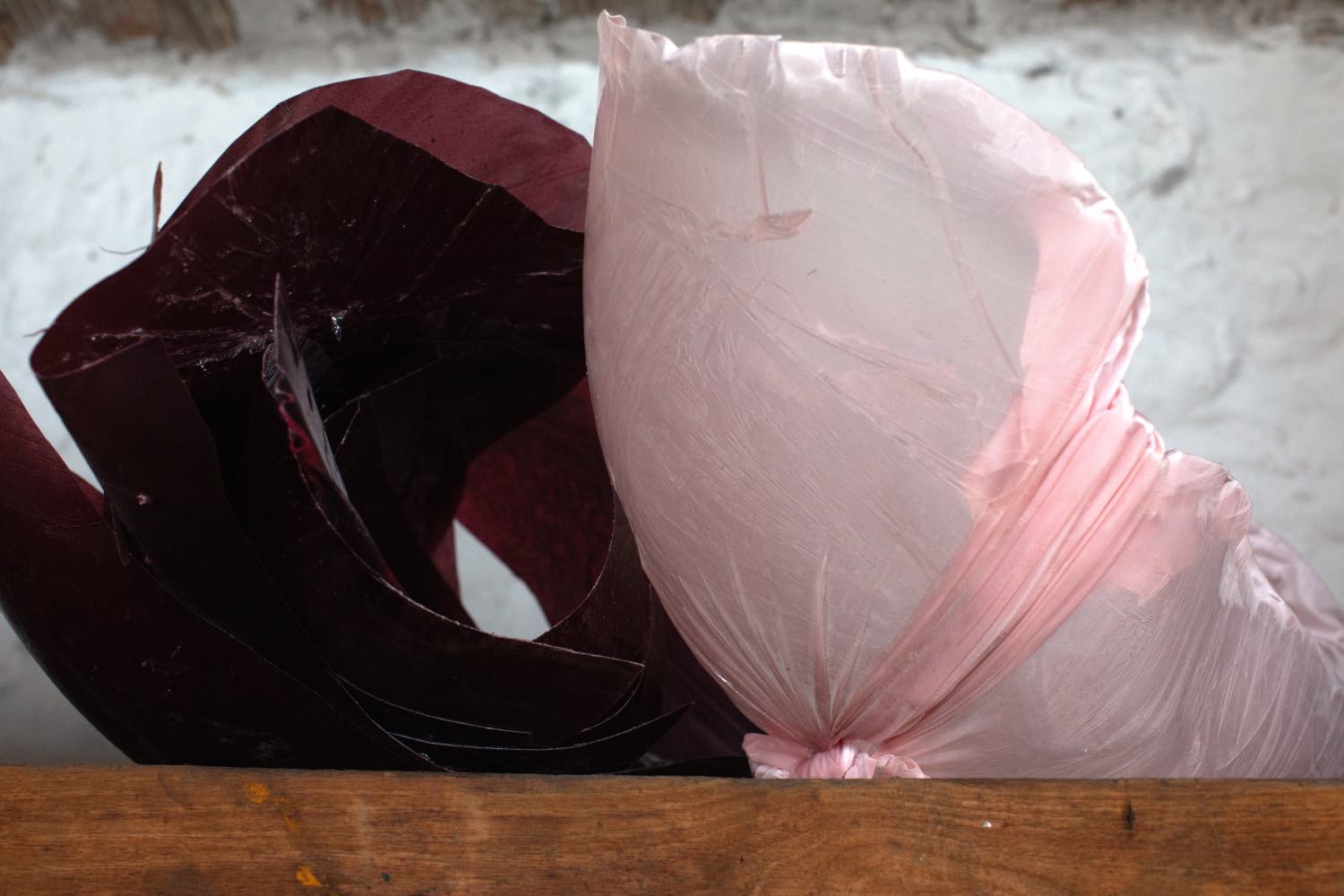
AJ: I like this idea of poetry as a way to return to something: an idea, a feeling, a conversation. This idea of return or revisiting also comes up in other parts of your process.
DG: Yes, when the work arrives back at the studio after a show and you take it out of its box, it’s like looking at yourself in the mirror. It doesn’t always feel good or easy what you find.
It confronts you each time, but I’m looking for that diversity of feeling in the work. Sometimes you see something you want to change a little, and other times you can’t take what you see at all. I’m interested in the process of going back into the work before releasing it again. I find it as interesting as making a totally new work. Perhaps there’s something that was not right, and then you learn from it, you learn why it wasn’t right, even if the work is then destroyed in the process.
AJ: In a previous interview you did for this publication in 2020, you spoke about the influence of Tony Conrad’s incredible “Yellow Movies” (1972–73). You mentioned it again in our recent conversations, too. Those works, squares of emulsion paint which Conrad articulated as endlessly “screening” films, document the passage of time through the slight yellowing of their surface. They’re subtle, but grow into these vast gestures through their sheer duration. Last time, you talked about their relationship to light, but there’s also so much there in how you understand the materials you work with over time.
DG: Yes, Tony Conrad, and the “Yellow Movies” in particular, remain significant for me. It’s film as skin. I understand that work as a growing, large, porous membrane. My practice is about how far you can become that skin, how sensitive you are. Time becomes increasingly important to how deeply you can occupy that position.
Now, I’m using many different materials, and each material has its own time. You can’t work with everything at the same pace. Some materials demand more contact, and that defines the pace. Even though I’m using metal now, it’s metal that feels like a tissue. I look at wood and see its fibers. There are constant possibilities for materials to flow in and out of each other. This gives me a sense of being able to travel through an entire feeling — from cold to smooth to warm. Materials become like instruments, helping you get somewhere. It’s a feeling of liberation, being able to travel so far within a few square meters.
AJ: It brings us back to the spiral again. How the everyday experience of light shining through a window, in Conrad’s case, transforms into something monumental over time.
DG: What can happen in a day is an existential thing. It’s not to be undervalued. When you look closely, even impressive human movements like space exploration are about small steps, teamwork, and multiple parts coming together—not just one person’s achievement. The art world is similar. We’re all working on something incredibly large, but we don’t always see that. We’re traveling in an incredible space through culture.