
There is a moment, somewhere in the middle of A Place in the Sun (2026), when the three screens seem to lose all faith in simultaneity. One image trails another by a few delayed heartbeats; a gesture returns after it has already decayed elsewhere; a figure appears twice, though no longer as the same person. Watching Genti Korini’s contribution to the Albanian Pavilion at the 61st Venice Biennale, “In Minor Keys,” feels less like a watching a film than like trying to recall a dream while still trapped inside it. The dream resists retrieval. It frays at the edges each time one reaches toward it. It loops, mutates, sheds its own skin in real time.
The film opens onto a CGI landscape that resembles the speculative emptiness of a video game environment: a fictive desert terrain of rocks and burning sand where everything feels provisional, constructible, endlessly rewritable. Across this artificial horizon appear the words: “It is not all true but it is not false either.” The sentence sounds like a cosmology: from the beginning, Korini situates the viewer inside a space where fiction, memory, projection, and history can no longer be smoothly separated.
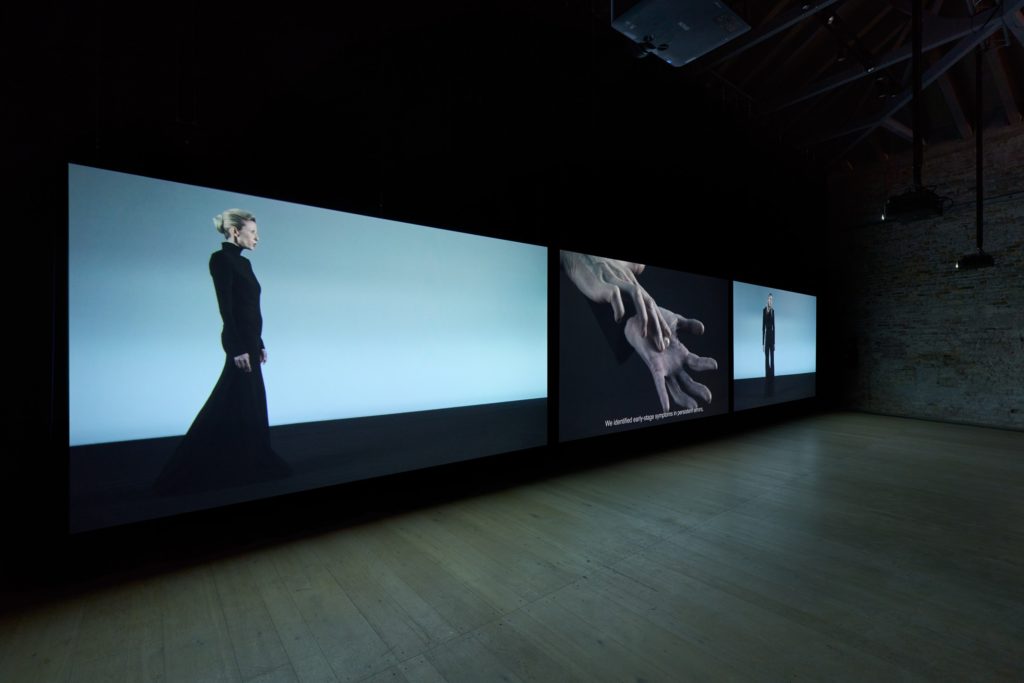
Curated by Małgorzata Ludwisiak, A Place in the Sun unfolds as a three-channel moving-image installation where live-action cinema, puppetry, synthetic landscapes, ritual choreography, and theatrical monologue circulate through one another like unstable weather systems. Nothing settles into allegory very long. Meaning appears only provisionally, like condensation on glass. The work does not ask to be interpreted so much as absorbed osmotically, endured like humidity or fever.
The pavilion opens not onto Albania exactly, but onto Albania as atmospheric condition: Albania as projection, rumor, hallucination, peripheral mirage. Korini draws from the 1916 “Albanian Issue” of Bloodless Murder, the avant-garde publication produced in Petrograd by Russian Futurists who transformed the country into an orientalist fiction onto which imperial anxieties and fantasies could be displaced. Albania existed there less as a geography than as psychic theater; a place available for invention precisely because it remained illegible from afar. Korini takes this historical absurdity and stretches it across the present tense until it becomes almost cosmological. The installation emerges as a kind of anti-ethnographic opera in which identity flickers continuously between costume and disappearance.
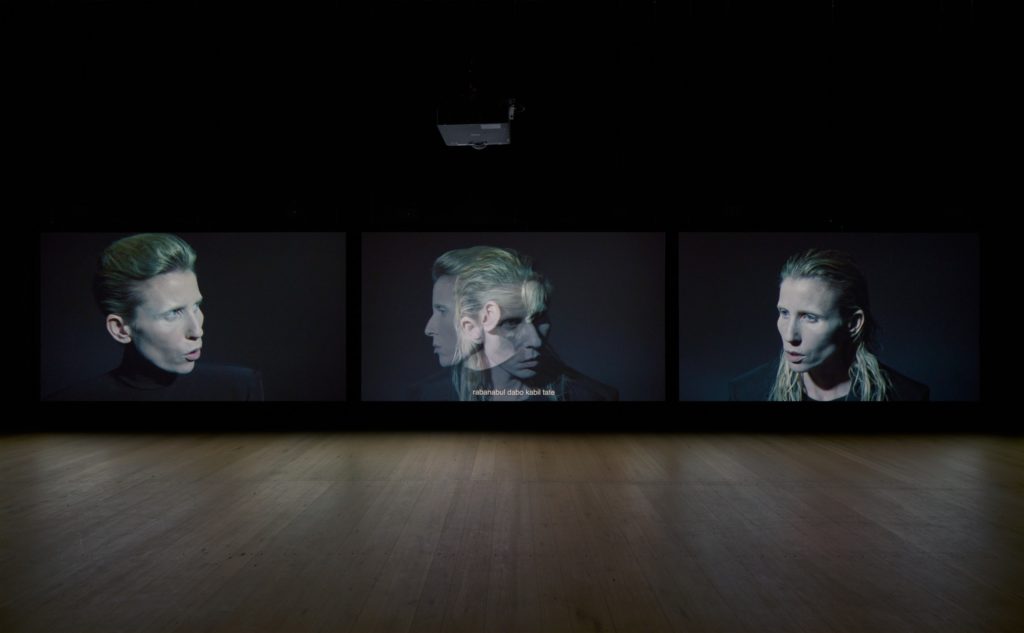
At the center of the work is a single performer; the actress appears throughout the installation under different guises, different hairstyles, different costumes, at first almost as though she were embodying two separate character. Gradually, however, the distinction dissipates. One realizes it is the same body split across multiple projections of self, mirrored into figures of indeterminate gender. She becomes less a stable protagonist than a drifting consciousness, narrating events while simultaneously entering into fragmented dialogues that slowly fold back into monologue. Her speech moves between English, Albanian, and Zaum, the experimental translational language invented by Russian Futurist poets in the early twentieth century.
Certain lines recur like fragments overheard from another dimensions: “Only so someone, somewhere, can get hold of Albania.” Then, a dialogue unfolds:
“Have you ever been there?”
“No”
“They say the place has no nouns. They speak in sounds.”
And later: “I heard time does not move forward. It waits.”
These utterances never fully stabilize into narrative information. Instead they function like linguistic residues: myths circulating without origin, rumors detached from geography. Zaum itself becomes central to the installation’s uncanny gravity. Originally conceived as a language beyond grammar and social order, capable of rupturing consciousness and reorganizing perception, here it feels spectral. Words arrive as though washed ashore after a catastrophe. Speech no longer communicates; it drifts through the installation like static from a distant transmission no one remembers sending.
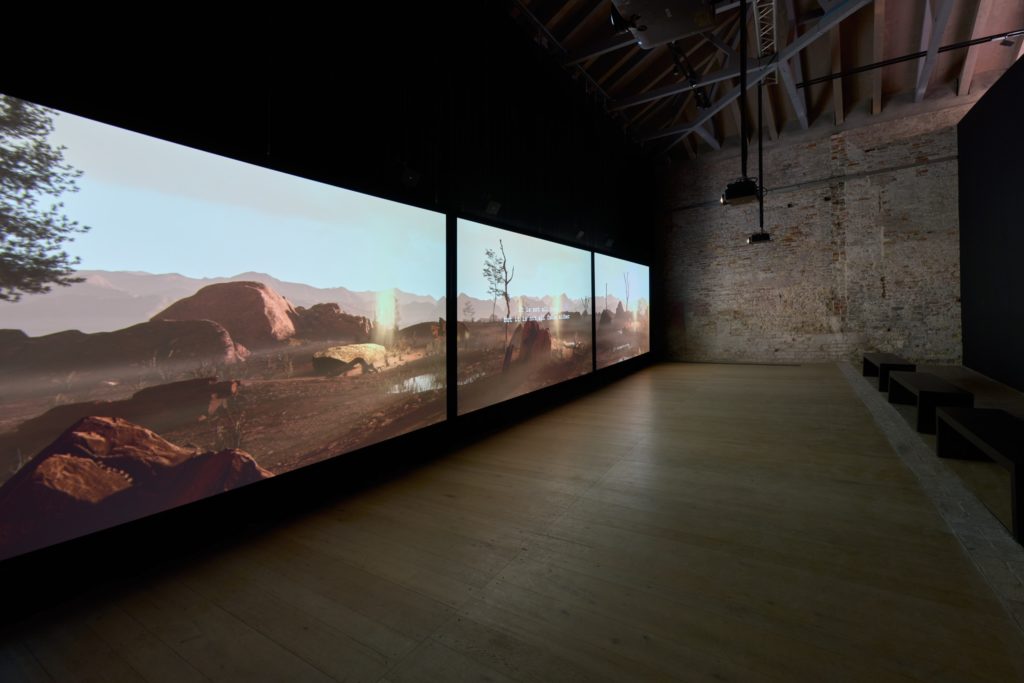
Korini intensifies this instability through the visual structure of the work. The actress’s face is frequently illuminated by speculative digital environments rendered in bruised cobalt, metallic ash, and radioactive dusk. These landscapes resemble abandoned gaming engines or unrealized futures left running after civilization has exited the frame. Yet the installation also cuts abruptly to footage shot in Albania, where performers in folkloric dress execute traditional dances with a solemnity so prolonged it begins to resemble mourning. The juxtaposition never hardens into irony. Korini refuses the comforting binary between ancestral ritual and technological future. Both appear equally estranged from themselves, equally theatrical, equally suspended in the afterlife of representation.
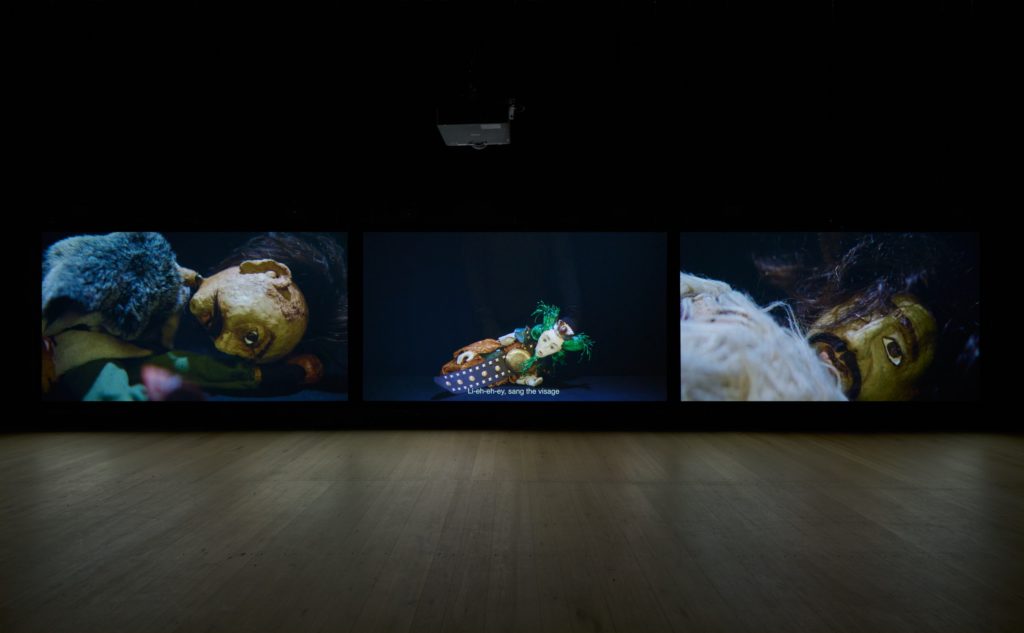
Interspersed throughout are sequences involving the marionette figure of King Yanko — a puppet apparition that introduces another unstable layer of theatricality into the installation. The puppet scenes evoke both folklore and political caricature, as though national mythology itself had become mechanized performance. Their presence complicates the work’s meditation on authorship and identity: bodies become ventriloquized, histories manipulated by invisible hands, nations reduced to portable fictions staged for external spectatorship.
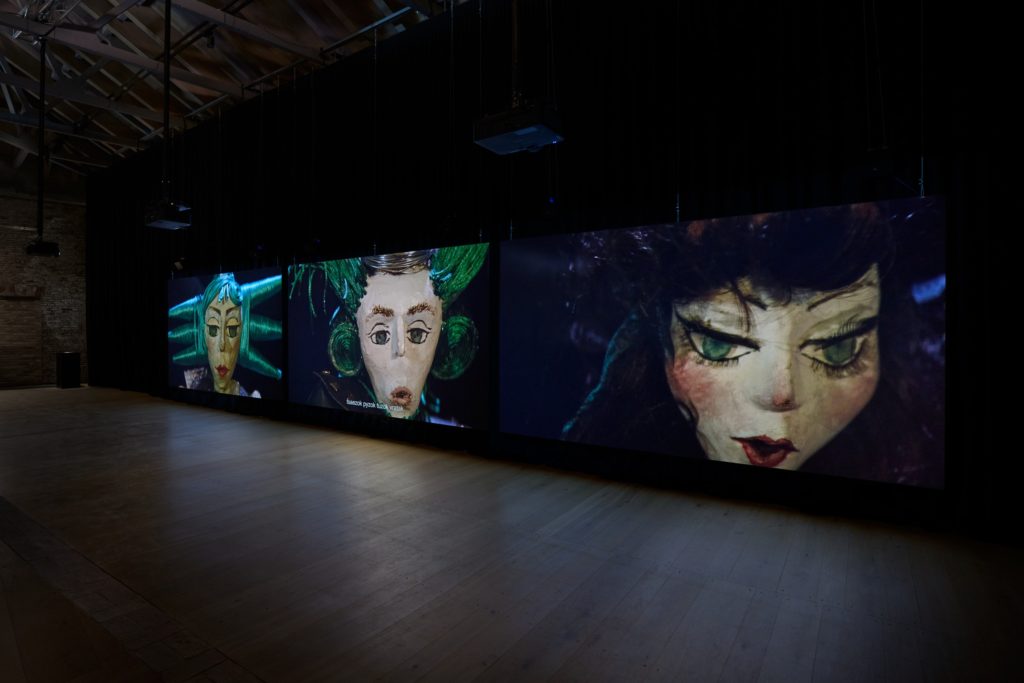
At times the three channels synchronize, producing fleeting illusions of coherence; at others they splinter violently into competing temporalities. A hand raised on one screen returns seconds later on another. A sentence echoes after the mouth that uttered it has vanished. Faces repeat with microscopic differences, as though copied too many times. Gradually one stops watching for narrative progression and begins instead to drift with the rhythms of recurrence itself. The installation behaves less like cinema than like fugue: motifs displaced, folded back, replayed in altered tonalities until repetition becomes its own form of delirium.
Looping is not merely the formal structure of A Place in the Sun but its governing metaphysics. The videos repeat, certainly, but more importantly repetition itself emerges as a historical condition from which neither image nor body can escape. Every element within the installation appears condemned to return in damaged form: the orientalist fantasy, the nationalist performance, the folkloric body staged for external consumption, the futuristic promise of modernity perpetually deferred. Korini presents culture not as inheritance but as recursive playback — history trapped in the stuttering mechanics of its own reproduction.
And yet the installation never collapses into the exhausted cynicism that so often accompanies contemporary meditations on identity and representation. Unexpectedly, almost painfully, there is tenderness here. Particularly in moments where the dancers appear suspended between choreography and fatigue, as though uncertain whether they are preserving tradition or merely reenacting its image for an absent spectator. Their movements possess the fragile beauty of gestures repeated long after their original meanings have become partially opaque. Watching them, one senses bodies carrying inherited symbols like sleepwalkers carrying candles through ruins.
Opacity becomes the work’s deepest ethic. Korini refuses explanatory closure at every turn. The installation never resolves into a stable thesis about Albania, post-socialism, Balkanization, or the violence of representation, despite brushing insistently against all these territories. Instead it accumulates densities of estrangement. Watching it, one thinks less of political cinema than of those late Tarkovskian dream-zones where symbolism itself has begun to decay under historical pressure; or avant-garde theater in which gesture survives after language has failed.
The sound design intensifies this sensation of unstable reality. Voices emerge and dissolve beneath an original score oscillating between industrial drone, liturgical vibration, and electronic distortion. At times the soundtrack appears to drag images behind it like chains; at others it behaves autonomously, indifferent to the visual field altogether. Sound leaks across channels the way memory leaks across generations. Even silence feels recursive, rehearsed, haunted by previous silences.
There is also something profoundly moving about the installation’s refusal of national legibility. National pavilions at Venice often labor beneath the burden of representational clarity: they are expected to condense an entire country into a coherent aesthetic proposition consumable within the accelerated circulation of Biennale spectatorship. Korini seems to sabotage this demand from within. His Albania remains stubbornly unstable — neither documentary nor symbolic, neither fully historical nor entirely fictional. It exists instead as a trembling field of projections, overcooked by foreign fantasies and internal mythologies alike. If the pavilion communicates anything “about” Albania, it is precisely the impossibility of stabilizing the image of a place perpetually imagined by others.
Still, A Place in the Sun never mistakes opacity for emptiness. Beneath its fractured surfaces runs a current of profound emotional intelligibility. The repeated doubling of the central figure, the cyclical editing structure, the slippages between voice and incomprehension all produce an atmosphere of historical loneliness so pervasive it begins to feel geological. The installation imagines what it means to inhabit a place continually narrated from elsewhere, perpetually translated into external vocabularies. Zaum, in this context, becomes more than avant-garde experiment. It becomes an exhausted form of resistance. If language itself has already been occupied, perhaps nonsense remains the final territory not yet fully colonized.
Even the title arrives carrying its own irony like concealed shrapnel. A Place in the Sun evokes visibility, arrival, geopolitical ascension — the fantasy of finally occupying the illuminated center rather than the obscure margins. But Korini’s sun is sterile and overexposed. Nothing grows beneath its light. Illumination here does not clarify but erase, bleaching the world into mirage.
Leaving the pavilion, one retains fragments rather than whole scenes and, above all, remembers the emanation of temporal dislocation; the eerie certainty that the work had already begun long before one entered and would continue indefinitely after one left.
In the end, the loop reveals itself not simply as aesthetic strategy but existential condition. History does not conclude. Images do not disappear. They return endlessly, slightly corrupted, carrying inside them the unresolved fantasies of those who first projected them into the world. A Place in the Sun ultimately offers no escape from repetition. It seals the viewer inside it, until repetition itself begins to resemble the last surviving form of language.