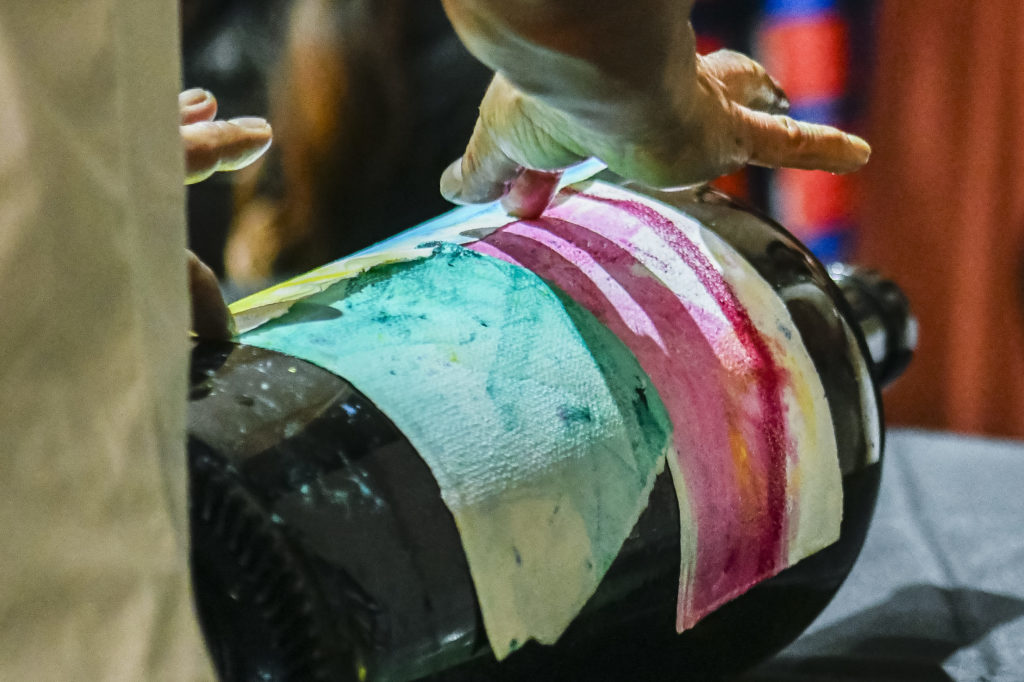
Gea Politi: Your Art Basel performance involved transforming four improvised drawings into a single wine label through tearing and reassembly. How do you approach decision-making during the moment of recomposition, and what do you hope the final image will reveal about improvisation as authorship?
Abraham Cruzvillegas: Even when materials and strategy were designed earlier, I always like to respond to accidents, contradictions, and mistakes during improvisation. Unexpected findings and random encounters can become as important as everything else. I make decisions accordingly when unexpected sensations arise while creating an artwork. In this case, there was an element I didn’t consider that remains only in the very moment of the performance but is definitely an important part of the piece: the sound made while dealing with a gigantic twelve-litre wine bottle, which I was using as a tool.
GP: Terra Mista blends Italian varietals with Napa terroir and will carry your image as its label. How do you see the wine’s “metaphorical mini rebellion” — its hybrid grape mix and adaptability — resonating with your concept of autoconstrucción and cultural assemblage?
AC: Rebellion takes shape not only in improvised gestures but also while materials take on a voice in response to my actions. Paper, colors, water, and even myself rebel against expectations, accepting failure as part of success. There is no metaphor here, just facts.
GP: The performance uses tinted charcoal and water-soaked sponges to create watercolor-like effects before collage. How did you select these materials and techniques for a durational public activation at Art Basel, and what sensory or material qualities were you aiming to evoke?
AC: I used four tinted charcoal bars — blue, yellow, pink, and green — to allegorically evoke the different cultural contexts of each grape, each with its own environment and context, but all now shifted to what we call California.
GP This project follows your Two Untitled Maps installation at the Louis M. Martini Winery. In what ways did that site-specific work inform your approach to producing a portable, reproducible image for a wine label and for a global audience at Art Basel?
AC: The work at the Martini tasting room in Napa allowed me to learn about winemaking, including the labor in the vineyards, which involves people with very particular backgrounds and environments. Insects, birds, gophers, and other plants are also part of that process, which culminates when the liquid enters our bodies, transforming us alchemically and connecting us with nature, culture, landscape, and other people in different ways. The artwork made for the label carries all this learning in a way that does not illustrate anything but provides evidence of my own transformation in that very moment.
GP: Your practice often repurposes found materials and foregrounds local histories. How did collaboration with a commercial winery and the constraints of label design influence your process and considerations about circulation, objecthood, and audience?
AC: I have created similar works for tequila and beer brands, each of which is completely different, starting with the proper questions about the precise context of each product — not only economically or socially but also in terms of manufacture, traditions, history, and nature, thinking about agave, hops, grapes, substrata, soil, earth, sunlight, water, and hands. Then there’s someone sipping something all around the globe.
GP: Terra Mista’s concept responds to changing climate conditions in Napa. Does the project prompt you to think differently about ecological narratives, migration, or adaptability in your art, and if so, how will those ideas appear in the final label or in the broader collaboration?
AC: I’ve been interested in how to engage in conversation with specialists about the environment in context. I’m constantly learning from biologists, historians, lawyers, botanists, and others to find ways to include those dialogues and the critical apparatus that each field provides. Without making any literal representations, people on the move, plants, animals, and myself are at the heart of my long-term, transdisciplinary (and mostly indisciplinary) research. This research aims to be an educational device, in which the one who learns is me.