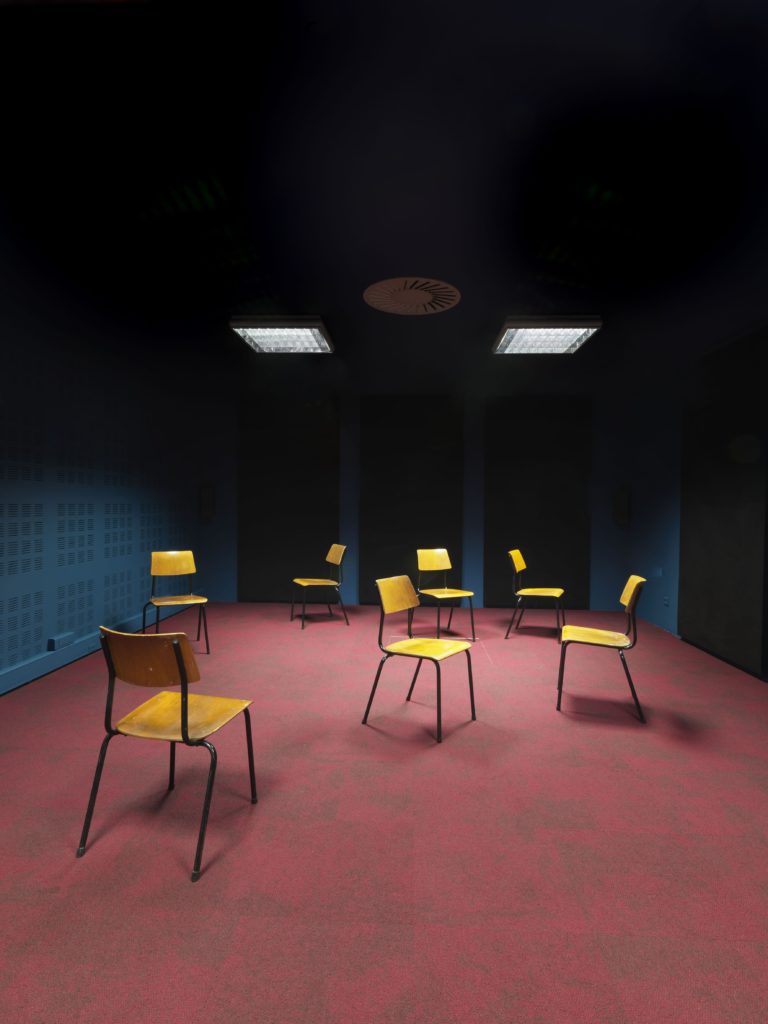
This September, Centre Pompidou will close for five years, beginning an extensive renovation process that includes asbestos removal and essential structural maintenance. The iconic Parisian institution, designed by Renzo Piano, Gianfranco Franchini, and Richard Rogers in the early 1970s, was conceived during a moment of high-tech optimism and radical architectural innovation. Among the many departments relocating temporarily is the Bibliothèque publique d’information (Bpi), the expansive public library that once animated the Pompidou’s second floor, hosting thousands of visitors daily. Before the library is completely cleared, Wolfgang Tillmans has been invited to stage an intervention titled “Rien ne nous y préparait – Tout nous y préparait” (Nothing could have prepared us – Everything prepared us).
The Pompidou was born in a moment of radical architectural and political reimagination. Post-1968 Paris required not just new spaces but new models: transparency, flexibility, and public access were not simply aesthetic decisions but ideological imperatives. The building’s exoskeletal structure and its exposed infrastructure became shorthand for institutional openness. But that openness, like the building itself, has aged unevenly. In today’s climate — marked by mounting threats to cultural institutions across Europe, emboldened far-right governance, and a palpable suspicion of public intellectual life — it feels necessary to ask: What, precisely, will the Pompidou reopen into?
This question isn’t just theoretical; it reverberates throughout Tillmans’s exhibition. His intervention, set amid the emptied spaces of the library, reflects a deep sensitivity to the building’s ideological legacy and its uncertain future. The rooms, now vacated, seem to echo with both possibility and foreboding, mirroring the political and cultural forces that have shaped Tillmans’s own life and work.
The exhibition spans nearly four decades of Tillmans’s work but resists chronological order, instead organizing images and installations into apparent thematic clusters. Among the first works that drew me in was The State We’re In, A (2015), an unframed inkjet print capturing a stark stretch of the Atlantic Ocean from a pier in Porto, Portugal. Taken with a high-resolution digital camera, the image reveals the water’s detailed surface textures — the restless undulations and brooding, muted colors evoke a palpable sense of tension. This piece belongs to Tillmans’s “Neue Welt (New World)” series, which seeks to cultivate empathy and attentiveness to the world’s complexity rather than impose definitive narratives. For this project, Tillmans traveled widely, revisiting familiar sites and discovering new ones, using digital technology to capture a dense, stratified experience of contemporary reality.
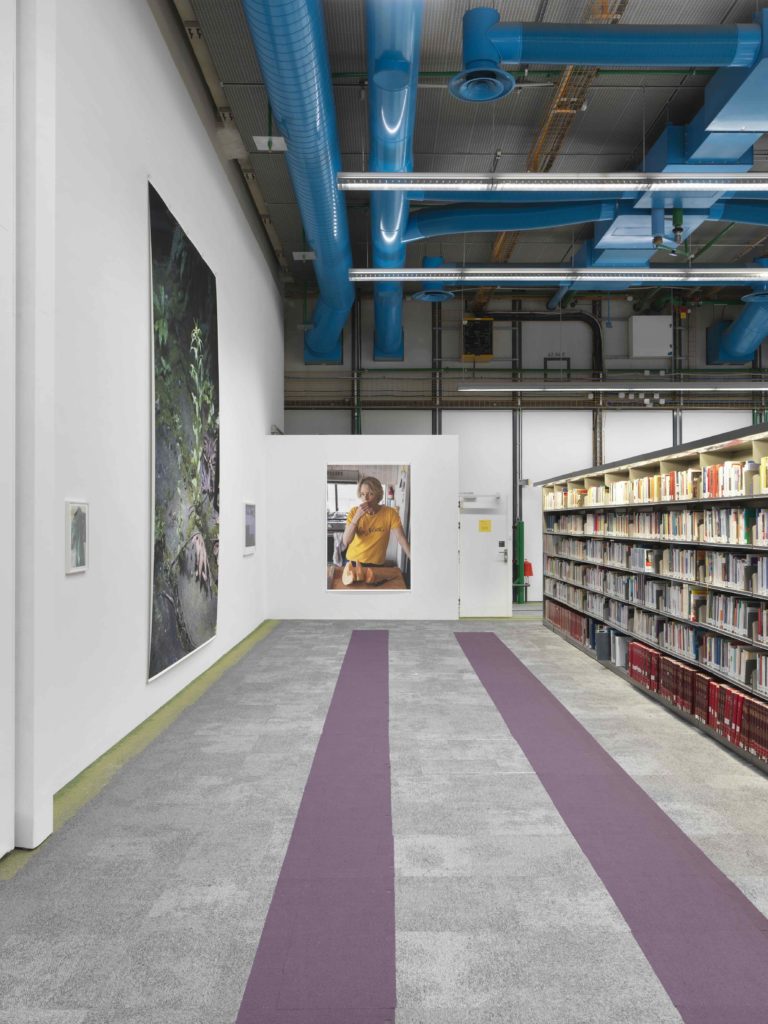
The exhibition’s dense layering of historical, political, and personal contexts can feel overwhelming. However, the careful and detailed manner in which Tillmans engages with the library space itself requires particular attention. His installation Library shelves with an unusual amount of space around them (2023/2025) exemplifies this. Many original architectural and furniture elements remain in place throughout the exhibition, most notably entire bookshelves. Yet these shelves do not simply reproduce the library’s collection — they condense and isolate parts of the classification system, highlighting the constructed nature of such categorizations. The Bpi follows the Dewey Decimal Classification system, which categorizes knowledge into ten broad fields, each further divided. Though seemingly neutral, this taxonomy has been widely critiqued for embedding colonial and Eurocentric biases within its organization of knowledge.[1] By isolating these shelves, and keeping the original library signage intact, Tillmans seems to point toward the limitations and exclusions inherent in such systems. The twelve thousand volumes included in this installation are part of a recent deselection process, in which many older physical encyclopedias and reference books were removed to make way for newer formats and digital media. This curation raises urgent questions about institutional memory, knowledge obsolescence, and the evolving role of physical libraries in a digital age. Subtle reminders of the library’s former life remain everywhere — patterns of purple carpet mark where shelves once stood. And there are carpet stains in abundance. Libraries are messy bodily places. Through this, Tillmans transforms the space into a self-reflexive image of itself.

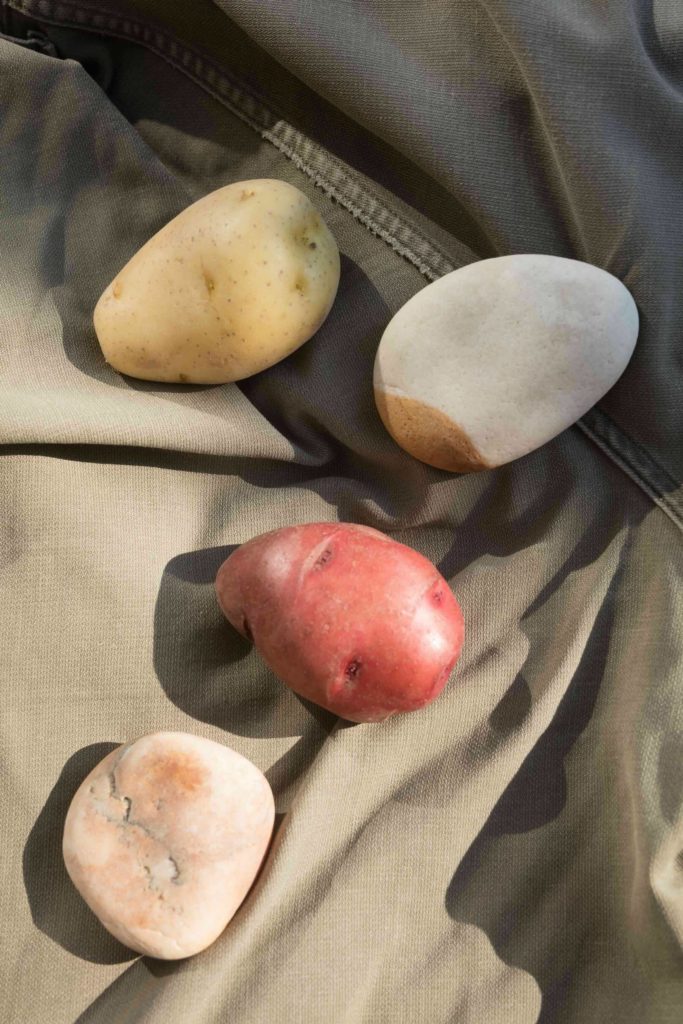
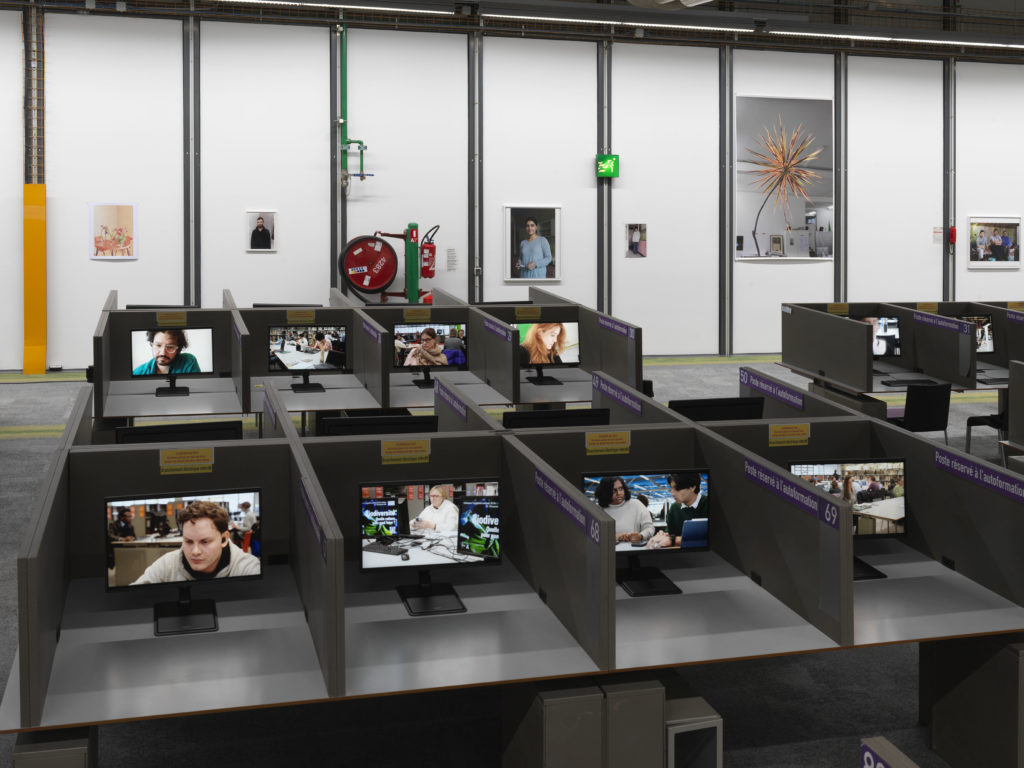
Tillmans’s impact on contemporary photography is well known for his distinctive wall arrangements — constellations of images that create dynamic visual dialogues. Equally significant in his practice is the use of horizontal surfaces to present images and printed materials. In this exhibition, he repurposes original library tables, transforming them into shallow vitrines. These tables showcase a diverse array of works, ranging from intricate collages and graphic designs to archival newspapers and influential books. Pieces such as Roses de Nîmes (2025) are displayed alongside editorial documentation and bibliographic materials, while one mirrored tabletop cleverly captures and reflects the Pompidou’s distinctive ceiling, a work which totally disorientates in a cubist fashion. I needed to take a break after viewing this work.
“Rien ne nous y préparait – Tout nous y préparait” gathers a dense constellation of contexts, histories, and meanings that echo through the emptied halls of the Pompidou. This multiplicity invites deep reflection, but it can also leave viewers grasping — the emotional and intellectual intensity of the show occasionally dissipates in its breadth. A more focused engagement with the library’s physical and symbolic presence might have more sharply evoked the precariousness of institutional change. Still, through architectural remnants, discarded volumes, and the fading imprints of communal life, Tillmans composes something close to an elegy — not for a building, but for a certain model of public knowledge. In the spirit of Walter Benjamin’s dialectical image,[2] where fragments both conceal and reveal the past, the exhibition’s overwhelming scope mirrors the very difficulty of holding onto meaning in a time of dissolution. As the Pompidou enters a prolonged dormancy, Tillmans offers not a resolution but a reckoning — a meditation on loss, yes, but also on the fragile architectures that make cultural memory possible.”
[1] Sanford Berman, Prejudices and Antipathies: A Tract on the LC Subject Heads Concerning People (Metuchen, NJ: Scarecrow Press, 1971). Berman critiques library classification systems like Dewey Decimal and Library of Congress for perpetuating Eurocentric biases and marginalizing non-Western knowledge systems.
[2] Walter Benjamin, “Theses on the Philosophy of History” (1968), in Illuminations: Essays and Reflections, edited by Hannah Arendt, translated by Harry Zohn (New York: Schocken Books, 1969), 253–64.