Writing about Trisha Donnelly’s work feels like a betrayal — or, at the very least, a contradiction in terms. Her more-than-twenty-year-long career has been marked by a reluctance to trust language as a proper tool to mediate, describe, or document her exhibitions, let alone her practice. Over the years, her proverbial reticence toward words has resulted in major exhibitions entirely without captions, accompanied by equally sparse press releases, often resulting in reviews that resorted to dry, formal descriptions, thinly disguising a certain degree of frustration. Despite a gradual softening of her personal policy toward language (the most recent press release runs a remarkable five lines), her current solo show at the TOWER of the MMK (Museum für Moderne Kunst) in Frankfurt continues in the same spirit.
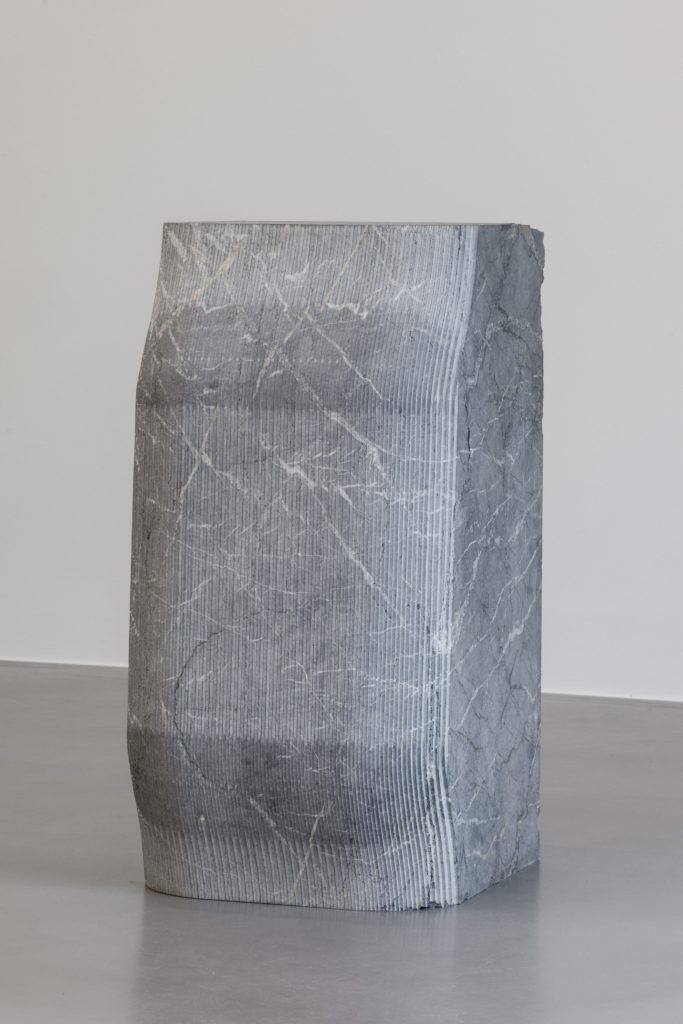
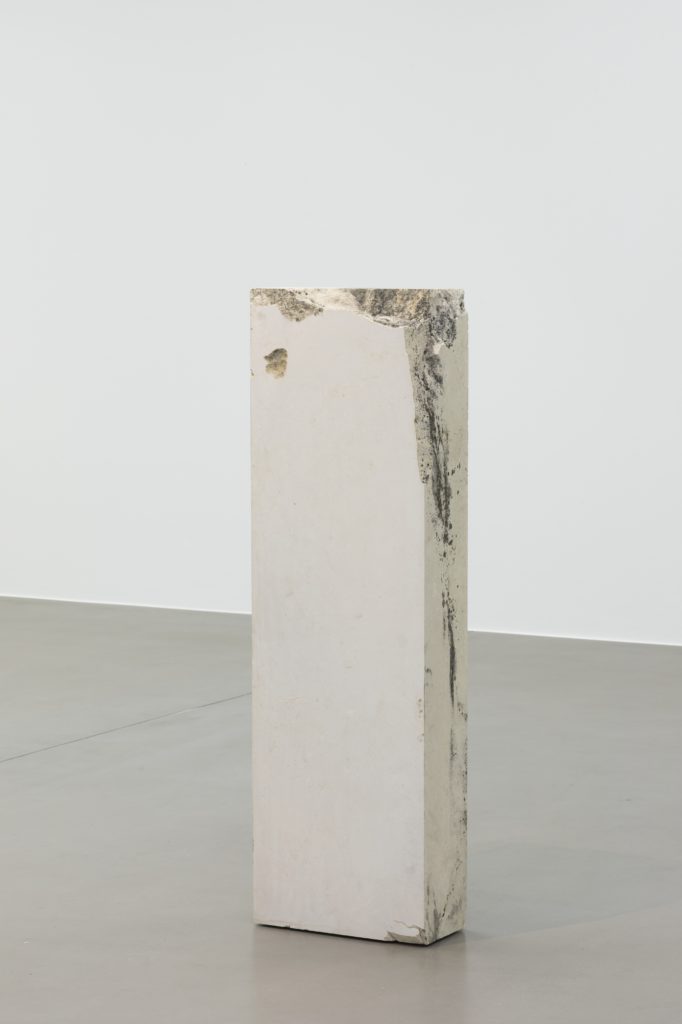
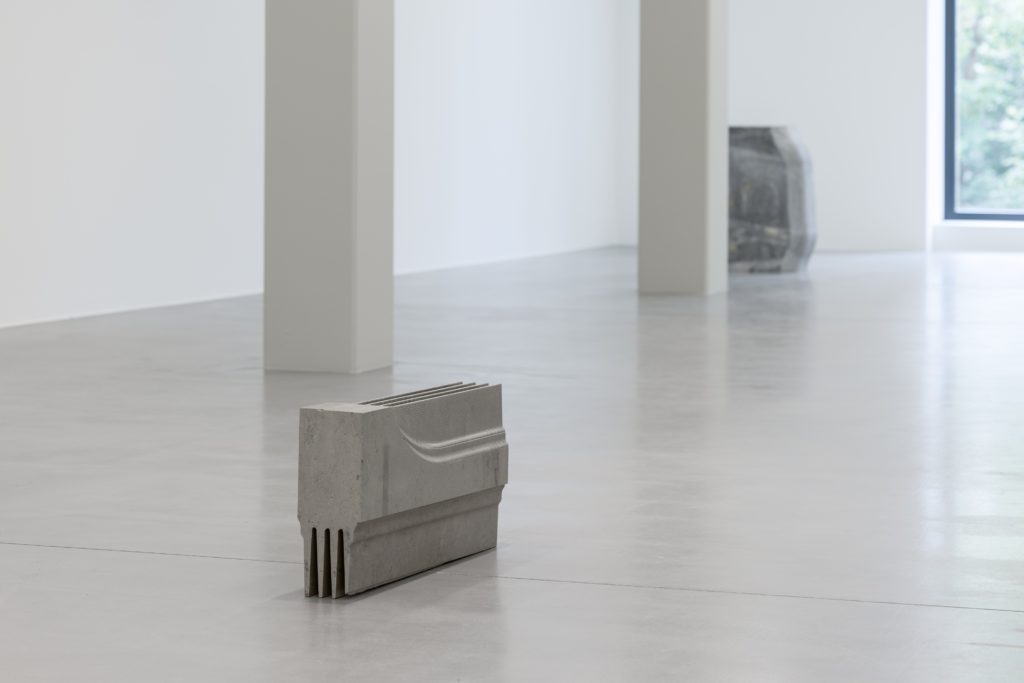
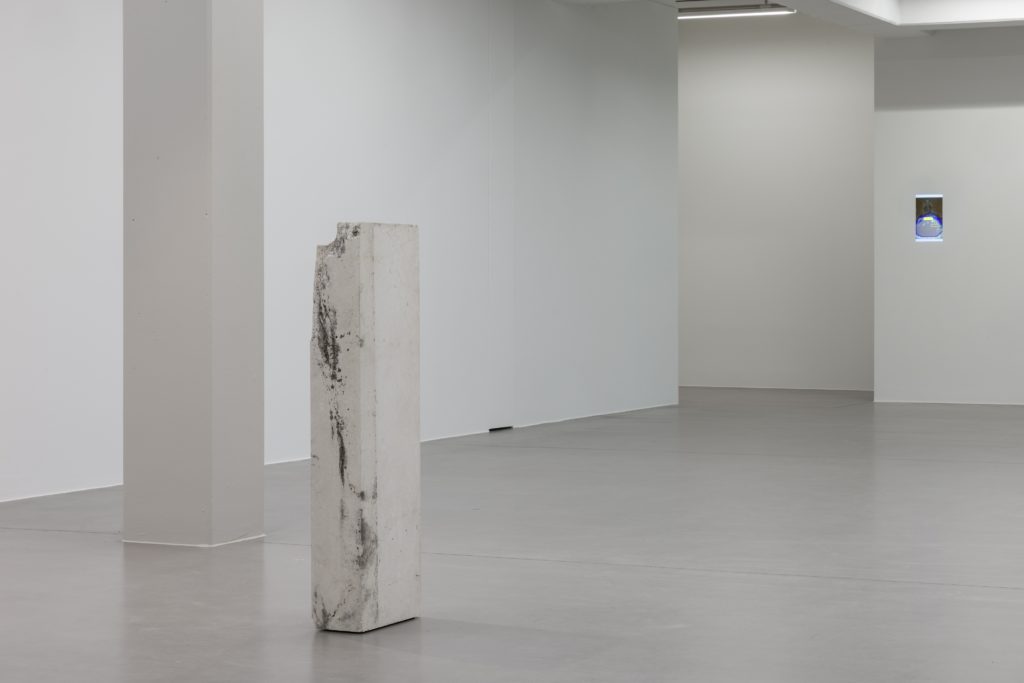
The predictably untitled exhibition comprises a series of marble pieces from past years, orchestrated across the two-thousand-square-meter space. The sculptures are punctuated by a smaller number of wall works: a silkscreen, a C-print, an embroidery, a still projection, a tiny video. Were it not for these interventions, which unequivocally locate the works within a contemporary era, the show might feel like the remnants of an unknown civilization. The colors and veining of the stones reveal processes sedimented across deep time. The shapes of the artifacts bear witness to human intervention, yet no information remains as to how they were made or what function they might serve. Unlike archaeological ruins, the works are organized throughout the space with methodical meticulousness, triggering the eerie sensation that everything must be exactly where it is for a reason. At the ideal center of the exhibition stands The Secretary (2008), a 1950s wooden desk that serves as an oddly mundane, gravitational hub in a galaxy of timeless- looking objects.
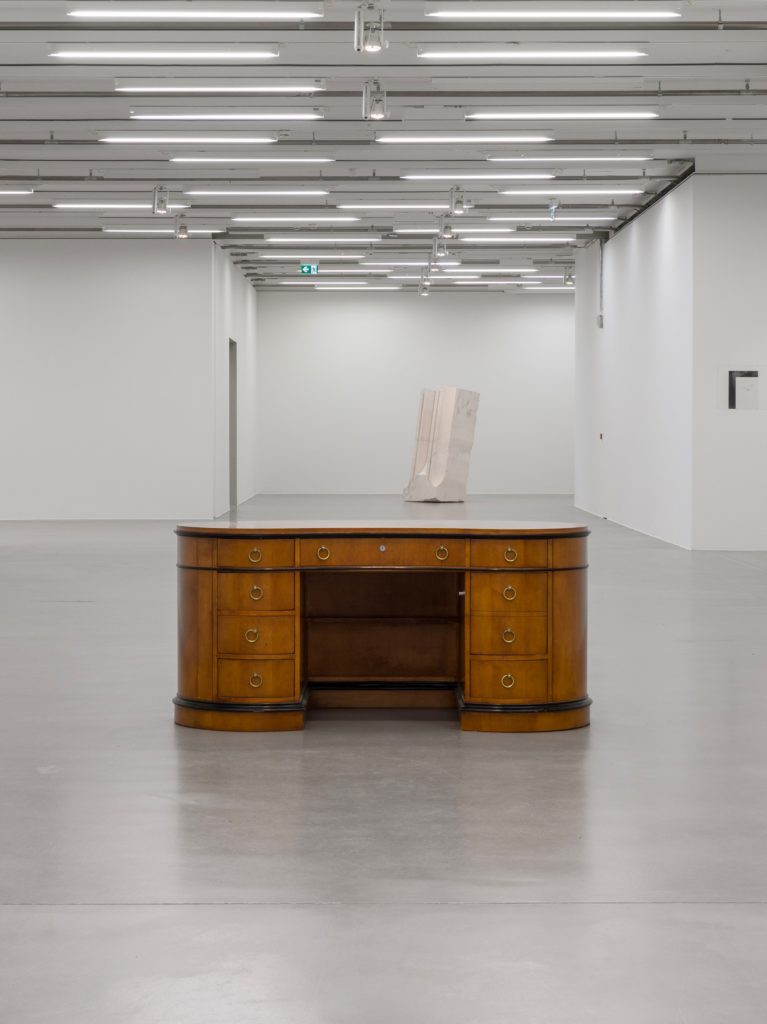
One of the few works to be granted a title, The Secretary arrests the gaze because of its privileged position and its singular, human-scaled status. Mysteriously standing in the middle of the space, it is the true MacGuffin of the show. When asked about the piece some years ago, Donnelly mentioned her fascination with the 1980s Italian TV show Pronto, Raffaella?, in which the iconic Raffaella Carrà sat at a desk with an old rotary phone, answering questions from a live audience. It is tempting to read the piece as a mischievous way for Donnelly to state: If you have any questions, please refer to The Secretary — and then leave us alone with no clues, no answers, and no phones to be picked up.
Raffaella-less and guide-less, the experience of the exhibition rests on the unsettling — yet somewhat relieving — understanding that the laws governing a museum visit must be renegotiated. A lack of information calls for an exercise in perception, encouraging a heightened, sensorial attention closer to experiencing a natural phenomenon than to that of an artwork. The intensity of the encounter is increased by the sublimesque confrontation of humble human bodies with entities often shaped by millions of years of geological processes. It is no surprise that language proves inadequate in the face of such an experience, which seems to manifest a deeper cosmic movement we have been serendipitously propelled into.
It feels apt that, in the exhibition leaflet, captions were replaced by excerpts from The Prelude (1850) by William Wordsworth, in which the Romantic poet recounts his inner growth through the experience of nature. The poem appears as a tentative epistemological tool: where critical language fails, perhaps poetry might succeed. Interestingly, Wordsworth does not address an audience; he speaks directly to nature. He calls upon the “beings of the hills,” and the “cliffs and islands of Winander,” thanking them for introducing him to “high objects” and “eternal things” rather than the “mean and vulgar works of man.” It is at this point in the visit that one might reasonably begin to doubt whether they have stumbled upon a conversation that was never intended for us in the first place.
In a recent recorded appearance, Donnelly speaks about photography to a group of students. In a moment of linguistic impasse, she decides to read aloud an excerpt from the 1899 novel The Tower of Love by Rachilde. The scene is set in a lighthouse where an old, heavy-drinking guardian confronts a zealous younger man who has just joined him on the job. After their first silent dinner together, the younger man examines barometers and maps, parading the scientific terms he knows. In response, the older man walks to the lighthouse door, opens it, and vomits profusely. He then spreads his right hand into the air, allowing the sea spray to soak it completely, before proceeding to lick it carefully, to the younger man’s horror. Only later will the younger figure understand that this was the old guardian’s method for gauging an incoming storm. The moral of the story is that, even within the limited physical possibilities of our bodies, there are certain — sometimes brutal — ways in which we can temporarily become conductors of a broader form of consciousness. According to Donnelly, this is true of photography: a moment that allows the past and the future to end up compressed together on the negative. The same may be true of an exhibition, where — much like Wordsworth with nature or Raffaella Carrà through the telephone network — we witness a condensed manifestation of the enormity of things, briefly feeling as though we might access it all. Yet, in this epiphanic event, humans are nothing more than an accident, a collateral effect of a deeper, transcendental movement passing through our bodies. We may embrace it or resist it, but barometers, maps, and words will hardly recreate the experience either way — I guess you really had to be there.