There is, at the heart of Clémentine Bruno’s practice, a question that refuses simplicity: How does one make space for presence through absence? Clarice Lispector once wrote that, “To see is to become aware of the absence that surrounds everything.”1 Never stated as a thesis yet persistently enacted through material decisions and gestures, it is a question that does not seek resolution but insists on being rehearsed and returned to — much like the surfaces Bruno produces, where nothing appears without first being withheld.
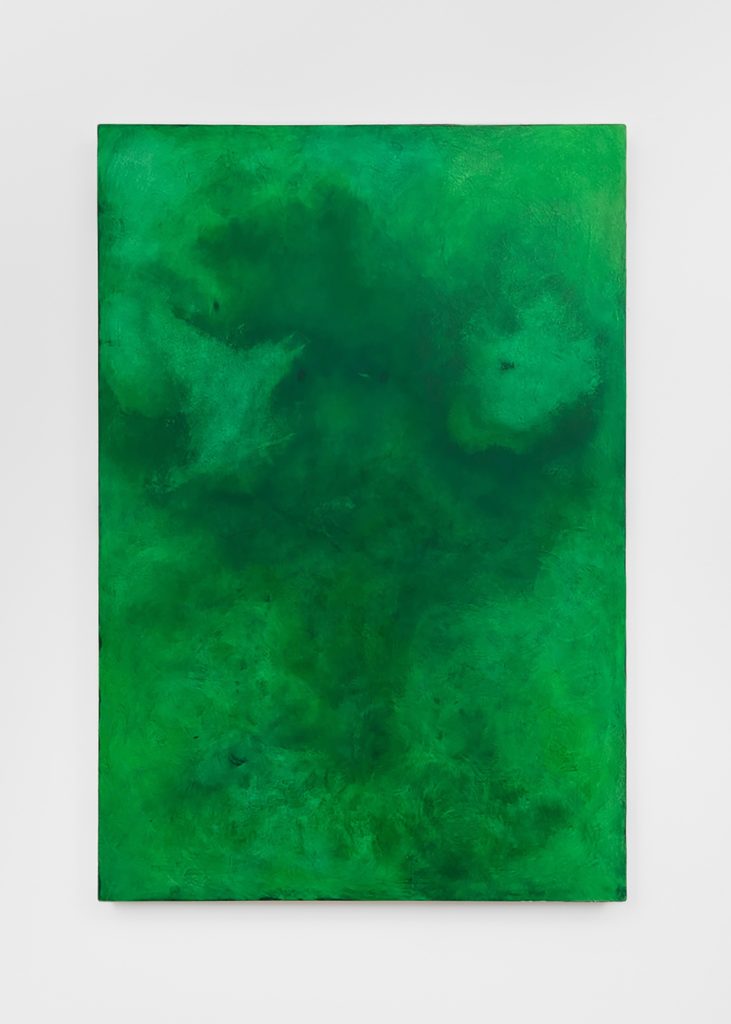
Painting, in her work, begins before the image and often remains there. Not as a nostalgic return to origins, but as a deliberate suspension. The preparatory moment — the laying of the ground, the cogitation of the support, the repetitive gestures that historically precede representation — does not vanish once the painting “begins.” Instead, it becomes the site of the work. The image, when it does, emerges belatedly, almost reluctantly, as something already receding. What is offered to the viewer is not the image itself but the condition of its having been possible.
The insistence on what comes before — and what remains after — produces a form of displacement that runs through Bruno’s entire practice. The image is never allowed to occupy the center comfortably. It is shifted downward, backward, or sideways — embedded, sanded, veiled, partially erased. Painting becomes less an act of presentation than one of relocation. Meaning is not abolished but postponed. Presence is not denied but redistributed.
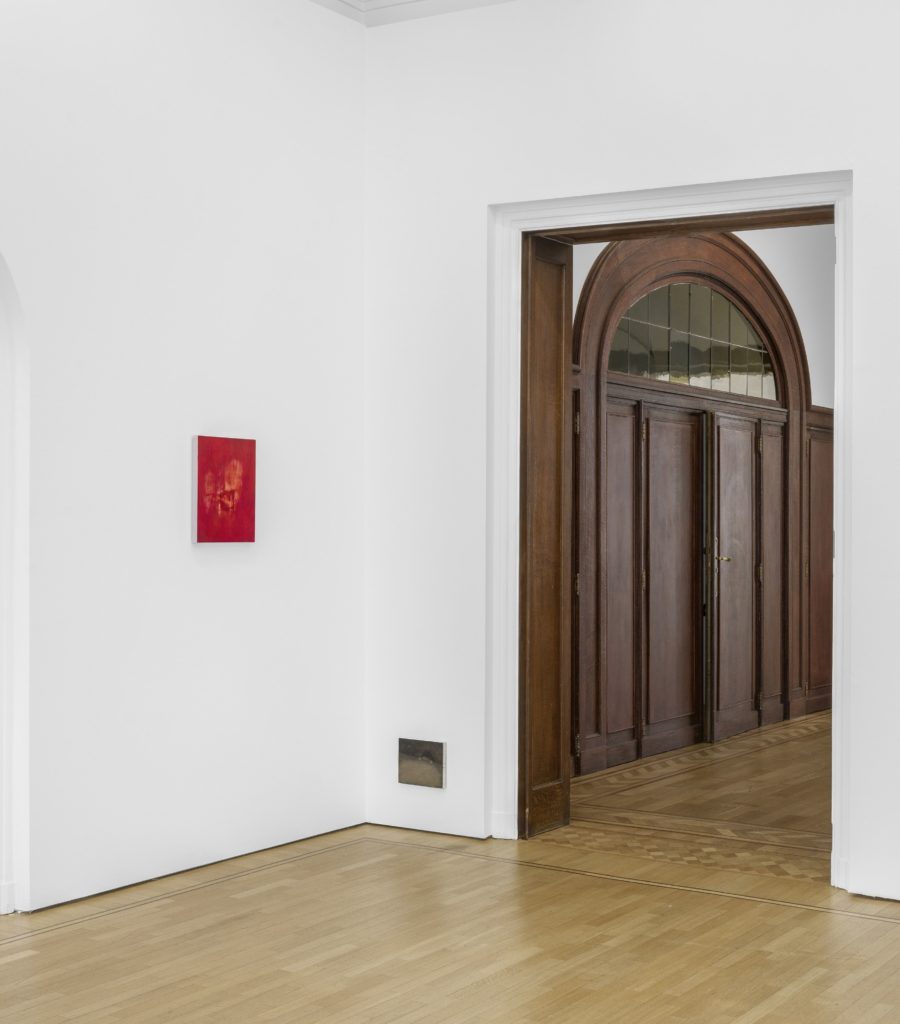
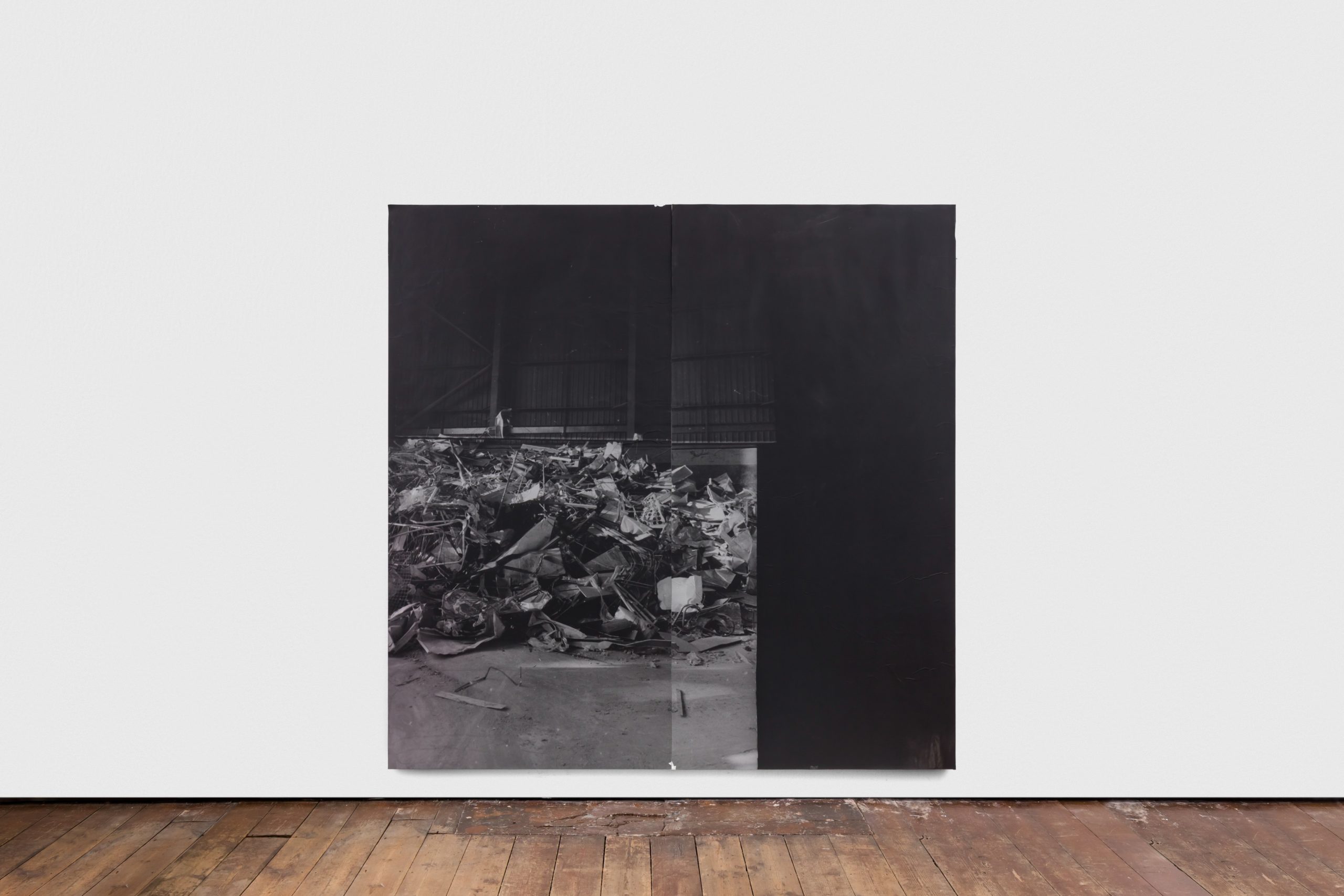
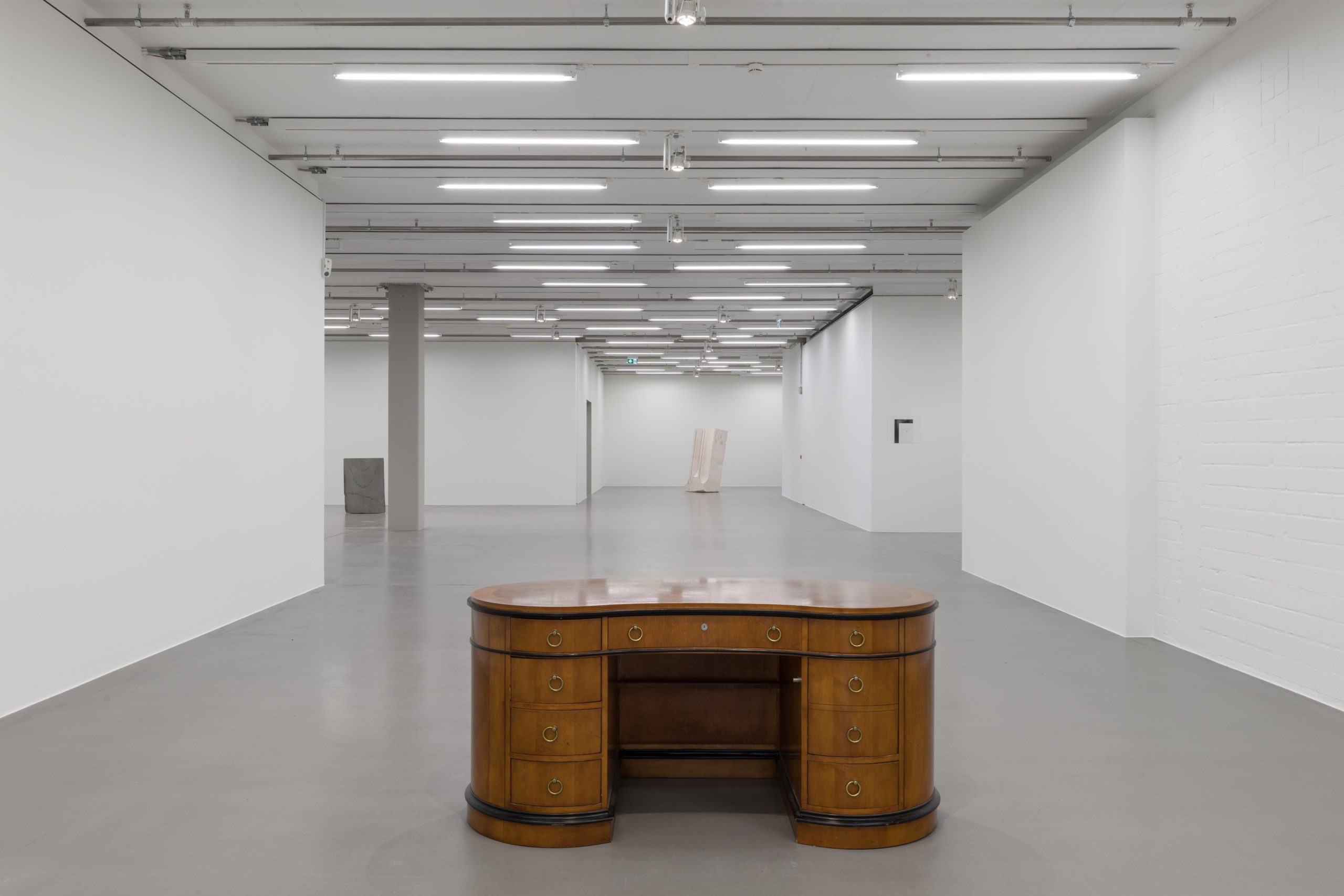
This logic was made explicit in “Educational Complex,” Bruno’s solo exhibition at Tonus, Paris, in 2024. Borrowing its title from Mike Kelley’s 1995 project — an architectural reconstruction based on memory maps — the show unfolded as a meditation on what institutional structures retain and what they systematically forget. Rather than illustrating education as transmission, Bruno approached it as a layered process of omission and substitution. Paintings and sculptural elements functioned as partial supports, surfaces that seem to await instruction while quietly resisting it. What was foregrounded was not knowledge but its scaffolding: the material conditions that authorize certain forms of belief while rendering others invisible.
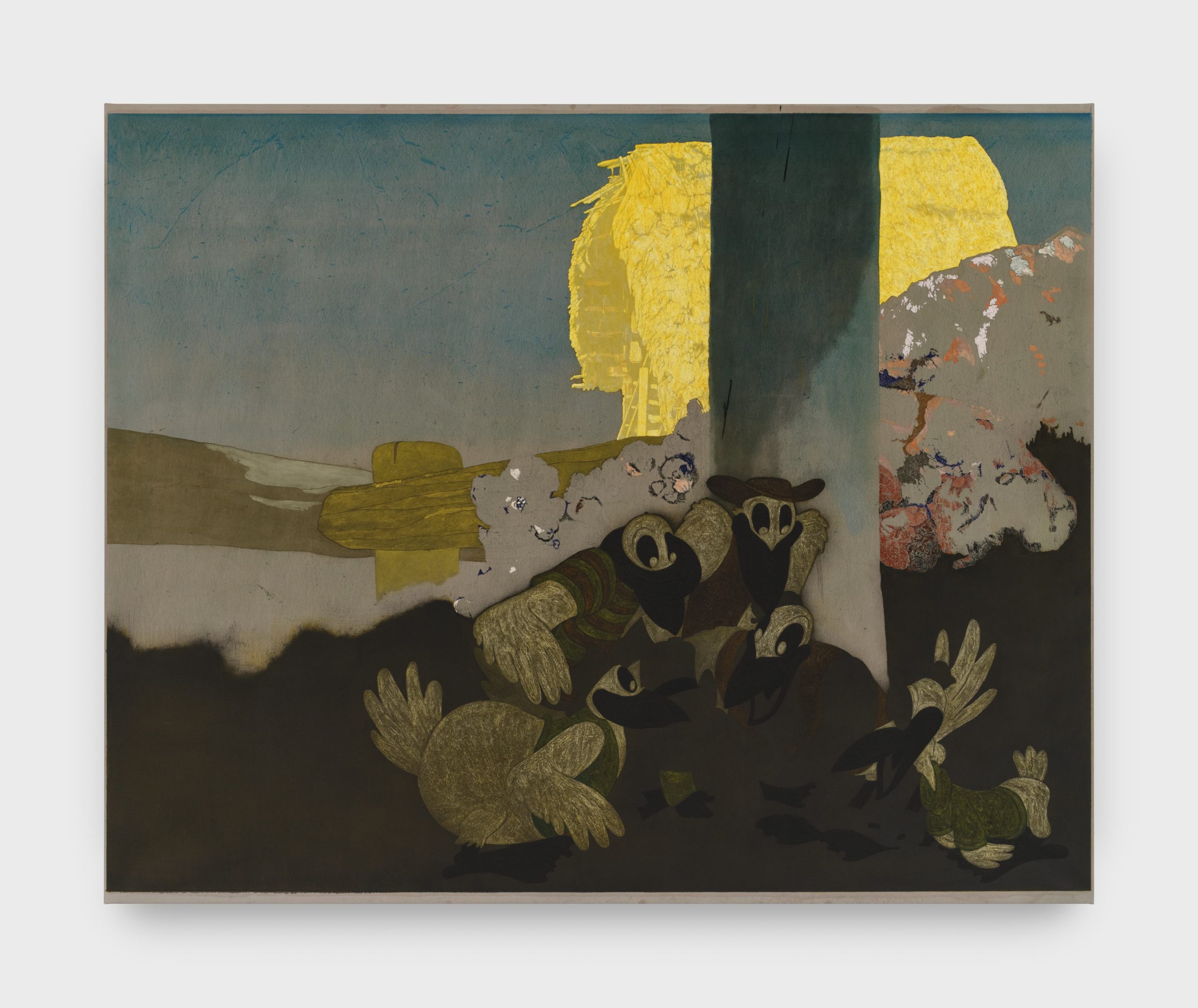
Bruno’s paintings often feel less like images than like sites — surfaces that have been worked, interrupted, reworked, and worked again. They ask to be read temporally rather than frontally, as one might read a ruin. There is a strong sense that something has already taken place, and that what is visible is the remainder of that event. This remainder is not melancholic. It is precise, intentional, and insistently material.
Forms appear through a process closer to apparition than representation. Ordinary objects — matchboxes, matches, scraps of paper, cigarette packs — emerge from still-wet paint, reworked by the brush in gestures that blur their contours and unsettle their status as objects. Figuration hovers at the threshold of recognition, becoming almost ghostlike. What allows the object to appear is a condition of semi-detachment: it separates from the ground without fully escaping it. The background retains its pictorial force, so that both object and surface remain active, bound together by the material continuity of the painting.
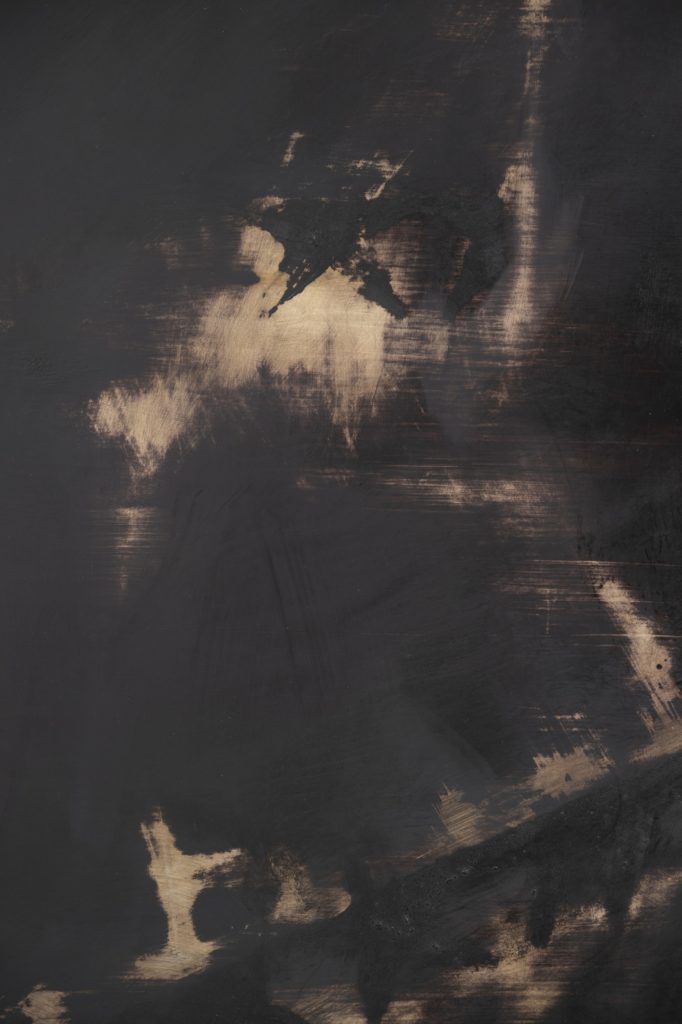
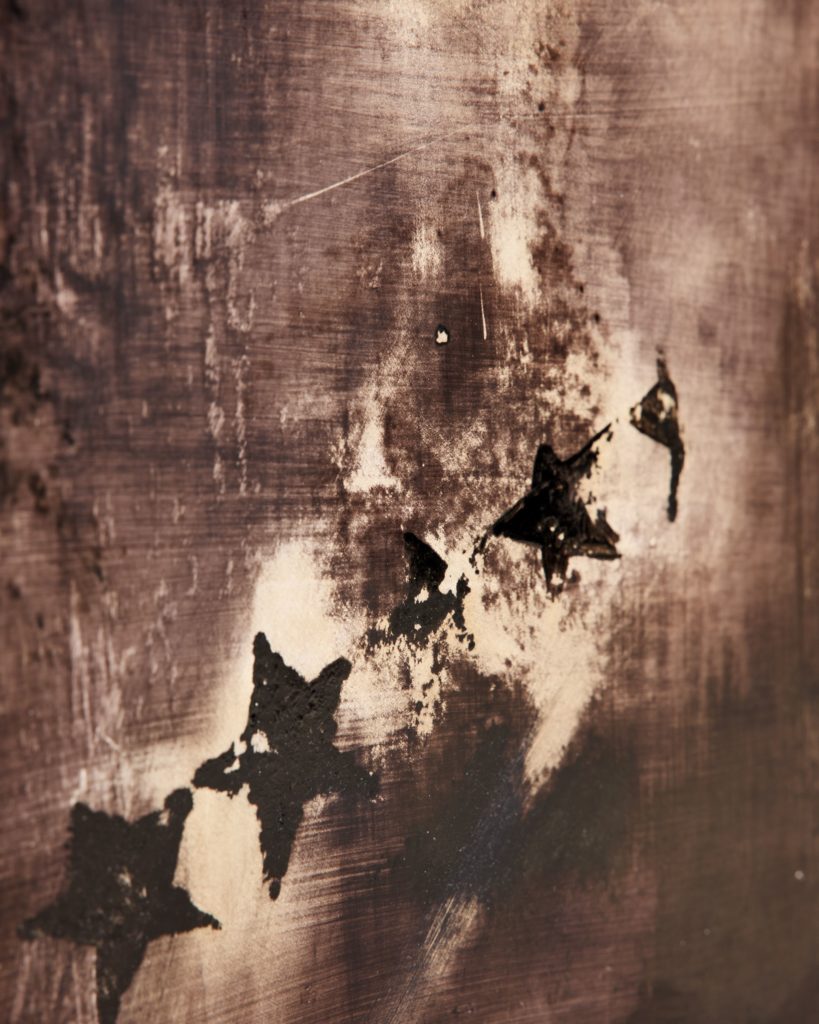
Absence, in this context, is not emptiness. It is an active condition. Bruno’s work suggests that absence can be constructed, layered, even cultivated. Presence, rather than being immediate or expressive, emerges slowly, through friction. This is where the displacement becomes productive: by shifting the image away from its expected role, Bruno creates space for another kind of encounter — one that resists consumption and demands attention.
Central to this process is her sustained engagement with gesso. Traditionally understood as a preparatory material destined to disappear beneath paint, gesso becomes, in Bruno’s work, a site of decision and insistence. Applied in successive layers of rabbit-skin glue and calcium carbonate onto oak or linden panels, it embodies a labor that is meant to be invisible. Bruno refuses this invisibility. Gesso ceases to function as support alone and asserts itself as surface, substance, and subject.
“With gesso,” she notes, “its color presented itself to me prior to any surface of representation.” This encounter with color before image is not anecdotal; it is foundational. The eggshell white of traditional gesso — historically associated with icons, altarpieces, and devotional painting — carries with it a dense cultural memory. It is the white of Beato Angelico’s grounds — of early Tuscan panel painting, of images designed to teach belief before interpretation: the luminous preparatory white that surfaces in works such as the Annunciation (1440–50) in the northern corridor of the Convent of San Marco in Florence. By allowing this white to remain, Bruno displaces the hierarchy of painting itself. What was meant to disappear becomes what persists, accumulating drastically as a residue of decisions, hesitations, and substitutions.
Meaning does not arrive directly but obliquely, through a push and pull between divination and analysis. The image operates allegorically, proffering and deferring significance at once, soliciting belief while frustrating full comprehension. In this sense, painting becomes a site of replacement: earlier meanings are effaced or obscured, only to be provisionally reconstructed. What emerges is a threshold image — transparent yet withholding — engaging the viewer in a contractual relation shaped by desire, belief, and the persistent confusion that underlies representation itself.
This gesture recalls, without reenacting, the Renaissance workshop, where preparation was not subordinate to painting but its very condition of possibility. Cennino Cennini’s Il Libro dell’Arte (1821) describes panel preparation with an almost liturgical precision — “layer by layer, patiently,”2 as he insists — detailing actions repeated until mastery collapses into ritual. Bruno’s return to these techniques is not sentimental. It is analytical. By working with methods that have changed little since the fourteenth century, she places pressure on the modern idea of originality. Authorship, here, is not invention but transmission, operating through filters of invisibility in which gestures, techniques, and forms are carried forward rather than claimed. What matters is less the assertion of a singular voice than the circulation of a practice that persists by remaining partially unseen.
Displacement operates again. The “original” is no longer located in the image but in the process. The painting does not assert itself as a singular statement; it is a compressed accumulation of time, labor, and decisions. Beneath each surface lies dense strata of actions — coating, sanding, erasing, recoating — each layer remaining fully present rather than instrumental or preparatory. The coating is not a protective skin destined to vanish. It is paint in its own right, intended to persist. In this way, the painting becomes diachronic, gathering multiple temporalities into a single plane.
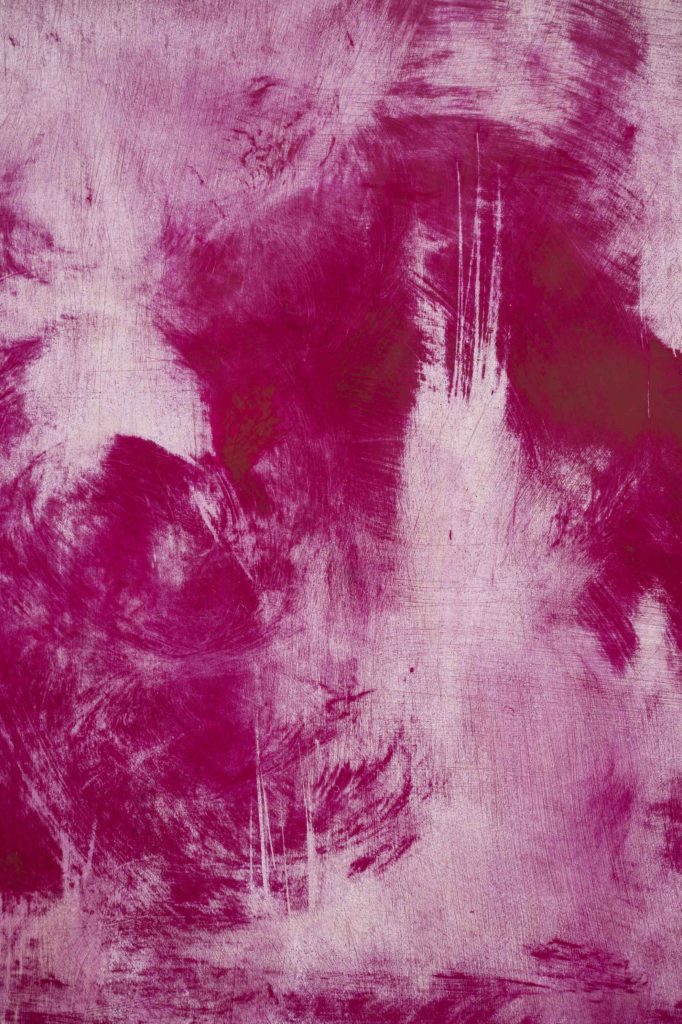
All this is taken further in “Specters in Pentimento” (2025), Bruno’s solo exhibition at Tabula Rasa Gallery, Beijing. Here, the notion of pentimento — traditionally understood as the involuntary resurfacing of earlier compositional decisions in old master paintings, like the shifting of guides in Titian’s Danaë (1542–43) or the repositioned Madonna in Raphael’s Small Cowper Madonna (1504–1505) — was mobilized as an intentional strategy. Works present images caught between layers, revealed through sanding or abrasion, only to be partially reabsorbed by subsequent coats of gesso and oil. What emerged were not corrections but apparitions: figures and forms that refused to stabilize, lingering as evidence of decisions neither fully affirmed nor erased.
At times, Bruno sends gesso down to reveal what lies between layers: an image caught midburial, neither fully present nor fully erased. These moments produce a peculiar tension. What appears is not revelation but reinsertion — an image re-entering the surface only to be partially absorbed again. The effect is ghostly but without sentimentality. These ghosts do not haunt; they insist. They mark the painting as a site where erasure and presence co-constitute one another.
Here, displacement becomes almost ethical. The image is not allowed to dominate. It must coexist with what precedes it and what undermines it. This recalls Maurice Blanchot’s reflections in The Space of Literature (1955), where the image is described as something that withdraws at the very moment it appears; as well as Georges DidiHuberman’s insistence — particularly in Confronting Images (2005) — on the image as a site of survival rather that clarity. What survives in Bruno’s work is not representation but its conditions.
Her frequent use of bituminous brown oil paint intensifies this temporal instability. Historically associated with painters such as Théodore Géricault, bitumen is a material that carries its own future deterioration within it. In The Raft of the Medusa (1818–19), it lends bodies a tragic density, as if they are already dissolving. In Bruno’s paintings, bitumen functions both as binder and disruptor, giving the surface a polished depth while undoing any promise of permanence. Painting becomes exposure rather than preservation.
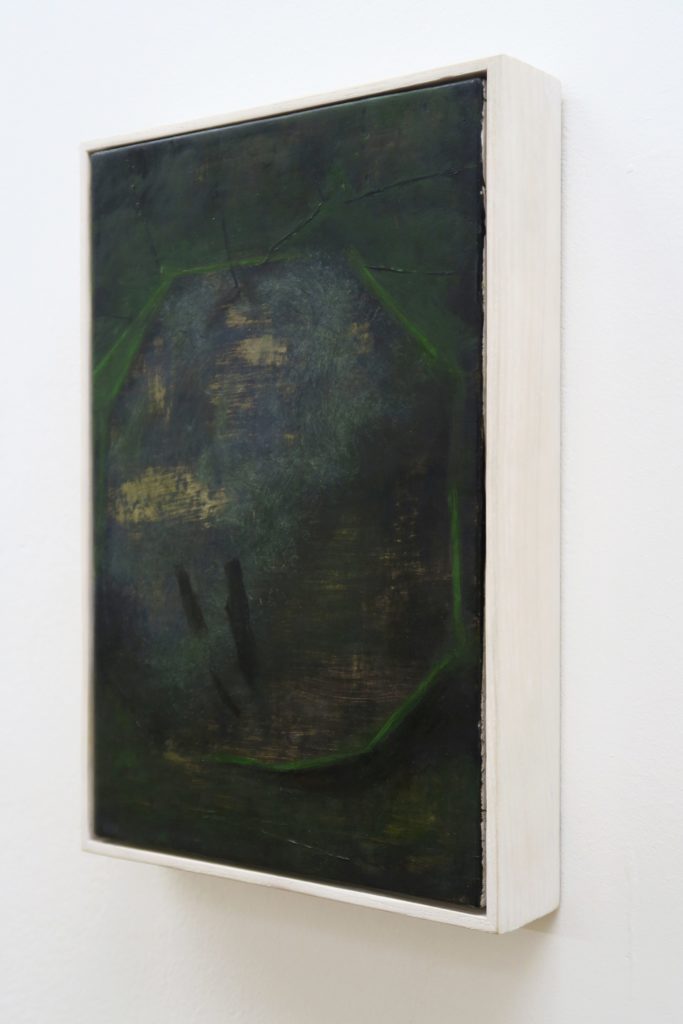
This exposure extends beyond the object itself. In the group exhibition “Visions of Fading” (2025) at Mendes Wood DM, Brussels, Bruno’s work entered into dialogue with practices similarly concerned with disappearance, erosion, and temporal instability. Rather than asserting autonomy, her paintings operated as thresholds within the show — zones where visibility faltered and attention slowed. The works did not illustrate fading; they enacted it, implicating the viewer in a process of gradual withdrawal.
Bruno’s 2024 residency at Villa Medici in Rome sharpened this relationship between material, history, and institutional space. Working within an architecture saturated with layers of artistic canonization, her engagement with preparatory techniques acquired a new resonance. The residency became a focused inquiry into questions of authorship and authenticity as they emerged in the Byzantine era, particularly through an exploration of gesso as a multicultural, transhistorical material. In Rome, where Byzantine workshops operated alongside early Christian basilicas such as San Clemente, between Esquilino and Celio, gesso functioned as a layered threshold: its repeated strata allowed sacred images to emerge as if revealed, rather than authored, anchoring belief in technique. The Villa Medici — itself a palimpsest of pedagogical ideals and aesthetic authority — extended this investigation into how belief is materially constructed and transmitted. Painting, in this context, appeared less as an object than as a mode of thinking through institutional time.
Bruno is acutely aware of this dynamic. Once exhibited, her works become part of what they reflect. They engage the viewer in a contractual relationship — one based not on spectacle but on attention. What is offered is not immediacy but delay, not clarity but a form of calibrated opacity.
In an image-saturated culture, where visibility is often equated with value, this withdrawal feels pointed. Bruno’s work does not compete with the velocity of images; it refuses it. It insists on slowness, on surfaces that resist instant legibility. In doing so, it makes an act of looking itself visible. One becomes aware of one’s desire for resolution, for recognition, for meaning that arrives on time.
There is something deeply literary in this resistance. One might think of W. G. Sebald’s prose, where images appear only to dissolve into digression, or of Samuel Beckett’s persistent undoing of form in Worstward Ho (1983) — fail again, fail better. Bruno’s paintings enact a similar persistence. Gestures are repeated not to refine them but to exhaust them. What remains after exhaustion is not nothing but rather a quieter, more fragile form of presence.
This fragility is not weakness. It is the condition under which something else can appear. By displacing the image, Bruno does not abandon painting; she makes room for it to function differently. Painting becomes less a vehicle for meaning than a place where meaning is tested, delayed, and redistributed.
So how does one make space for presence through absence? Bruno’s answer is never declarative. It is procedural. It lives in the ground, in gestures meant to disappear, in the refusal to let the image settle too comfortably into view. Beneath spectacle, there is labor. Beneath belief, repetition. Beneath meaning, matter.
What remains, in the end, is not an answer but a condition. A pause held open. A surface that refuses to close on itself. Bruno’s paintings do not conclude; they linger. They stay with the moment just before something takes shape, and just after it begins to dissolve. They ask what it means to remain with that interval, to resist the urge to fill it, clarify it, or move past it too quickly. Her work feels less concerned with making images than with caring for the space around them — the space where belief hesitates, where attention wavers, where meaning has not yet decided whether to arrive or withdraw.
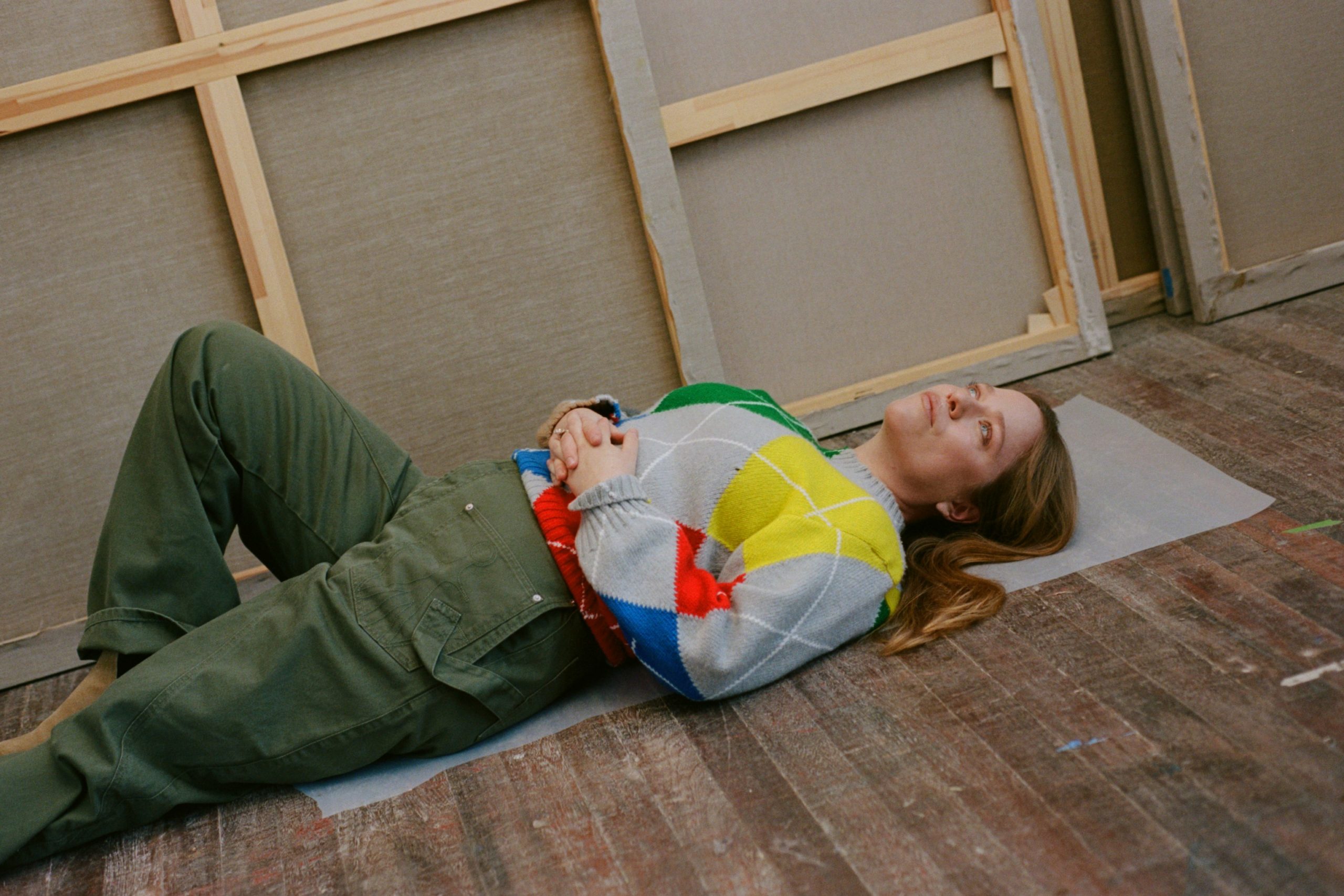
In the first days of January, as I speak with Bruno, the landscape around me is sealed beneath a thin crust of ice. For weeks, everything has been immobilized by frost; the horizon dissolves into a pale, suspended light, and the world appears estranged from itself, as if held in a prolonged state of latency. This condition — neither fully inert nor fully alive — feels uncannily close to the temporal state her paintings inhabit.
Over time, our exchanges have unfolded through messages and images. I return to a photograph she sent me from New York a few days before Christmas, in which the city is entirely snowbound. You can’t see anything; the horizon line disappears. She had just been to the Met, and whiteness outside recalls, for her, a Bruegel she had just seen: a landscape where vision falters, where figures emerge gradually from weather, ground, and distance. Observation from life, she explains, remains fundamental to her practice — alongside language and writing. She spends hours with a single painting, studying it, tracing its history, attending to a detail that shifts everything: what is true, what is false, what has been altered, what persists.
She tells me she is now preparing a new series of paintings for her upcoming exhibitions, drawing from Italian Tenebrism — its constructed darkness, its dramatized thresholds of visibility. Here again, light does not illuminate so much as it withholds; forms appear by subtraction, pressed forward by shadow. What is at stake here is not darkness as effect but obscurity as method: a way of insisting on the time it takes for an image to appear, and on the ethical weight of what remains unseen.
Painting becomes a way of holding time, of working with that which is meant to disappear and allowing it to stay. Each surface carries the memory of what has been covered or sanded away. One is reminded of Marguerite Duras’s words in The Lover (1985): “Very early in my life it was too late.” 3 Not an ending, but a condition — a presence shaped by what has already slipped away. Bruno’s work inhabits that same temporal dislocation, offering not resolution but a threshold: a place to linger, again and again, with what remains unfinished.