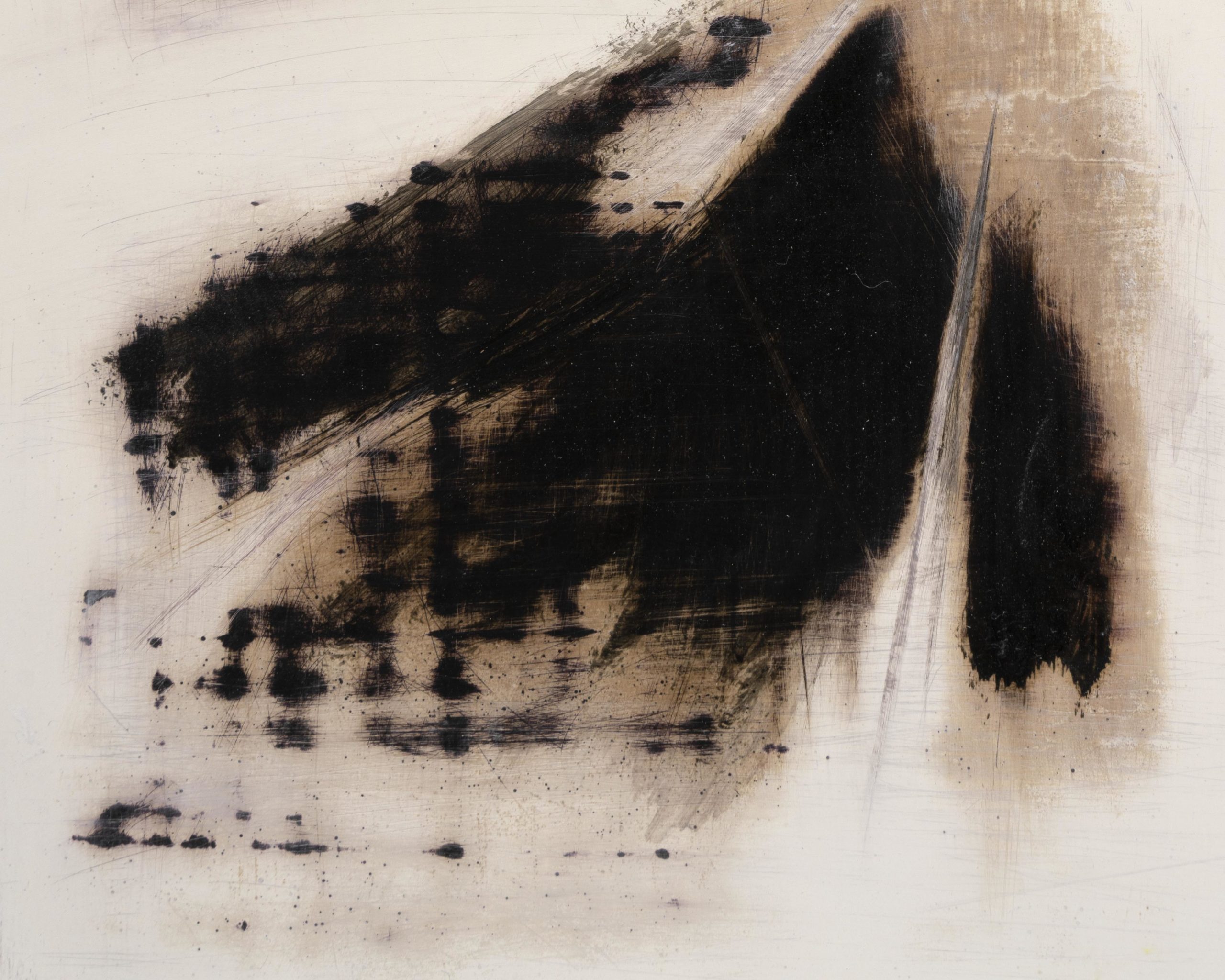
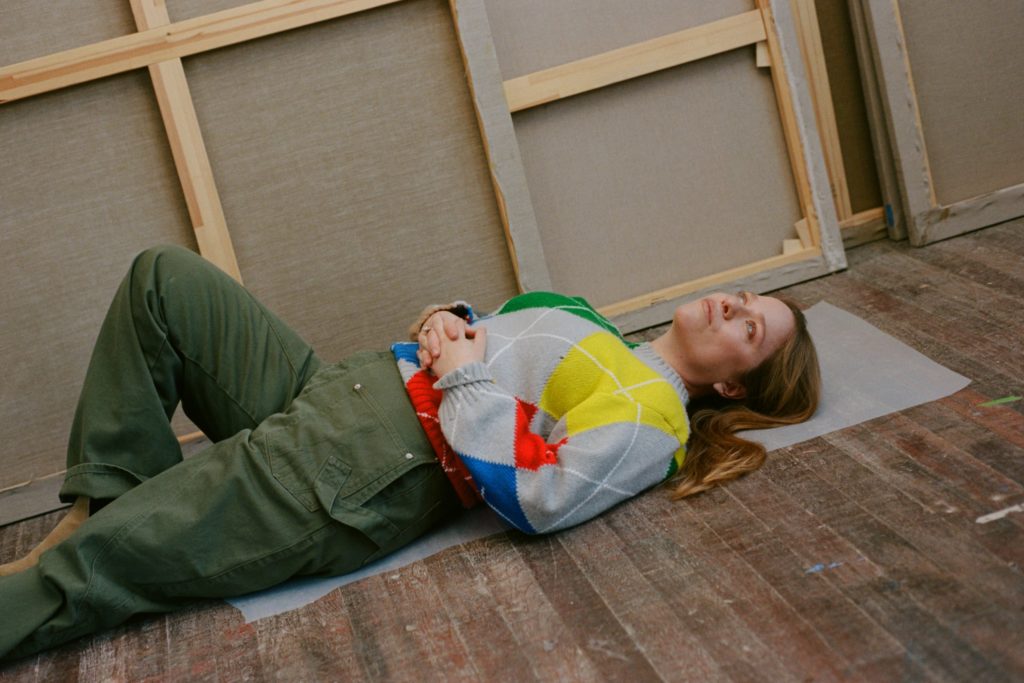
During our conversation, Mary Stephenson used the phrase “ghost mark” to describe the inerasable traces left by previous marks on her painted surfaces — a phrase that feels emblematic of her recent work. Though unpopulated by figures, her dreamy, liminal architectures — beds, rooms, doorways, houses — rendered in monochrome washes of pink, blue, and yellow, remain viscerally haunted by invisible bodies, feelings, and residues.
This atmosphere emerges from Stephenson’s process and her intimately dialectical relationship with paint itself. Her gestures seek to excavate and channel the ever-shifting internal motions of memory and feeling, producing compositions that are at once generous and open to projection, while remaining highly specific and personal. Her recent body of work presented in “Hue” (2026) at Maureen Paley, London, marks a lucid moment within her ongoing evolution toward a distinctive psychological abstraction.
Sonja Teszler: To start on a nostalgic note — we have known each other since we worked on your 2021 exhibition with Bosse & Baum, “Fertile Spoon” with Grace Pailthorpe, which I think back on very fondly.
Mary Stephenson: Yes, it was a turning point for me, showing alongside Grace. The way she came to make art and her thinking were so liberating for someone at that stage. She said something along the lines of: the unconscious is never wrong, anything that comes out of my body is correct. For someone grappling with how to make sense of these things, it was so exciting.
ST: Even though your language has shifted significantly away from those early figurative works, the same themes still feel central to your practice — the unconscious, memory, dream logic. Standing here at Maureen Paley, with these new, much more abstract paintings — how do you think this way of representing the unconscious has evolved for you? Why did you let go of the figures?
MS: A lot of it has to do with confidence. When I was making very populated paintings, I was conscious of wanting to prove that I am a “good painter.” But those busy, frantic canvases were more confusing than emotionally clear — even though depicting the motion of an internal world has always been the aim of the work. Leaving increasingly more space has allowed people to inhabit the paintings, rather than being controlled by a narrative. I’m realizing now that they are becoming increasingly monochromatic for a similar reason — it allows for more complementary color projection; it’s more generous.
The work has become more abstract because my relationship with paint has become stronger. It’s about acknowledging how solitary working in the studio is; once the medium becomes another presence in the room, it becomes a coping mechanism. The “failings” within that dialogue, where things recede too much or drip, become part of the argument with the surface, which I find exciting.
ST: Do you feel like you have new challenges, or things to prove, within this new relationship?
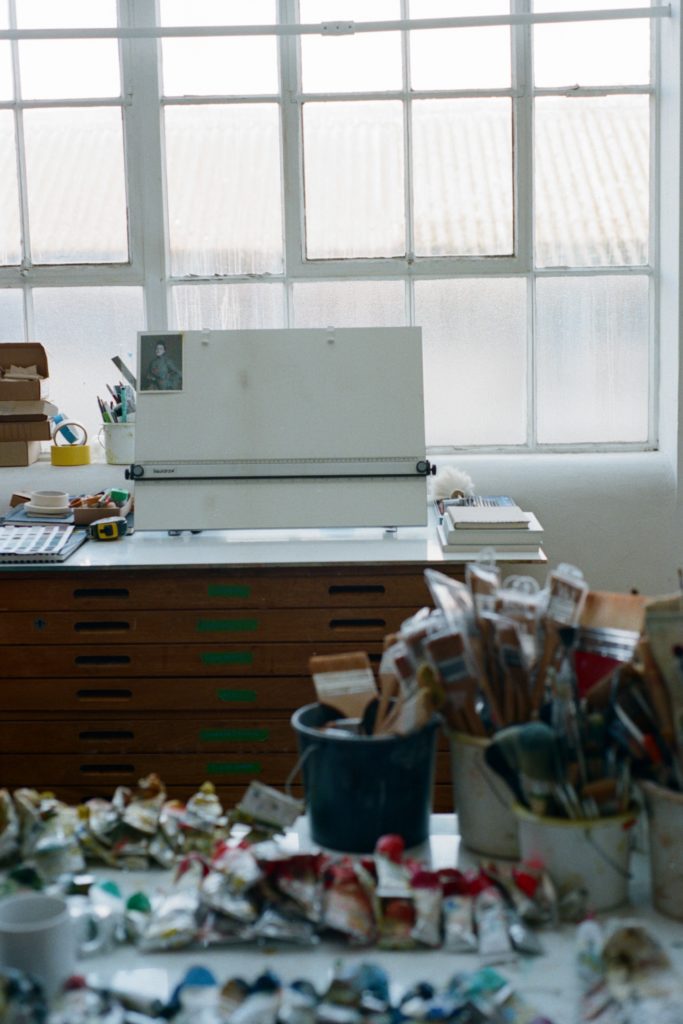
MS: Like most painters would say: achieving light. Light is so complicated. And continuing to ask questions at the canvas and get answers back. I’m conscious of being a student in the studio. I don’t want to design paintings. I want constant dialogue and surprise.
Someone recently asked me the age-old question of how I know when a painting is finished. For me it’s whether I laugh or cry, or both. It’s a kind of resolve, even though catharsis is fleeting, and you move on to the next painting. It’s about those “aha” moments.
ST: Your language around the painting process feels almost therapeutic, as though a kind of cathartic psychoanalytic dynamic unfolds between you and the canvas as conduit. How do the images themselves arise within this process?
MS: It’s funny — my therapist noticed that every time I spoke about a memory I pulled my hand across my eyes, as if drawing across a film reel. That is how I observe things internally: pressing play on memory in a filmic way. Images are triggered by missing someone, by being in a particular place, or simply by being drawn to a color — color is very much an archive in my mind. I draw, read, look at family photographs, observe things in motion. Painting feels like excavation, or resolution — something removed from me and placed onto the canvas. The paintings are grounded in bodily feeling and things appearing in my peripheral vision. They are like screenshots. Painting is filmic because you are, in a sense, directing a reality and chasing the unconscious, which you can never quite catch.
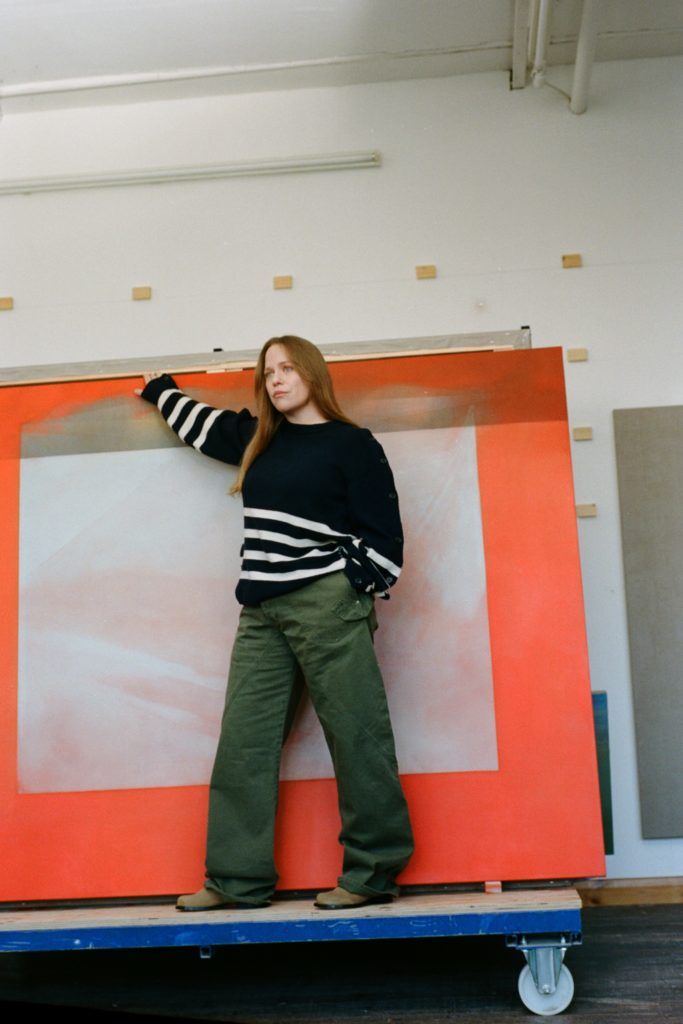
ST: Your surfaces almost seem to glow from within. Is this connected to the way you build up layers in the work? What comes onto the canvas first?
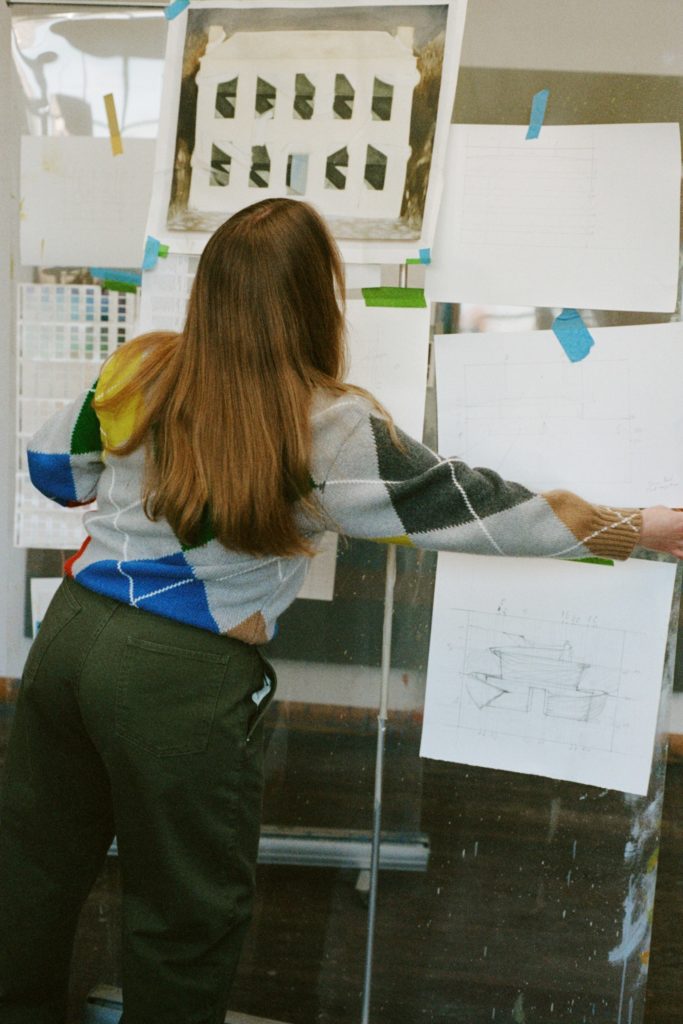
MS: I begin with chalk drawings, which allow for some degree of control. These create a seam on the dry surface where the paint soaks in differently, forming crevices in which pigment can gather. It becomes a kind of skeleton or blueprint of memory. For the paint, I reduce it until it is almost pure pigment, so that it sinks into the canvas rather than sitting on top. This has become very important — almost as though figuration is now occurring on another level, within depth itself, through the pigment’s absorption into the surface. The density is extremely fine and dries quickly, almost like blush applied to the skin, which gives the work its glowing, throbbing effect.
ST: I notice recurring motifs in your paintings — houses, beds — almost like an index taking shape over time.
MS: I think that as you continue making work, your vocabulary tightens. More confidence allows you to expand that vocabulary again, and to bend or even break the rules.
ST: Do these individual images hold stable meanings?
MS: For me, when bodies left my paintings, buildings replaced them. Most of the works reflect intimacy and personal relationships — translating how someone makes my body feel into architectural space. Houses start to take on a torso-like position, or an anchoring sensation, a gut feeling that feels intrinsic to art-making.
Baby Blue Door (2022), a work I showed at Michael Werner, London, was a turning point in this sense. Realizing that this particular composition of a house was about letting someone go, grieving them, really shifted my practice. In the painting New House (2025) in “Hue,” a new structure falls onto a previous one decaying into water. The title sounds optimistic, but grief is embedded within it. I think every painting, and every creative process, involves grief. You’re always letting go of what you thought would happen.
ST: And the beds… they feel as though they represent people. One motif is this recurring pinching, thread-like moment between them, here in Medium Pink and Two Identical Beds (both 2025), which carries a tension that is uncomfortable, but also somehow kinky?
MS: Yes, this goes back to Five Beds (2023) from my RA degree show; five white beds, a hole in the floor, and slithers of light, almost like umbilical cords of connection, referencing both literal and invisible bonds. I later realized it was a portrait of my siblings, with my mum in the middle, and once that association clicked, it stuck. The beds in my works are about nurture — but they can also feel like tombs, or even panels of color. As for the threads, much of that tugging relates to how my body receives the idea of another person. So yes, sometimes the threads feel erotic, in that sense of two beings pulled toward one another. Two Identical Beds (2025) is about this tethering — an impossible, exquisite tension. It’s the largest painting I’ve made, centered on the most significant relationship in my life.
The threads are always the last element that I do, because it’s where the paint is thickest. If they would go wrong, it would be really hard to bring it back, because there would be no way of hiding the ghost mark. These are the most tense bits.
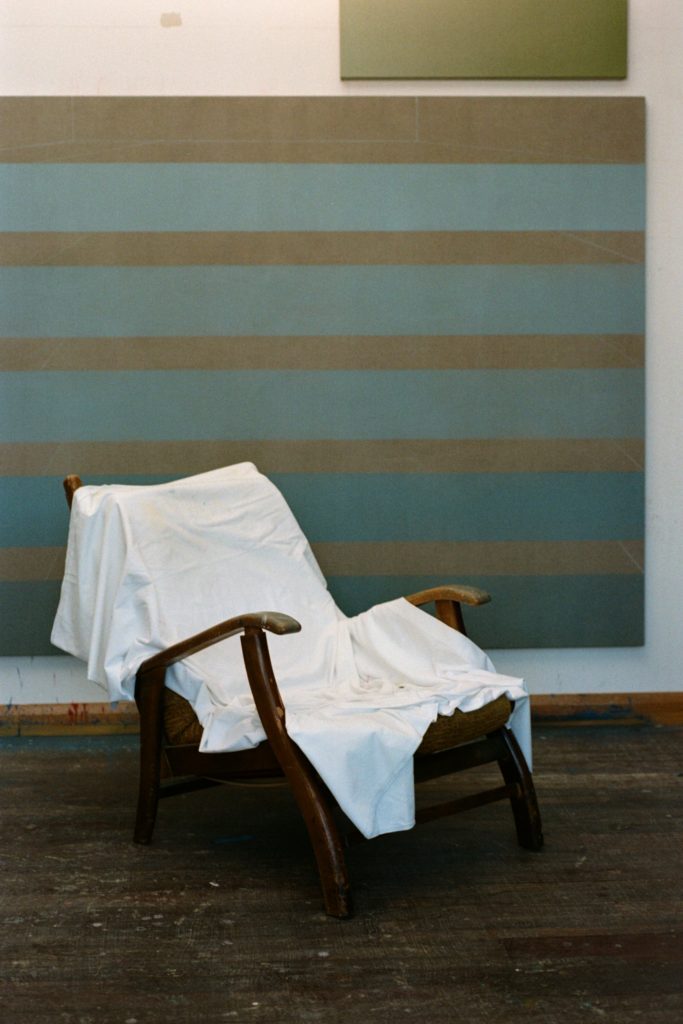
ST: More and More and More (2025) is perhaps the most abstract, enigmatic painting here…
MS: Yes, this one is about the excessive looping of memory. I’m obsessed with this gorging of the unconscious, and felt compelled to paint a continuous looping white in this cone-like shape over an entire sphere of colors. There are blues, reds, greens, and yellows beneath it too, peeking through here and there.
ST: So in a way, it’s your secret what colors are actually hiding in the painting. Is that part quite fun?
MS: Definitely. There’s something playful about being a little cheeky — the hide-and-seek of painting. Having all these colors and then covering them with a slick white surface is satisfying. Paint can be manipulative. Even the white stairs leading toward this work are part of that manipulation, pulling you in towards its central vanishing point as if towards a portal.
ST: Was choreographing the space important for you through these interventions?
MS: Yes. I’m interested in leading people into spaces that ask them to populate the work with their own projections, and to create a playful, cathartic arena in the mind. My degree show used soft play objects similarly.
ST: A lot has happened for you since then! You’ve shown in Chapter NY, Michael Werner, White Cube, now Maureen Paley among many others. Are external influences like trends or commercial pressures difficult to shut out when it comes to your work?
MS: It’s hard not to listen to external voices. But I’ve gained so much creatively from shifting my practice that I’m very aware that pushing the work is valuable. There were nine years between my BA and postgraduate; returning felt like the canvas was my oyster. There is a Hayao Miyazaki quote along the lines of: To expand your audience, you must betray expectations. For me, I’m the audience. I have to betray my own narratives to stay excited and keep discovering. Losing crutches in the studio matters.
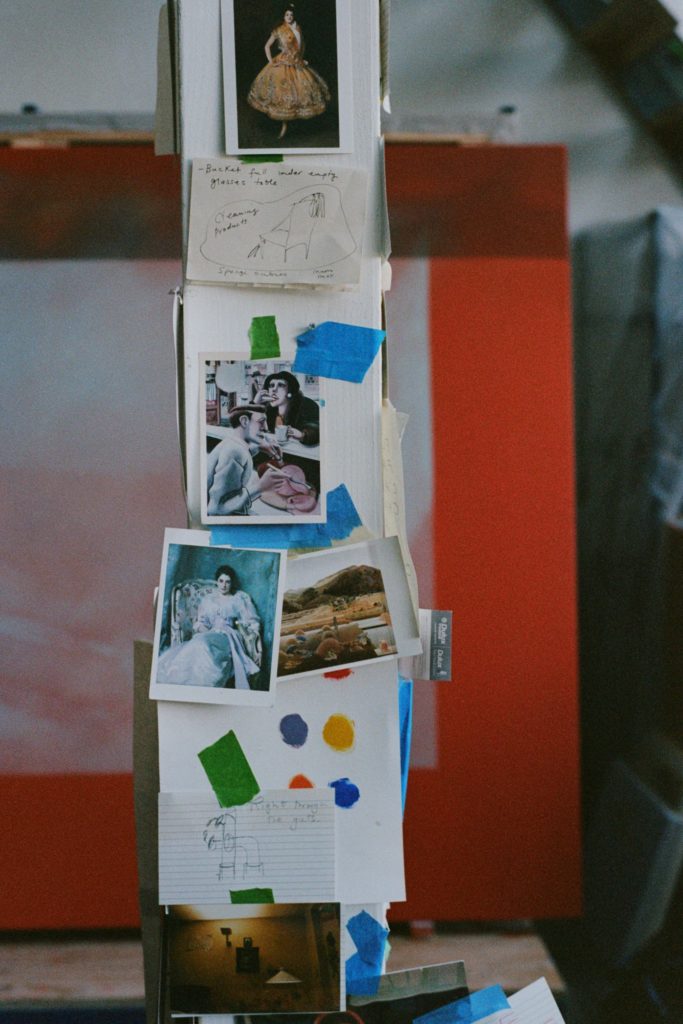
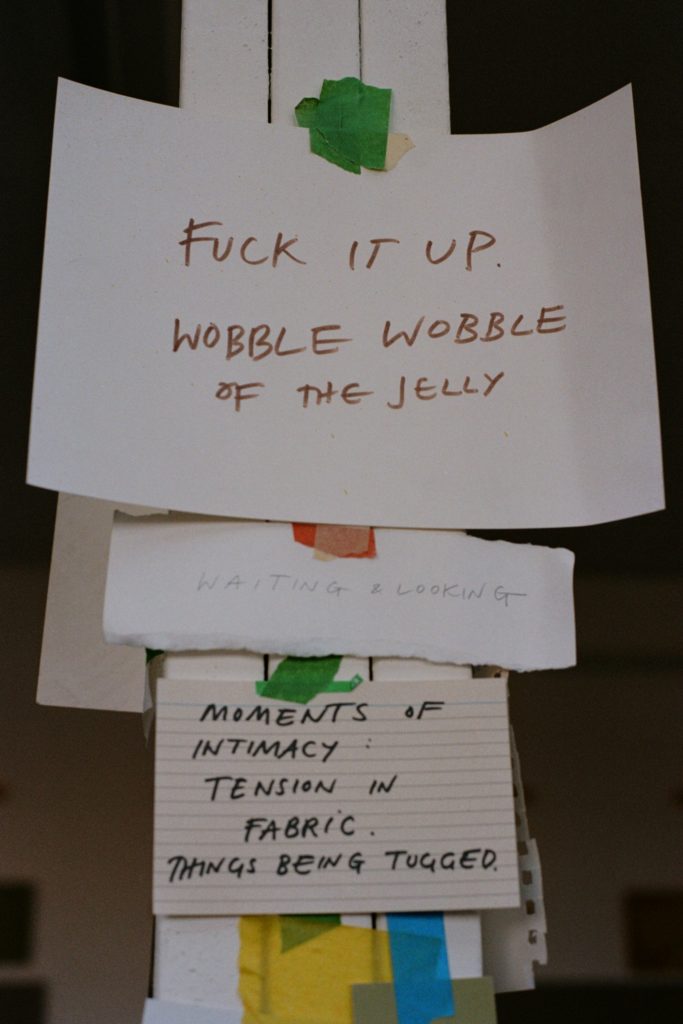
ST: I saw you keep notes in your studio. What is currently the one you’re looking to most?
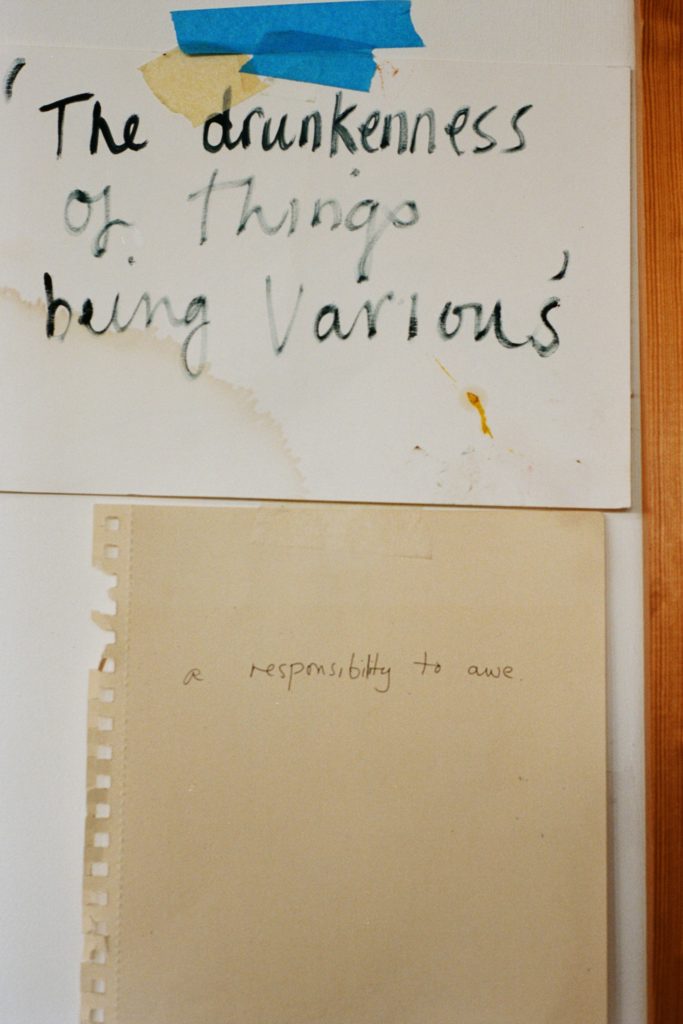
MS: I often return to Louis MacNeice’s “the drunkenness of things being various,” from his poem “Snow.” It captures the frenzy of life. As director of a canvas, my role is to relay that experience.
ST: In screenshots.
MS: Yes. In screenshots. And another note next to it says “slow down.” Holding those together, frenzy and stillness, is about gaining some control over everything happening inside and outside, and conveying how that feels.
Artist: Mary Stephenson
Photographer: Benedict Brink
Creative Direction: Alessio Avventuroso
Stylist: Anna Stephenson
HMU: Iga Wasylczuk
Production: Flash Art Studios
Clothes: JW Anderson
Location: Artist’s studio, London