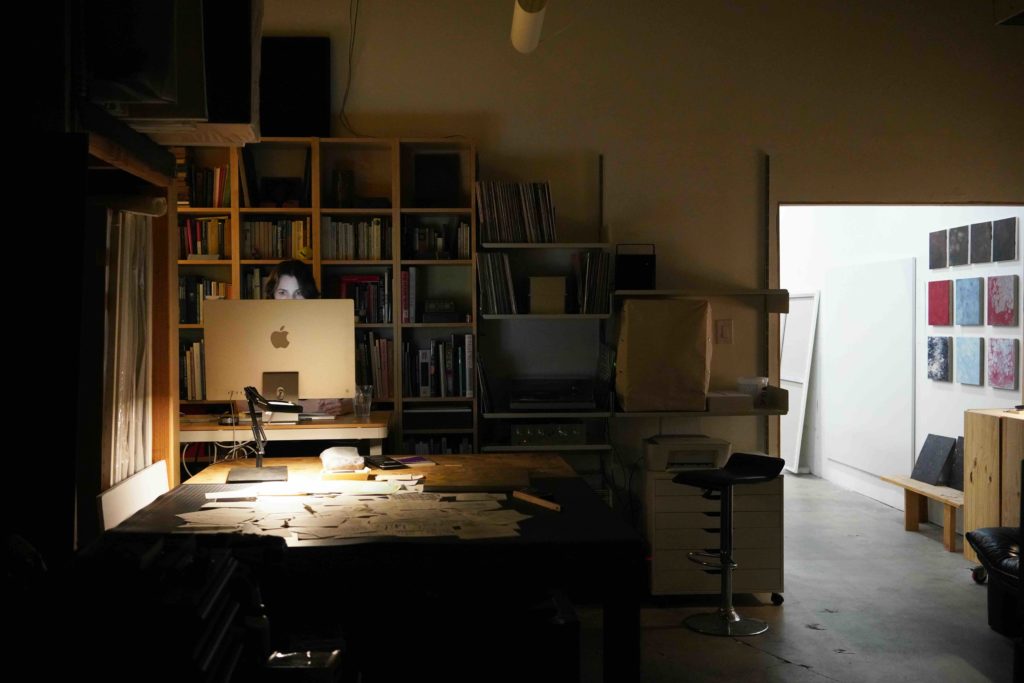
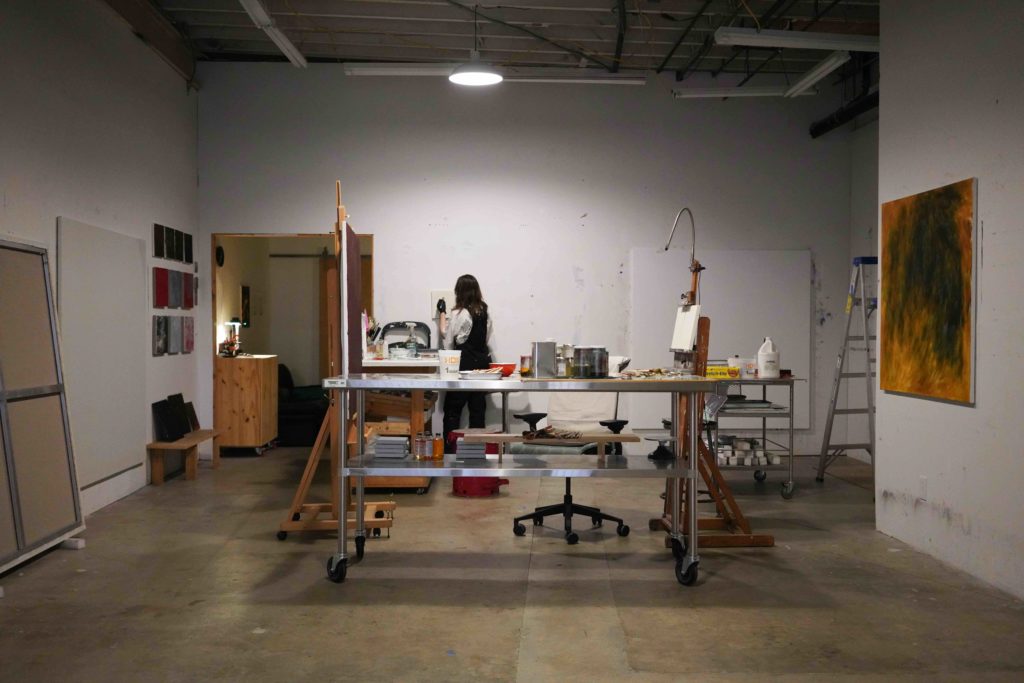
The Los Angeles–based artist Kate Spencer Stewart and I video chat from our respective desks — mine is actually my kitchen table. We are far from each other and far from the studio, so one of the first things I ask the painter, who makes large abstract works, is to describe her studio. Her process. A typical day in detail. It’s not so interesting, Stewart replies, and continues to tell me how her studio is large enough for her to be able to work on a series of paintings all at the same time. Each painting is an individual, she says, and I know what she means. I know what she means because I have just seen “Nuit,” an exhibition where Stewart’s paintings — large, abstract, colorful — are shown alongside framed pages from La Nuit, a portfolio of lithographs by Odilon Redon from 1886. The works were interspersed throughout the small rooms of the Clerk’s House, Emalin’s gallery space in East London, an eighteenth-century house that was once used by night watchmen to guard the neighboring graveyard from body snatchers. This haunting context, alongside Redon’s dark, detailed drawings, were both perfect matches for Stewart’s paintings, almost too large for the spaces in which they are shown. Ambitious and beautiful, these are works that suggest that a nonliteral, indirect way of being in the world matters as well.
Orit Gat: I would like to thank you for teaching me a new word. Your 2023 exhibition at Emalin was called “Diurne,” which means daytime, basically, and feels like a nice bookend to the recent exhibition at the same gallery, “Nuit.”
Kate Spencer Stewart: It was a new word to me too! The titles always come after the paintings, and this one was very last minute. I was already in England and the place where I was staying had a book on perfume. I leafed through it thinking that maybe I could find some ideas and one text mentioned a nocturne, which is always compelling but kind of belongs to Whistler — and I realized there must be a word for its inverse, a composition about the daytime. It made sense in a way that was about celebrating light, and the work that is carried out during daylight hours. The show was naturally lit by the windows in the gallery.
OG And two years later, comes night — or “Nuit.” Tell me about the background for this show.
KSS We had been talking about doing something at the Clerk’s House since Emalin moved into the space two years ago. Leopold Thun, the gallerist, knows about my interest in Redon and in the late nineteenth century in general. He sent me photos of the portfolio at auction and because of the time difference I saw it first thing in the morning — I was half-asleep and it felt like a dream.
OG Did you see the portfolio in real life? How does knowing that your paintings will be shown alongside the Redon lithographs change the paintings?
KSS Not until I was in London installing the show. They were so much more tactile and subtle than I expected. The images didn’t really change the way I made the works for the show, but I knew I needed to veer towards color and find ways of addressing not just the prints, but the space itself. So, there’s these three elements in the show, the Redon portfolio, the paintings, and the Clerk’s House.
OG The space being part of this trifecta feels crucial. The Clerk’s House is far from a traditional gallery — it’s several small rooms over multiple floors, and by the time viewers reach the attic, it feels so crammed but then there’s a painting hanging off of two screws, moving about a bit in the breeze from an open window. In a previous show, “Youth,” at Hakuna Matata in Los Angeles, you showed a single painting hanging from the ceiling of a treehouse-like structure in the gallery, which is in a private backyard. You do not seem to be particularly interested in showing large abstract paintings in white cube spaces. So, I want to ask you about your approach to display and installation. What do paintings do in space?
KSS It’s such a big question… They can reveal something about how a space is used, and, in turn, the context influences the painting — a painting hung in a restaurant might read differently than it would anywhere else, and I am open to the potential for intervening in extreme scenarios. I love large paintings installed in small spaces, but not exclusively! At the Clerk’s House, the repeating paintings become sort of a unit of measure, keeping constant time throughout the building. They managed to squeeze themselves into every room, but they feel strange, and I wanted to push that feeling as far as I could in the installation.
OG Tell me about the choice of working exclusively with square canvases.
KSS I started for really pragmatic reasons — to minimize decisions — and over time it became clear that it’s a philosophical choice. Square paintings feel alien, they reflect into themselves and don’t contort for wall or subject, they simply contain. On top of the form there’s a built-in dialogue with twentieth-century painting history, and also other references, like Mike Kelley’s “Arenas” and Polaroid film. Squares never fit very well in a room or look natural. I mean, sometimes they can, but most walls are horizontal or vertical. And in the case of the Clerk’s House these objects start to have a lot of friction just based on their form. In my experience, a square painting has the ability to exist in a room but not assimilate — to remain autonomous. They also aren’t that practical! I started working with squares when I was in school and felt I needed to settle on a format because the paintings themselves were very different from one another. How could I compare them if all of their attributes are constantly changing? So I just went with big squares and thought about Agnes Martin keeping the same format for her entire life. Maybe it comes from me being sort of scrappy and not wanting to waste anything, but in some ways it is also a removal of a hierarchy of landscape or portrait, which in my mind shouldn’t be the question anyway when it comes to abstraction. Each one is a separate entity with its own concerns, and the way that the paintings are made with my human body results in what the painting becomes. The content and form are unified.
OG How do you see this relationship between form and content?
KSS It feels like a paradox: if I think about something while I’m painting it’s always there for me as content, but I’m also trying to eliminate anything representational and to allow for contradictions to create new visual relationships within the painting. The problem is to make a painting, and that’s the only thing that I have to solve. And so it’s not like, make a great painting, or make a painting of a person or fruit or whatever. It’s just, make a painting. If it starts to look like something in the world (even an Abstract Expressionist painting) I try to apply some type of diabolically brilliant or shamelessly insipid intervention. It’s all very cold, but it’s never truly fixed.
OG You mention Abstract Expressionism, which is obviously a reference that haunts so much abstract painting and has a tradition of a very specific relationship to the body in the act of painting — I’m obviously thinking about those Life magazine photos of Jackson Pollock making his drip paintings. What does the act of painting look like for you?
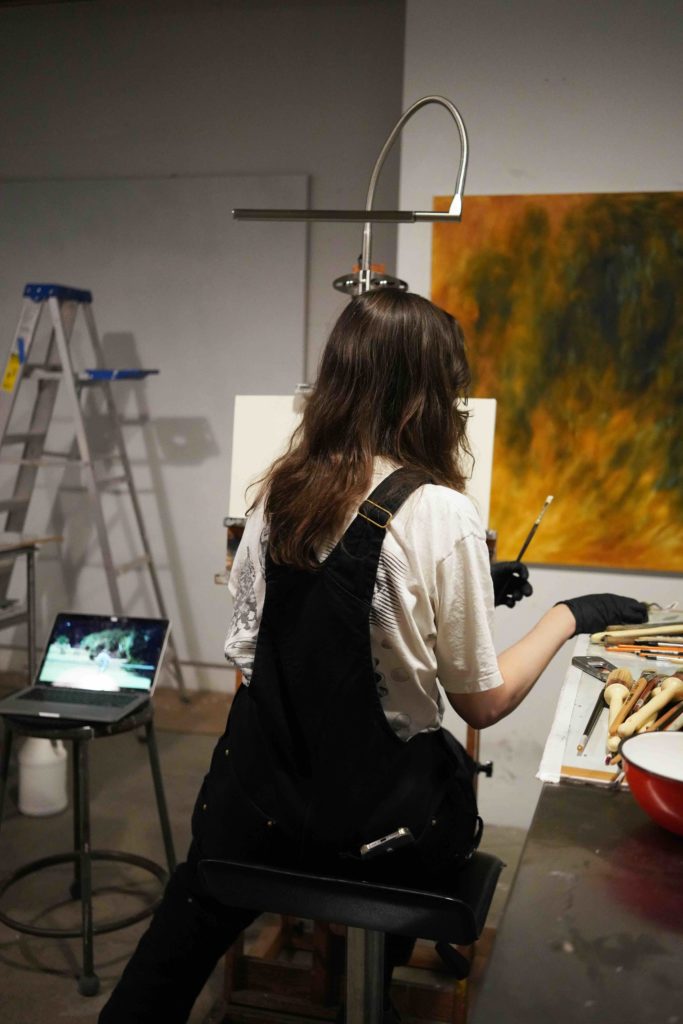
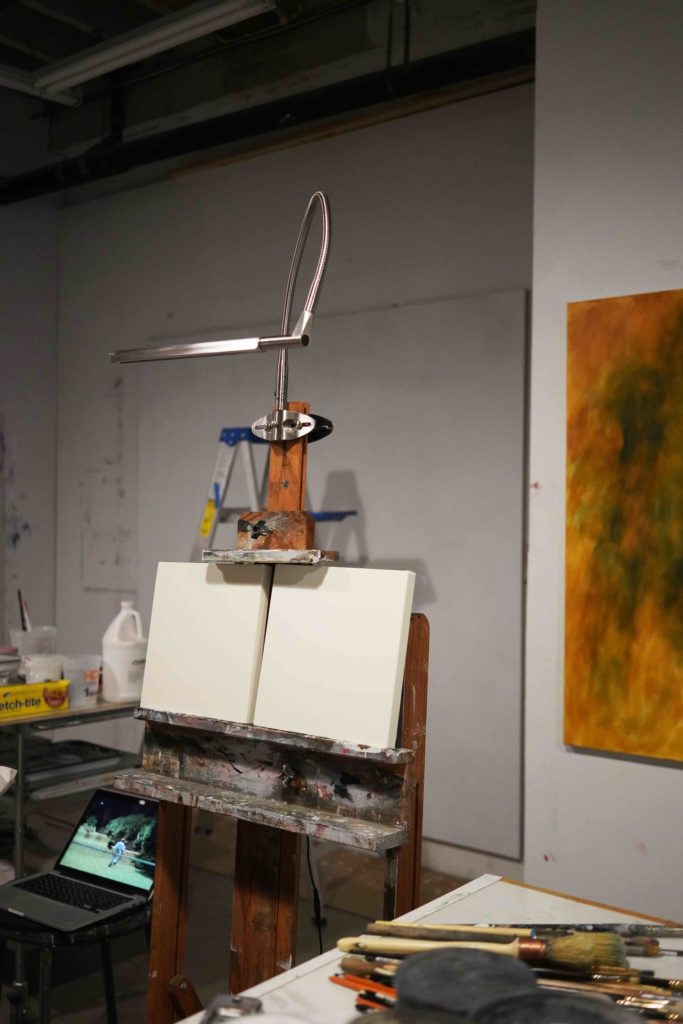
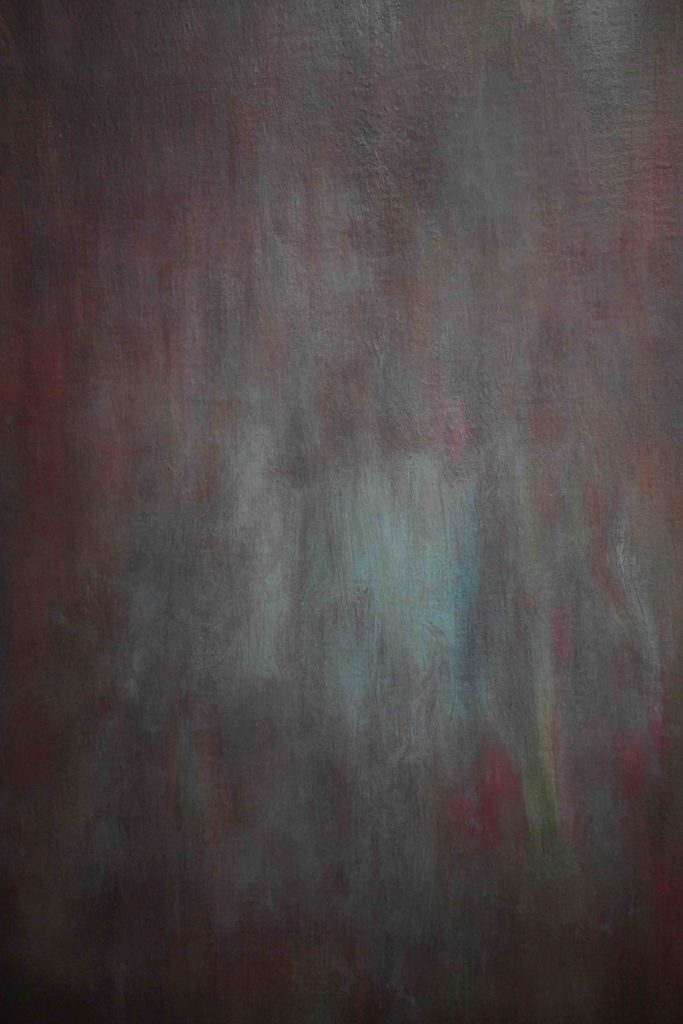
KSS There is the edge of the canvas which to me describes the autonomy and basic architecture of the painting. I want to acknowledge this edge and let it push the painting back into itself. I follow a few rules: I can move the canvas up and down on the wall but it’s always right side up; I’m also not painting it on the floor, flipping it around, using a sprayer or anything — not that there’s anything wrong with doing any of those things! Being able to understand how the painting operates optically and being able to make changes very quickly is at the heart of working like this.
OG So now we’ve both discussed Abstract Expressionism, even if it’s not necessarily a direct reference in your work. You also mentioned Whistler earlier (and I also had Whistler’s name in my notes as I was preparing for our conversation!) and Agnes Martin. Your paintings very much feel like they are constantly responding to a long tradition of abstract painting, but who else are you looking at in these works?
KSS I think what led me to abstraction was realizing how physical it actually is by looking at early abstract art (like the cracks in a Piet Mondrian painting), and in turn how much abstraction is in paintings going back centuries. But if I name a bunch of other artists it’s not going to provide much insight and I’ll just end up sounding like a jerk, plus I have an awful memory for these things.
OG I am gasping because to me — and I have a degree in art history — nothing could be more boring than a Mondrian solo show.
KSS Maybe it’s boring to look at, but if you’re making something like a Mondrian or a Malevich you find it becomes a distillation of painting, and to get through it is unpredictably psychedelic. You have to be aware of what your body is doing, what your mind is doing, how your eyeballs are responding. What’s that quote about filmmaking? What you’re pointing the camera at also includes everything you aren’t pointing the camera at. Painting is kind of the same — I could try to include everything or I could see how far I can get removing as much as possible.
OG And how do you do it?
KSS Mainly I just try to stay in the studio.
OG And what’s next?
KSS I have a show at Bureau in New York which opens on November 1! They’re in a beautiful new space, which is big, airy, and light. You will be able to see all the paintings at one time from pretty far away, so that’s the first thing I’m trying to wrap my mind around. I’m just starting the process, feeling very behind schedule but optimistic!
OG What does starting the process look like? What are you researching?
KSS I’m still immersed in the world of Redon, reading Joris-Karl Huysmans, and thinking about decadence and the book we’re making at Emalin. A friend and I started reading Macbeth together and I’ll be picking it up as much as I can handle. I’ve also recently discovered the folk singer Shirley Collins and will listen to her sad, sad songs all summer. I feel the need to open myself up to the American side of history and folklore, which feels quite unmentionable right now, but it’ll seep in no matter what, either intentionally or through pure angst. So the process at the moment… I’m just trying to fill up my studio with surfaces, then I’ll start underpainting with umber pigment from the Blue Ridge Mountains of Virginia. It’s hard to predict what will happen but if I keep working I’ll find some kind of spark that will carry me forward.