It takes more than nine hours to drive from Tokyo to the Noto Peninsula by car. This remote stretch of land, more than three hundred kilometers west of Tokyo, became even harder to reach following the 7.6-magnitude earthquake that struck on New Year’s Day in 2024. The three members of the Japanese art collective SIDE CORE — Sakie Takasu, Tohru Matsushita, and Taishi Nishihiro[1] — responded with a love letter and a rallying cry, tracing a route west of Tokyo through the Japanese Alps of Nagano, toward the landscape of Ishikawa prefecture, a region capable of stirring their collective imagination. Founded in 2012, the collective formed around the idea that street culture offered more than a status symbol: it provided an opportunity to pose questions within public spaces of spontaneous production and chance. They turned to the street as a primary site of artistic practice and reimagined the “route” as a series of collaborative explorations that capture a rural sense of identity as well as the many different sources from which the idea of the street is drawn. The result is “Living road, Living space,” an exhibition at Kanazawa’s 21st Century Museum of Contemporary Art that is less a museum retrospective than an interpretation of what a museum can be, curating other artists and transforming public spaces into a setting where marginalized and misunderstood cultures happily collide.
The show is in four parts. “NEW ROAD — Opening a ‘path’ through the Museum” sets forth directly into the building, inviting visitors to wander through sections of the collection. In one open courtyard, Leandro Erlich’s The Swimming Pool (2004) is now exposed to the general public; viewers are able to stand at its edge and stare at the pool bottom where visitors underneath can be seen staring up through the separating film of water and glass. The pool is also watched by My Outside Family (2025), a mural by Stephen ESPO Powers, commissioned by SIDE CORE, that depicts across several walls a vague collection of faces from ESPO’s neighborhood. Adjacent to that, a skatepark fills another room with a pool-like ramp, constructed with the help of professional skater Morita Takahiro.“
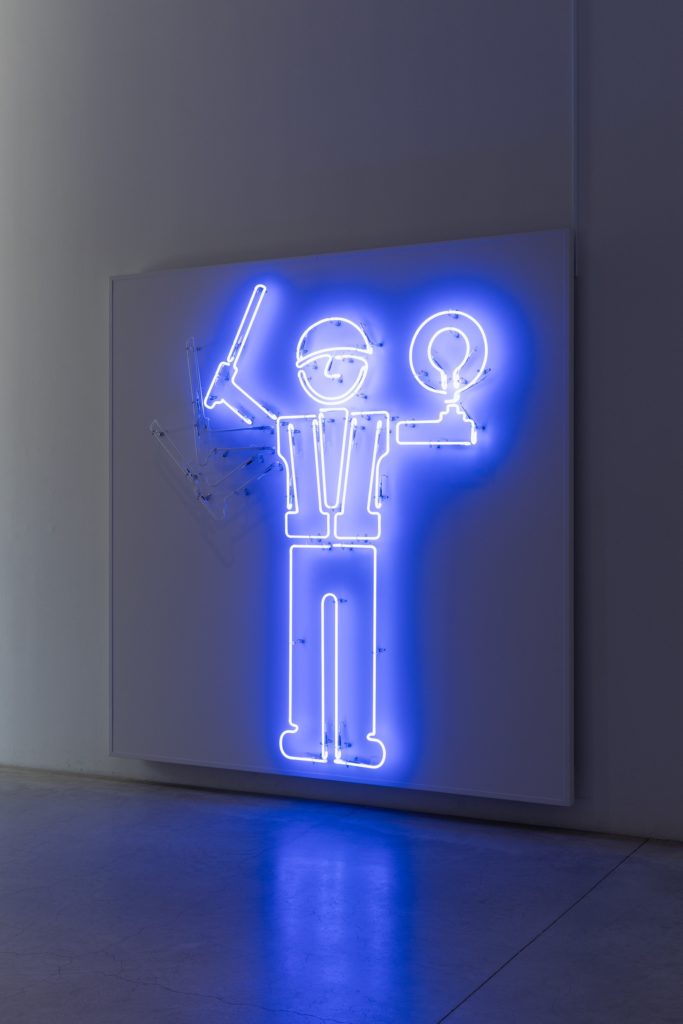
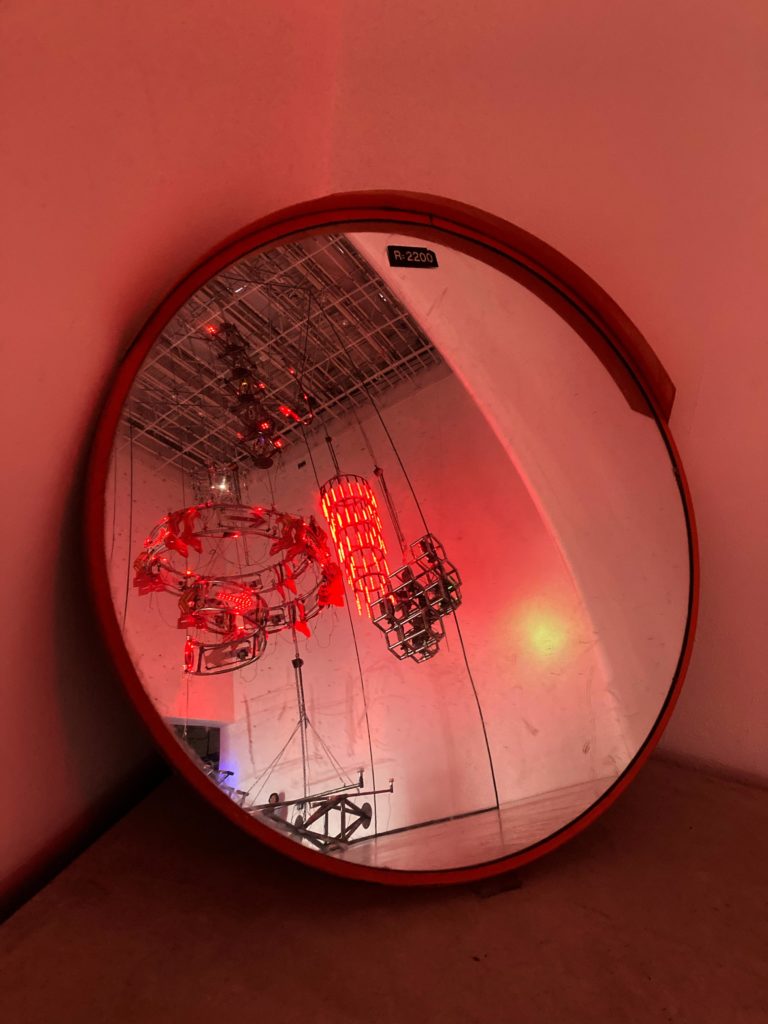
UNDER CONSTRUCTION — Tracing the Trajectory of SIDE CORE” describes the museum in flux, with the artists documenting the street as they mediate the space between film and sculpture. rode work ver. Ishinomaki (2017) shows an old factory heavily damaged by the Great East Japan Earthquake of 2011. There, a skatepark is built and dismantled in a single day. When the factory was finally demolished, the remaining skate ramps were removed and redistributed around the city. rode work (construction lights) (2017/2025), next door, carries its own vocabulary of construction: a mass of warning lights, pipes, chains, and other materials hang from the ceiling like a chandelier, picturing the city — and the work itself — in a state of perpetual change. The sound of passing traffic is echoed by breath of night (2024), with a bank of car headlights that processes the noise of museum foot traffic into the image of a traffic jam.
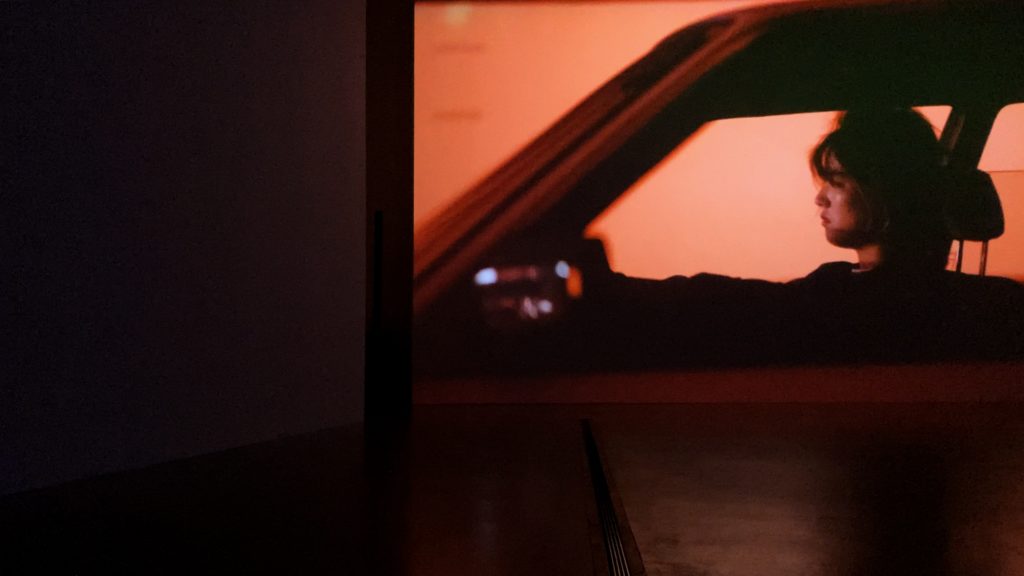
If this “road” opens the museum to spontaneity, “LIVING SPACE — A Place for Living” blurs the boundaries even further. I’M HOME (2025) by invited artist Kotaro Hosono is a temporary, artist-run space. The small wooden hut, quietly embedded in one museum corridor, confronts the nature of the museum with its own exhibition. Mini Theater “9” (2025) and end of the day (2025) introduce a screening room alongside a slice of SIDE CORE’s own studio, each rubbing up against the other. “LIVING ROAD — The Road That Lives” takes a broader view of what the street represents and how its geography connects with a wider cultural landscape. Two video works, new land (2024) and living road (2025), unfold like a lucid dream.[2] Playing on the rooftop, new land (2024) lifts the viewer on a scaffold tower that mirrors the altered Noto landscape. Having risen in places by more than four meters, the rooftop screen imagines this stretch of new land as a habitat for hungry birds, while SIDE CORE member Sakie Takasu waves a fish sausage at them from a terrain of fresh white volcanic pumice and oyster shell lifted from the sea floor. Inside the museum, living road (2025) envelops the crowd with its five-channel film of a young woman from Noto, played by local actor Ayana Sakaguchi. She is seen driving between Tokyo and the peninsula through the Fossa Magna lowlands — shaped by the Tanakura Tectonic Line to the east and the Itoigawa- Shizuoka Tectonic Line to the west — as the storyline moves left and right between the screens to mirror the collective’s trips before and after the earthquake.
Both new land (2024) and living road (2025) widen the idea of what the road might be. Places that resonate with personal and collective memory remind us of the fragility of our own existence. Well-traveled examples like America’s Route 66 embody a national spirit and identity, along with a sense of personal discovery, yet they also reveal how landscapes can carry the imprint of the people moving through them. At one point in the film, Sakaguchi drives through a tunnel while struggling not to succumb to the exhaustion of such a long drive. The space between her and the car gradually dissolves, and the shifting pitch of the engine lulls her to sleep before she is shaken awake by the rain. This dissonance can be traced to a kilometer- long section of the Noto-Satoyama Kaidō Expressway, also known as the Melody Line. Driving over grooves cut into tarmac once played the theme song from a local television drama, but the constant hum of traffic and the ongoing roadworks that repair and retune its surface have rendered it inactive.
Other works in this section, such as Mud Enough (2025), play on geology as a visible record of pressure and time. Clay and charred wood from the Noto peninsula form a loose architectural model displayed in a wet, humid room to keep it from falling apart. Images of other “underground” spaces evoke the pressures of working in darkness. “We’re intrigued by the notion of the underground because that’s something we can only imagine,” says SIDE CORE’s Tohru Matsushita from a factory space in Tokyo built on reclaimed land.[3] Below the surface, the museum is not immune to its own closed cultural ecosystem or to the pressure of bureaucracy. A single black bass swimming in a tank — The Fish Exchanged for Art (2018) — belongs to a species first introduced to Japan in 1925; this specimen, fished from a nearby river, now circles an aquarium beside an enlargement of the stamped license required for the museum to keep it. This ecology of human and nonhuman cultures demonstrates how civic and peer pressure — alongside authority from “above” and the land from “below” —produces what the collective has termed “sideward pressure”: the compression that street culture exerts on the civic imagination. By the time living road (2025) ends and the lights come up, the louvered ceiling opens to remind everyone that Noto — and the world outside — still exists. Shortly after the earthquake, officials urged visitors to avoid the peninsula to prevent roads from grinding to a halt. When SIDE CORE spoke with residents, it became clear that they wanted more people to visit so they could tell their own story about how life is lived in Noto today. “Living road, Living space” becomes a road trip in search of meaning. Only time will tell when — and where — it ends.
[1] Urban exploration at night is part of SIDE CORE’s ongoing practice. The nickname of each member — JANGO (Sakie Takasu), TOHRY (Tohru Matsushita), DIEGO (Taishi Nishihiro) — and their shared identity embody that exploration, connecting people and places in unexpected ways.
[2] Films were shot by the collective’s video director Kazunori Harimoto.
[3] In conversation with Sakie Takasu, Tohru Matsushita, and Taishi Nishihiro at BKL STUDIO, Ota-ku, Tokyo. Monday, December 22, 2025