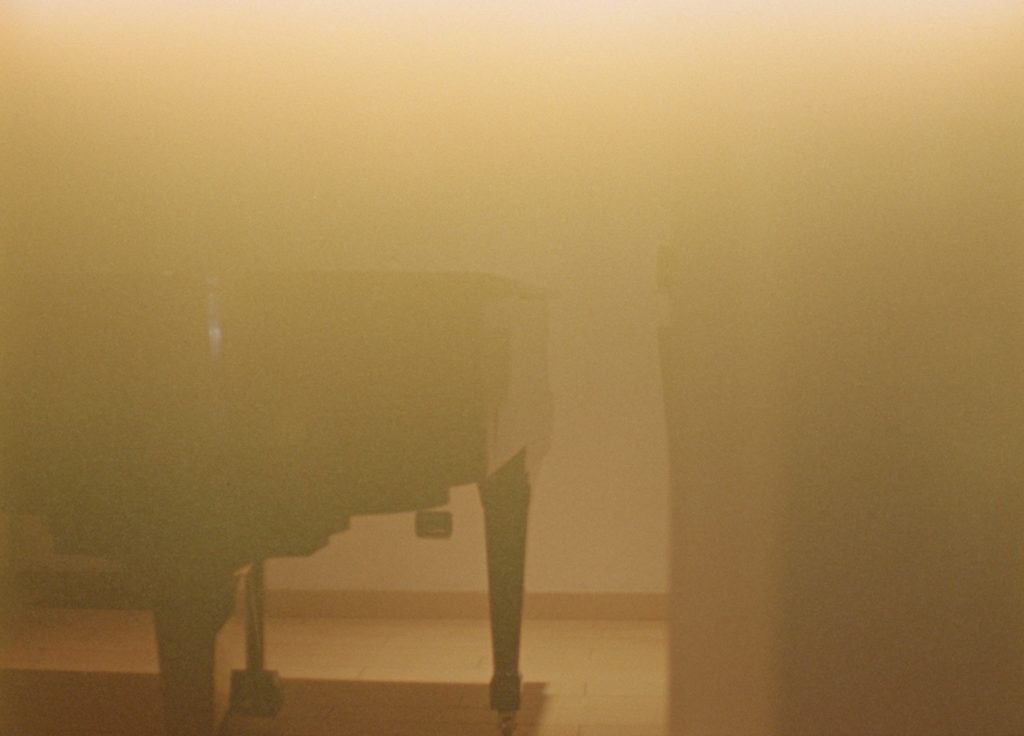
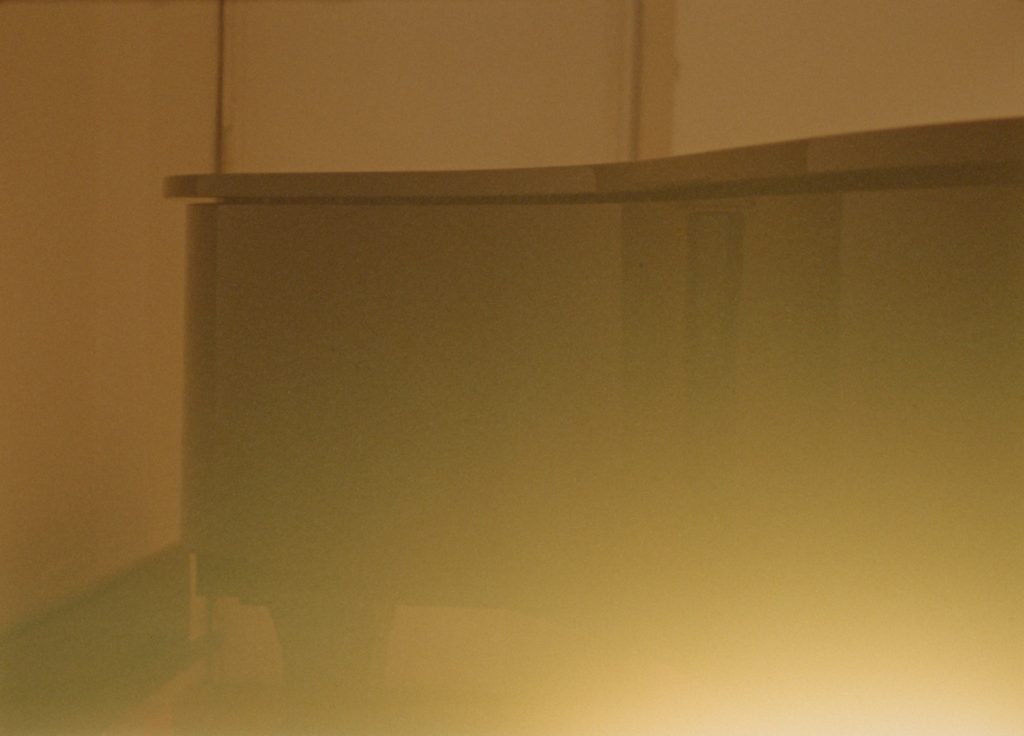
Lenard Giller sees his moving-image works as closer to photography than film. The camera never moves; its stasis is kinetically similar to that of a long-exposure photograph in which duration plays a key role in the final image. On this aspect of his practice Giller has said, “I consider the durational aspect of the piece and then I place static content within that container.”[1] Rather than the images themselves, Giller’s medium is this temporality of the image. His camera fixates on slumbering pianos and billowing smoke meandering across the sky; in another, the practiced routine of cutting one’s own fingernails gestures toward the poetic time of self-ablution. Recently in his work, the cinematic image has been paired down to its most essential elements, evading the typical genre distinctions of film. His description of the duration and apparatus of filmmaking as a container is apt; in his films the content sets the tone, but his project’s reticule remains organized around the apparatus of production that makes moving image possible, and in turn structures our perception.
[1] “Lenard Giller: Revisions.,” CURA, accessed July 16, 2025, curamagazine.com/digital/revisions/
Writing at a moment when the effects of the globalized transmission of television had not yet become evident, Marshall McLuhan noted that “the personal and social consequences of any medium — that is, of any extension of ourselves — result from the new scale that is introduced into our affairs by each extension of ourselves, or by any new technology.”[2]Taking up this insight, Giller’s project examines the foundational assumptions underlying how media shapes an epistemology of perception through the technologies that produce it. In his poignantly reticent installations, Giller carefully traces a tactile line between images and their absence, revealing an aesthetics of cinematic reduction that brings the conditions of viewing into sharp contrast.
[2] Marshall McLuhan, Understanding Media: The Extensions of Man (New York: McGraw-Hill, 1964), 23.
This is most acutely articulated in Giller’s recent video work systems/structures (2024). First shown as a 16mm film transferred to digital projection at Artissima in Turin in 2024, the work consists of a 107.8 foot film reel that, when projected, depicts several angles of the back-side of a quiescent piano. The footage has a warm orange tone, suggesting a lack of post-processing, and the silhouette of the individual operating the camera is visible reflected in the piano’s curve. After almost half a minute of the first static shot, the film cuts closer to the instrument. This time the shot lingers for only nine seconds. Attentive viewers may notice a pattern: the length of each shot is determined by the piano’s measured distance from the camera.

This refinement of filmmaking to its ur-stuff — duration, distance, image — is a recurring strategy in Giller’s project, shaping a visual logic of subtraction that lays bare the relationship between image production and structured perception. Through its entanglement of time and distance, systems/structures suggests that, like time, distance is also an empty medium, waiting to be filled with content. Measurement has enormously structured our reality through its standardization and, as is made evident in Giller’s film, this standardization is also a reduction: a system of negation that posits a homogenous universal as opposed to a constellation of singularities.
Measurement hasn’t always been stable. Before an era of global standardization, small-scale trading was achieved across localities by learning the exchange rates between several heterogeneous local forms of measurement.[3] The difficulty of mistranslations between measurement systems led to the creation of a universalized system. However, it was more than the protection of profit that drove the introduction of a universal system of measurement. The political theorist James C. Scott argues that for the National Assembly of the French revolutionary government, the metric system was a national project, writing that “the abstract grid of equal citizenship would create a new reality: the French citizen.” [4]
This same universalization of a national measurement enabled the camera to define new ways of seeing. In filmmaking, measurement grounds the mechanical processes of image-making, and has a direct relationship to the modes of temporal perception that these technologies produce. Even today, when most measurements are automated by digital sensors, nearly every aspect of camera operation relies on universal measurement. Through the industrialization of cinematic images, the universal meter became central to an epistemology of perception created by the mass distribution of cinematic images.
Reflecting the careful measurements of wire lengths and tensions calculated such that each key on the piano produces a specific resonance, the edits in systems/ structures are decided according to the distance between the camera and the object. In this minimal gesture, Giller’s work entangles the ideology of the universal measurement with the production of cinema, quietly revealing the ideological charge present within the structuring scaffolds of film.
This minimalism continues in other works in which Giller explores the structures that enable the conditions of cinematic spectatorship in exhibition settings. The artist has stated that he has little interest in becoming a “filmmaker” or working in cinematic space. For Giller this is a temporal concern. Movie theater time demands specific restraints, while gallery time — what Giller has referred to as “reflexive time” as opposed to the “consumable time” of the theater — allows the viewer to float in and out of a viewing room: there is no insistence on an exchange between the film and the viewer.[5] Rather than demanding specific viewing conditions, Giller folds the constraints of the gallery into his work.
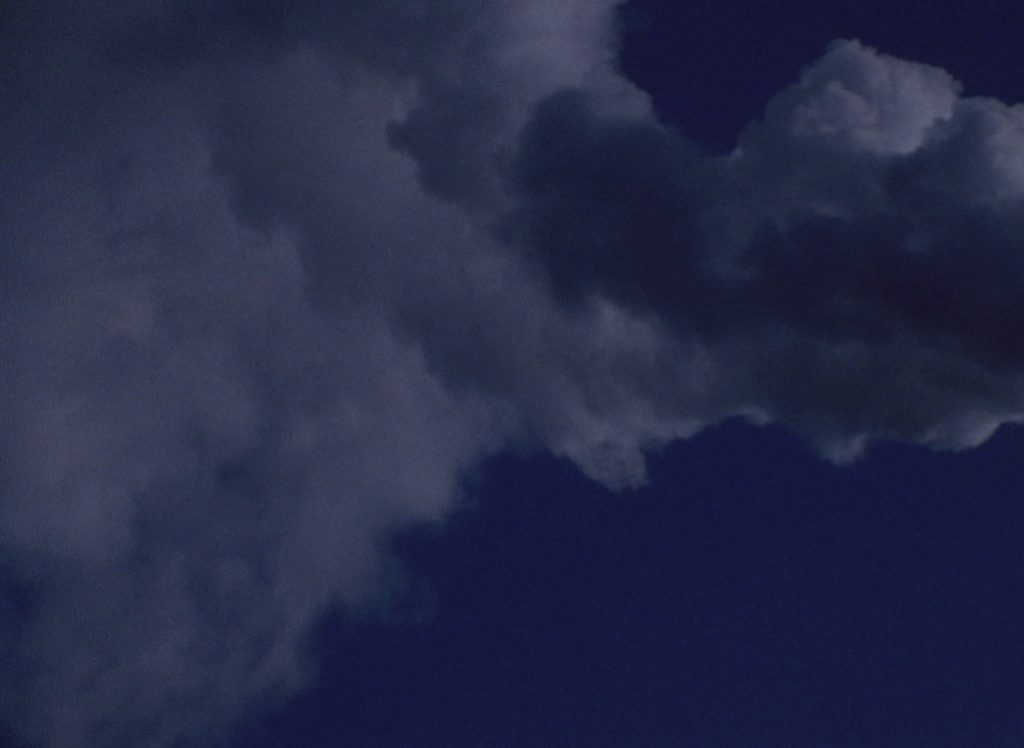
Giller’s 2023 work actors, for instance, uses the brightness of the exhibition space itself as a variable element in the work. In the 16mm film, a thick cloud of white smoke billows across a deep navy sky. The smoke is barely visible against the starless firmament, and without its movement across the visual field, one might mistake the frame for a flat wash of navy blue. Multiple prints of the film have been produced at different brightnesses, and the brightness of the print displayed is determined by the conditions of the work’s exhibition. The work’s enigmatic title gestures to these prints, each playing a specific role as it is matched to the brightness of its surroundings.
[3] We still see the echoes of the existence of these local forms of measurement in language; phrases that describe distance stick to our tongues as traces of this history: “a stone’s throw,” “within arm’s reach,” “a hair’s breadth,” “a pace,” “shouting distance,” or even in the now standardized imperial unit “foot.”
[4] James C. Scott, Seeing Like a State: How Certain Schemes to Improve the Human Condition Have Failed (New Haven: Yale University Press, 1998), 32.
[5] “Lenard Giller: Revisions.,” CURA, accessed July 16, 2025, curamagazine.com/digital/revisions/.
Giller’s work articulates a growing interest among contemporary artists in returning to analog film-making techniques for the resistances that the wet processes of celluloid film afford.[6] Rather than an aesthetic or nostalgic return to a previous generation of technology — we find this kind of return present in the recent proliferation of “digi-cam” aesthetics on social media platforms — Giller’s structuralist use of analog film embraces its limitations as a method of adding friction to a world inundated by the textural smoothness of immediacy.
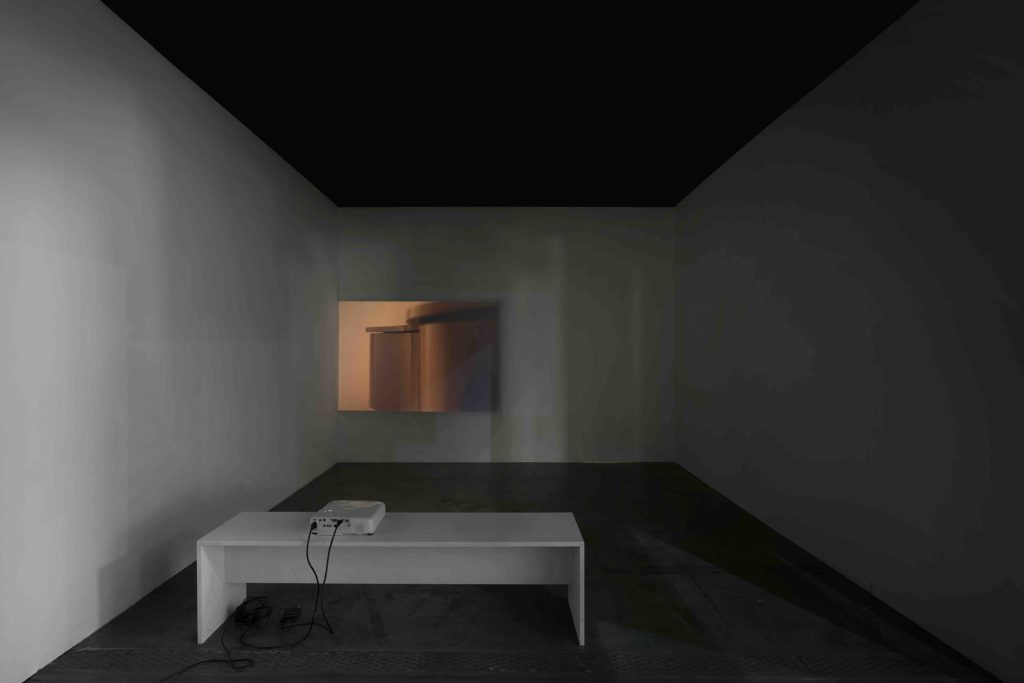
This structuralism is not strictly a cold conceptualism however. In works such as untitled (2024), shown first in a 2024 two-person exhibition with Maria Toumazou at Bar Civil in Dusseldorf, the poetics of living scaffold a quiet contemplation on the rhythms of everyday life. The film consists of fifty-five seconds of a close-up on a pair of hands cutting their fingernails. The footage — 16mm film transferred to digital — is dark and quiet, the movements of the hands are practiced, rehearsing actions seemingly done hundreds of times before. In contrast to systems/structures in which the structuring script feels almost mathematical, untitled evocatively describes the ways that our time is measured through routine; reality breaks the frame, and time is given completely to life.
Through Giller’s process of reduction, the mutable limitations of media formats appear as willing collaborators, a structuring body for his work. Even when sound and image are exhibited together, as in his feature-length film Productions (2022), they are considered separate works. Productions consists of 360 found animation frames of Disney’s 1950 movie Cinderella taken from a 1982 sticker album. Each frame is scanned and reinserted into the exact time-code they appear in the movie, appearing for only a moment, a flash before the image returns to white, producing a Tony Conrad-esque flicker effect. In 2023, the film was exhibited alongside its timecode displayed on a CRT monitor, a work titled Timestamp (107232) (2023). In a work titled Soundtrack (01:14:28) (2023), the audio of Cinderella’s soundtrack plays for only a moment each time a sticker appears; the rest is accompanied by a deep white noise. The installation of Productions is modular, and there exists a future possibility of each element being displayed as a distinct work.
[6] Other artists embracing analog technologies in their work include Kobby Adi, Nina Porter, and Philipp Fleischmann.
Thus, whereas sound appears in Giller’s practice, it appears in its asynchronous totality.
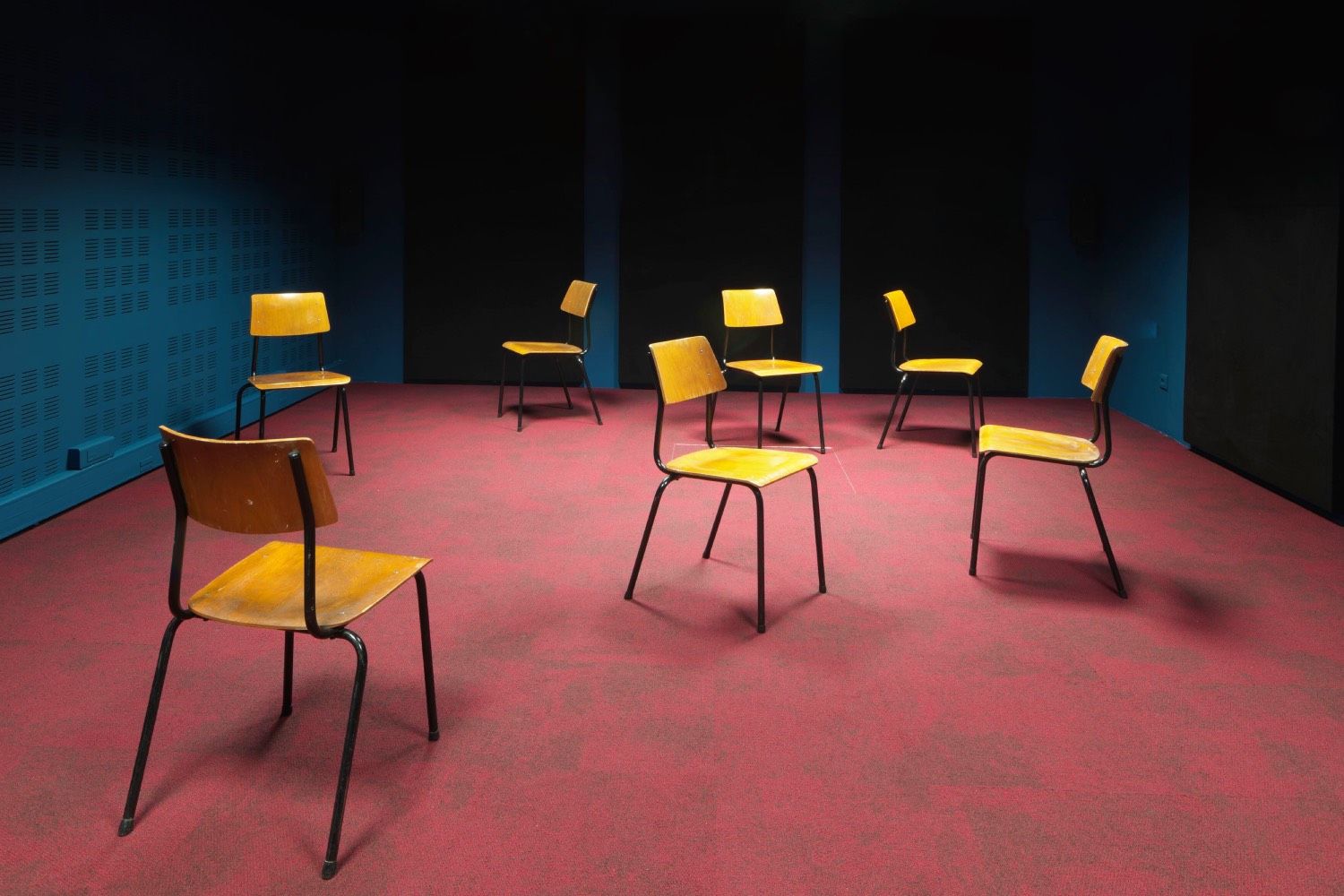
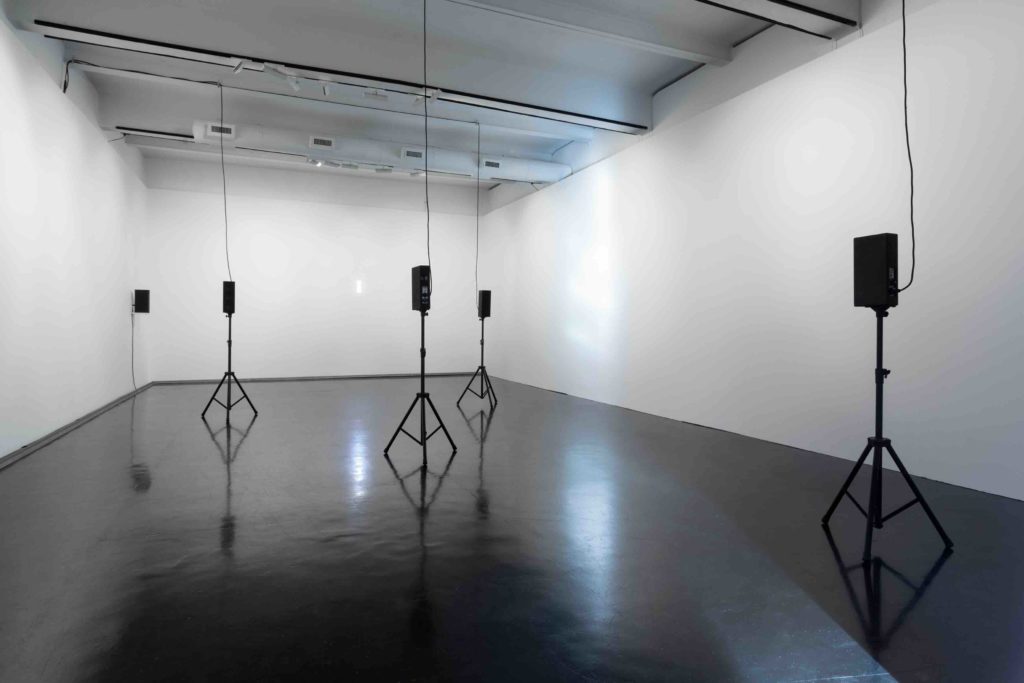
The great Austrian filmmaker Peter Kubelka has said that it is its asynchronicity, the possibility of its split from image, that is “the great possibility of sound in film.”[7] In Giller’s practice, we find the ultimate form of a split between sound and image in his audio installation action at a distance (2024). First exhibited in its full five-channel form at MACRO in Rome in 2024, action at a distance takes place in a sparse room — the only physical elements are several speakers on stands, which Giller refers to as “actors,” and a small rectangular cutout in the wall of the space, revealing a view of Rome through a window otherwise obscured by drywall. Avoiding medium essentialism, the cutout may be seen as the cinematic image itself — faceted to its essential presence and quietly embedded within the room’s expansive monumentality of sound.
Like Giller’s other work, the content for action at a distance is described with a script.The work has two elements: a static field recording of the surrounding city in which the work is exhibited, and a musical component created by the artist or by collaborators. The properties of the field recording (pitch, volume, and velocity) are then mapped onto the guest composition, transforming it by modifying specific frequencies.[8] The resulting audio is ethereal and sonorous: swells of soft ambient chords undergird moments from the field recording that escape the modified frequencies. Children’s laughter, the chirping of birds, and what might be the high-pitched ting of a bicycle’s bell float above dissonant harmonies and sharp, synthesized bursts of sound.
Giller sees action at a distance as a structural approach to audio. Like the images that fill the duration of his film works, the static content that embodies Giller’s duration here is the field recording that, when combined with the guest composition, becomes a warped version of itself. The cut in the wall revealing Rome outside is the antagonistic kernel — reality breaks through and the totalizing promise of structuralism dissolves in the light of the phone-sized aperture.
[7] André Habib, et al., “An Interview with Peter Kubelka,” Offscreen 9, no. 11 (November 2005), accessed July 16, 2025, https://offscreen.com/view/
[8] For its iteration in Rome, Giller collaborated with the musician Lara Laeverenz and the sound designer Oriol Campi.
If structuralist film has in the past been seen as obtuse or difficult to access, it is because it attempts to articulate a ground on which the consumption of all other media is built; it renders bare the skeleton of the production and consumption of images, and thus must reveal only the minimal images necessary to take specular form. In Giller’s project, this subtraction does not signify emptiness; rather, it functions through a generative clarity that brings into focus how media shapes perception and, by extension, collective reality. In revealing how minimal elements conspire to produce image and sound, Giller invites viewers to question the very conditions through which media structures our perception.