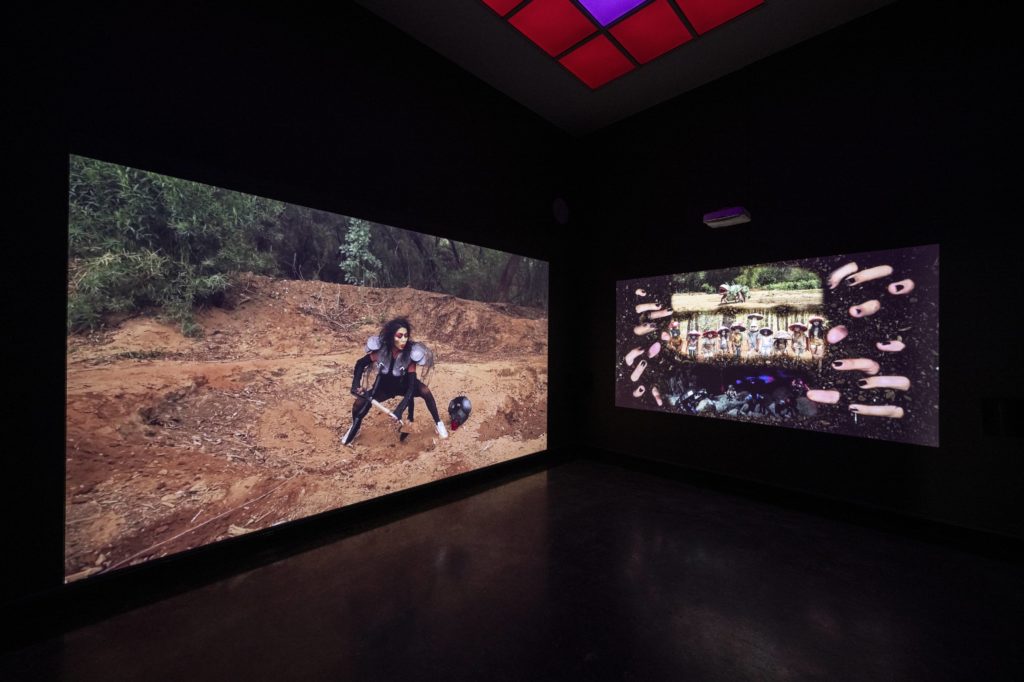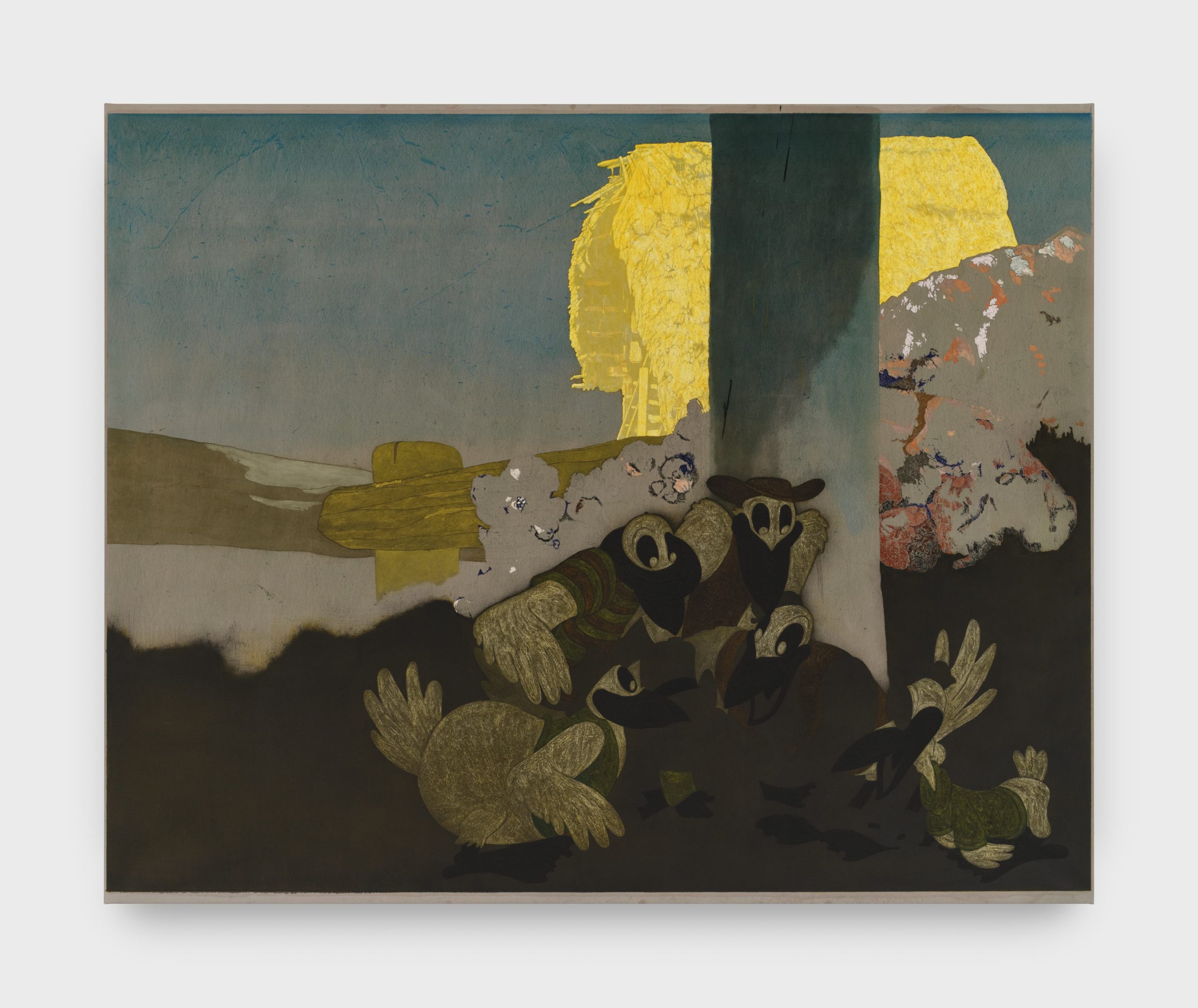
We have heard the story before: a person descends through a hole in the earth and enters a hidden world. From Lewis Carroll’s Alice’s Adventures in Wonderland (1865) to Dante’s The Divine Comedy (1308–21), our perception is challenged through new encounters in a world turned on its head. In Ludvig Holberg’s Nicolai Klimii Iter Subterraneum (1741), the titular character falls through a hole, said to be based on a real cave atop one of the seven mountains surrounding Bergen. This literary descent provides the conceptual framework for the group exhibition “Iter Subterraneum” at Bergen Kunsthall, and takes Holberg’s narrative as a point of departure rather than a script to be illustrated.
A gallery set apart from the rest of the exhibition is dedicated to past editions of Holberg’s book, made in collaboration with the Department of Special Collections at the University of Bergen. The visual narrative unfolds through black-and-white illustrations from the first edition, displayed along a wall, while vitrines at the center present the different versions of the book. The room anchors the exhibition in its historical origins, situating the narrative before it is expanded across the other three divisions at Bergen Kunsthall. While rooted in a local narrative, the exhibition opens a global dialogue by gathering ten artists from different parts of the world, working across video, sculpture, collage, and performance-based practices.
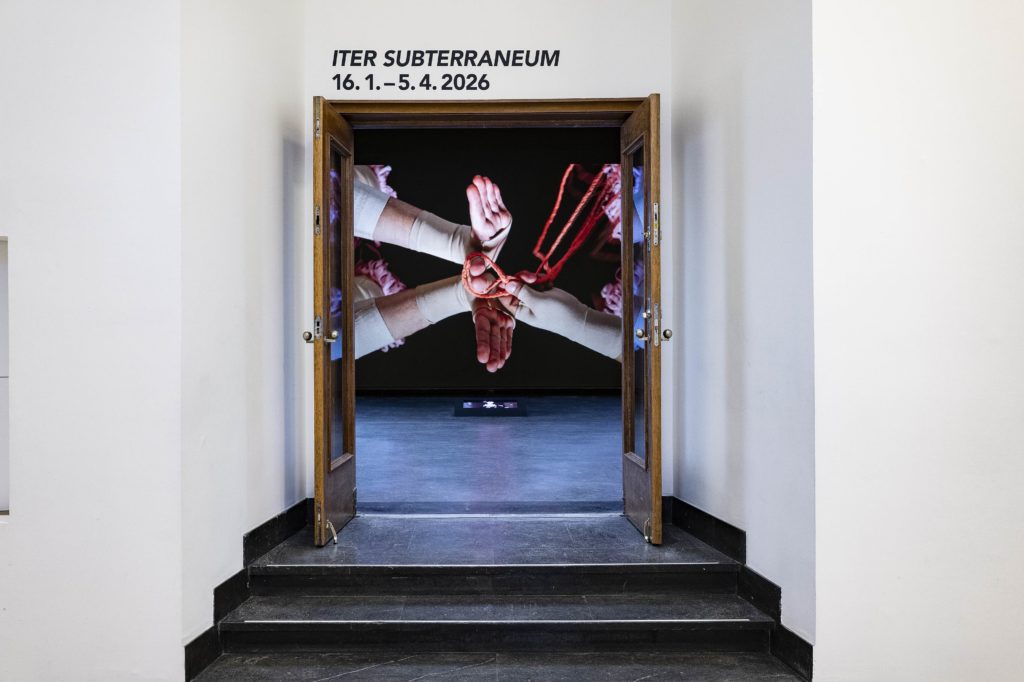
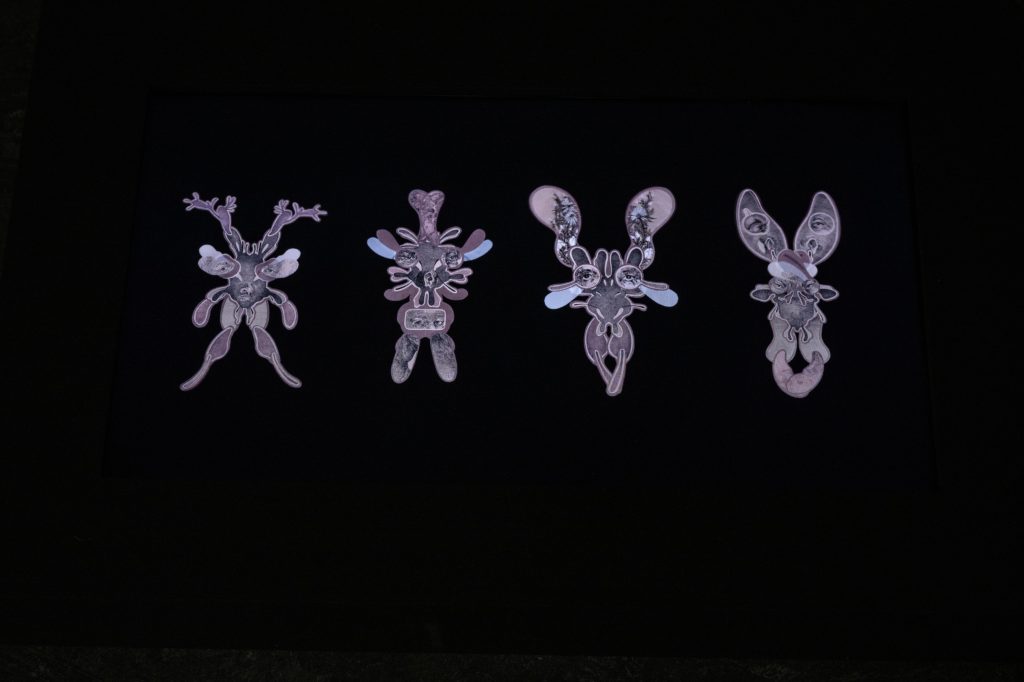
Projected on a tall wall in the entry hall is the video performance Asylum – A Poem of Unrest (2024), by Robert Gabris. Two human figures distorted by costumes in beige tones tower over the room. Against a void-like black backdrop, they move slowly, evoking insect-like gestures, fluttering and folding in a choreographed rhythm. This is paired with the animation Asylum – Bodies of Unrest (2024), which features fragmented elements from the performance and plays in a small box on the floor, contrasting with the large screen. From the speakers, a murmured voice is barely audible, sounding as if it originates from another room; it is narrating a poem handwritten on the gallery walls. In the dim light, it is just as hard to make out the words, demanding intimacy from the viewer. Looking up at the tall beings, it almost feels as though you yourself have shrunk and are not human anymore, but rather something small, witnessing another way of being. The displacement of the self is the installation’s core, as written on the wall: “The ‘I’ is no longer available, it should be us.” It suggests that to find a utopia, we must make room for collective existence.
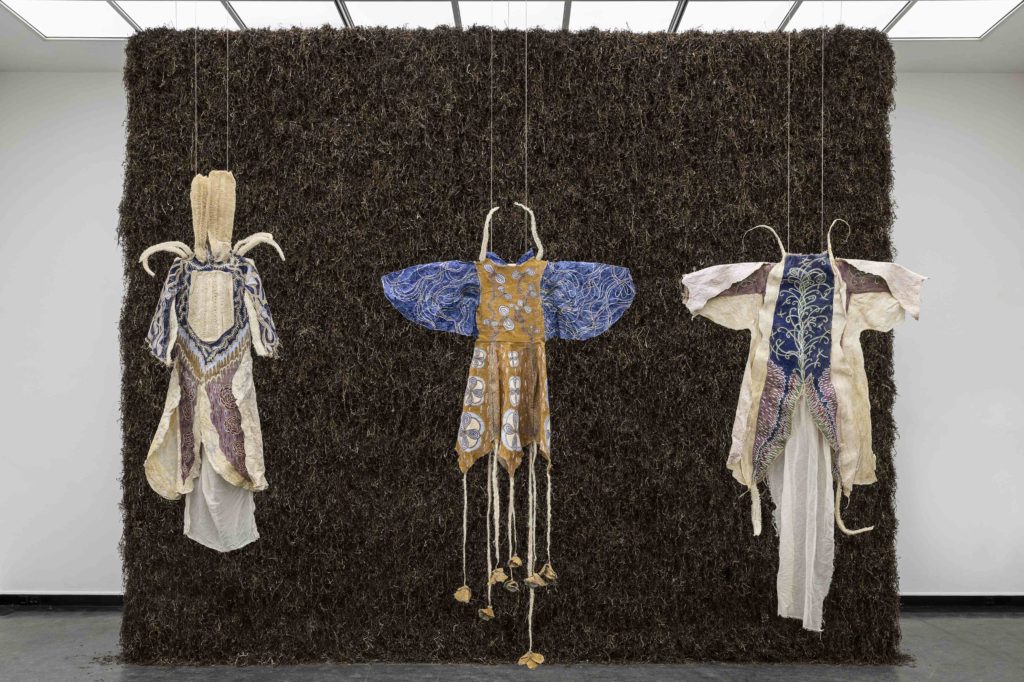
The publication of Peter Tompkins and Christopher Bird’s The Secret Life of Plants in 1973 contributed to a cultural shift in our conception of plants from passive backdrops to our human-led stage. What happens when we view plants as equals? In Holberg’s story, this question is explored through Niels Klim’s travels through the planet Nazar, where he encounters anthropomorphic trees in the region of Potu, which tellingly almost spells “utopia” backwards. This theme of organic equality is manifested in the final gallery, hidden behind a monumental wall of dry grass. Walking past it is like transcending into another world. Sculptures by Cecilia Fiona, from the series “Harvested, Gathered, Carried (The Life of Souls)” (2023–25), form a fantasy ecosystem, enhanced by fairy-like costumes hanging from the ceiling, What a Joy to Live Above and Below All at Once (2024-2025). Crafted in part from seashells, sisal fibers, and rabbit skin glue, the garments propose a utopia where the waste of industrial fast fashion is replaced by a symbiotic organic mechanism. Nearby, Mira Adoumier’s three- channel video Dreams of a Wandering Octopus (2021) stands out, with footage of a forest that resonates with Holberg’s utopia.
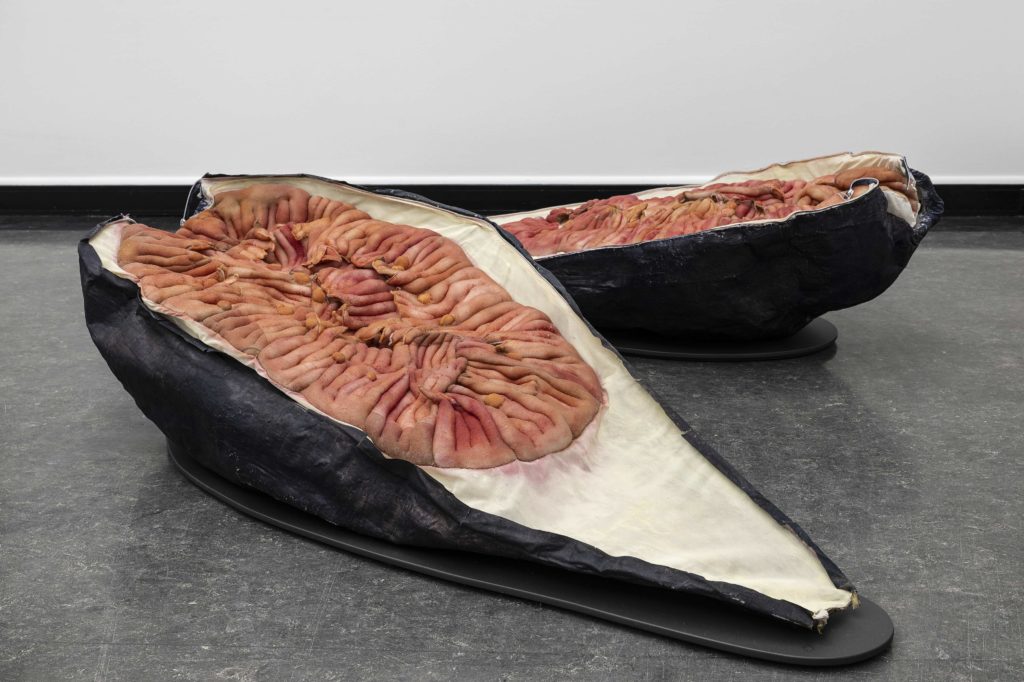
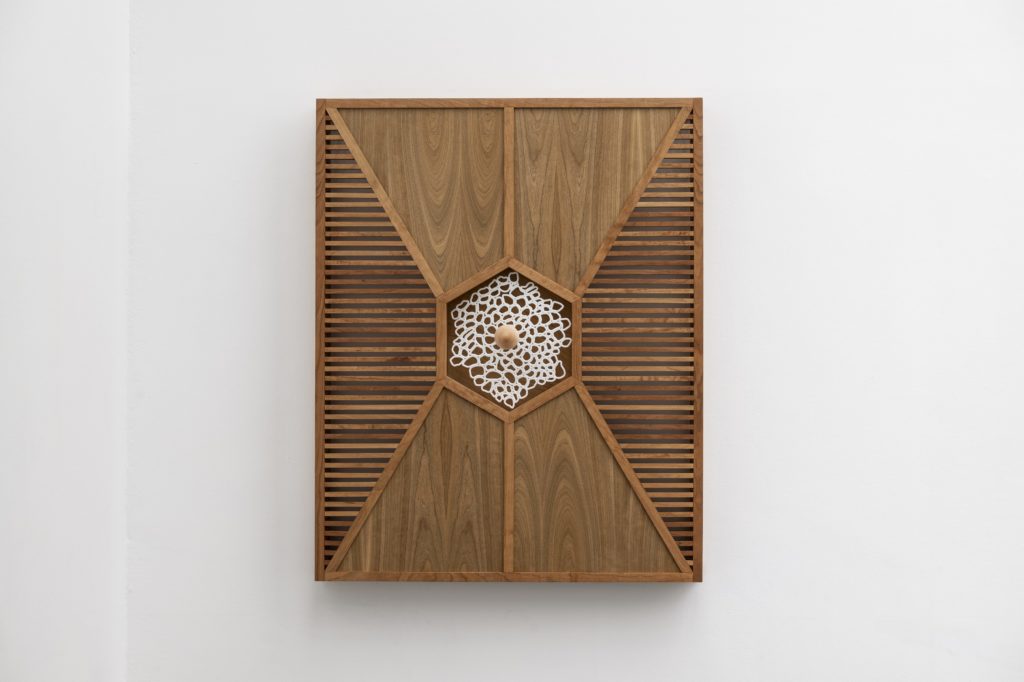
Near the exit, De-Gestalt Yourself (2022) by Anicka Yi hangs on the wall. At first glance it resembles wooden furniture, with the symmetrical lines of cherry wood enhanced by teak oil. This formal language is interrupted by a round, skin- or shell-like shape at the center, resembling a nipple. The shape is surrounded by white organic tissue, evoking both the anatomy of breast milk ducts and the white veil on the fungus Phallus indusiatus. To de-gestalt is to dismantle the idea of the whole, breaking it down into components. By blending separate elements — such as human anatomy and wooden structures — the work allows the viewer to study the objects individually, revealing a body that is no longer an isolated unit but something hybrid. It forces a shift in perspective: we are no longer looking at nature as an object from the outside, but instead recognizing ourselves as part of the whole. This hybridity is also apparent in I skyggerne er alting skævt / lad myrerne / bygge sine slotte / af mine haarstraa. / saa / jeres minne / i mine sprække. / aabne / mine saar / igen, / og igen (2024) by Kaare Ruud, in which layers of bark are used to form a human hand.
Taken together “Iter Subterraneum” forms a contemplative whole. Anchored in local history, it adopts Holberg’s book using imagination as a means to propose alternatives to established ways of being, placing diverse life forms within a shared relational field. Rather than reaching a finalized utopia, it challenges the viewer to reconsider the world by looking at it from below.