One enters the sequence of galleries at Hauser & Wirth on 18th Street, New York, with an initial expectation of an intellectually resonant revelation from Glenn Ligon. What one gets when viewing “late at night, early in the morning, at noon” is rather a summation of an artistic practice — a mini-retrospective of a thinking process and a method. As the title of the exhibition suggests, what we see will be evocative and elusive. Knowing the boundary-pushing practice of Ligon, including his systematic framing of visual and verbal cultures and his nods to the figures of James Baldwin and Toni Morrison, we expect to see a conceptual argument at the center.
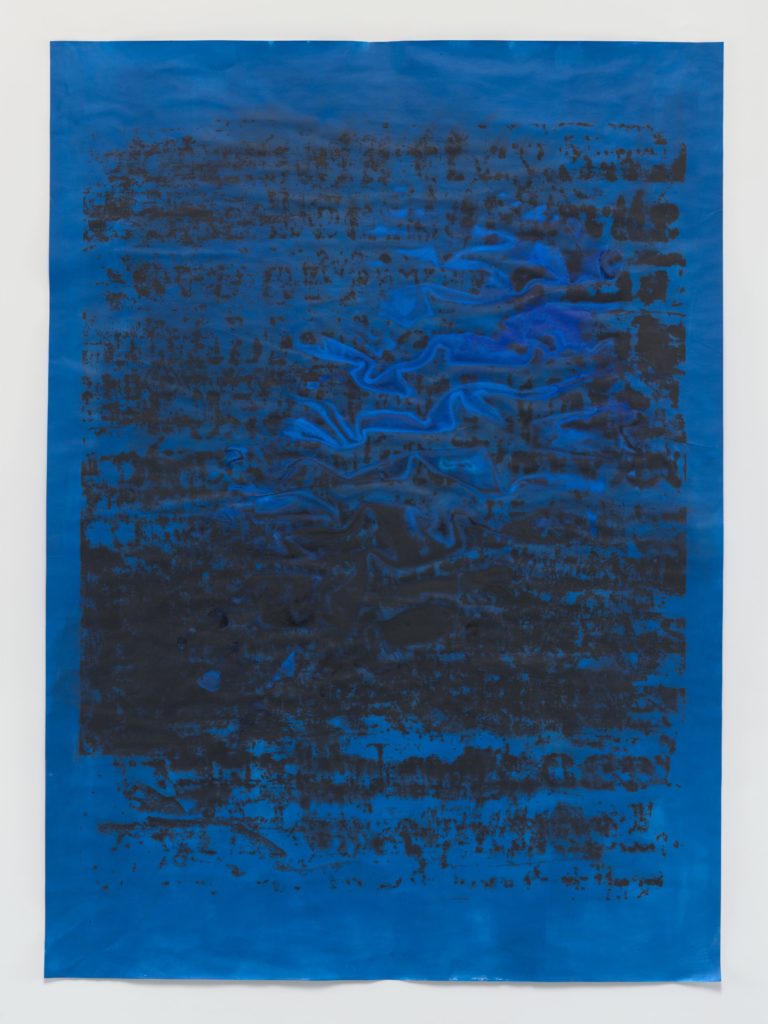
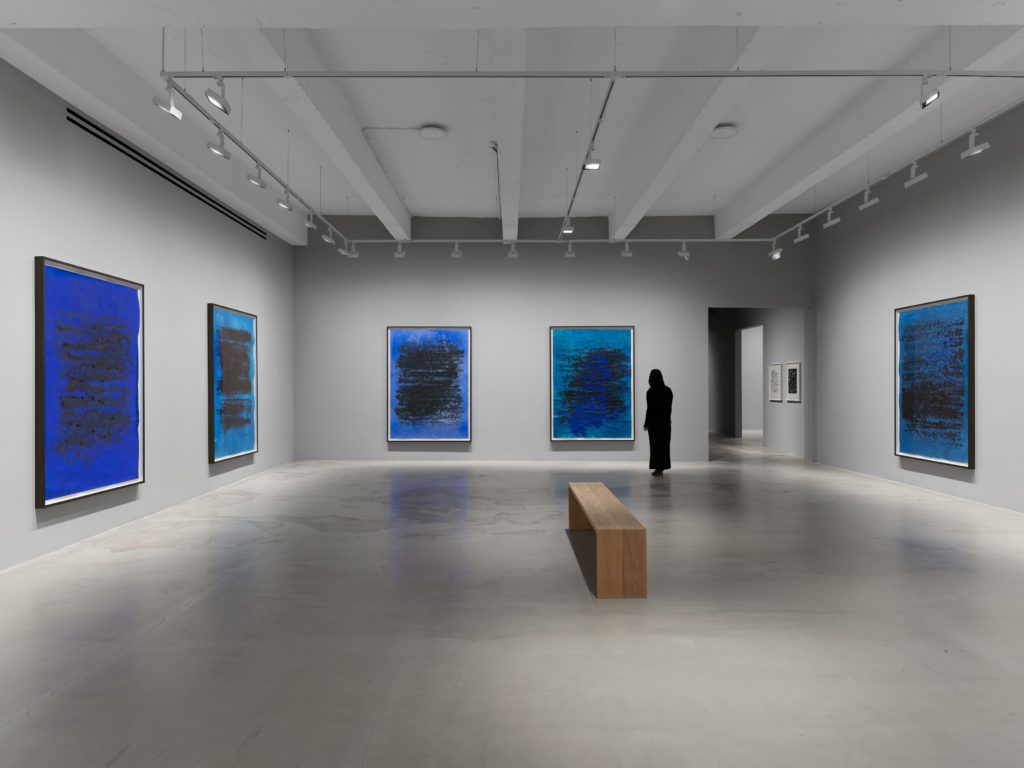
Yet the main character of this exhibition turns out to be color: blue that is luxurious, viscous, and triumphant. The color of tristesse, melancholy, a descending night, yet brought in as an untamed force of nature. Ligon presents “Blue (for JB)” (2025), a new series of large-scale works on paper that are conceptually connected to his systematic engagement with language in the “Stranger” paintings. That series, inspired by James Baldwin’s 1953 essay “Stranger in the Village,” began in 1996 and includes more than two hundred paintings, drawings, and prints created over several decades. For the new series on view at Hauser & Wirth, Ligon begins by making rubbings on delicate sheets of Japanese kozo paper laid over preparatory studies for those earlier text works. The resulting impressions coagulate words and abstract forms, and the line between language and image becomes blurred and transitory. The ink is then added through silkscreens on blue backgrounds, creating eight larger and six smaller inner landscapes that are a crossover between a rebus word puzzle and an artwork.
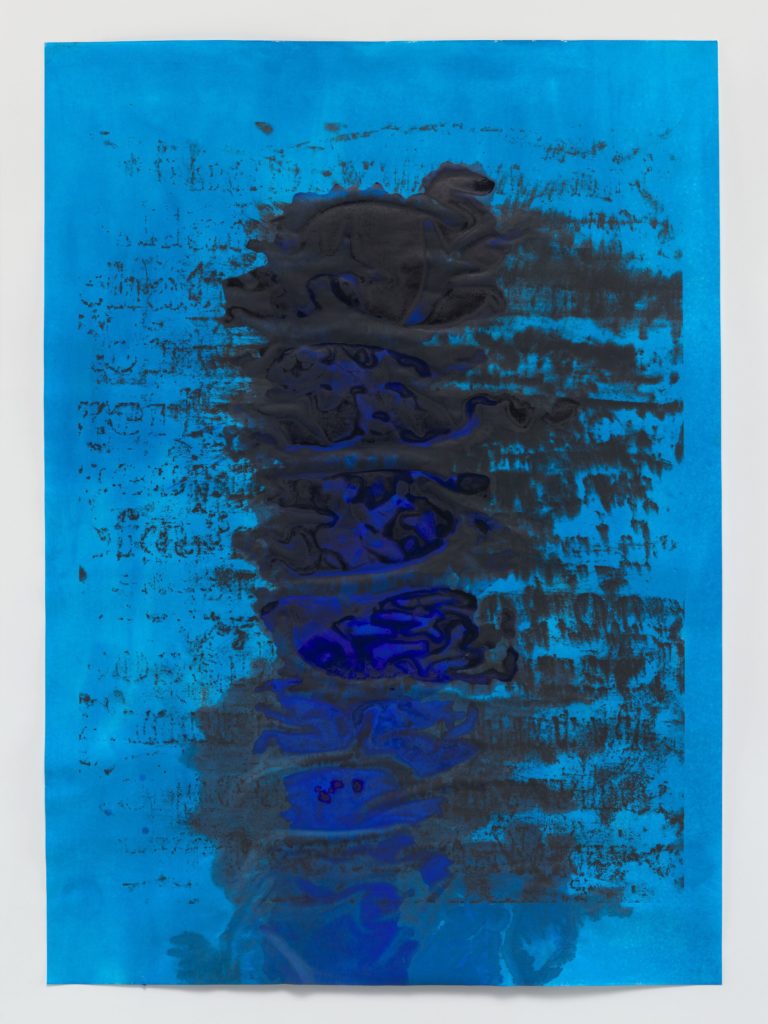
Cerulean blue, cobalt, and turquoise rectangles confront viewers with a challenge to look at the nature of erasure through multiple layers of materials. Can one erase a human being? An entire race? The registers in which Ligon wants us to consider this erasure operate on two levels. One register is the intersection of the power of the artist and the surfaces he is trying to erase, transform, and transfigure. The second is erasure by time, as the temporal process involved in creating some of these works spans decades. Yet what we see does not end in a conceptual, thinking space; instead we are invited to look closely into a very different space of splashes, warps, and markings of black ink amid diverse hues of blue. Each work on paper acts as a separate living system. In physics, a system is defined as a combination of internal and external forces acting within or on a single element. Here, time and force are presented as counteracting influences on our shared cultural heritage. We see a problematic notion of power and race enacted in each artwork, a configuration shared with vastly dissimilar gestural Abstract Expressionism results. Ligon, who was influenced by and experimented with Abstract Expressionism during his studies in the 1970s and 1980s, returns to his formulaic roots in these blue works, albeit with the fluency that comes with mastery.
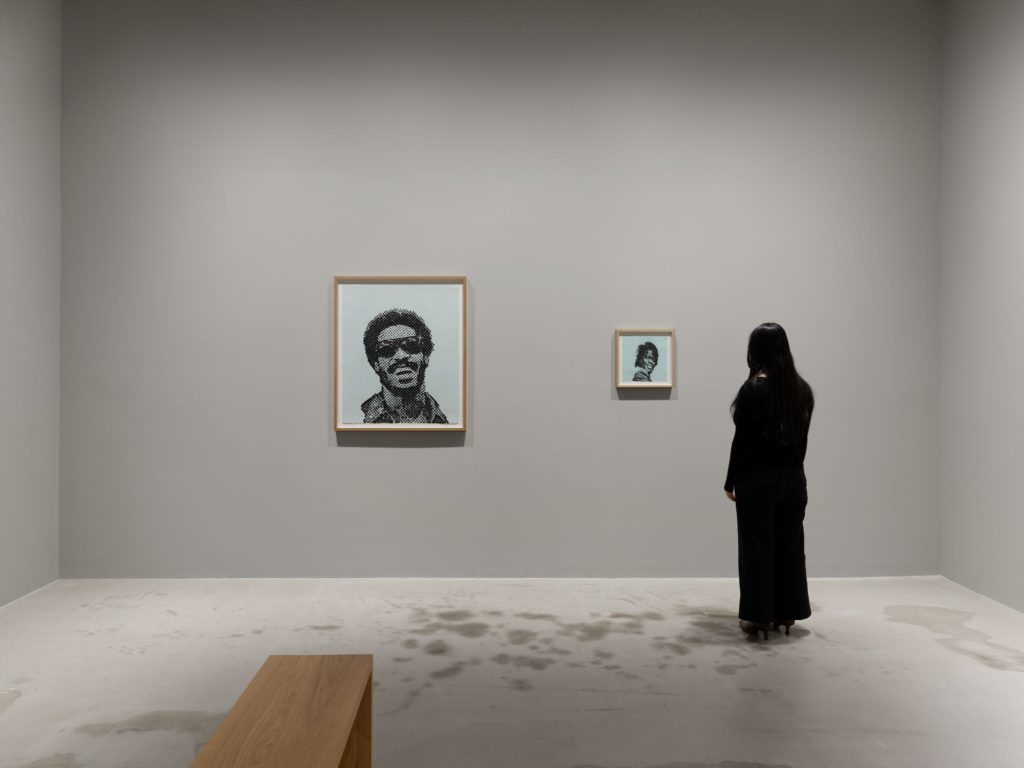
. This elegiac meditation on erasure and power leads to the exhibition’s second gallery, a more intimate space that functions as a point of concentration rather than culmination. After the immersive abstraction of the blue pieces, the viewer encounters a markedly more concrete and conceptually direct body of work in black and white. The second gallery assembles a selection of prints spanning three decades, mapping the trajectory of Ligon’s print practice from the early 1990s onward. Among the works presented is Untitled (Four Etchings) (1992), a quartet of prints that draw on texts by Zora Neale Hurston and Ralph Ellison. This historical grounding is extended through the artist’s self-portraits from 2004 and 2008, created in the image of himself at nine and eleven years old, in which Ligon pays homage to his musical heroes — Stevie Wonder and James Brown — using stenciled pulp on various types of paper. Together, these works foreground questions of selfhood, visibility, and constraint, asking how one can live fully when one’s skin is persistently read and interpreted. How can one be free and materially present in black-and-white environments? These questions are poignantly asked using concrete visual means: white words on a white background and black words on a black background. Here, language operates not only as content but as structure, framing the artist’s cultural and sociopolitical experience with a rigor that underpins the exhibition as a whole.
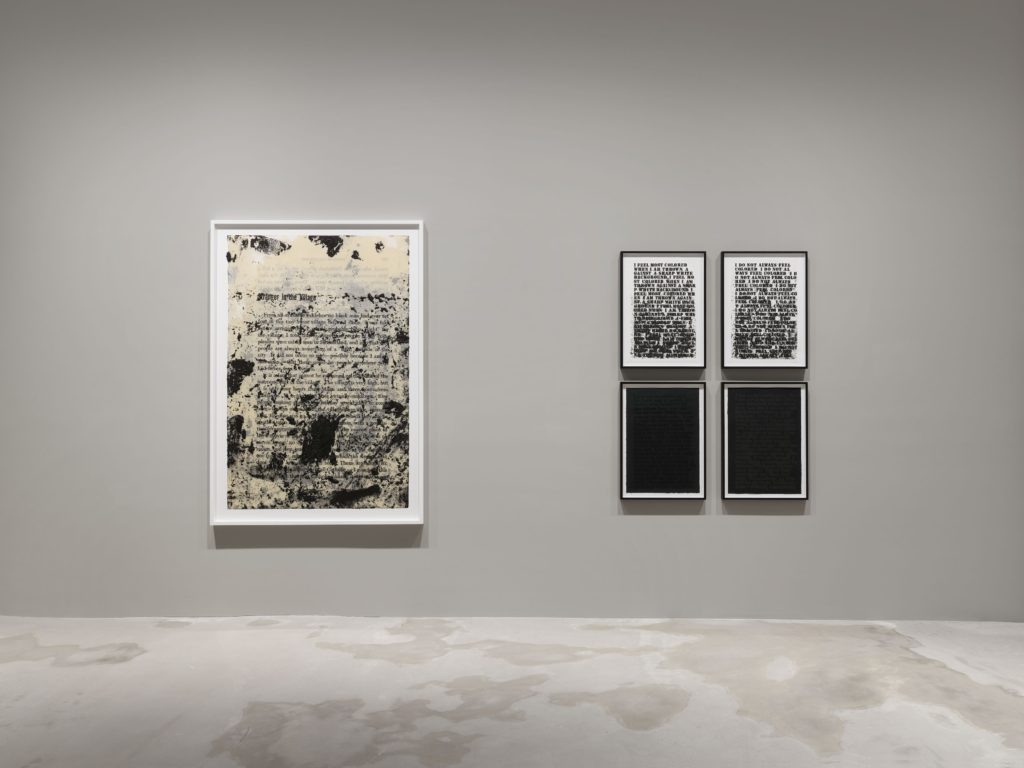
The most incisive moment of the exhibition, however, resides in two smaller, framed works: Untitled (Condition Report for Black Rage) (2015) and Black Rage (back cover) (2019). These silkscreen and digital prints are derived from an annotated reproduction of the cover of the landmark 1968 book Black Rage by psychiatrists William H. Grier and Price M. Cobbs, a text that examines Black identity through intersecting social and historical pressures. Meticulously catalogued marks inscribed by Ligon on the cover of the book in black pen record bends in the spine, abrasions to the face, bent edges, scratches, dust, creases, liquid accretions, and remnants of a label, among others details — essentially documenting what it feels like to be Black or non-white in a white world.
Taken together, both galleries present Ligon as a rigorously methodical artist pushing the boundaries of media in his material and conceptual queries, from seminal works that transformed the art world in the 1990s to those that continue to do so today by revisiting and renewing his own legacy of experimental confrontation with cultural and racial erasure.