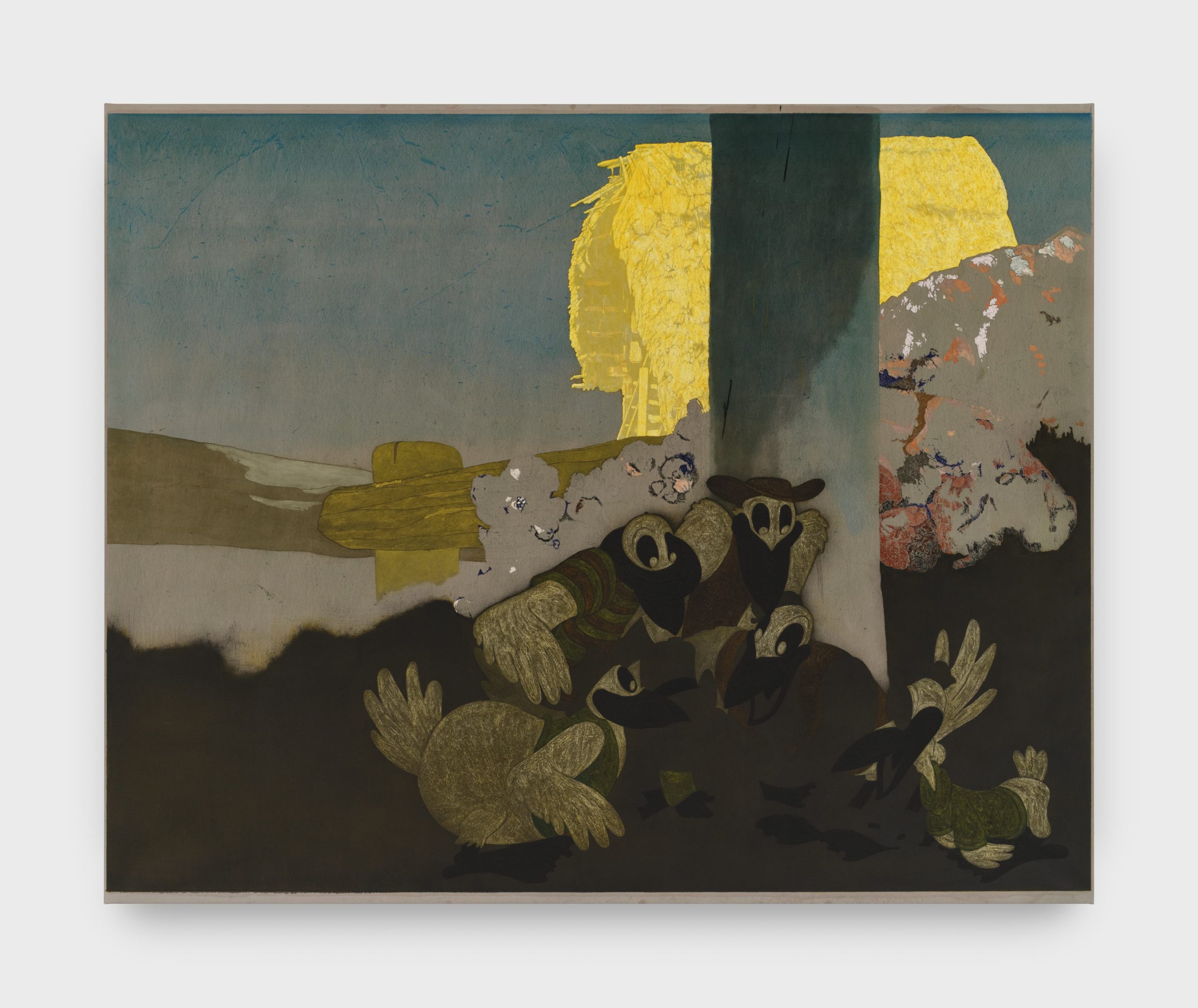
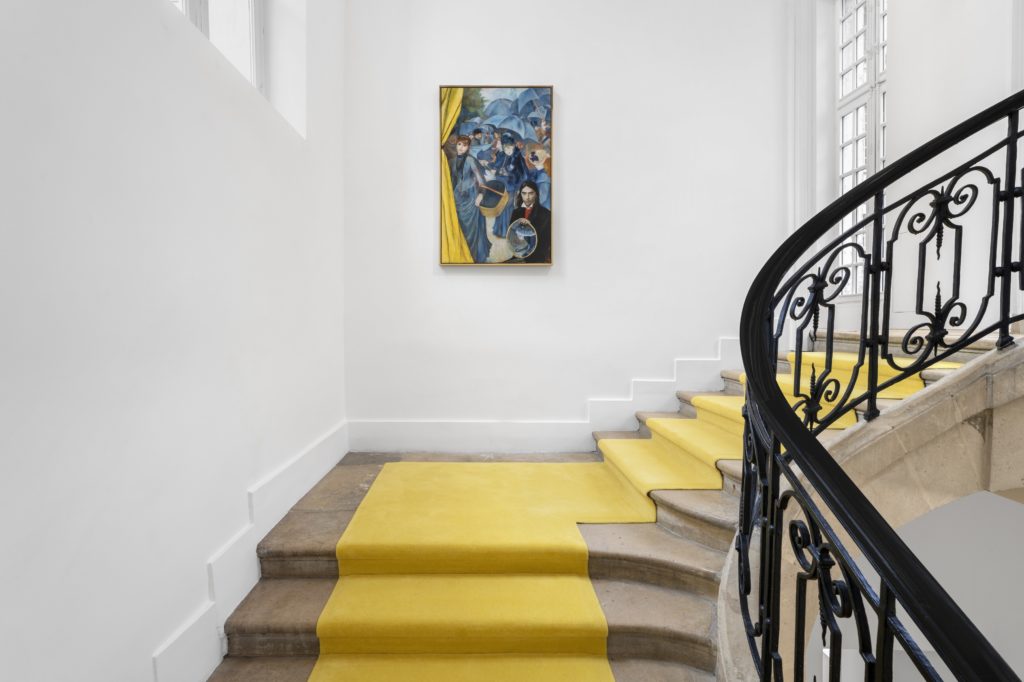
In Giangiacomo Rossetti’s latest exhibition, “Résurrectine” at Mendes Wood DM, Paris, a mysterious yellow glows. Vivid and sickly, the color first emanates from The party (all works 2025–26), a painting hung in the gallery’s entrance. The artist depicts himself walking brightly out of frame, dressed in a shade of wilting mimosa. Two men follow behind him, and I do too, turning towards the staircase of the gallery where a yellow carpet spills. A trompe-l’oeil curtain of the same hue frames the painting at the top of the stairs, Here comes the child (2025–26), a curious reworking of Pierre-Auguste Renoir’s The Umbrellas (1880–86). The artist greets me again in the bottom right-hand corner of the composition, holding what seems like a mirror, but is instead a kind of game.1 In very few gestures — by way of scenography, art history, and other tricks — I enter the idiosyncratic logic of “Résurrectine,” the dusky light of its “party.”
1 In this composition, Rossetti literally obscures — deletes — the young girl from the original composition, and instead holds her hoop. He however still paints the girl’s feet that her hoop originally framed, hence — out of joint — appearing like a reflective surface.
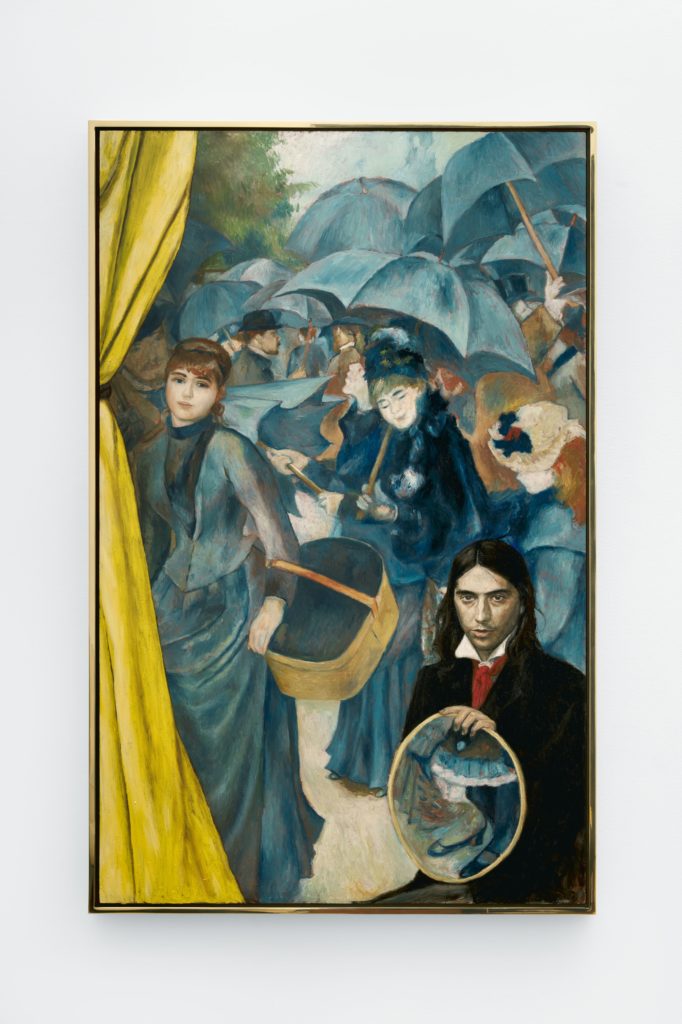
I use the word “logic” because Rossetti’s paintings are never straightforward figurations. Rather, in an age when the texture of imagination is digital and networked, he resurrects figurative painting’s illusory devices, crafting synthetic compositions that recast contemporary subjects in styles reminiscent of historical painting. Rossetti thus rewires their bodies and souls through references ranging from anti-fascist painter Mario Mafai to Camille Pissarro’s once-scandalous realism, not so much depicting his subjects as displacing them within the very particular socio-historical “network” of the canvas.
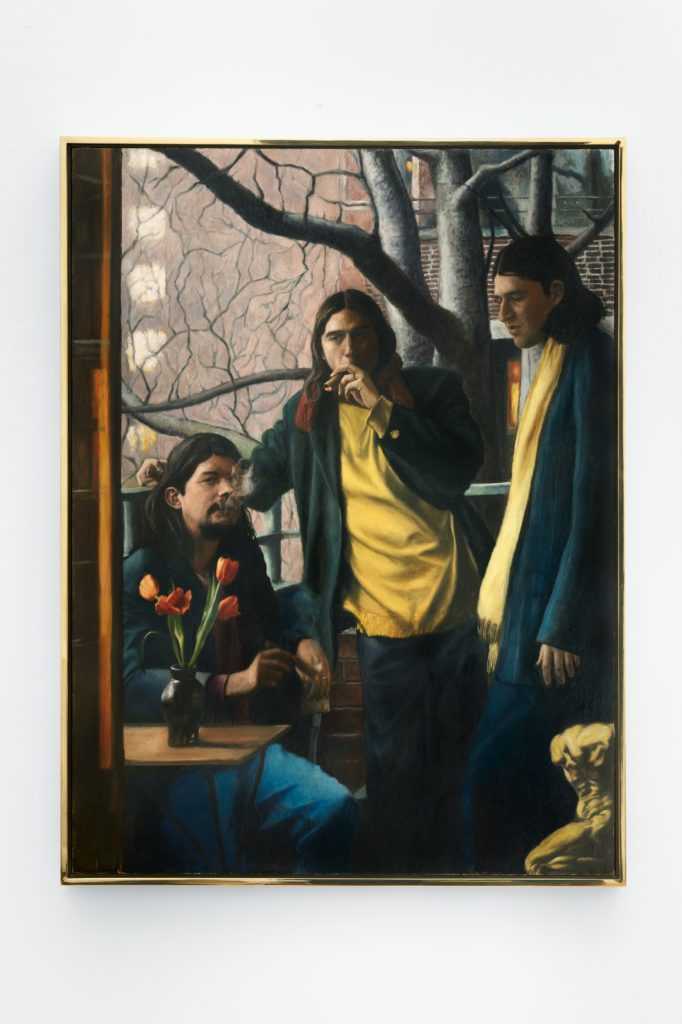
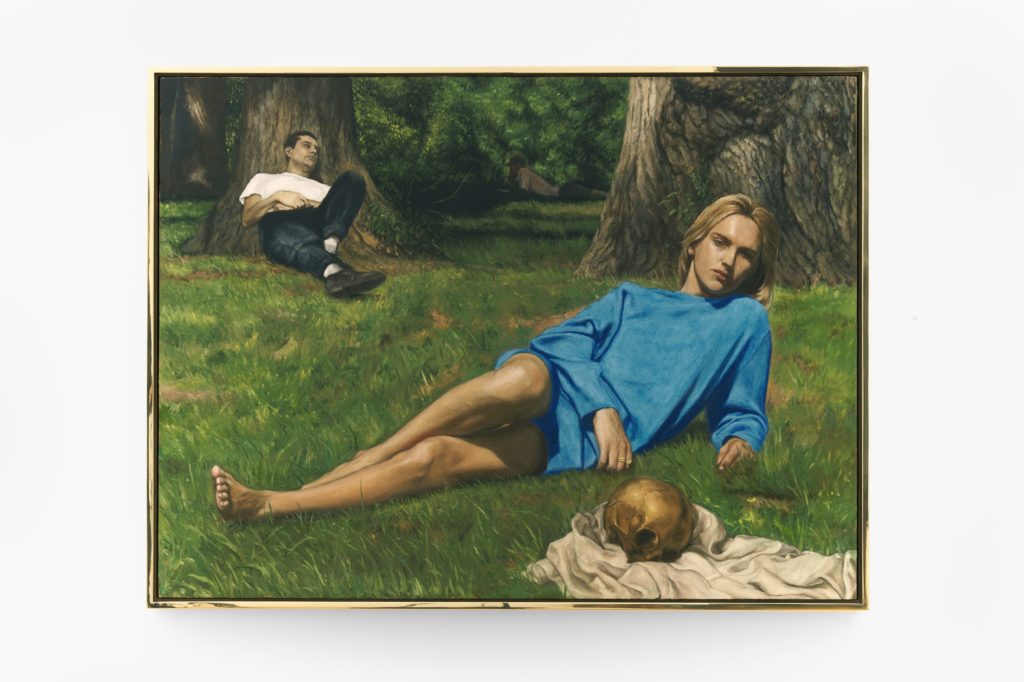
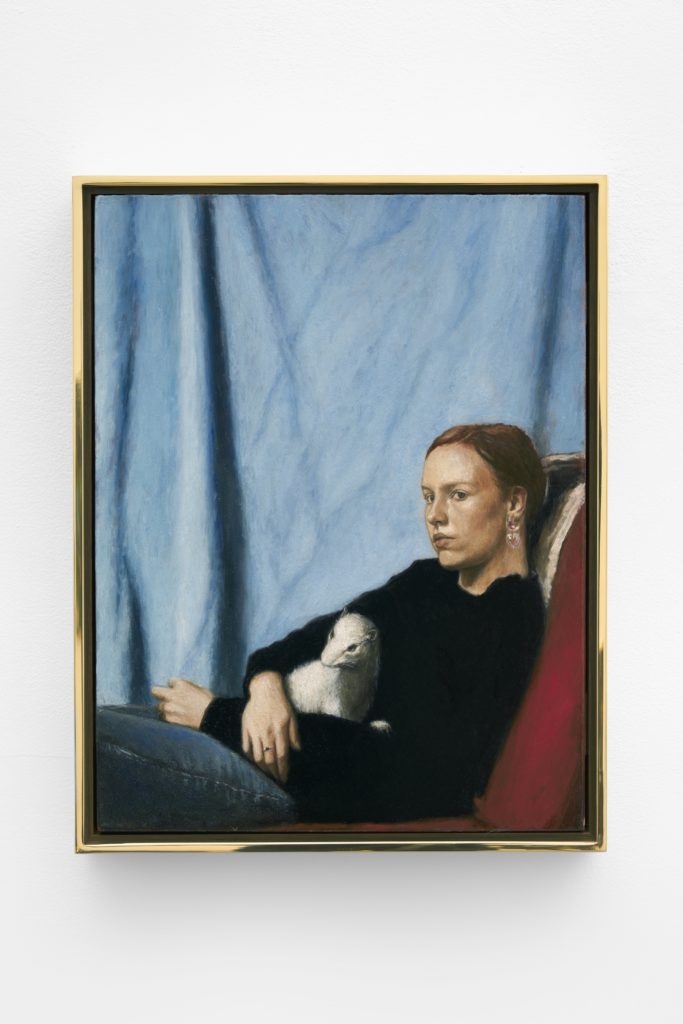
The nine paintings in “Résurrectine” continue in this vein: a mélange of interior and exterior scenes that chronicle a certain kind of creative class in New York, this time inflected through vanitas motifs and framed by gold, their surfaces mostly glazed to shine. The allusions are sometimes obvious. Beside the revisited Renoir, Rossetti paints his own version of Lady with an Ermine (1489–91) after Leonardo da Vinci, as well as his Saint John the Baptist (1513–16). Some viewers might also identify his subjects; I notice the painter Witt Fetter in The Gift of Life (2025–26), Rossetti’s rendering of Mary Magdalene as a Hermit (1833) by Francesco Hayez, but the rest — the woman with the red hair, Leonardo’s boy-lover double, the husbands — I have only the faintest clue.
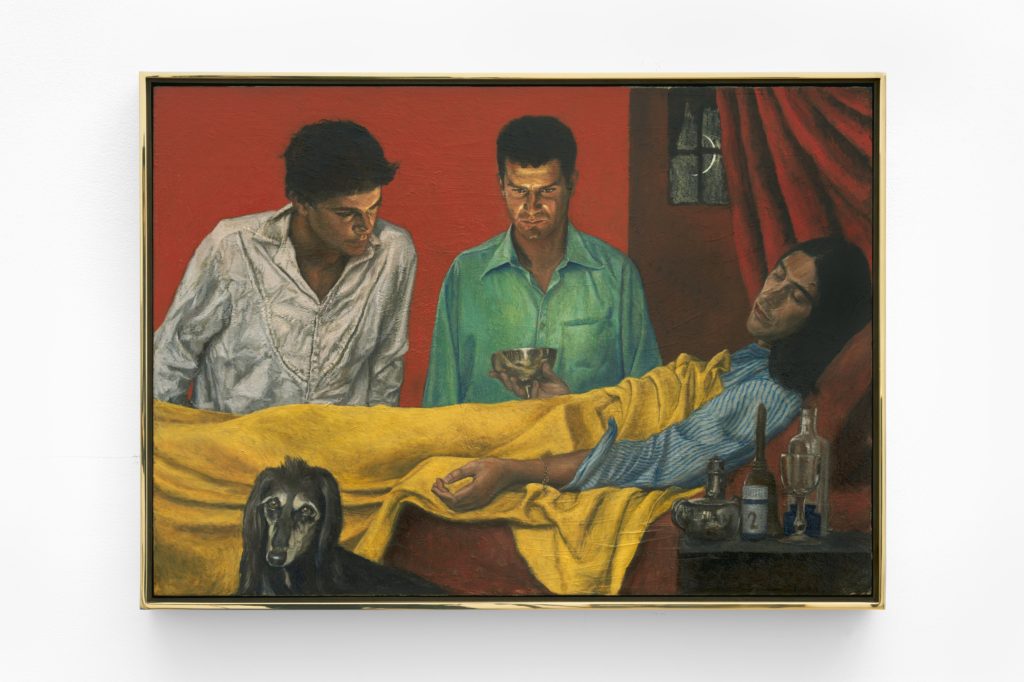
My ignorance, the paintings tell me, is no problem. Rossetti’s compositions are neither jokes nor codes, but rather subtly disjointed hallucinations that rely on, and revel in, painting’s illusory surface: its capacity to represent everything and nothing, and most of all, itself. Take, for example, Golden bowl, for their eyes were heavy (2025–26): the artist parodies himself as a dying Christ, his chalice miraculously illuminating the two “disciples” (presumably his friends). Yet this religious subtext, even if interpreted as burlesque, is too slight to hold together the painting’s more unwieldy dimensions.
The composition falls apart as it does in a dream: the three planes of the painting (the dog, the artist, his friends) appear impossibly compressed and disconnected, while the crescent moon through the small window — the outside world — appears scratched onto the sky. Even small details appear strange: the two men’s shirts have opposing textures — one rough and blurred, the other smooth and crisp — while the dog looks absurdly out at the viewer, messageless, reminding me, it seems, not to read the painting for meaning, but rather as a form of miraculous manipulation, in and of itself. This kind of hallucinatory logic tints all the canvases in “Résurrectine,” and herein lies Rossetti’s particular sleight of hand. Some are clearly imaginary scenes, like the floating heads in Melancholia (2025–26); in others, the fantastical effects are subtler, from the wavering materiality of the guitar strings in Counting the Teeth (2025–26) to the kitsch pink earrings disrupting the otherworldly elegance of the ermine’s lady.
Born of Rossetti’s audacious irreverence, this sense of distortion also comes from outside the frame; in the same show, he displays two homages to the world’s most famous painter alongside Husbands (2025–26), a self-portrait of the artist, dressed in the same yellow shade, smoking a fat joint. Incongruous illusion is obviously nothing new in painting. I do wonder whether the résurrectine really is Édouard Manet, whose masterpiece Le Déjeuner sur l’herbe (1863) haunts Rossetti’s own unnerving scene of leisure, The Gift of Life. Hyperconscious of working in a historically late phase of figurative painting, Manet also used similar illusions — misaligned gazes, improbable lighting, out-of- frame spectacles — to presage the medium’s impending nothingness, something that art historian Emmelyn Butterfield-Rosen relates to “the loss of gesture” wrought by the invisible forces of a then nascent modernity. More than a century and a half later, Giangiacomo Rossetti is not late, but after. Our gestures have since been well and truly lost. Other invisible forces are at play. In this way, Rossetti is very much a painter of our time: he paints their pretty surfaces, their gimmicks, their hallucinatory void. And above all, their color: a sickly, vivid yellow. The light of painting’s yet-another afterlife.