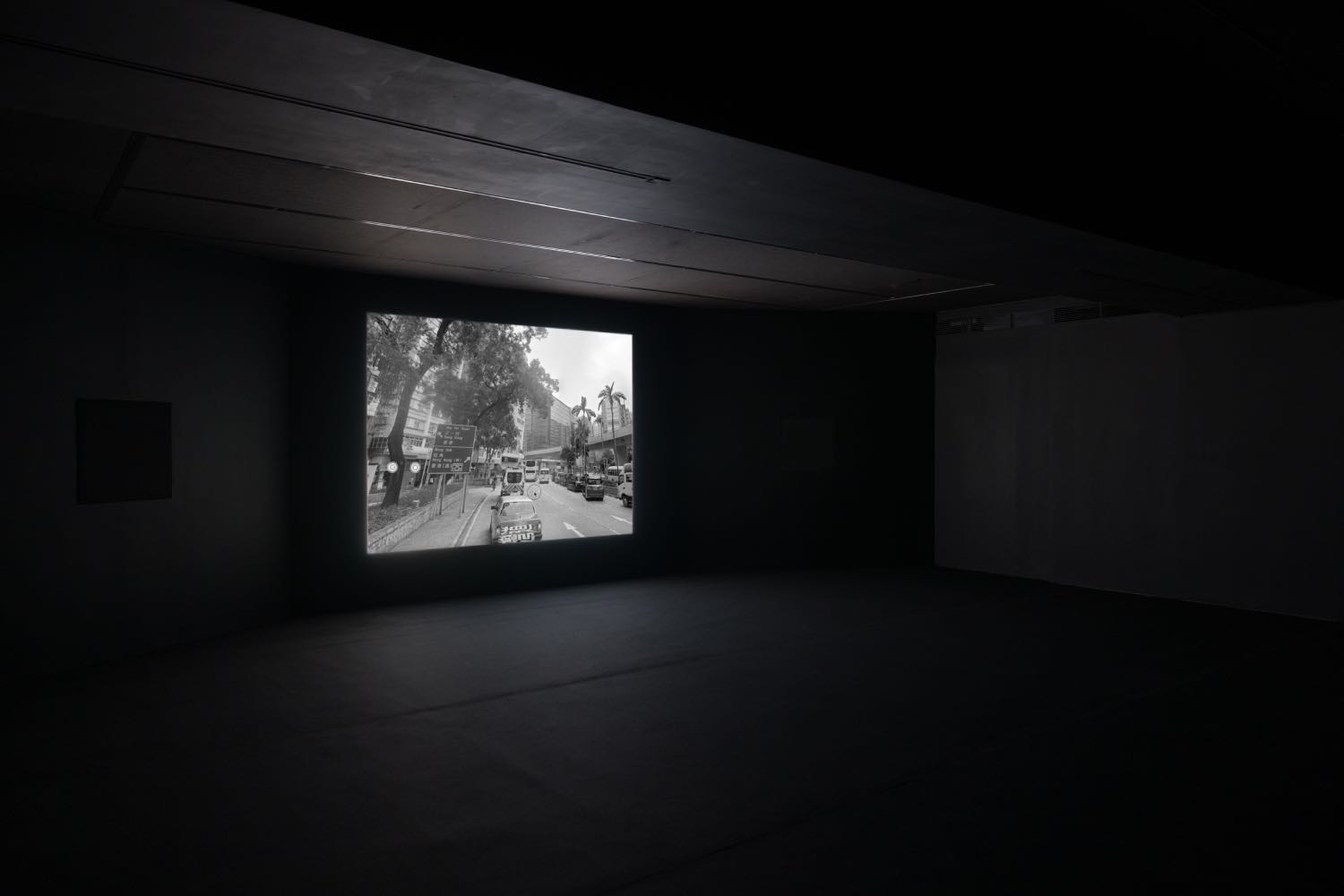
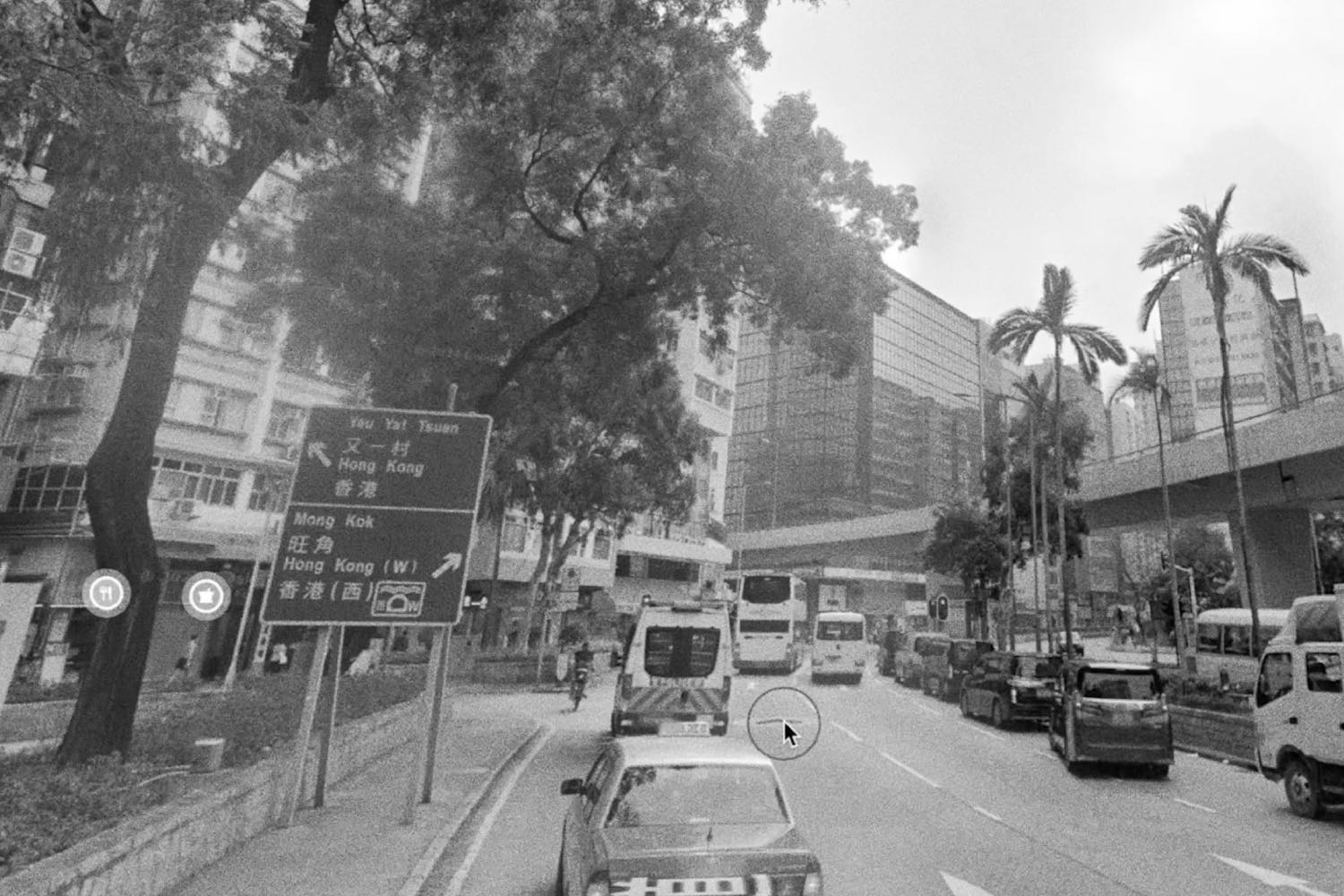
Located far from the city center, on the south side of Hong Kong Island, Empty Gallery is tucked into the upper floors of a commercial skyscraper. The black-and-white projection of Chan Hau Chun’s Map of Traces (2025), the sole work and namesake of the artist’s first solo exhibition with Empty, provides the only illumination in an otherwise dark, echoey space. The film’s cloistered presentation, with the feeling of a sparsely attended microcinema screening, heightens the intimate, hushed, and quietly demanding quality of its content.
Organized roughly into three parts that traverse diasporic subjectivity, local public life, and speculative cinematicity, the film begins with a letter to an anonymized “C. R.” in white type across a textured black field, dense with fleeting recollections: an ephemeral encounter, an imprisoned acquaintance, whispers of whimsy against mounting darkness. The aesthetic austerity and temporal drag of this opening gesture and Chan’s other letters on forced silence woven throughout the film situate inscription as a key medium through which memory circulates in time. “If history is always tied to events,” the narrator suggests, “then memory is like a hidden shape, waiting for the right moment to resurface.”
That hidden shape begins to emerge as the film settles into an exchange between Chan and a friend drifting through Hong Kong in Google Maps Street View. We begin from a still frame of a Hong Kong sidewalk, held long enough to elicit the affective weight of looking at a photograph one knows is dear to someone before Chan scrolls away to take us down Tong Yam Street in her friend’s former neighborhood. For the technologized way of seeing that gives us access to the place, intimacy suffuses it with humanistic tenderness. The pair reminisces on the seemingly eternal presence of three large banyan trees and the old men who gather in its shade, pointing out Street View’s capacity to archive while using their computer cursor to gaze up lovingly into a canopy of leaves or observe games of chess.
As the pair wanders out into the more public Nathan Road, knowledge of place proves to be unequally distributed, shaped by divergent proximities and lived experiences. Their conversation gradually folds inward into a wistful contemplation of the conditions of distance and the ambient uncertainty of permacrisis. The artist’s friend admits, “I don’t even know if I’ll ever walk this road again.” The declaration is neither sentimental nor final. It hovers in the fog of competing timelines, blurred images, and fragmentary information — a false composite of home.
Though the artist is based in Hong Kong, the film’s first chapter aligns it with a body of moving-image work by contemporary artists such as Simon Liu and Tiffany Sia, who have looked back at the city from the temporal and geographic remove of diaspora. Emerging from the incandescent years of the late 2010s and the ensuing wave of political suppression, these works negotiate an ambivalent relationship to Hong Kong by navigating the terrain of affect and memory rather than proffering straightforward documentation. Map of Traces also joins a lineage of video letters by earlier artists like Yau Ching, who similarly blend diaristic reflection with personal address to ease a sense of displacement.
Throughout the film, verbal language is freed from the role of didacticism or polemic to which contemporary video work so often relegates it. In Chan’s sensitive treatment, verbal language dances with the visual and auditory logics of the film and carries its own aesthetic weight: the latency of letters, the specificity of anecdote, the stumbling rhythm of memory spoken aloud. Together, the tangle of aesthetic forms confirms memory’s malleability. It goes even further to suggest that revision happens through forces both authoritarian and subjective, reminding us that one of repression’s subtlest tools is making forgetting feel self-authored.
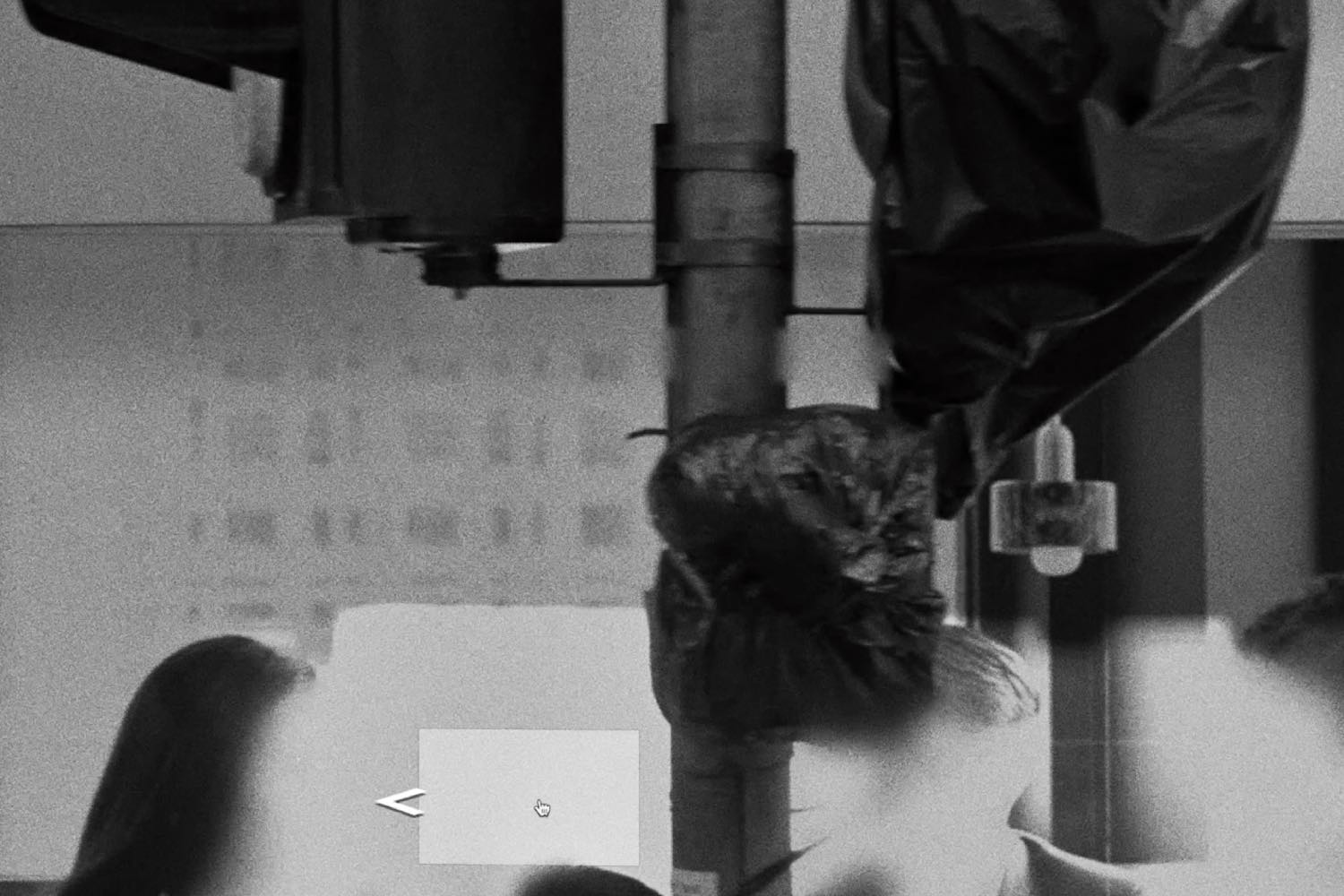
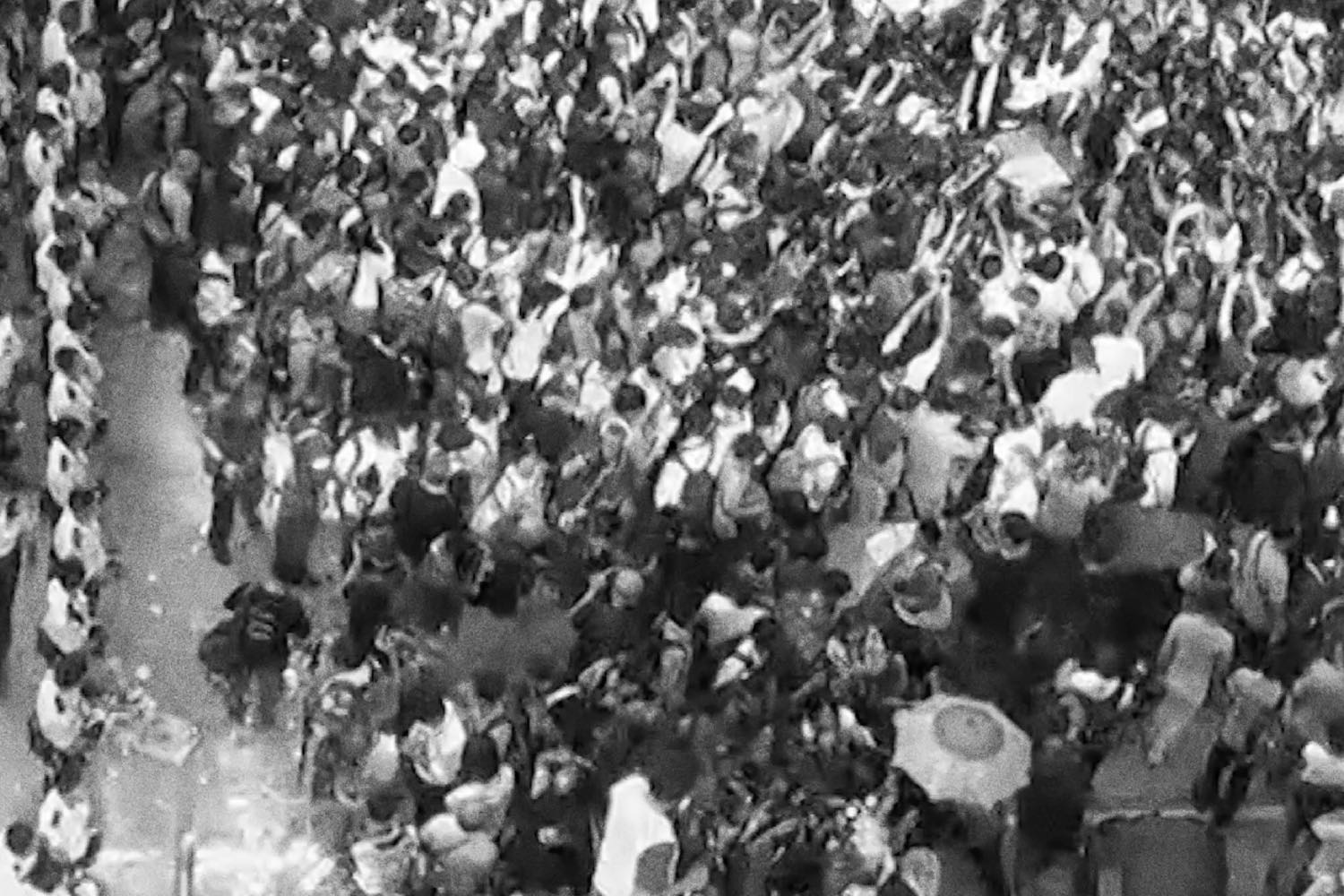
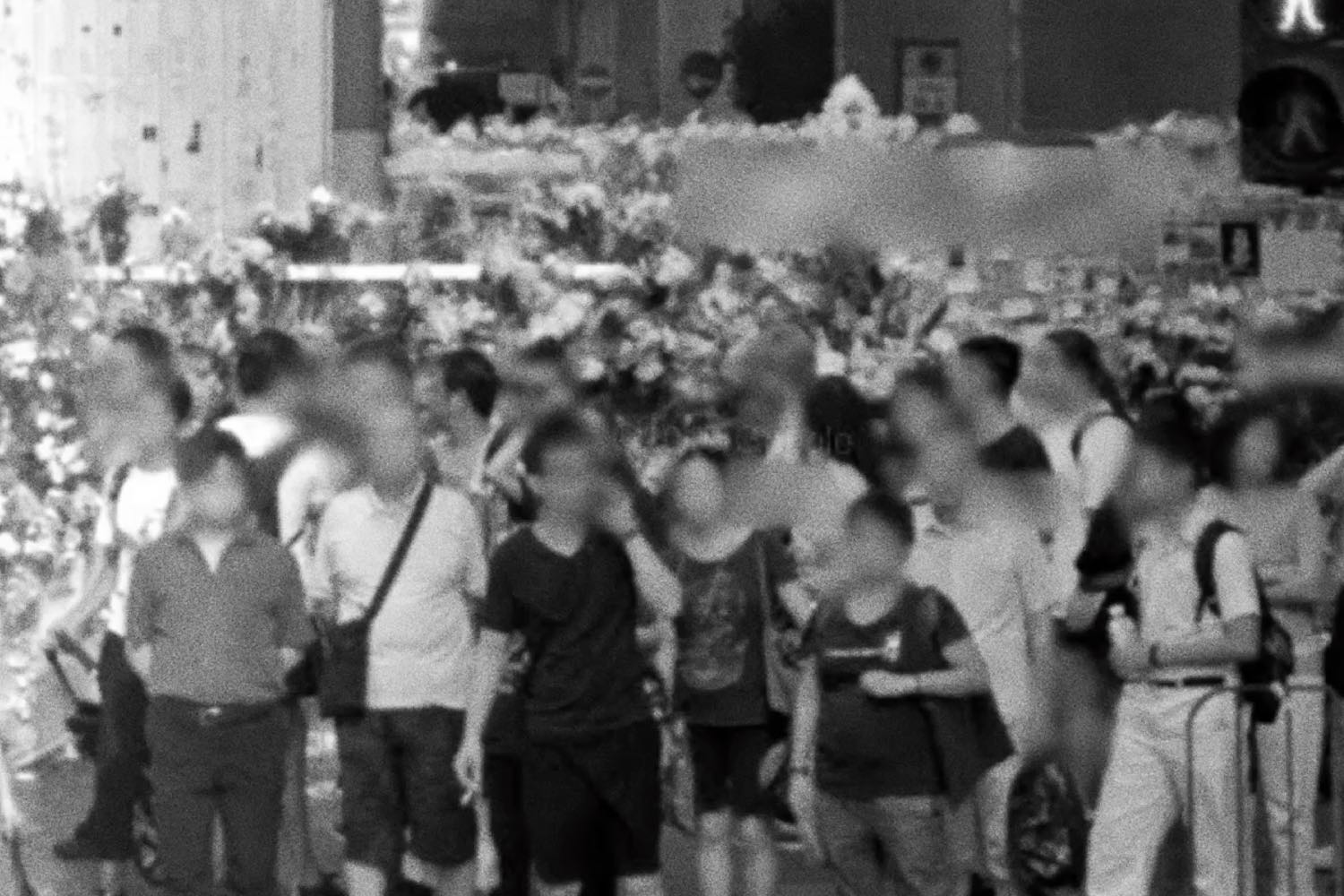
The film’s second chapter shifts from diasporic remove to local entanglement as we continue down Nathan Road, historically a key site of public actions. The first part’s ambient percussion gives way to a more vernacular soundscape anchored by Hong Kong’s familiar crosswalk countdown as the figure of Lau Tit Man, an elderly graffiti writer and former “street sleeper” featured in Chan’s previous works, comes into focus. Once detained for writing on public walls, Lau now tags only in water. “Others can’t see it,” he explains while presenting his notebook chronicling street life (stray cats, the rays of the sun) in hundreds of locations in Hong Kong. “Only I can.” The film layers scans of Lau’s drawings over footage of the invisible graffiti, then lingers on a street-side memorial being torn down. For a moment, the mourning symbol 奠 (dian) for which Lau was previously arrested flashes into our line of sight. These scenes accumulate into a meditation on ephemerality — writing that evaporates, public actions silenced — that notes the shared conditions shaping the respective invisibilities of exilic and local inhabitations of the city.
The third chapter, and the film’s most atmospheric section, comes quietly. Its images stutter, pixelate and blur, and then, after a final letter to C. R. about the quiet endurance of the land, shatter into a slow retreat from the detention center mentioned in Chan’s letters. The film ends with a shot of a foggy mountain outlook. Slowly, the mist lifts to reveal a birds-eye view of the valley below. Chan’s work does not aim to rescue Hong Kong from disappearance, but to question the terms of remembrance when erasure is built into visibility itself. Hong Kong becomes a speculative construction formed in the spaces between commitment and loss, intimacy and distance, a tension that Empty Gallery director Kaitlin Chan (no relation to the artist) has called “ambivalent locality.” The film doesn’t so much articulate this ambivalence as inhabit it. Disappearance is not absolute: there is correspondence, however fragmented; memories, however mediated.
“Map of Traces” then demonstrates that ephemerality is a strategy as much as a condition of form. The multiple forms of inscription the film offers, from digital mapping and diary-keeping to doodles and letter-writing, alongside documentary filmmaking itself, though each flawed and fleeting, offer a scrappy toolbox that recognizes memory’s quantum physics under repressive conditions. Through its affective precision and unsettled form, Map of Traces holds to sentimentality not as retreat but as a necessary way of staying with and working through the intersecting forces of surveillance, displacement, incarceration, and censorship that shape what can be remembered and by whom. Against doomerist insistence on Hong Kong’s death and disappearance, Chan’s accumulation of traces constellates what still remains to be said, felt, and seen of the city.