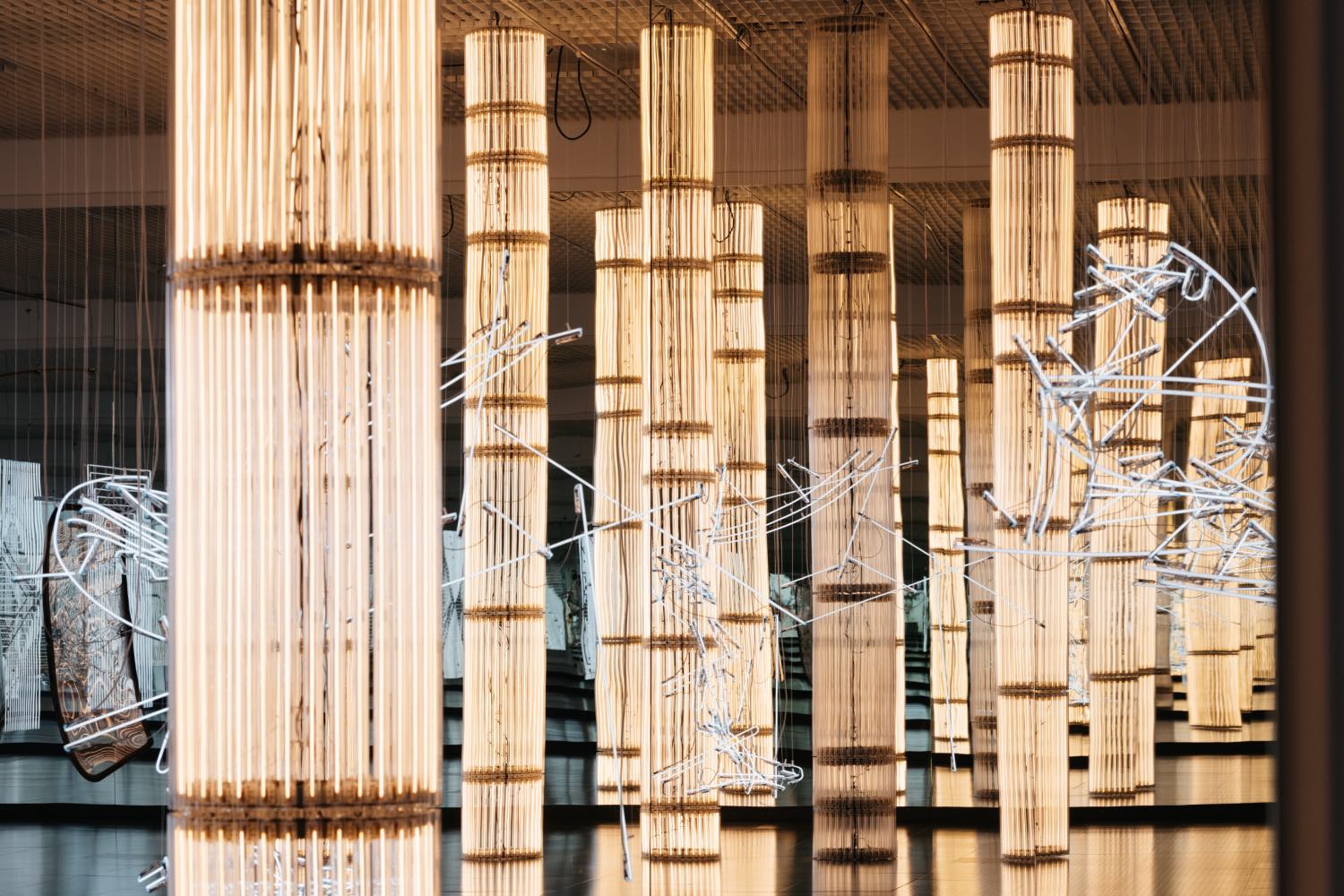
Cerith Wyn Evans has created a time-based installation that transforms Centre Pompidou-Metz into a vessel for experiencing “borrowed lights” across a series of vibrant material encounters. Engaging in dialogue with the museum’s architecture, the project begins in the large entrance lobby with a winter garden, an echo of Marcel Broodthaers’s Un Jardin d’Hiver (1974). Here, however, the palm trees become bonsais, a magnolia, and a pear tree, all placed on a slowly rotating base. Arranged diagonally at varying heights and juxtaposed on wooden pallets like commodities, these elements are sourced from local nurseries or transported from South America – like the massive amethyst geodes encased in glass crates. This first, Interlude (Borrowed Landscape) I (2014), recontextualizes and sets the stage.
At its center, two cylindrical neon columns from S=U=P=E=R=S=T=R=U=C=T=U=R=E (2010) stand switched off, caught in a latent stage of obsolescence. Stripped back to their material essence, they appear as giant lamps in a petrified garden. Above, a translucent suspended skeleton, What of it? (2024), gleams with acetate bones, performing a macabre dance alongside its projected double swaying on the wall.
Evans’s background in film,having collaborated with Derek Jarman, resonates throughout the exhibition’s looping and feedback principles. Repetition, as theorized by Deleuze and Klossowski (both translators of Nietzsche), plays a central role. The suspended skeleton recalls Baphomet1, one of Klossowski’s figures, while upstairs, a rhizomatic network of lights expands this theme. Evans transforms Gallery 3 into an immersive experience of variable time and space. Visitors move through a forest of lights, encountering layered temporalities and spatial disjunctions via fragmented reflections, screens, sounds, and shifting scales.
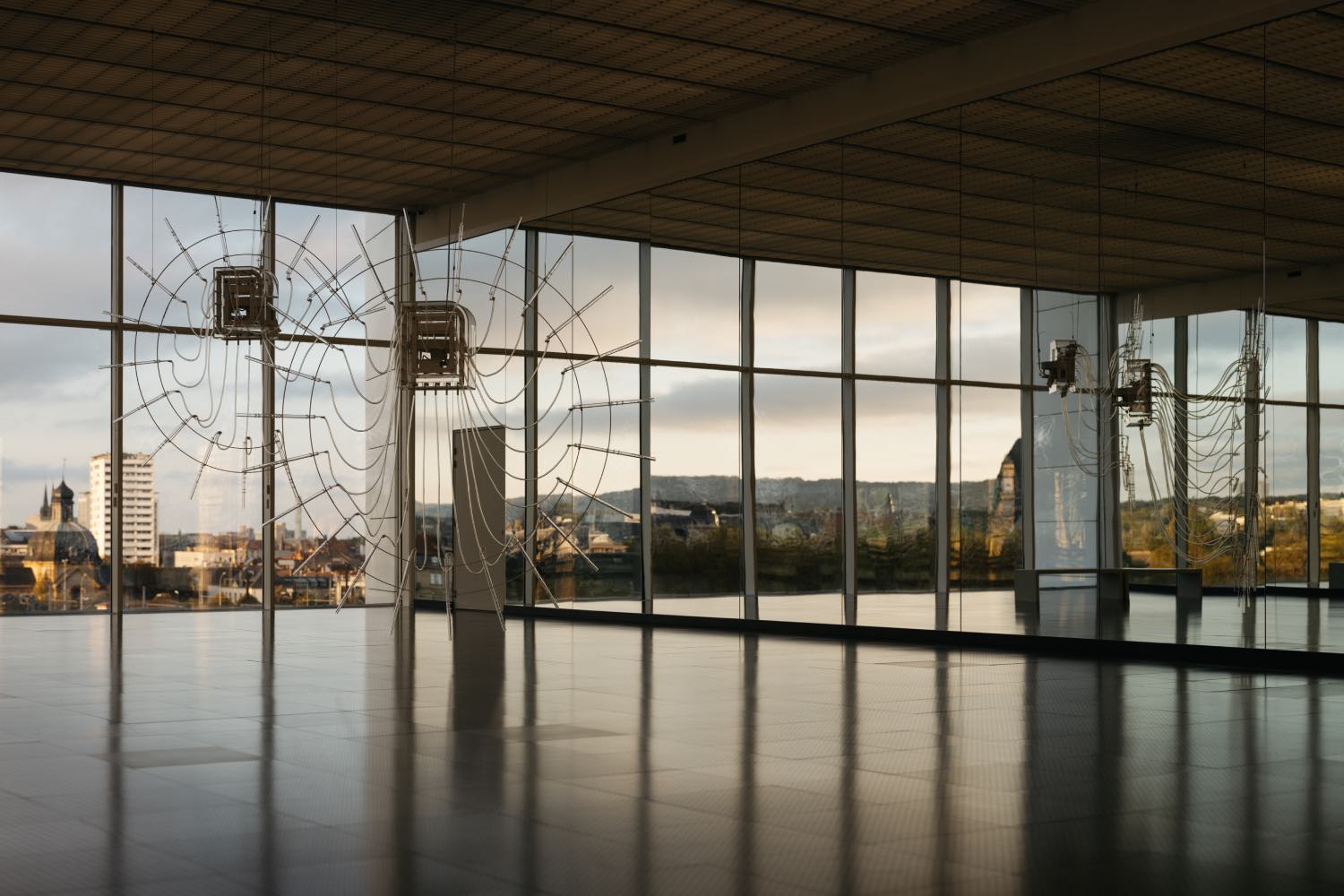
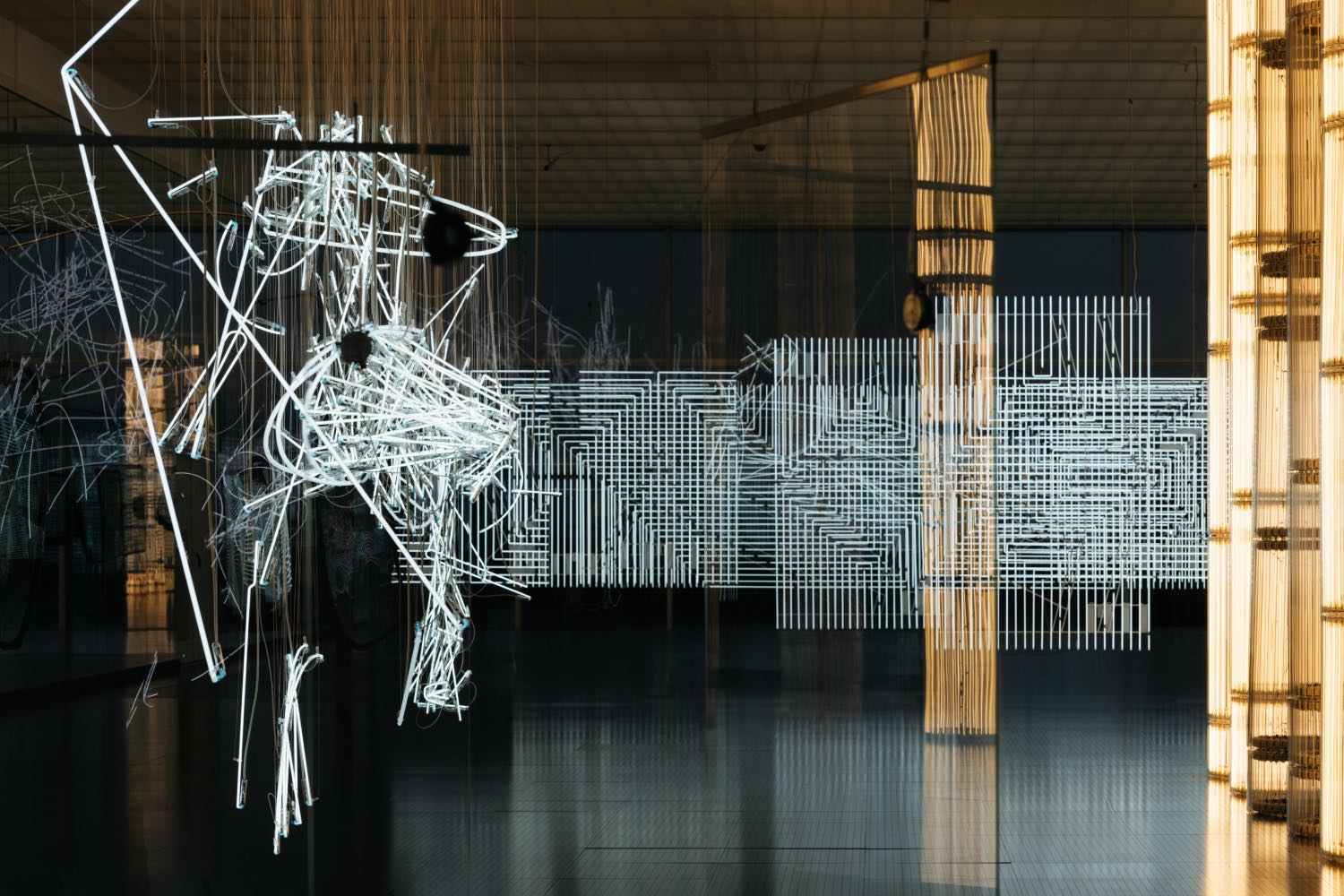
Stepping into the space feels like entering a time-machine – an interiorized, glitched microchip. A twenty-meter-long mirror spans the main wall while natural light floods in from Metz’s two open bay windows. Artificial and real light interact to generate a flickering, vibrant atmosphere. Quasi-twinned Venetian chandeliers (Mantra, 2016) pulse alongside alternating neon columns StarStarStar/Steer (Transophoton) (2019), where Morse-coded flickers transform sound into light. The experience is kaleidoscopic: rather than scrolling through a screen, we find ourselves inside of one, navigating an oblique, drifting pathway from mobile sculptures to panels, from sound machines to transistor glasses.
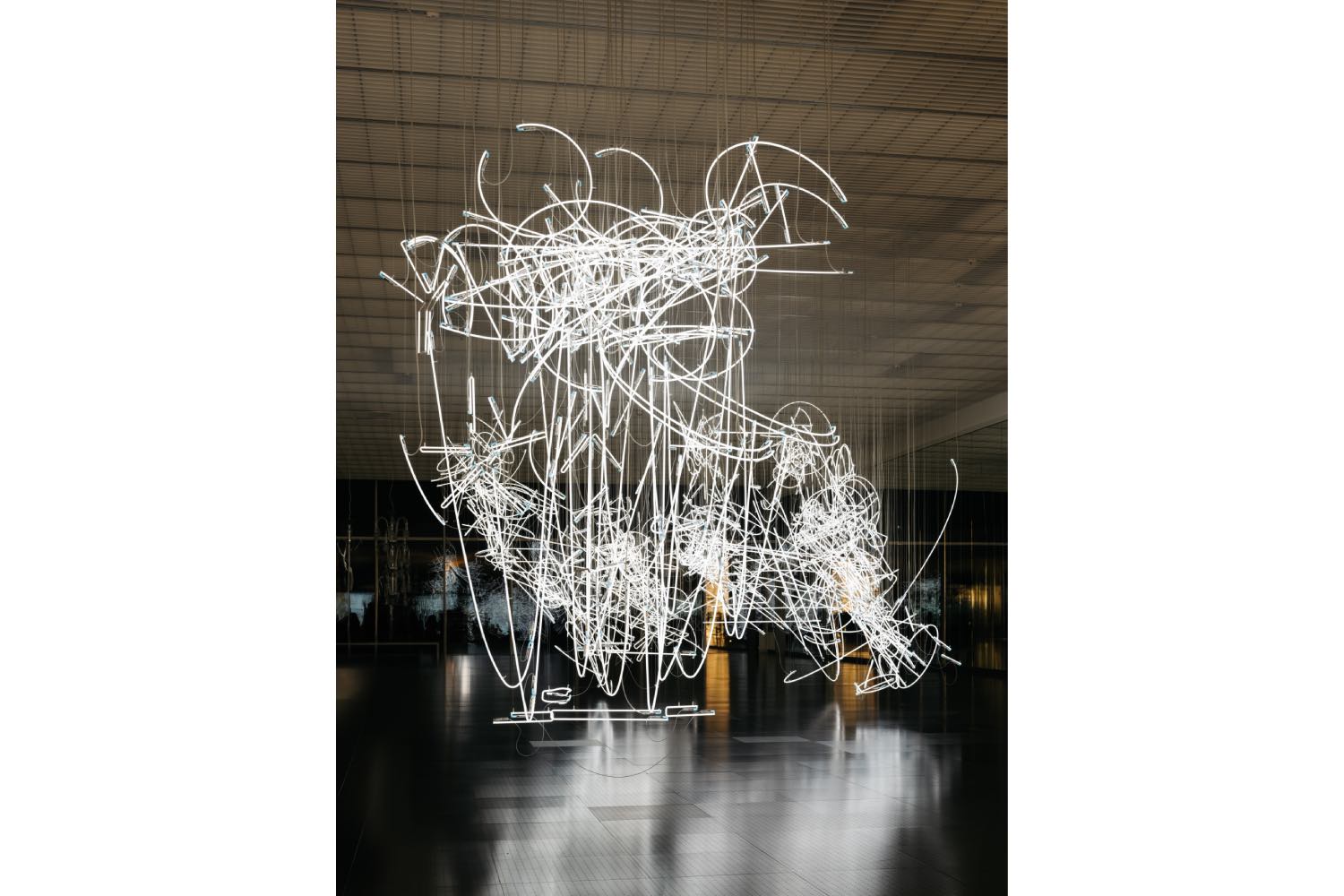
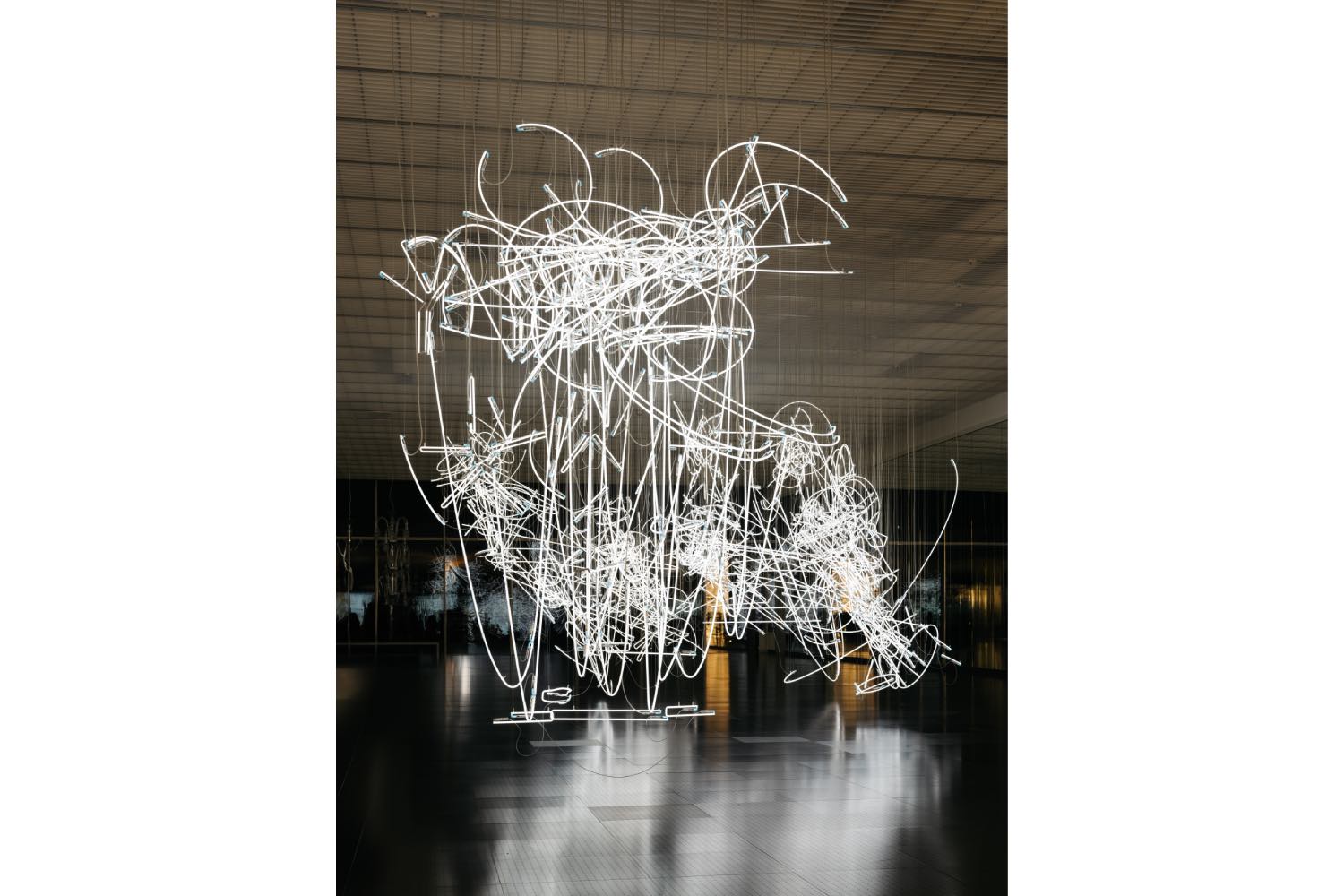
The serial neon works — from Neon Forms (after Noh I-II) (2015–ongoing) to Neon Forms (after Noh V-XII, XIII) (2018–19) — function as scores. Inspired by Kata diagrams, which teach Noh movement patterns, these neon lines are soft extensions of computerized body movements. They perform the space as much as the space performs them. In a techno-animistic manner, the musical props crafted from glass – such as the windshield panels of Phase Shifts (after David Tudor) (2023), emitting Tudor’s sound; the thirty-seven crystal tubes forming Composition for 37 flutes (2018); and the metal gong wrapped in Mylar blankets in Sounding Felix (Paris 8 assemblage) (2022) — activate circular, open-spiral shapes. Evans himself has stated, “On the breeze … the diagram is no longer an auditory or visual archive but a map or instruction, a cartography that is coextensive with a social field… It is an abstract machine between dimensions.”
Pneuma, the breath of matter and the universe, is at stake here. It guides us through slices of time, events, and accidents. The suspended windshield recalls David Cronenberg’s Crash (1996), while its shattered glass reveals layers of laminated transparency, evoking zebra-like striations. Marcel Duchamp’s Large Glass (1923) is an ongoing reference, as seen in Apprentice in the Sun (I-II-III) (2020), which embraces accident as process.
The exhibition performs a continuous inversion of perception – revealing and concealing, illuminating and obscuring. As Pompidou Metz curator Zoé Stillpass notes, Evans’s Neons after Stella (2022) enacts a “deep inversion of modernist univocal objectivity into an ongoing performativity.” In this work, black strips are emptied and transcribed into square neon-lined panels, reversing positive and negative, and transforming into a spatial score.
Each piece in the exhibition functions as a character, part of an unfolding structural relationship of emerging power dynamics. After all, don’t we call it a “power plant”?