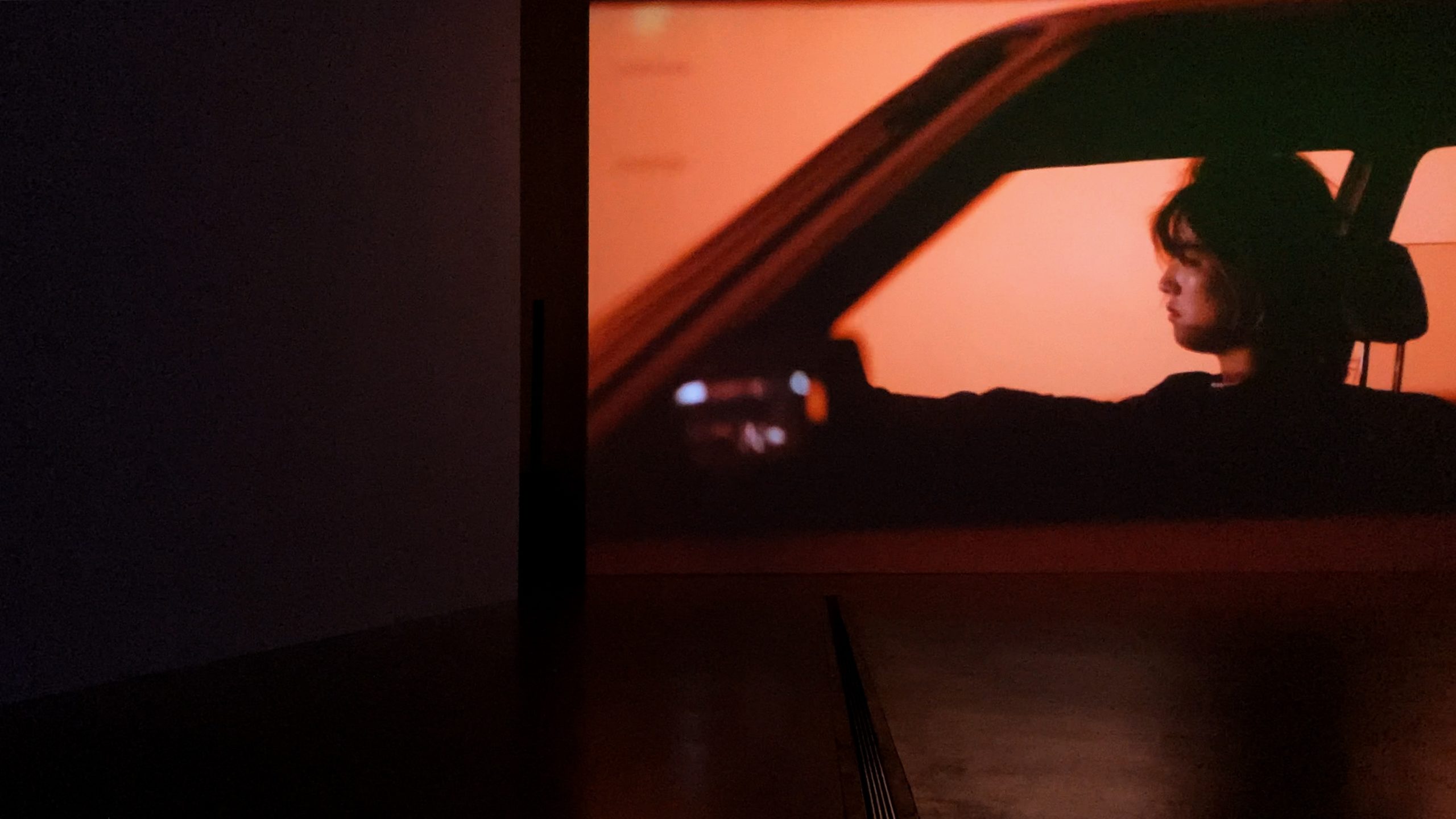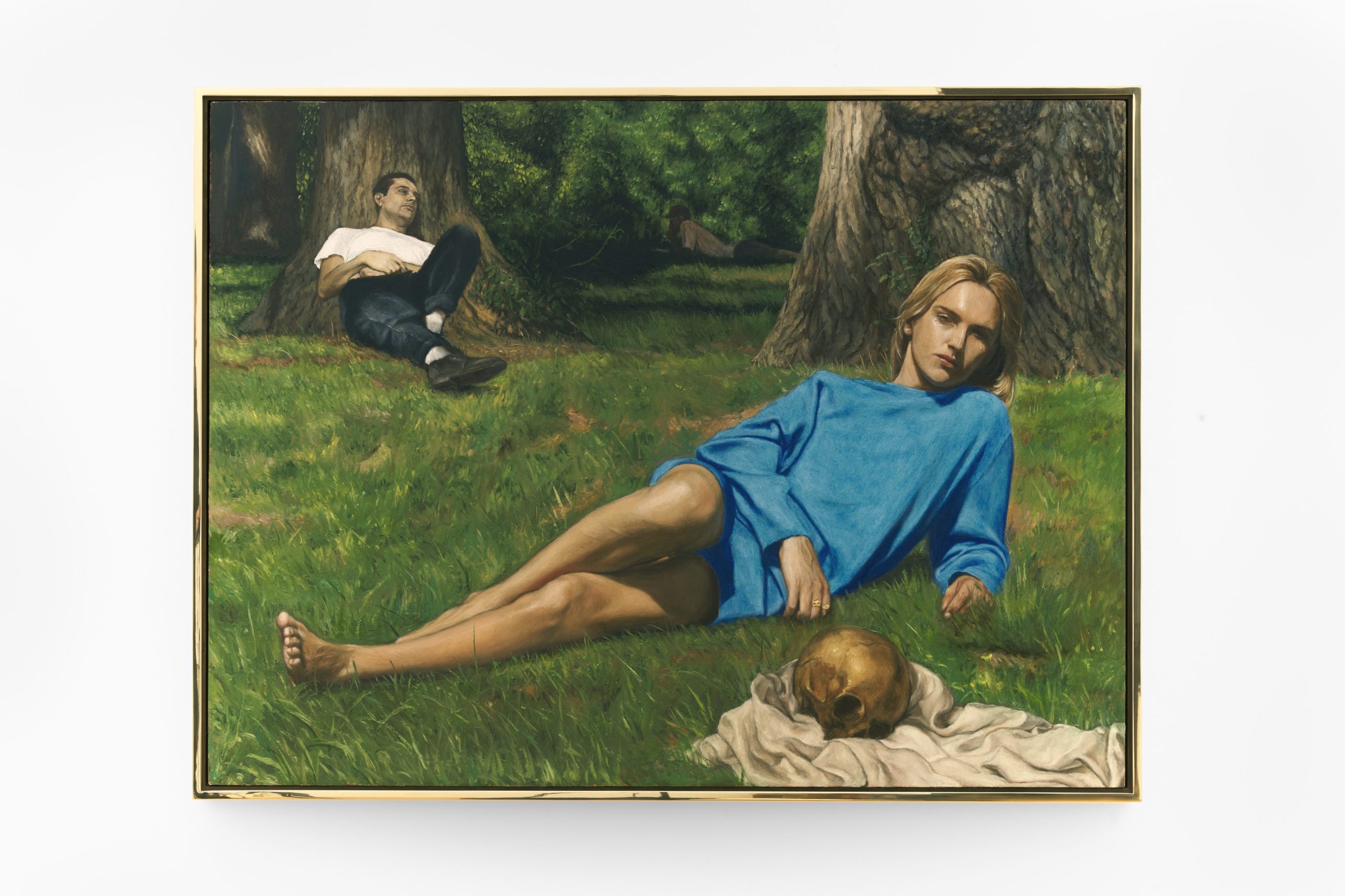
In 1985, Marxist scholar Silvia Federici wrote a poem dedicated to what she called “the conspiracy theory of history,” rejecting the altered, sanitized versions of history presented by forces of capitalism and imperialism.[1] Lines from Federici’s In Praise of Conspiracy Theory appear in artist and filmmaker Alison Nugyen’s video installation Perforation, Ellipse (2026) — the centerpiece of her eponymous exhibition at New York’s Storefront for Art and Architecture. The work is a testament to the stories and songs hidden by “men who sit and plan deeds that cause any of us to die.”[2] Fashioning a “conspiracy” of her own through video, sound, and text-based work, Nguyen’s Perforation, Ellipse exists in the space between histories, recognizing the fragility of collective memory in the face of authoritarian rule and exploring the fragmented culture produced in its collapse.
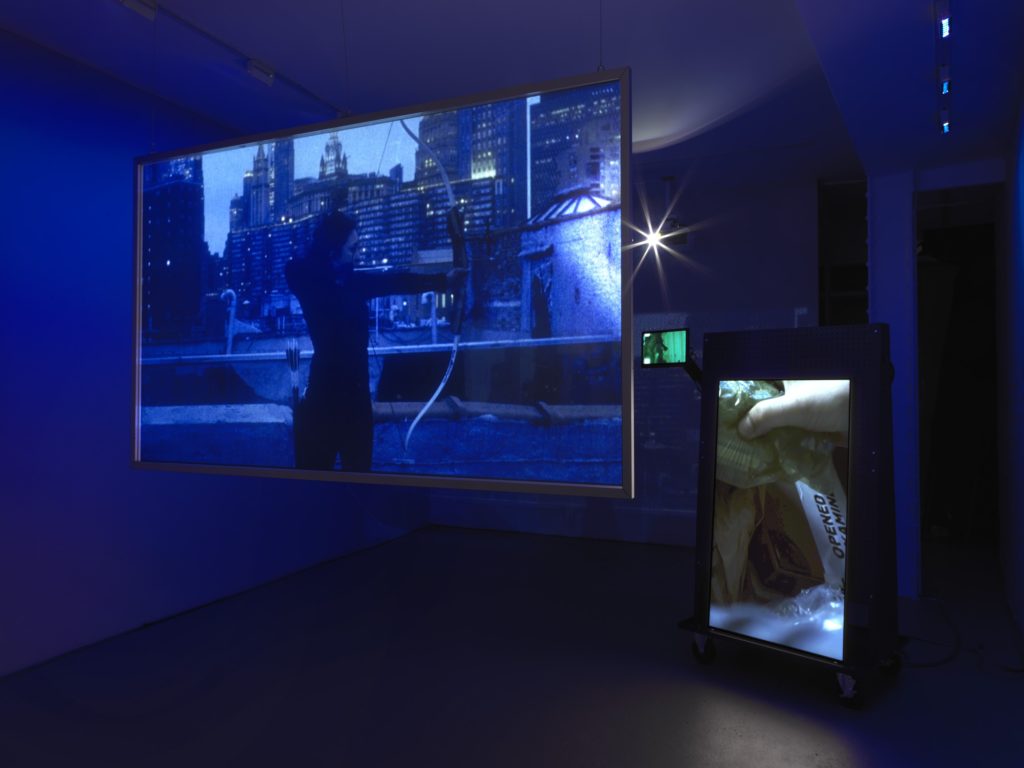
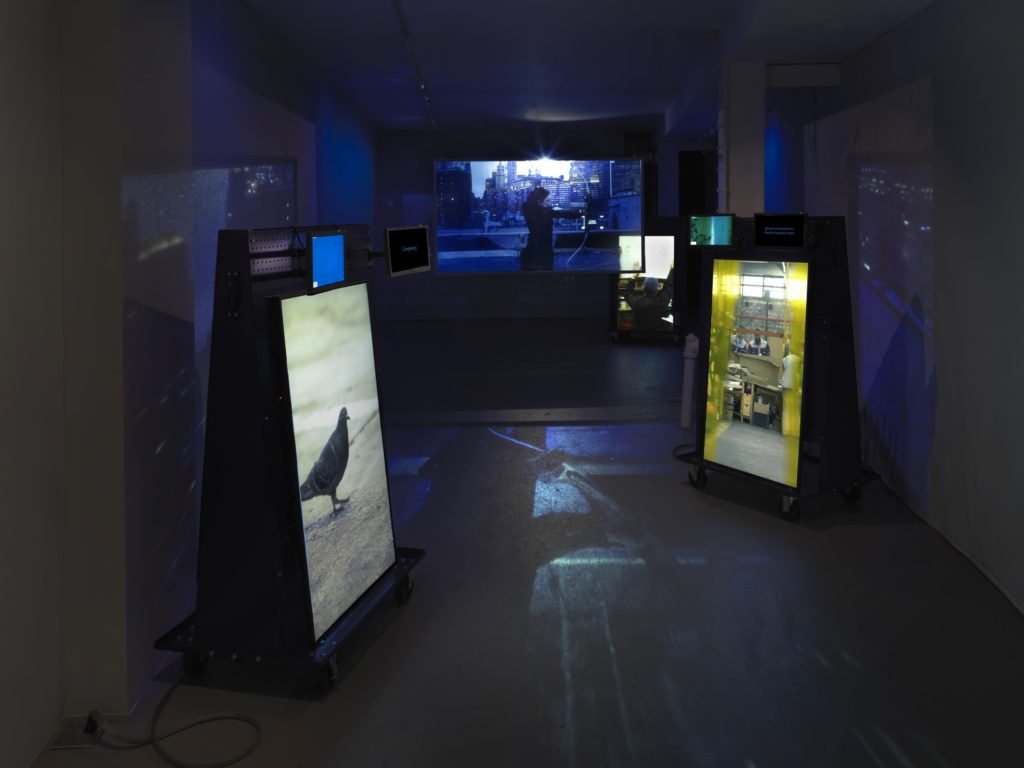
Bathed in blue light, Storefront’s street-level gallery presents Perforation, Ellipse across nine screens of various sizes, eight of which are grouped together on tall, rectangular plinths that allow the viewer to see multiple scenes at once. The ninth — and largest — screen is situated near the center of the gallery and is suspended in mid-air. It shows looping footage of Nguyen with a bow and arrow, shooting toward an off-screen target that, in its absence, suggests a slippage or interruption in linear time. The videos on the plinths weave together narrative and non-narrative sequences, including internet videos, abstract fields of color on film strips, and the aforementioned quotes from In Praise of Conspiracy Theory. The narrative portion of Perforation, Ellipse is constructed from scenes from Nguyen’s short film Aisle 9 (2026), a work of speculative science fiction set in a nondescript warehouse. Aisle 9 presents a near future undone by censorship, represented here by the warehouse’s clandestine function as a repository for home videos, films, and recordings seized by a government contractor. The warehouse’s workers, who unknowingly discover this cache of forbidden material, turn the storage facility into a local cinema, screening the videos in secret.
While a work of fiction, Perforation, Ellipse grounds its premise in the real-world censorship that occurred in postwar Vietnam. Fictional sequences from Aisle 9 are spliced with videos of bolero musicians from the Vietnamese diaspora. Colloquially known as nhạc vàng or “yellow music,” bolero was a popular musical genre in Saigon that drew from southern Vietnamese folk song and Latin ballads brought to Southeast Asia during periods of colonization. Following the fall of Saigon in 1975, these sentimental songs were banned by the newly installed communist government, which argued that bolero’s romanticism was counterrevolutionary to an emergent working-class culture. Faced with extinction, the genre persevered through black-market music consumption and, most importantly, refugee performers who immigrated to the Americas and Europe.
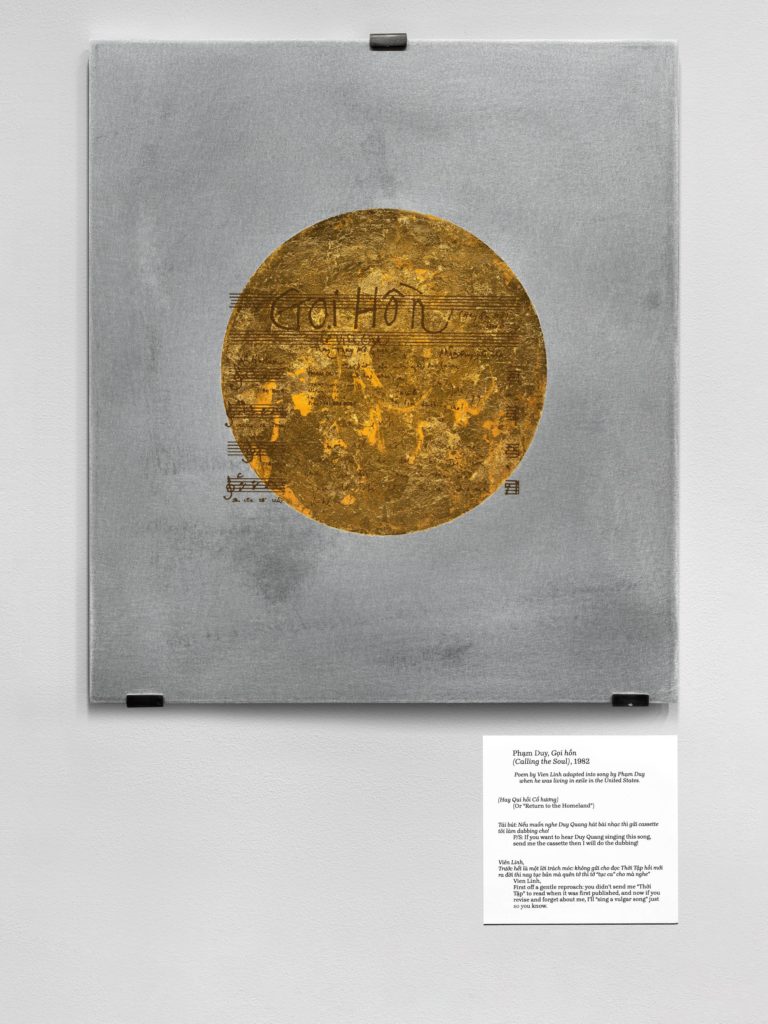
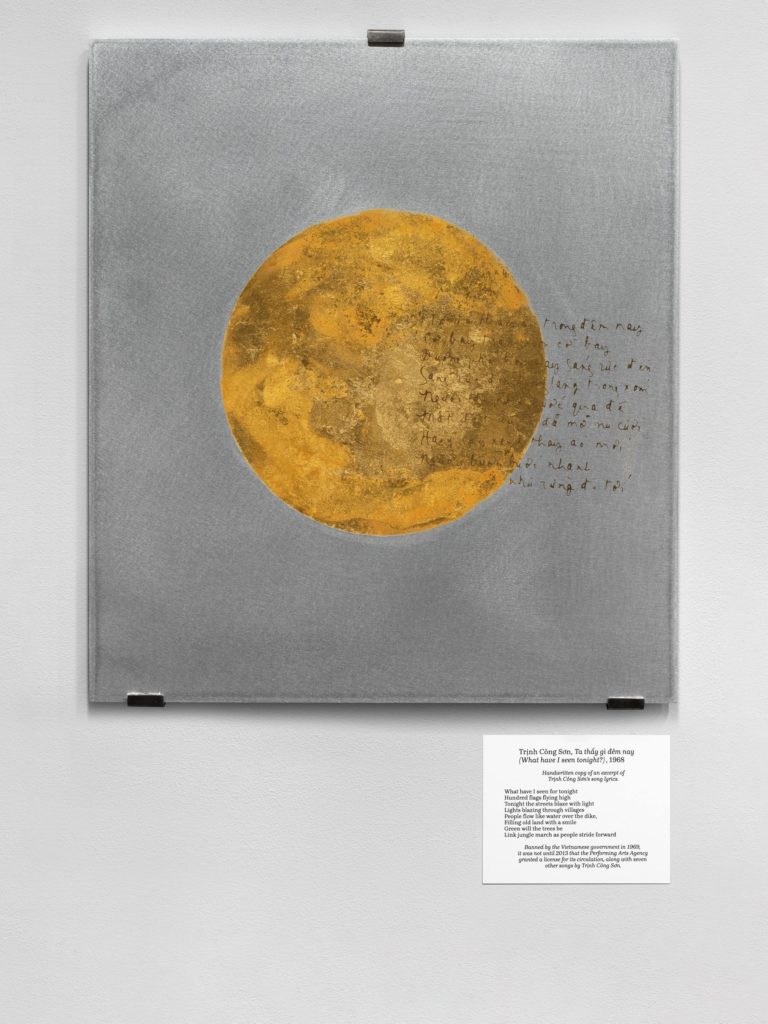
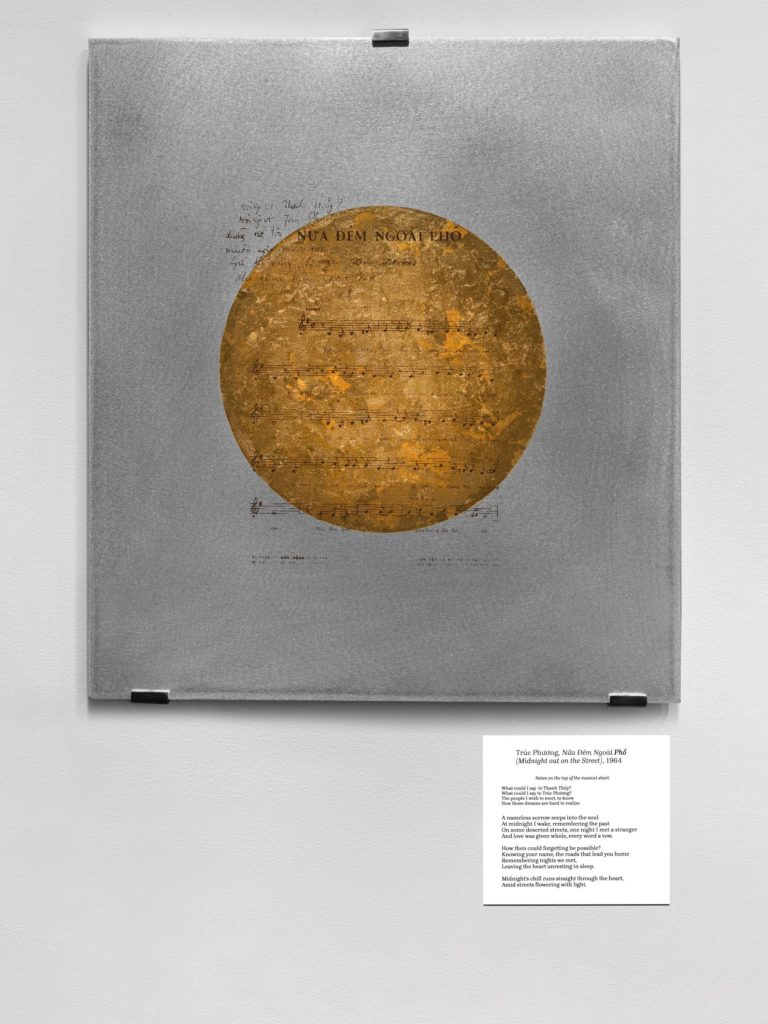
Much like the contraband home videos in Aisle 9, bolero’s inclusion in Perforation, Ellipse represents both the fragility of memory and its enduring strength against total erasure. Installed throughout the Storefront space among the configuration of screens are six aluminum plates, titled Ellipse 1–6 (all 2026). Each panel features a single, centered gold circle and an overlay of scrawling handwritten text featuring the lyrics of previously banned bolero songs, some of which, such as Ellipse 2’s “Han Mac Du” by Pham Duy, are heard in the video. In the corresponding wall labels, Nguyen includes English translations of the Vietnamese lyrics, notes from the musicians, and, in some cases, accounts of the consequences faced by bolero musicians who performed these songs.
Alison Nguyen’s Perforation, Ellipse does not offer a clear or simple message of cultural resilience in the face of censorship. Rather, the artist is interested in the gaps of the historical record and within memory — and, crucially, in what might grow in these empty spaces. Consider the bolero performers: like the home videos in Aisle 9,their songs illustrate a cultural heritage kept secret, and their existence challenges a mainstream, government-prescribed narrative. These stories become conspiracies. In an era when history is rewritten by the highest bidder or the strongest armies, let conspiracy reign.
[1] Silvia Federici, “In Praise of Conspiracy Theory,” Midnight Notes Collective: Midnight Notes #9 (May 1988): 41.
[2] Federici, 41.