I arrived in Berlin the day after the AfD’s victory in Saxony-Anhalt, and the timing was difficult to ignore. The city was preparing to turn itself into what it does particularly well: a dense network of exhibitions, openings, dinners, performances, collectors, artists, curators, and people moving quickly from one part of town to another. But underneath the choreography of Art Week was another kind of movement, less visible and harder to locate: a country negotiating, once again, the question of who belongs where and under what conditions.
This is perhaps why so many of the exhibitions I saw seemed to return, directly or not, to questions of territory, memory, displacement, and visibility. There was, at times, a particular kind of politeness to the week, as well as an almost unanimous preference for complexity over confrontation — for carefully constructed spaces of inclusion over anything that might feel too declarative. At its best, this produced generous exhibitions. At its weakest, it produced repetition.
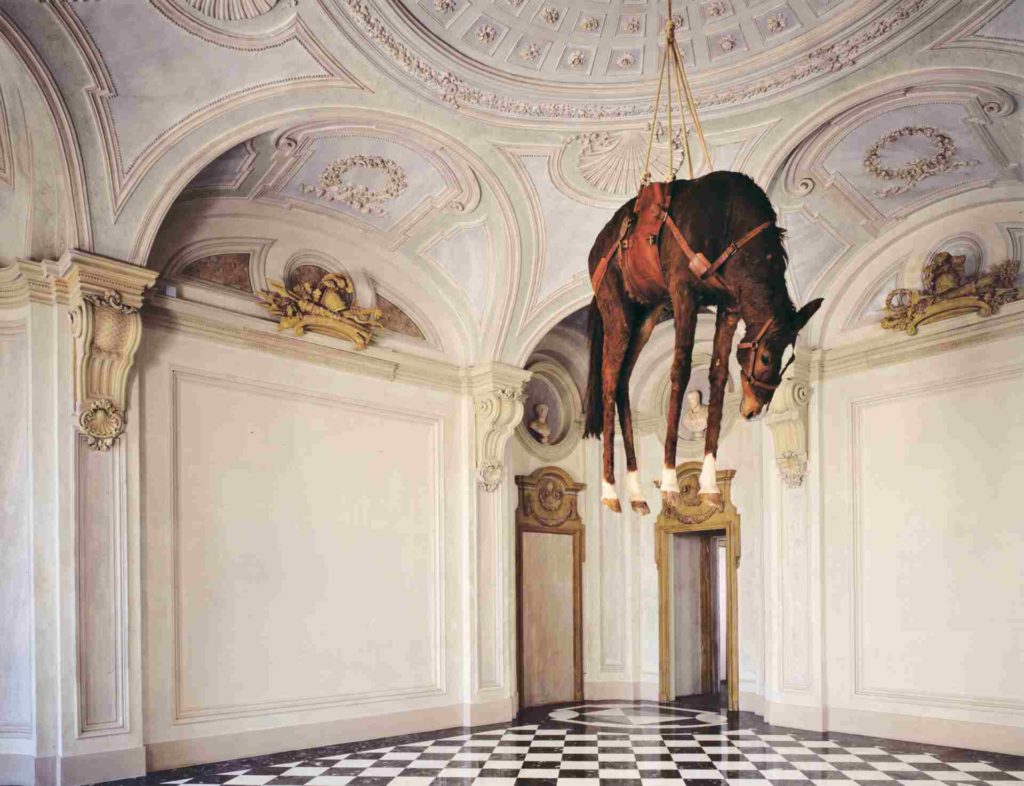
Maurizio Cattelan, Novecento, 1997. Detail. Taxidermized horse, leather slings, and rope. 200 × 70 × 270 cm. Installation view at Castello di Rivoli Museo d’Arte Contemporanea, Rivoli-Torino, 1997. Photography by Paolo Pellion di Persano.
The most spectacular event of the week was, predictably, Maurizio Cattelan’s “NIGHT” at the Neue Nationalgalerie. On the evening of the opening, the building seemed to have morphed into a club: the queue descended the monumental steps and continued into the street. The image was difficult to resist, yet I found myself interested in the exhibitions that seemed concerned less with producing an image of Berlin than with listening to what was already there.
At KW Institute for Contemporary Art, the Kyiv Biennial’s “A Bird That Cannot Land” offered the most convincing starting point. Founded in Kyiv in 2015 with the aim of brining Ukrainian art and culture into a wider international context, the biennial has changed radically since Russia’s full-scale invasion of Ukraine. It has become a nomadic, multi-sited project that continues to take place in Ukraine while extending into other European cities. This is its second edition in Berlin, and its current form reflects the conditions that have made displacement, exile, conflict, war, and the idea of a homeland central to contemporary Ukrainian experience.
The title could hardly be more precise: a bird suspended between departure and arrival, unable to settle into the place it has reached. Bringing together more than forty artists and participants across generations, the exhibition moves through a geography that deliberately refuses to remain fixed, connecting Eastern Europe with Central and Southwest Asia and the Mediterranean. Its central condition is one of estrangement; the experience of being displaced not only from a country but from a shared language, history, or sense of reality.
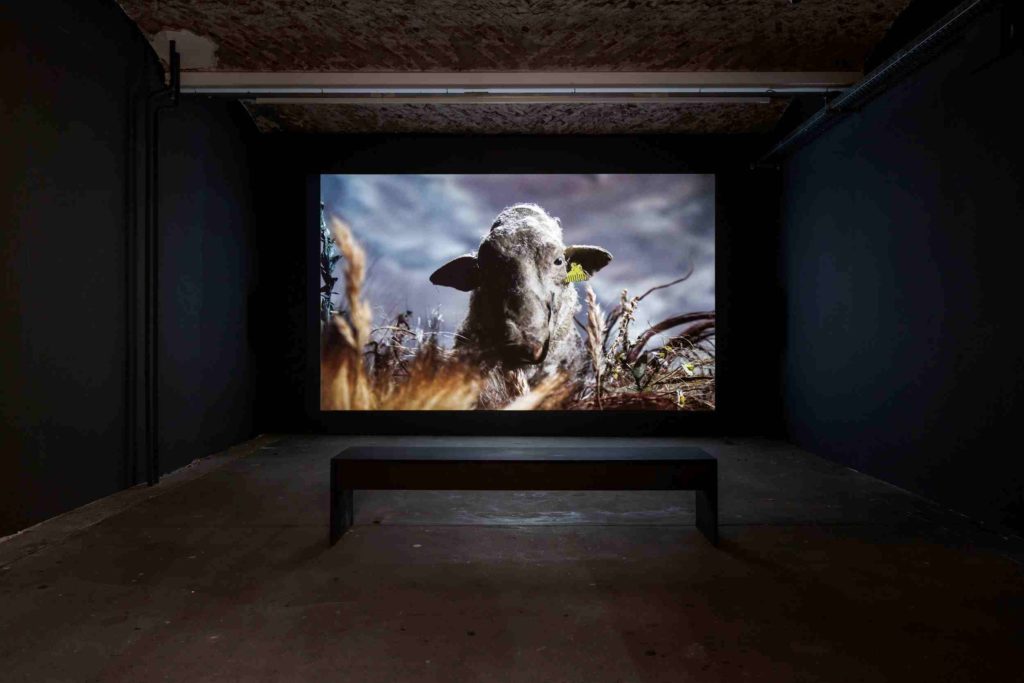
This sense of being unable to settle becomes particularly vivid in Dana Kavelina’s Grey Heart (2026). “Communication’s dead,” one character tells another at some point of the stop-motion film. A soldier, a cow, and the earth itself become figures within a strange world devastated by wars, in which language seems to have broken down. The work gives displacement a form: If there is no language through which to speak, and no ground on which to settle, what remains?
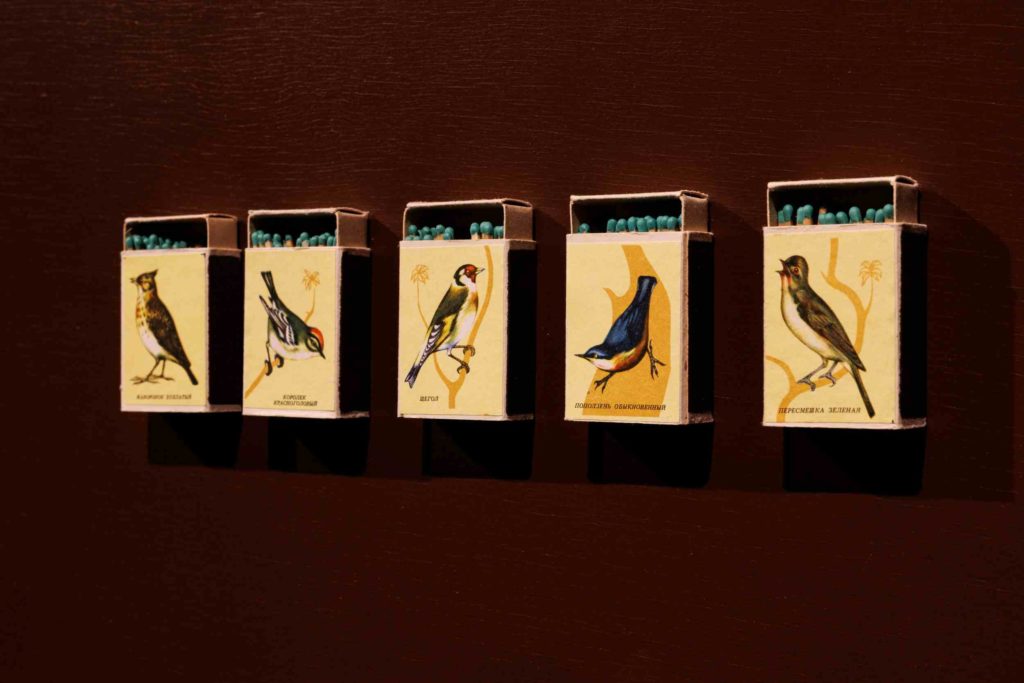
Joyce Joumaa’s Works of Centuries (2026) approached the question of time from another direction. The work takes as its starting point a posthumous letter John Berger wrote to Rosa Luxemburg in 2015, imagining a correspondence across different times and historical moments. Berger posits a future that will never be; Luxemburg, in her letters from prison in 1918, turns instead toward the immediate present, finding a kind of grounding in the birdsong she can hear from her cell. Joumaa brings these different experiences of time into relief through a framed letter and an open wooden structure containing Soviet matchboxes arranged in a grid: small containers of flame, but also of memory and narrative.
The exhibition’s program, too, is built around forms of gathering: listening sessions, performances, conversations. It understands polyphony not simply as an aesthetic condition but as a social one, and this distinction truly matters. There is a difference between representing a community and allowing a space to become one, however temporarily.
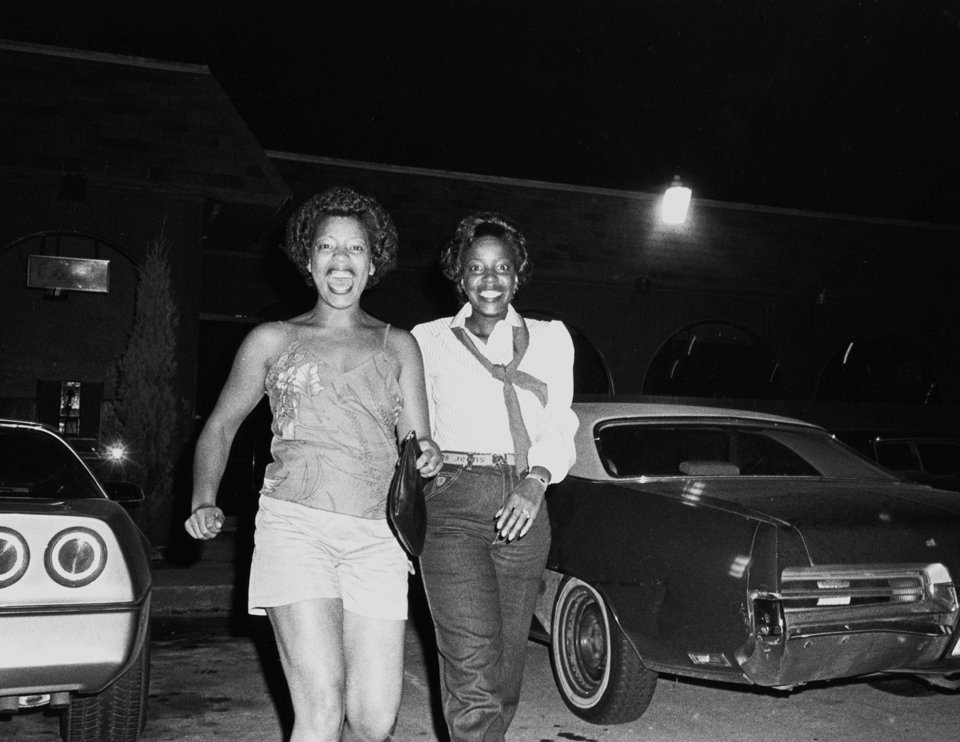
Carrie Mae Weems, Welcome Home, 1978–84. Courtesy of the artist; Gladstone Gallery, New York; and Fraenkel Gallery San Francisco.
A related question runs through Carrie Mae Weems’s “The Heart of the Matter” at C/O Berlin, although from a very different historical and visual position. Weems has spent decades examining who gets to enter the frame (literally and not), who remains outside it, and what happens when photography (a tool of classification as much as representation) is used to complicate those hierarchies. The retrospective brings together more than a hundred photographs and videos spanning over four decades, returning repeatedly to questions of race, femininity, power, memory, and the politics of representation.
At C/O, these questions also exist within an institution dedicated to photography itself, and therefore focused on the ways images are made, circulated, framed, and looked at. Seen during this particular week, Weems’s work acquired a particular significance. The question was not simply who is represented, but who is granted visibility, and under whose authority. Visibility is never neutral, and neither is the decision to look.
At Sprüth Magers, Salvo’s “La Città” offered a quieter counterpoint. His cities, churches, and landscapes are not concerned with displacement in any literal sense, yet they are engaged with place, with the act of turning somewhere into an image, and an image back into a memory. The repeated landscapes and archetypal locations in Salvo’s work gradually lose their specific geography, becoming instead fields of light and color and form. A city can arise almost anywhere; a landscape can become a recollection.
It was useful to experience Salvo’s work alongside Weems and the Kyiv Biennial, because it complicated the idea that belonging must always be addressed through explicitly political work. Sometimes it emerges instead as a persistent attachment to a detail, a color, a specific light, or a landscape. It’s the silent insistence that a place can continue to exist inside an image long after one has left it.
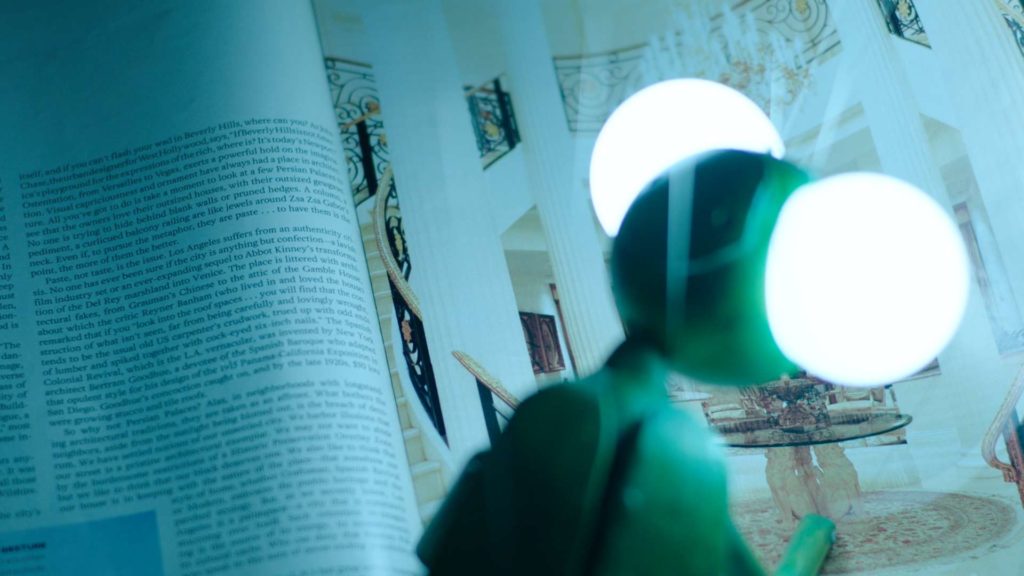
Arash Nassiri, A Bug’s Life, 2025. Video still. 1-channel video installation, 4-channel audio. 16:9, 21’18’’. Co-commissioned by Chisenhale Gallery, London; Fluentum, Berlin; and Fondation Pernod Ricard, Paris. Produced by Chisenhale Gallery. Courtesy of the artist.
At Fluentum, Arash Nassiri’s “A Bug’s Life” shifted the scale again. The exhibition, the artist’s first institutional solo presentation in Germany, centers on the film of the same name and includes two new series of sculptures. Installed at the grandiose entrance of the former Luftwaffe building that houses Fluentum, the video work begins with an apparently absurd premise: an insect puppet moving through a luxurious Beverly Hills mansion at night, guided by a series of unsettling forces.
Gradually, however, the house reveals another history: it is one of the mansions designed by Hamid Omrani, an Iranian architect who became sought after by wealthy Iranian diaspora families who settled in the USA after the revolution in 1979. The insect’s journey through this world becomes a way of moving between public and private space, between what is visible and what remains hidden, between architecture as a display of wealth and architecture as a container of memory.
This is somehow characteristic of this year’s Art Week in general: a tendency to approach difficult realities sideways, through systems, environments, altered forms of perception, as if direct address had become almost impossible. And yet the political history remains embedded in the spaces themselves. In “A Bug’s Life,” the final protagonist is only an insect, but its smallness makes the surrounding architecture seem even more monumental.
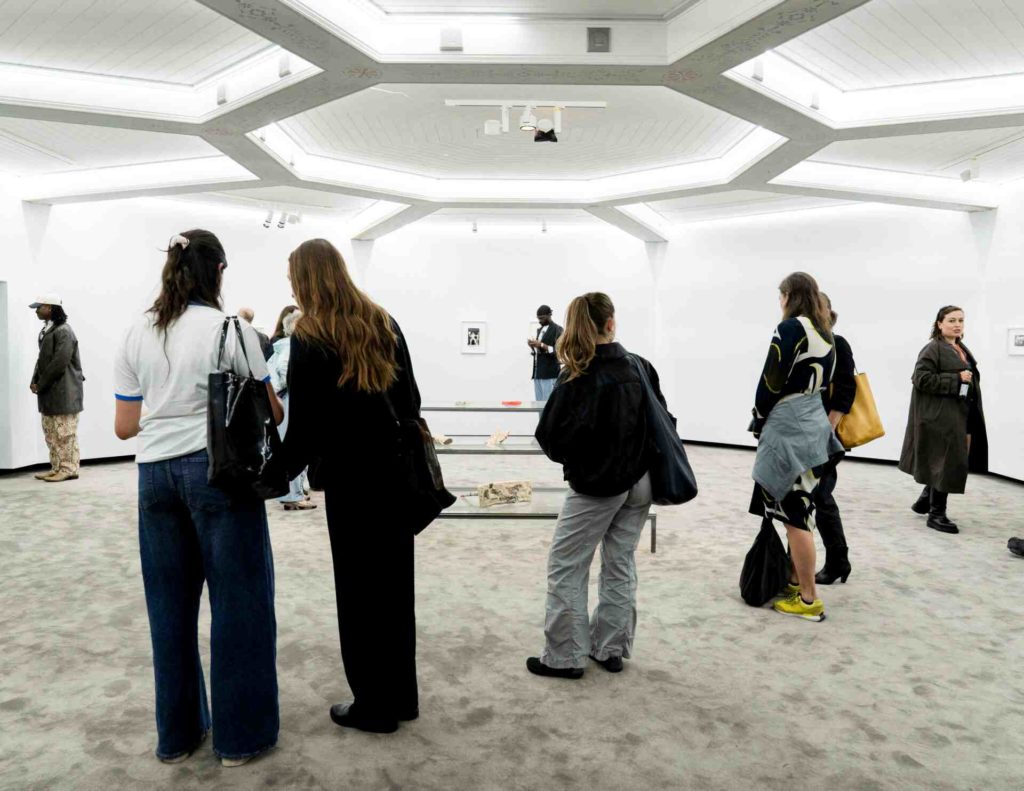
“Projections onto the East.” Installation view at Schinkel Pavillon, 2026. Photography and © Cansu Kuscu for Berlin Art Week. Courtesy of Berlin Art Week.
“Projections onto the East,” spread between n.b.k. and Schinkel Pavillon, made the question of looking at territory even more explicit. Bringing together artists from Ukraine, Moldova, Romania, and Germany, the exhibition examines how the idea of “the East” has been produced through political, cultural, and aesthetic projections. What appears to be a geographical direction is revealed instead as a construction: a category shaped by the history of the Cold War, by Western ideas of difference, and by the transformations that followed the collapse of the Eastern bloc. In this context, the East becomes not simply a place but a way of looking. The exhibition also makes visible how persistent the East/West divide remains, even as its political and cultural coordinates have changed. Its title contains its own warning: to look at a place is never entirely separate from projecting something onto it.
Perhaps this is why the smaller encounters across the city felt connected to the larger exhibitions, even when their concerns were very different. In “Tensions” at CCA, the work of Polish twins Alicja and Bożena Wahl carried another kind of historical and psychological friction. The sisters worked together while maintaining distinct artistic practices, and in the 1970s they opened what became the first commercial gallery in Poland, operating within the very different cultural conditions of communist Poland. “Tensions” suggested another form of dialogue: between two artists, between individual and shared histories, and between forms of making that resist being neatly separated.
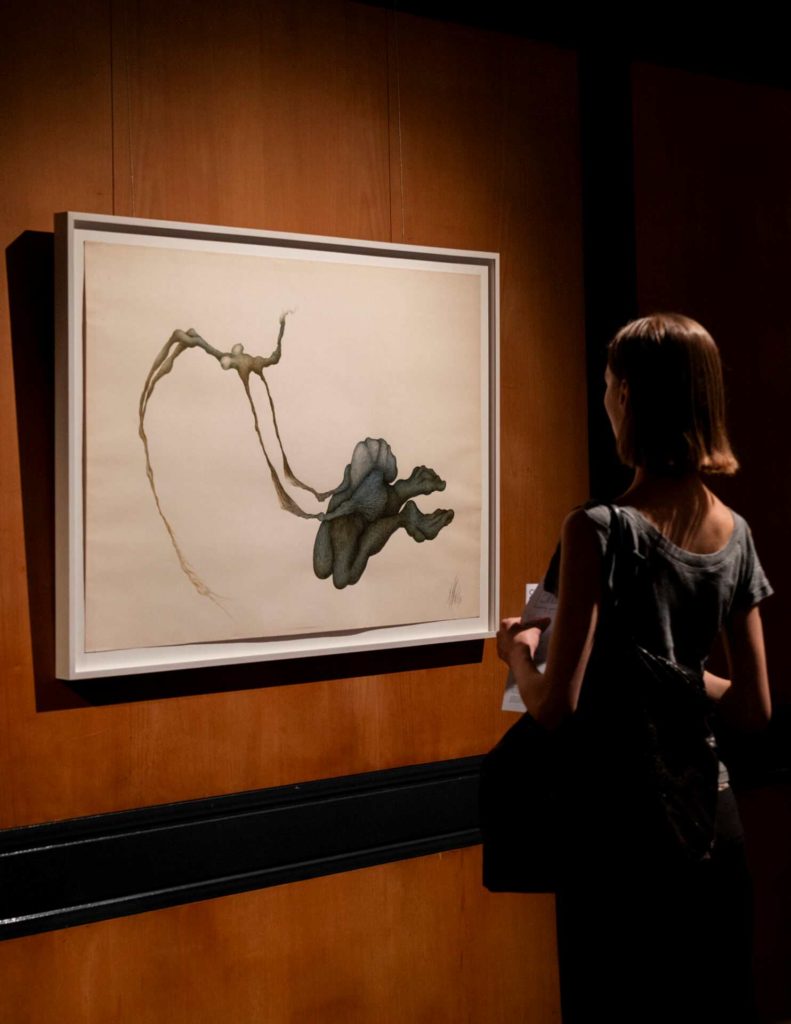
At KINDL, Mischa Kuball, Kira Freije, and Thu-Van Tran occupied the vast spaces of the former brewery through very different understandings of space, material, and memory. Carsten Höller’s Fly on Amanita (2025), encountered almost in passing near Hermannstraße subway station, briefly turned the movement through the city into something hallucinatory. At the Haus der Kulturen der Welt, “Not All Travellers Walk Roads of Humanity as Practice,” the 36th Bienal de São Paulo’s contribution to Berlin, expanded the question of movement into a broader meditation on humanity, travel, and the paths — chosen or imposed — through which people move.
Moving from institution to gallery, from Mitte to Neukölln and back toward City West, Berlin itself became part of the exhibition. Distance mattered. Fatigue mattered. The changing architecture mattered. So did the brief moments of stillness between one appointment and the next. The city began to feel less like a sequence of exhibitions than a collection of temporary rooms.
In that sense, the Bristol Berlin in Charlottenburg, the hotel where I was staying, offered a fitting place to return to. On Kufürstendamm, in the middle of City West, the hotel belongs to a part of Berlin shaped by successive layers of history, commerce, architecture, and reinvention. The building has been there for around seventy years, but its recent renovation has given it another life without entirely concealing what came before. After so many exhibitions concerned with the ways places are inherited, remembered, displaced, and remade, returning each evening to a place that had itself been remade felt appropriate.
Perhaps this was also why the contrast with “NIGHT” became clearer toward the end. Cattelan’s first major solo exhibition in Germany was impossible not to notice. Its queue was visible from a distance; its spectacle generated its own gravity. The other exhibitions required something else: time, proximity, sometimes patience. They were less interested in occupying the center than in asking who had been left outside it.
This does not make one approach necessarily more political than the other. Cattelan’s work has always dealt in provocation, irony, and the machinery of attention. But in Berlin, immediately after a far-right electoral victory in eastern Germany, the difference felt significant. One kind of exhibition gathers people through spectacle; another tries to make room for histories, voices, and experiences that are still too easily pushed to the margins.
At the end, Berlin Art Week seemed — at least to me — less concerned with defining what Berlin is than with revealing the many places being made within it. Some were temporary, some historical, some imagined, some inherited. Some could hold a crowd; others required only a few people willing to stay.
Belonging, after all, is not really about where one stands. It is a question of whether there is still somewhere being made for you.