“Oracles Beyond the Sea” is the final exhibition of the year-long residency of the fellows at Villa Medici. Curated by Marea Art Project, the exhibition brings together practices and research spanning visual art, music, writing, and architecture. The title takes its cue from a work by Palestinian artist Vera Tamari, opening onto a reflection on the Mediterranean as a space of memory, conflict, and imagination.
The range of disciplines represented in the exhibition speaks to Villa Medici’s ability to engage with the present in all its contradictions and transformations. In this conversation with the Marea Art Project’s founder’s Imma Tralli, and Roberto Pontecorvo, the duo reflects on the origins of the exhibition and the work developed throughout the residency.
The resident fellows were Alia Bengana, Arianna Brunori, Diaty Diallo, Marin Fouqué, Elitza Gueorguieva, Hugo Lindenberg, Giulia Lorusso, Paul Maheke, Marie-Claire Messouma Manlanbien, Randa Maroufi, Farnaz Modarresifar, Baptiste Pinteaux, Enrique Ramírez, Ben Russell, Camille Lévy Sarfati, and Thu-Van Tran.
Cristiano Seganfreddo: The title “Oracles Beyond the Sea” comes from a work by Palestinian artist Vera Tamari. Why did you choose the figure of the oracle?
Imma Tralli and Roberto Pontecorvo: The symbolic universe surrounding the oracle felt deeply resonant with the challenge of bringing together, within a single exhibition, the plurality of voices, genealogies, and projects developed by the Villa Medici fellows during their residency in Rome.
The exhibition moves away from a linear approach to exhibition-making, bringing together disciplines that range from visual and performance art to music, curatorial practice, art history and theory, literature, and architecture. In this context, the oracle became a framework through which to offer audiences an entry point into the works, suggesting possible connections and resonances without imposing a single interpretation. It is an invitation to embrace visions, omens, and questions, and to cultivate the critical awareness needed to navigate the complexity of the present.
The title emerged from a personal encounter: our meeting in Ramallah in January 2026 with Palestinian artist and activist Vera Tamari (Jerusalem, 1945), a key figure in the development of artistic movements connected to Palestinian resistance. Our encounter with her work Oracles from the Sea (1998) became a way of entering into dialogue with the poetic and political force of the works in the exhibition, but also with a collective action undertaken by the fellows a few months after arriving in Rome.
During the White Night in November 2025—which they collectively renamed Black Night—the fellows joined the international mobilization in support of the Global Sumud Flotilla. They expressed their solidarity with the Palestinian people and with “artist colleagues who create, resist, in places under siege, looted, destroyed; from the heart of displacement or exile,” while affirming their desire to “continue building archives of memory, weaving alternative narratives, surrounding ourselves with the voices of those who are no longer here and the presence of those who are still alive.”
“Oracles Beyond the Sea” thus becomes a way of reconnecting with a world of ancient genealogies and cosmologies, where the continuity of creation and the persistent impulse toward life resist every attempt at oppression. It is a radical act of imaginative practice that resonates with many of the works in the exhibition, which reclaim new narratives and forms of ritual.
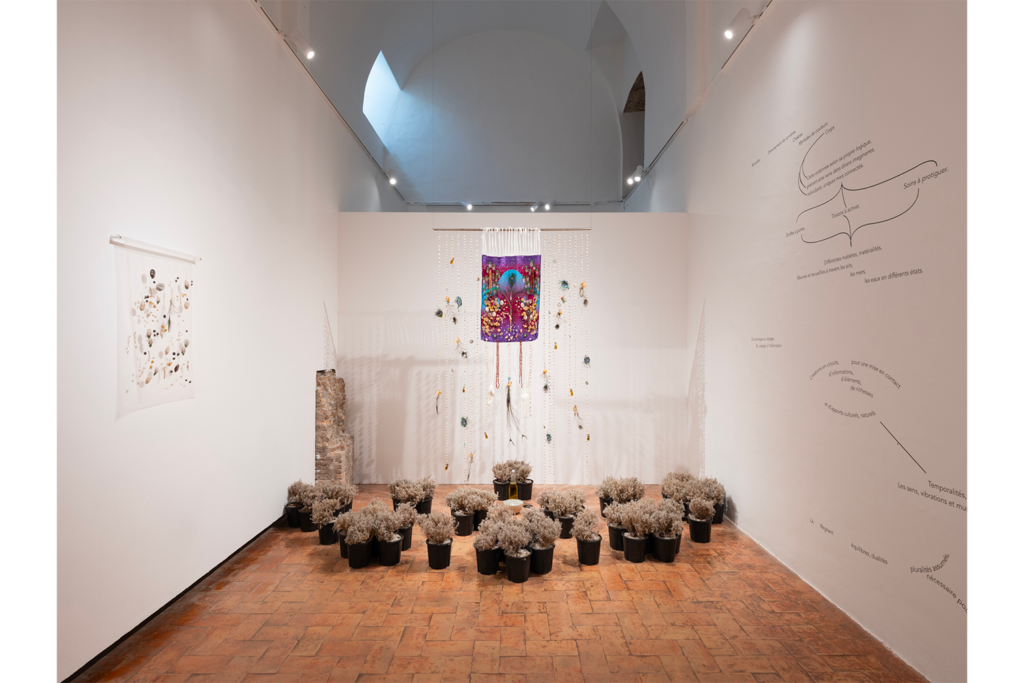
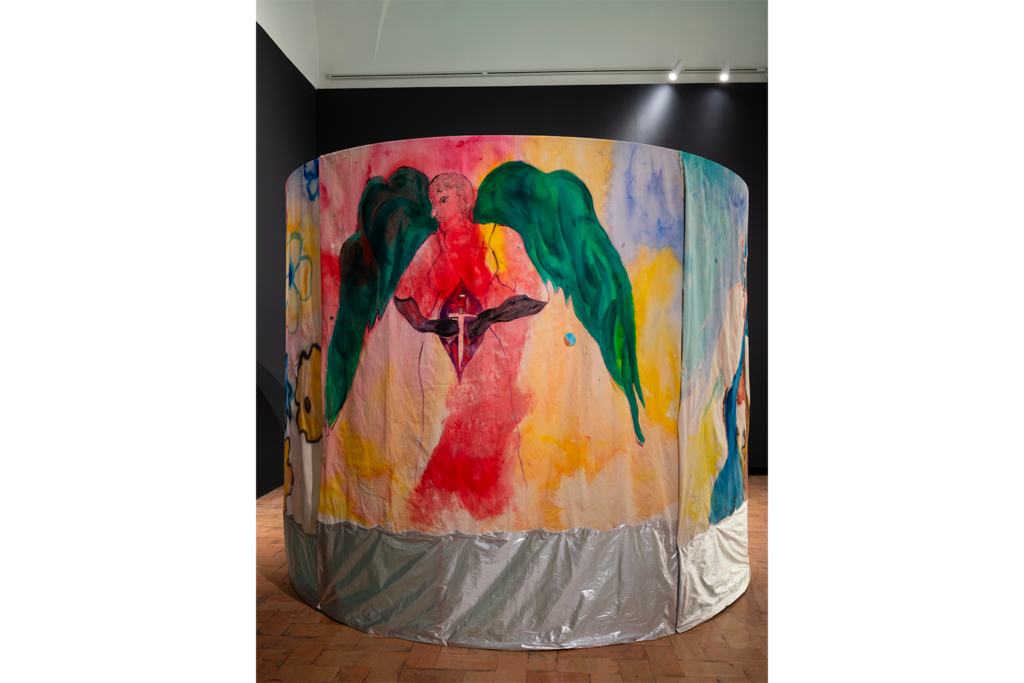
This is particularly evident in the practice of visual artist Marie-Claire Messouma Manlanbien, whose work appears on the exhibition manifesto that introduces the exhibition spaces. Drawing on ideas of healing and care, her work weaves together memories and representations of the ancient world to create new visions, while restoring a sense of magical continuity with the organisms that inhabit the earth, the skies, and the seas, all in profound harmony with the cosmos.
CS: In your work, the Mediterranean never appears simply as a geographical space. What does it represent for you today: a place, a shared memory, or a way of reading the world? Did you find echoes of this idea in the works in the exhibition?
IT & RP: The Mediterranean has always been, for us, a living body through which to critically read the present. It is a porous space shaped by layers of memory that settle and later resurface in fragmentary forms—through gestures, historical processes, and rituals.
In recent years, we have worked from both an urgency and a desire to create networks of exchange among artistic residencies across the Mediterranean: a poetic and political horizon, but above all a field of forces in which we can trace the tensions connecting past struggles to contemporary ones—displacement, diasporas, systemic violence, and forms of extraction and coloniality that have shaped the region’s history and continue to produce effects in the present.
From this perspective, the sea becomes a methodological threshold as much as a symbolic one: a space where individual and collective histories overlap, and where artistic practices can function as forms of listening and counter-narration.
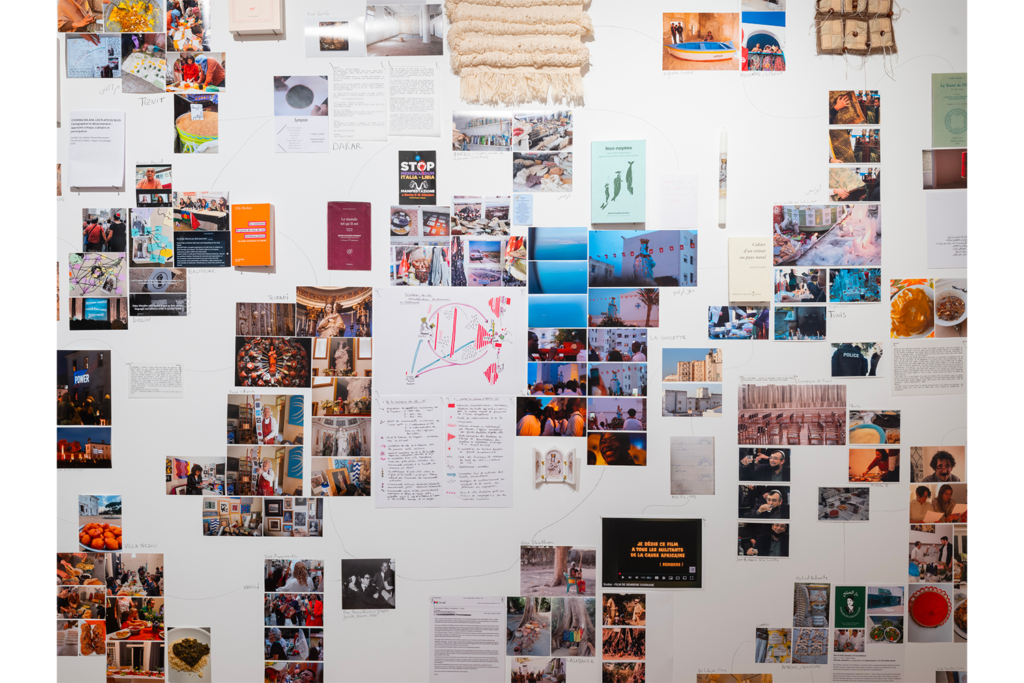
This resonates with several of the projects in the exhibition, many of which emerge from archives and from images that are missing, suppressed, or denied. One example is the work of curator and writer Camille Lévy Sarfati, whose research takes the form of an alternative atlas in which the Mediterranean emerges simultaneously as a ritual and political space—a network of gestures, practices, and histories that resist the logics of colonial and nationalist erasure.
Starting from ritual as a form of transmission and counter-cartography, her work allows us to understand the Mediterranean as a space of solidarity, thought, and practice, but also as a territory crossed by bodies, suspended between presence and disappearance.
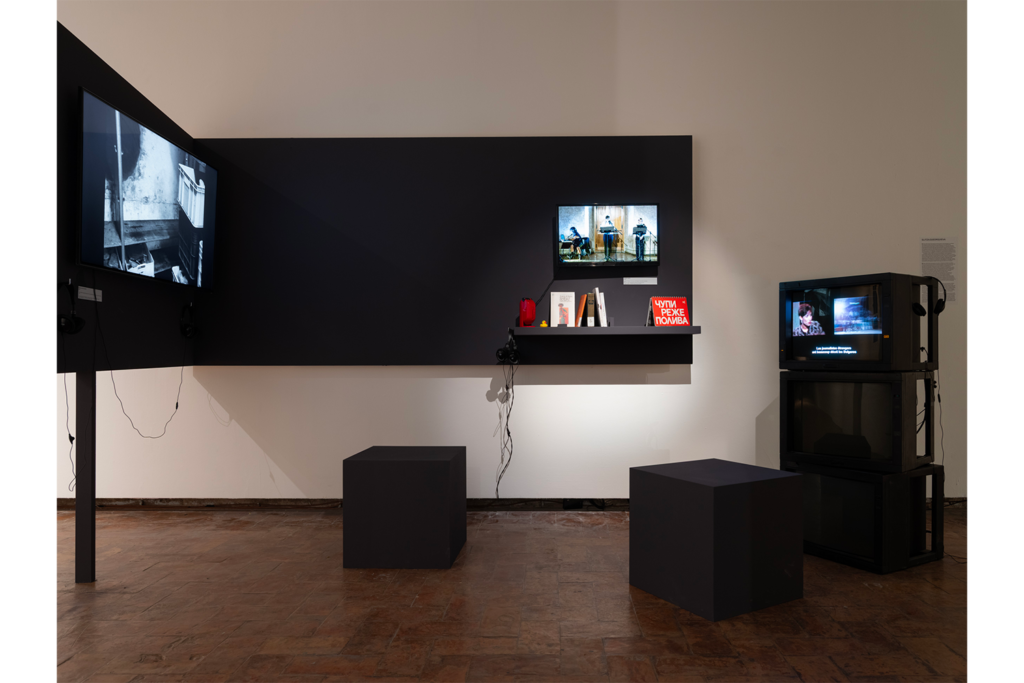
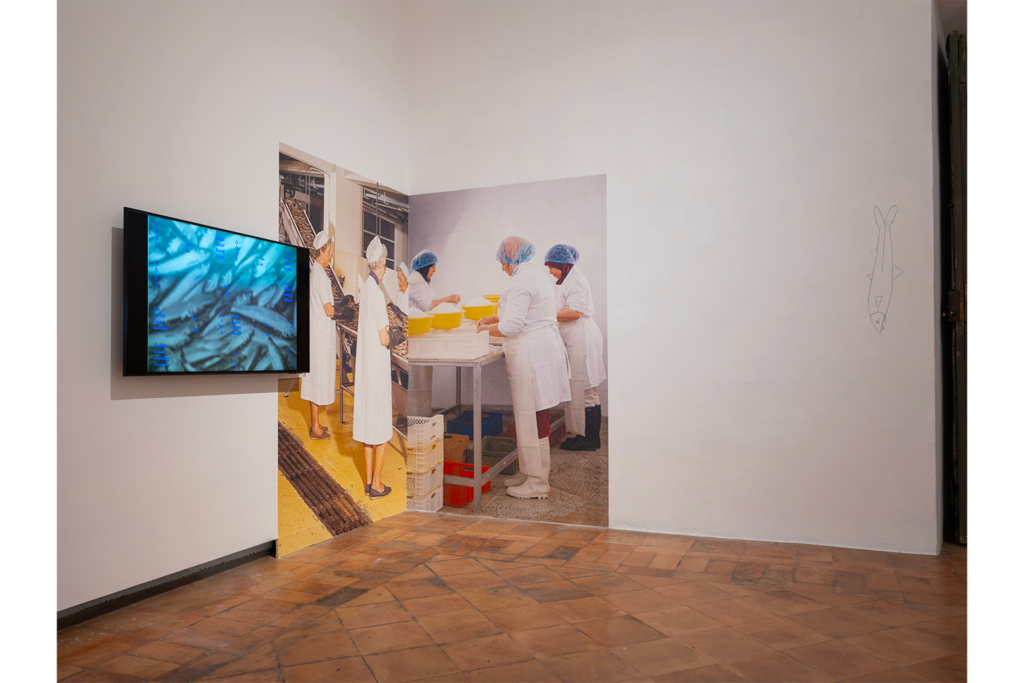
A similar perspective emerges in the work of filmmaker and visual artist Randa Maroufi, for whom the Mediterranean becomes a political space marked by historical wounds, in this case shaped by migration, the transformation of bodies, and exploitation connected to labor in the anchovy-canning industry and to the economic infrastructures surrounding the sea. At the intersection of ecofeminism, colonialism, and social struggles, her work brings forward a chorus of gestures and memories that emerge precisely from what usually remains outside the frame.
These reflections allow us to reconnect with contemporary forms of resistance and to understand the Mediterranean as an unsettled space of compromise, conflict, and constant transformation, where rituals and artistic practices can become tools for reactivating memory.
CS: After a year spent alongside the Villa Medici fellows, what portrait emerges of this new generation of artists, architects, musicians, theorists, writers, and researchers?
IT & RP: It would be very difficult, and probably inappropriate, to draw a portrait of a new generation of creatives based on the specific group of fellows in residence at Villa Medici this year. What we encountered was rather a constellation of practices, positions, and voices, at times very different from one another, temporarily brought together by the residency, of which the exhibition represents the concluding act.
What emerges is a shared way of inhabiting research: open to experimentation and cross-disciplinary exchange, attentive to genealogies, ecological, feminist, and decolonial forms of knowledge, but also to other forms of knowledge that pass through alchemy, the rewriting of ancient myths, ritual, and dialogue with what normally remains invisible. These practices constantly bring personal and collective memory, past and present, into relation, in a continuous tension between the poetic and the political. Within this interweaving, aspects such as care, desire, and new forms of relationship also find space, with the artistic gesture understood as a possibility of existence.
One recurring element is certainly the way autobiographical experiences are not isolated from collective history. The personal becomes a site through which contemporary conflicts and historical processes are traversed.
This is the case with the work of composer, santur player, and poet Farnaz Modarresifar, who for Villa Medici presented an audiovisual piece intertwining Igor Stravinsky’s Oedipus Rex with the violence inflicted upon the Iranian people in January 2026. In her work, Oedipus’s blinding becomes a metaphor for the gaze and its fractures, while ritual becomes a space in which voice and memory transform loss into a poetic act.
The same can be said of other projects, where the body, archive, photography, writing, or performance become ways of transforming lived experience into political imagination.
One of the most interesting aspects of the residency was also seeing how disciplines and practices ceased to be perceived as separate, self-contained categories, and how even non-visual practitioners engaged with the exhibition format.
Writer and clinical psychologist Hugo Lindenberg explored the cinematic medium through a work of fiction that is simultaneously literary and visual, creating a poetic documentary about grief and its representations.
Art theorist and philosopher Arianna Brunori invited visual artist Alice Visentin to conceive a large-scale installation that conveys, through allegorical figures, secret languages, and strange creatures, the experience of studying the alchemical imaginary, inviting audiences to move around the work.
Composer Giulia Lorusso created Cercle, a sound installation conceived as a site-specific work for the exhibition staircase and imagined as an echo of a broader diptych for sixteen voices, inspired by the myth of the sorceress Circe and the profoundly transformative power of the feminine imaginary.
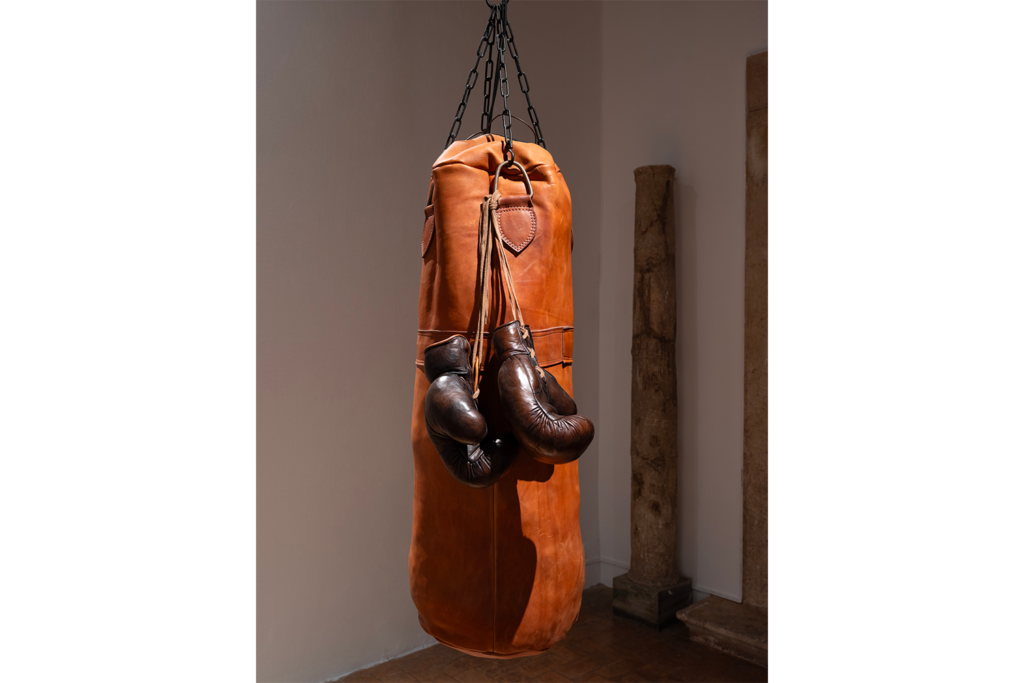
Writer, poet, and performer Marin Fouqué, a boxing enthusiast, continued his research into representations of masculinity through a sound installation developed with Roman boxer Adriano Tramontozzi. The work emerged from his experience at Palestra Indomita and Palestra Popolare di San Lorenzo during his months in Rome.
The residency provided the time and space for these crossings to become possible. It made it possible to conceive or consolidate a way of conducting research in which theory and practice, experimentation and creation, individual and collective dimensions were continuously brought into relation, with an emphasis on process.
CS: Many of the projects in the exhibition seem to move between imagination and political practice. Is contemporary creation returning to a more direct engagement with reality?
IT & RP: Over the course of this year spent following the work of the Villa Medici fellows, we encountered many practices that do not separate artistic research from political positioning, bringing embodied experiences into relation with radical imagination.
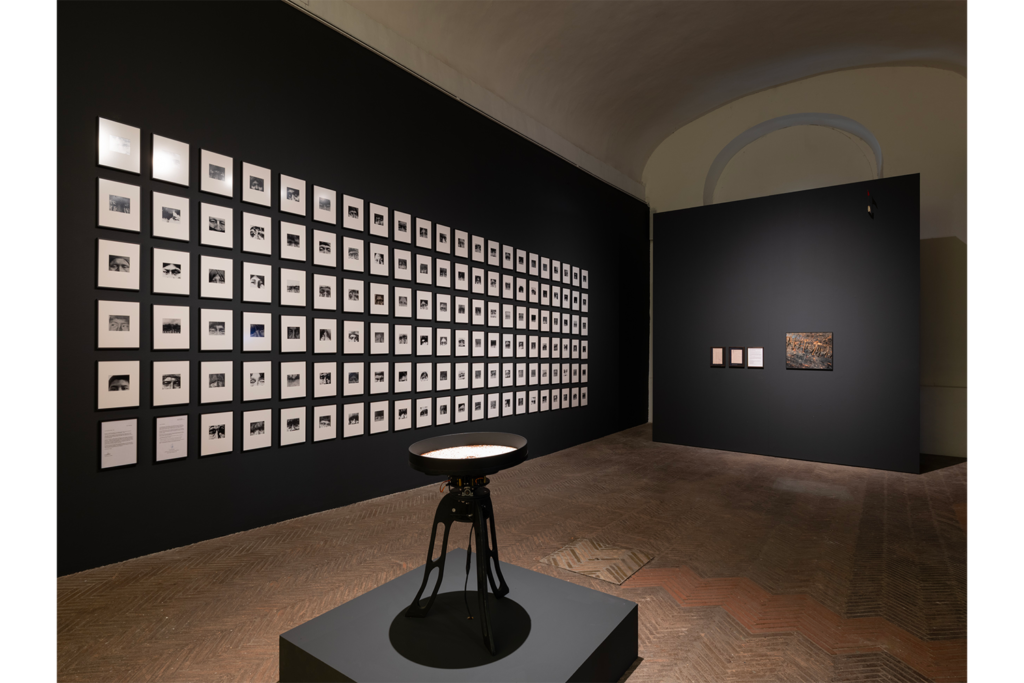
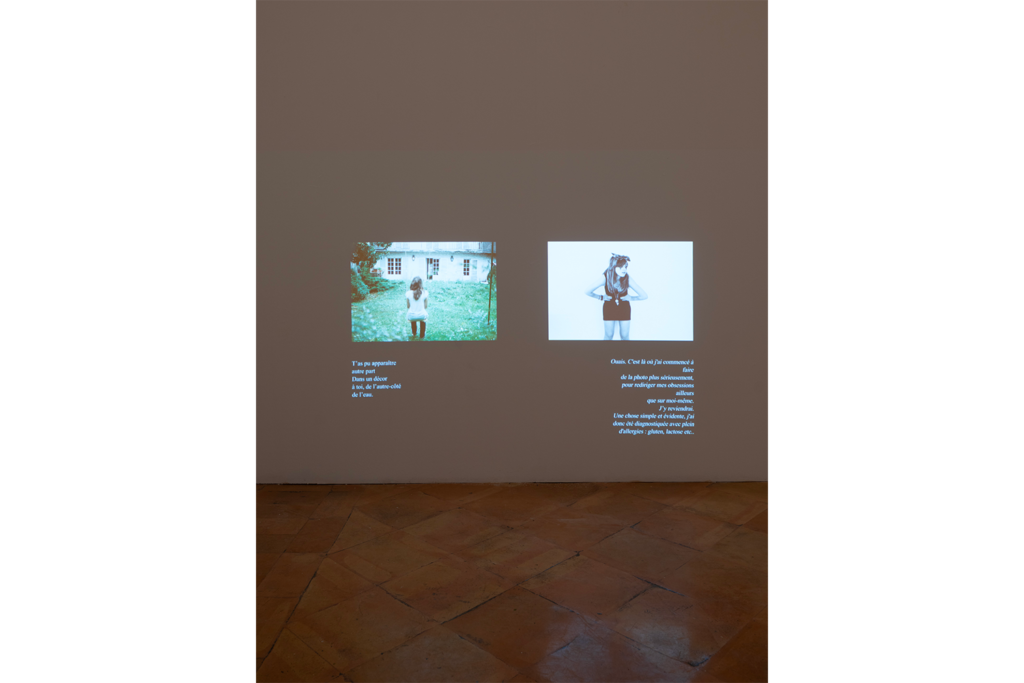
This concerns very different forms of expression. In writing, for example, the practice of author and performer Diaty Diallo and invited photographer and archivist Nastasia Alberti took the form of an intimate and fragmentary photographic archive of words and images, restoring visibility to racialized subjectivities and to the vulnerability of bodies marked by systemic violence often omitted from dominant narratives.
It is a gesture that reaffirms the importance of leaving traces and building new collective archives.
The work of writer, performer, and documentary filmmaker Elitza Gueorguieva likewise begins with a personal experience—her French naturalization process—to reflect, through a tragicomic yet deeply political lens, on suspended identities, belonging, and the ways in which institutions determine who can be recognized as a citizen and who cannot.
We observed the same in the visual arts. Enrique Ramírez works with the material traces of colonial dispossession through the history of a Yagán canoe stolen in 1893 from the far south of Chile and preserved in the collections of the Museum of Civilizations in Rome. He transforms a looted artifact into a living testimony to the colonial past and contemporary forms of resistance.
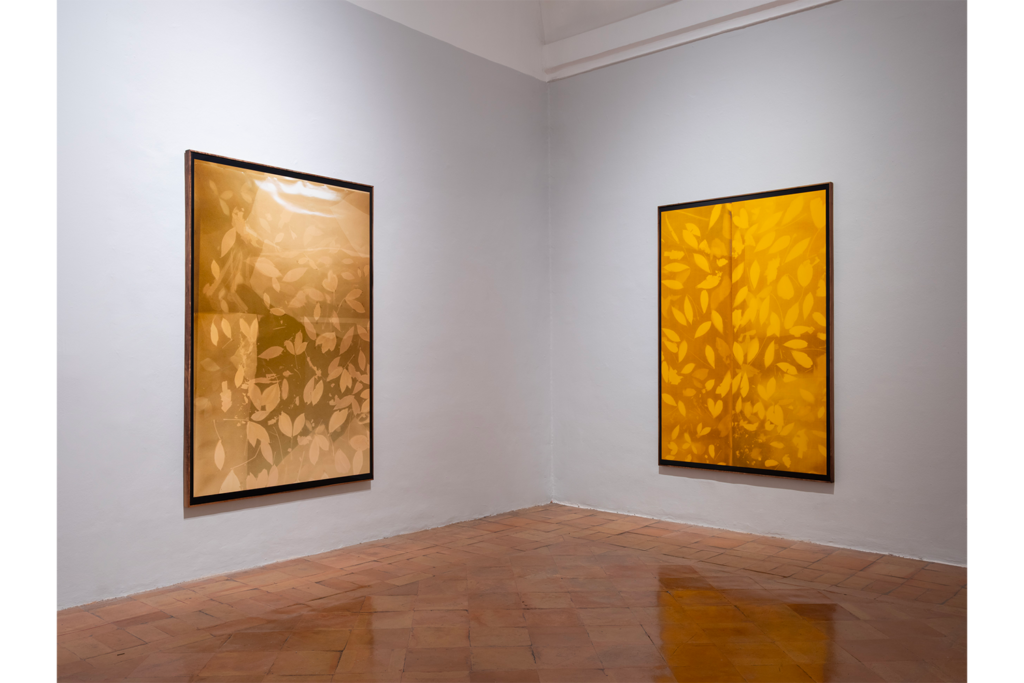
Thu-Van Tran, meanwhile, examines the colonial legacy inscribed in the landscape, bringing to light, through the imprints of hevea leaves originating from former colonial plantations, the relationship between exploitation, memory, and the persistence of living things.
This intertwining of imagination and political practice can also be found in the work of filmmaker and musician Ben Russell, who created a non-fiction audiovisual installation conceived as an in-situ projection for the Villa’s cistern and as research for a feature-length fiction film.
Rome becomes a body through which to read the present, a landscape traversed by demonstrations and inhabited by social centers and memories that continue to re-emerge from the city’s political and historical layers.
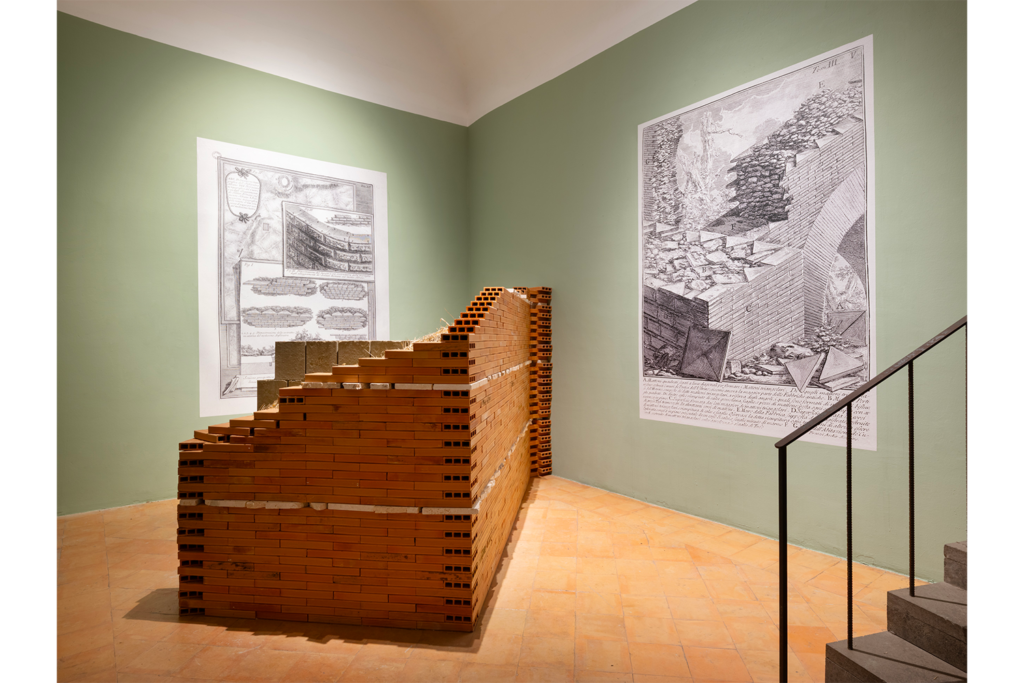
In Russell’s work, we also encounter engravings by Piranesi, stemming from a desire to enter into dialogue with the work of architect Alia Bengana, who, together with invited ceramist Jacques Kaufmann, draws on the ancient traces of Rome to imagine ecological forms of construction, expanding into a reflection on today’s high-carbon construction methods.
So rather than a return to reality, it seems to us that what is emerging is a desire to expand the ways in which reality can be narrated and made tangible. In these works, imagination becomes a condition for critically engaging with the contemporary world.
CS: The Italian landscape seems to emerge in the exhibition not as a physical place, but as a living archive of presences and absences. Did the encounter with Italy influence the fellows’ research in any way, bringing to light stories, images, and figures that have traversed time?
IT & RP: As we saw in the previous section, the Italian landscape, and Rome in particular, have been a living body for many of the research projects presented in the exhibition.
Rome is a city that bears multiple temporalities inscribed within its fabric: ruins, archives, and ancient layers coexist with invisible presences and repressed memories.
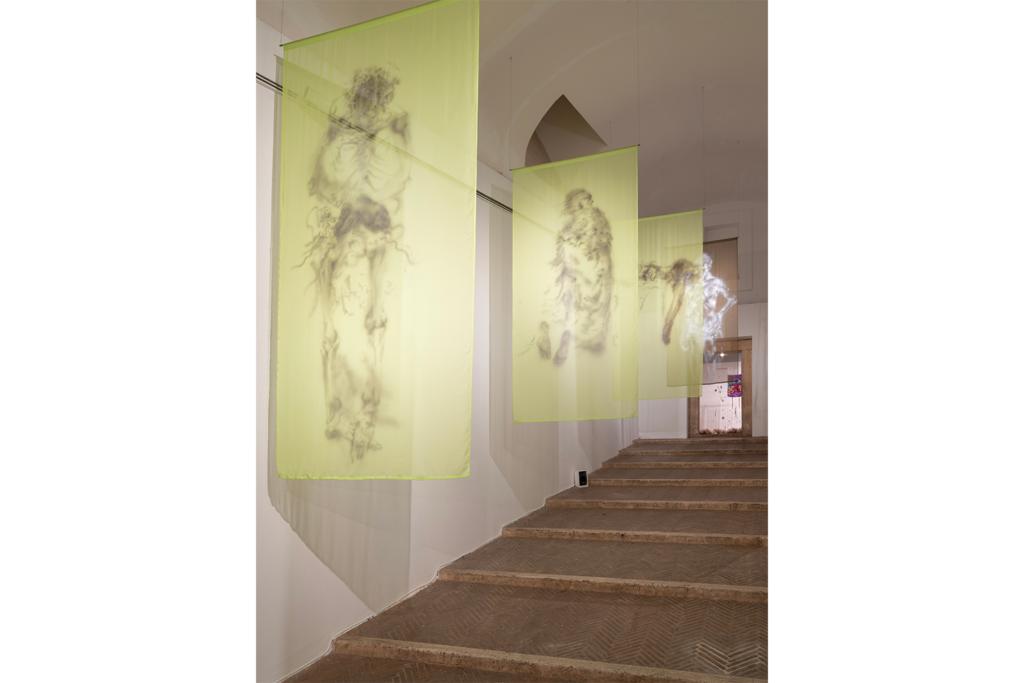
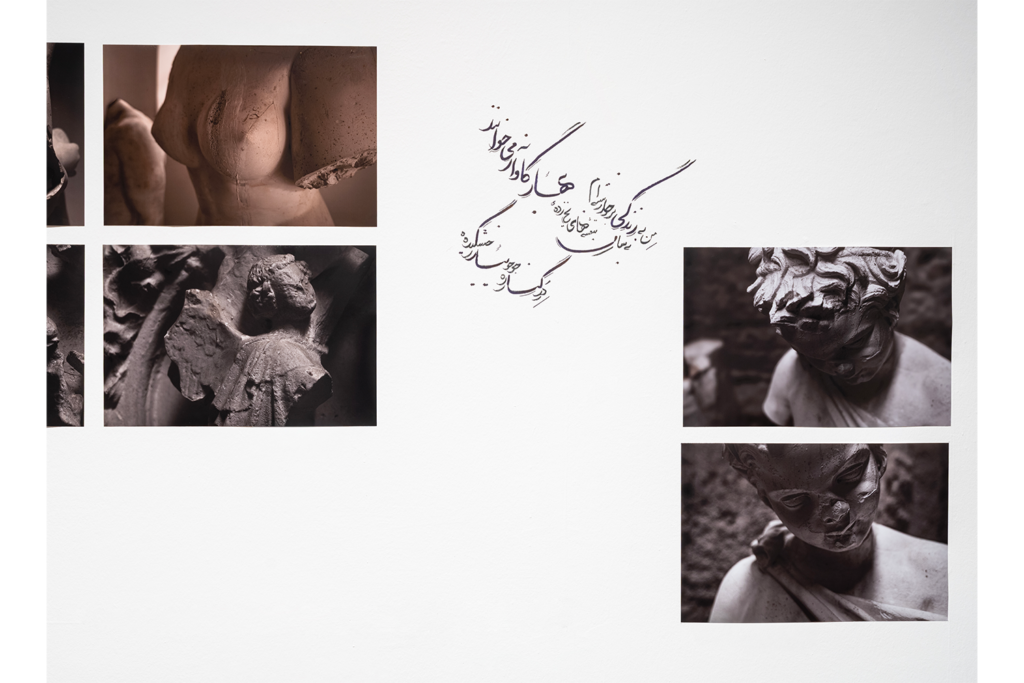
This emerges, for example, in the work of visual artist Paul Maheke, who during the residency turned his attention to funerary statuary and effigies of reclining figures preserved in Roman archives and cemeteries, as well as to Etruscan catacombs.
He brings to light images—or, even more so, presences—capable of questioning our relationship with memory, the invisible, and post-mortem violence against racialized bodies. His evanescent figures, created with an airbrush on canvas, remind us of the way the dead persist among us and of how the image can become a place where the invisible manifests itself.
A different trajectory emerges from the work of Baptiste Pinteaux, who developed research around the photographic practice of PaJaMa, the trio formed by Paul Cadmus, Jared French, and Margaret Hoening French, reconnecting with their experience in Italy between 1937 and the mid-1950s.
He offers dreamlike visions and celebrates a sensual and luminous imaginary in dialogue with the Italian Renaissance, challenging the normative categories of his time through bodies and desire, and opening up new ways of experiencing relationships.
The encounter with Italy thus emerges as an encounter with a place where traces of the past continue to act and generate new possibilities for interpretation, preserving stories that have often remained outside official narratives but possess enormous generative power when brought back to light.
These narratives resurface like threads capable of mending interrupted patterns, offering new ways of looking at and reactivating these legacies.
CS: Marea Art Project is a residency program, curatorial platform, and research center founded on the Amalfi Coast, far from the major art capitals. How has working from a peripheral position influenced your curatorial perspective?
IT & RP: Working outside the centers of the art world means, for us, first and foremost engaging with non-specialist audiences, with communities that do not belong to the contemporary art system or to established circuits.
This has required a constant practice of cultural mediation and relationship-building, in which practices respond not to the logic of the market or the production of visibility, but to the construction of a shared, everyday, situated meaning.
In this context, curating has progressively come to be defined for us as an exercise in listening and translation, rather than as an exhibition device.
More specifically, Praiano, the town of two thousand inhabitants on the Amalfi Coast where Marea was founded, is a territory located at the margins of the major centers of cultural and artistic production. At the same time, it experiences a strong discontinuity between margin and center, between depopulation and social isolation during the winter months and the summer transformation that leaves the territory trapped in homogenizing overtourism.
This tension has inevitably shaped our work and our political positioning, directing our research toward the re-emergence of unofficial forms of knowledge connected to the imaginary of Southern Italy and the Mediterranean, which have often remained outside processes of cultural legitimization.
At the same time, we have experienced this eccentric position as a space of critical distance. We have never viewed marginality as a deficiency, but as an opportunity for an oblique perspective, capable of stepping outside established hierarchies and imagining other forms of relationship between art, territory, and the people who inhabit it.
This is also where our understanding of residency, and of curatorial practice more generally, develops: as an interstitial space in which the logic of reality can be redefined through situated, affective, and political relationships.
It is a space where artists and communities come into contact in order to construct unprecedented constellations, unexpected alliances, and forms of shared thinking, in line with the idea of a relational politics and a continuous crossing between worlds. And this is what we sought to do throughout this year with the Villa Medici fellows.
Working from this position means constantly questioning what is considered central and what remains submerged, seeking to make space for forms of knowledge that are situated and connected to territories.
In this sense, the tension between marginality and centrality is, for us, a critical position that guides our work.
CS: Villa Medici is one of the few places in Europe where artists, architects, writers, composers, and researchers share time and space on a daily basis. What forms of interference or connection have you observed emerging between their practices?
IT & RP: One of the most valuable aspects we were able to observe during the residency was precisely this: the possibility for artists, architects, writers, musicians, theorists, and researchers to share time and space every day, circulating ideas among practices that can sometimes be very different.
This proximity was not neutral. It generated a web of relationships that transformed the Villa into a place of experimentation, but also into a living body, where the intimate and the collective were continuously intertwined through the circulation of emotions, desires, and ambitions, but also vulnerabilities, conflicts, and moments of dissonance.
It was precisely these moments that marked the rhythm of exchange and dialogue, amplifying the plurality of voices and positions that now inhabit the exhibition spaces.
Throughout the year, these points of contact took very concrete forms.
Take, for example, the work of Camille Lévy Sarfati, who during the residency brought together women artists and activists to imagine a Pluriversal Assembly of women dedicated to the relationships between art, ritual, and politics, involving several of the female fellows.
In the exhibition, her work enters into dialogue with that of Diaty Diallo and Randa Maroufi. While each maintains its own autonomy, they share a reflection on how to rethink archives beyond the logic of colonial domination and on the importance of producing new archives and forms of collective memory.
This possibility of coexistence had already emerged during Black Night, mentioned at the beginning of this conversation. It was the first moment in which they presented their research together, but above all it was an opportunity to collectively question the meaning of artistic creation.
Cross-pollination also occurred outside exhibition spaces and scheduled events.
A particularly beautiful example was “Villa Sonora,” a series devoted to experimental music and improvisation conceived by fellows Giulia Lorusso, Farnaz Modarresifar, Enrique Ramírez, and Ben Russell.
Through concerts and performances, together with other invited artists, they explored ambient music, electronics, noise, and hybrid practices combining traditional instruments and electronic devices, finding common ground for research.
Perhaps this is precisely what makes the Villa Medici residency such a unique place: transdisciplinarity is experienced on a daily basis and is always generative. Disciplines cease to be separate compartments and become opportunities for mutual listening, cross-pollination, and transformation.
And it is also this process, made up of often unpredictable encounters, that the exhibition seeks to convey.
CS: If you had to identify one insight or discovery that emerged during this year and that you will carry with you into Marea’s future projects, what would it be?
IT & RP: The truth is that the process has been so intense and layered that we will only truly understand its scope in the coming months, once we have had the time to retrace everything this year has transformed in the way we think and work.
We can say, however, that rather than a single insight, we are carrying with us a different way of understanding research.
Meeting the fellows, their geographies, and their very different practices and life experiences allowed us to broaden our perspective through the eyes of those who experience these histories and conflicts firsthand.
It was a continuous exercise in decentering, reminding us of how important it is not to shy away from complexity, but to embrace it. Remaining in dialogue, even when it is difficult or produces dissonance, is a profoundly political choice, because it means relinquishing simplifications and reassuring positions in order to make space for listening, confrontation, and the possibility of questioning ourselves.
This is an attitude that feels very close to Marea. Working from a margin has always taught us that artistic practices acquire meaning when they are able to enter into relationship with people, with imaginaries, and with the critical conditions that characterize them.
This experience made us understand how important it is to inhabit differences, creating, wherever possible, the conditions in which they can be collectively shared and discussed.
Certainly, in this historical moment, curating an exhibition or shaping a residency means taking on responsibilities. It can become a way of building alliances, preserving memories, and imagining the conditions through which other futures might emerge.
Our task is to open spaces of possibility, make visible perspectives that remain unexplored, and weave the threads through which horizons that the present is not yet capable of seeing can take shape.
The deepest feeling we take with us is the urgency to continue questioning the role of creation and the imaginative power of art, and its capacity to read, challenge, and transform reality.