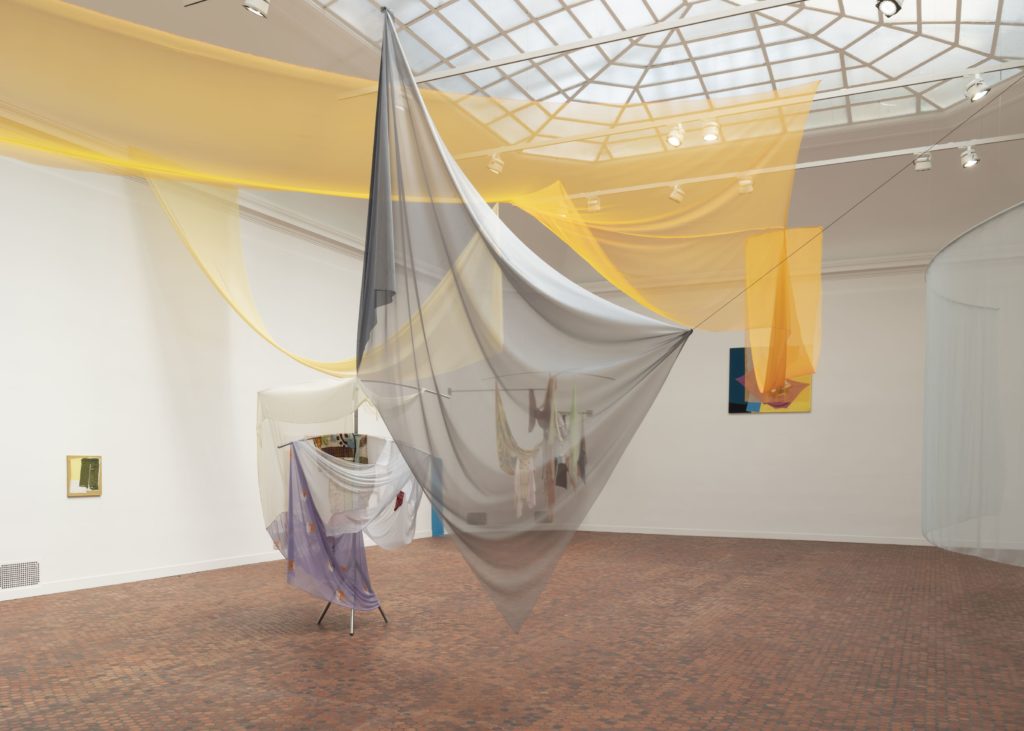
Upon entering the spacious North Gallery in the esteemed classicist building of the American Academy of Arts and Letters, one encounters a long, semi-rectangular diaphanous pale blue fabric that immediately functions as a visual filter. It transforms the hues and implied symbolism of the various textiles mounted on the walls via custom steel armatures. This initial filtering becomes a key to understanding Eric N. Mack’s fluid, site-responsive introspection. The question he guides us to ask is whether what we see is colored by our own perceptions and what it would take to walk away from these preconceived notions. The experience here is cleanly delineated into perceptual cycles.
As we walk around the room contemplating the softly whispering and sometimes screaming color combinations of mauve, lemony yellow, tangerine, gentle black, umber, sage green, and azure blue, presented through chiffons, kente cloth, polyester, and wax hollandais, we take all these aesthetics in. The fabrics come from a wide variety of places, including a fabric emporium in the garment district and the Twenty-Third Street flea market in New York. Some are fashion industry remnants, or scampoli, from Milan. These whimsical combinations of textiles reference our global interconnectedness and the democratization of fashion, travel, and the circulation of goods. In this post–Columbian-exchange, Anthropocene reality, the resulting aesthetic is both formalistically abstract and emotionally charged.
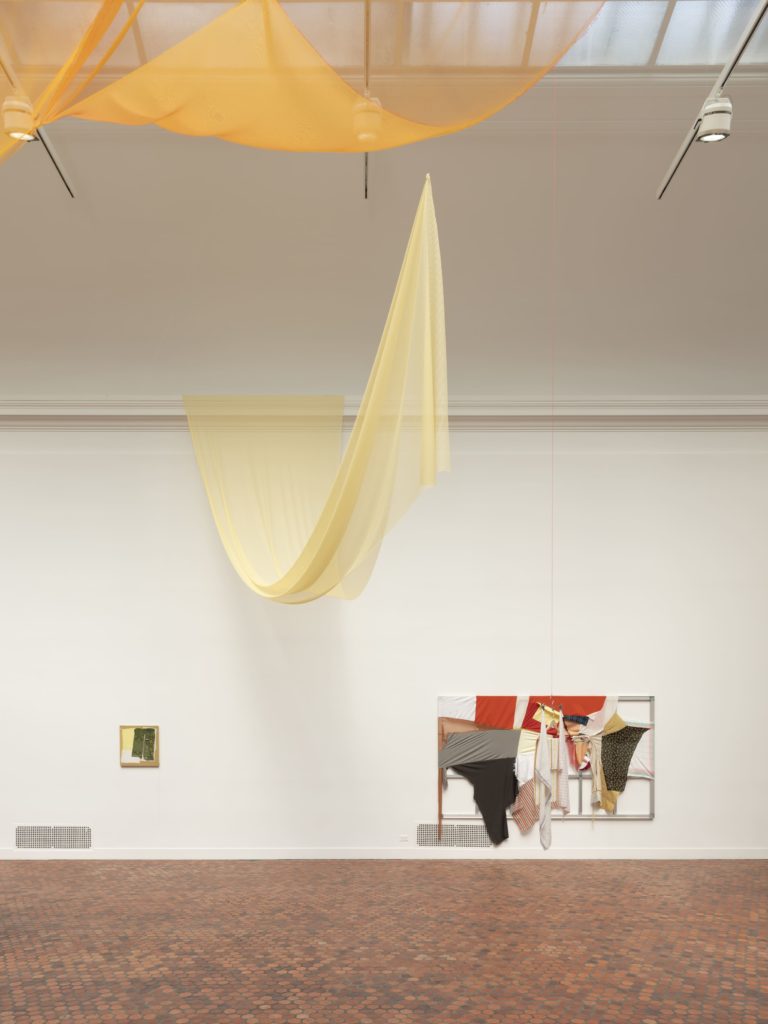
Mack calls these crossover installations and sculptures his “paintings,” although he never uses paint. Here, postmodernist and poststructuralist ideas intersect, creating a cultural moment of historical rapture reminiscent of works by Sam Gilliam or Robert Rauschenberg. And this is where the second perceptual cycle of the exhibition begins. Our present moment –– with its privatized fascism overtaking the globe in one form or another –– differs from the time of acute postwar optimism and Color Field vicissitudes. The present historical rapture brings into focus our deep uneasiness with the undefined and in-between. Looking at a sheared, overlaid yellow and red chiffon, we are prompted to consider notions of consumption and control, the dominance of fast fashion, the accumulation of wealth, and its costs on our ecological future. An age defined by influencers and TikTok does not care much about consequences, only effects.
Mack creates a space filled with air and subtle traces of color that shift in intensity as we move through it. Yet this walkabout makes us reconsider biases and uncertainties. Through these diverse fabrics, the exhibition questions the possibility of a grand narrative. As Theodor Adorno once pronounced, late-capitalist society is so irrational as to make any theory of its culture next to impossible to consider. Still, Mack manages to present a subversive narrative through these disrupted textiles. An epistemological break comes not from overt manipulation of the viewer but from a gentle hint, a whisper. The necessity of an alternative narrative and evaluation becomes a bit irrelevant as we are invited to dream rather than plan. Rather than asking us to create a blueprint for a bright new future, Mack gently guides us to be “fishers of men” and to spread his message of fluidity in the way Jesus called out to his disciples. On the other hand, is he criticizing the fashion industry for being the fishermen of souls? Such post-postmodernism at its best does not give a clear-cut response, and that is for the better.