Koo Jeong A’s exhibition “Land of Ousss [Kangse]” feels oddly scattered. Contrary to what the title implies, it isn’t concerned with a land – although it makes frequent references to real places, countries, and especially to Arles, France, where it is being shown at LUMA.
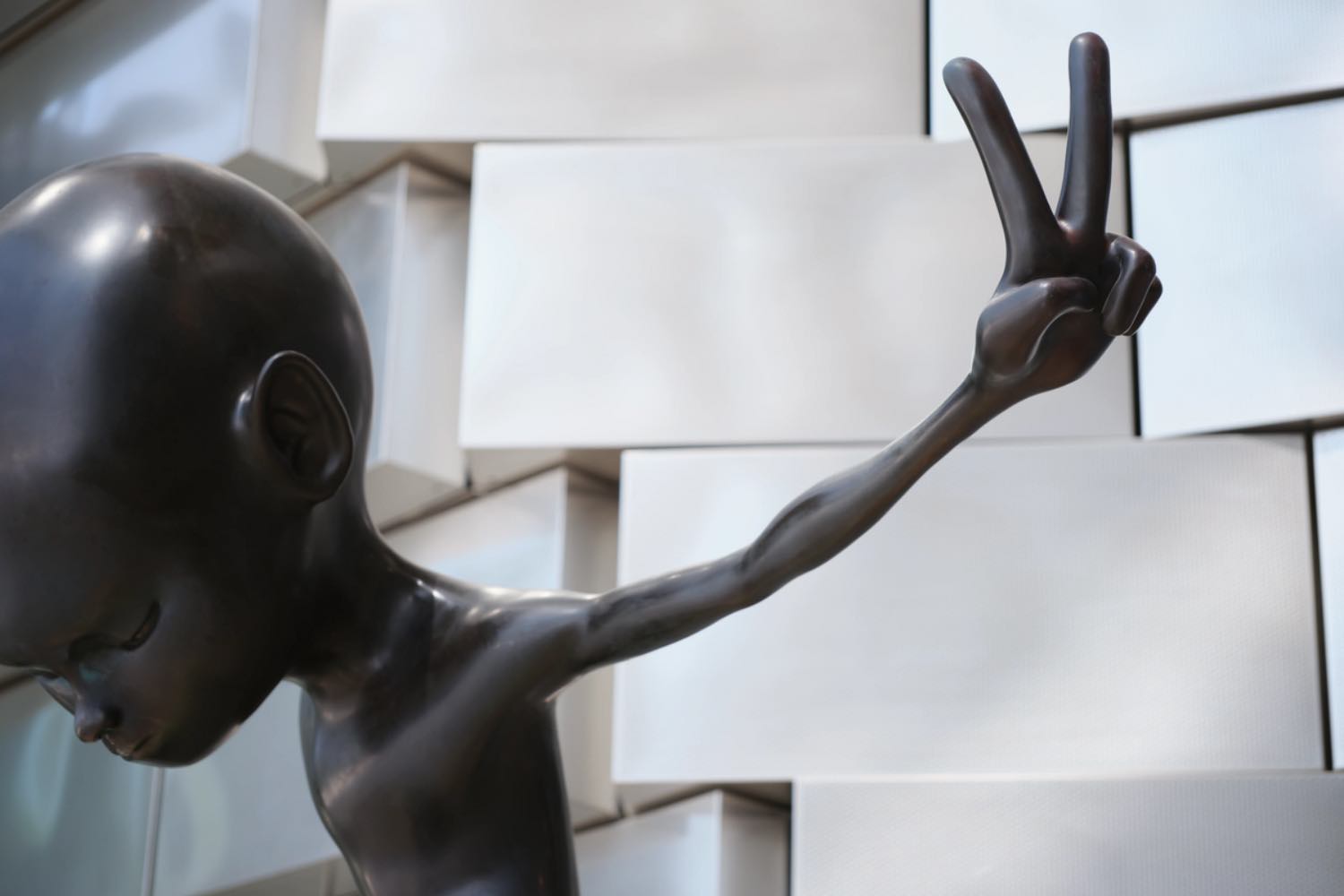
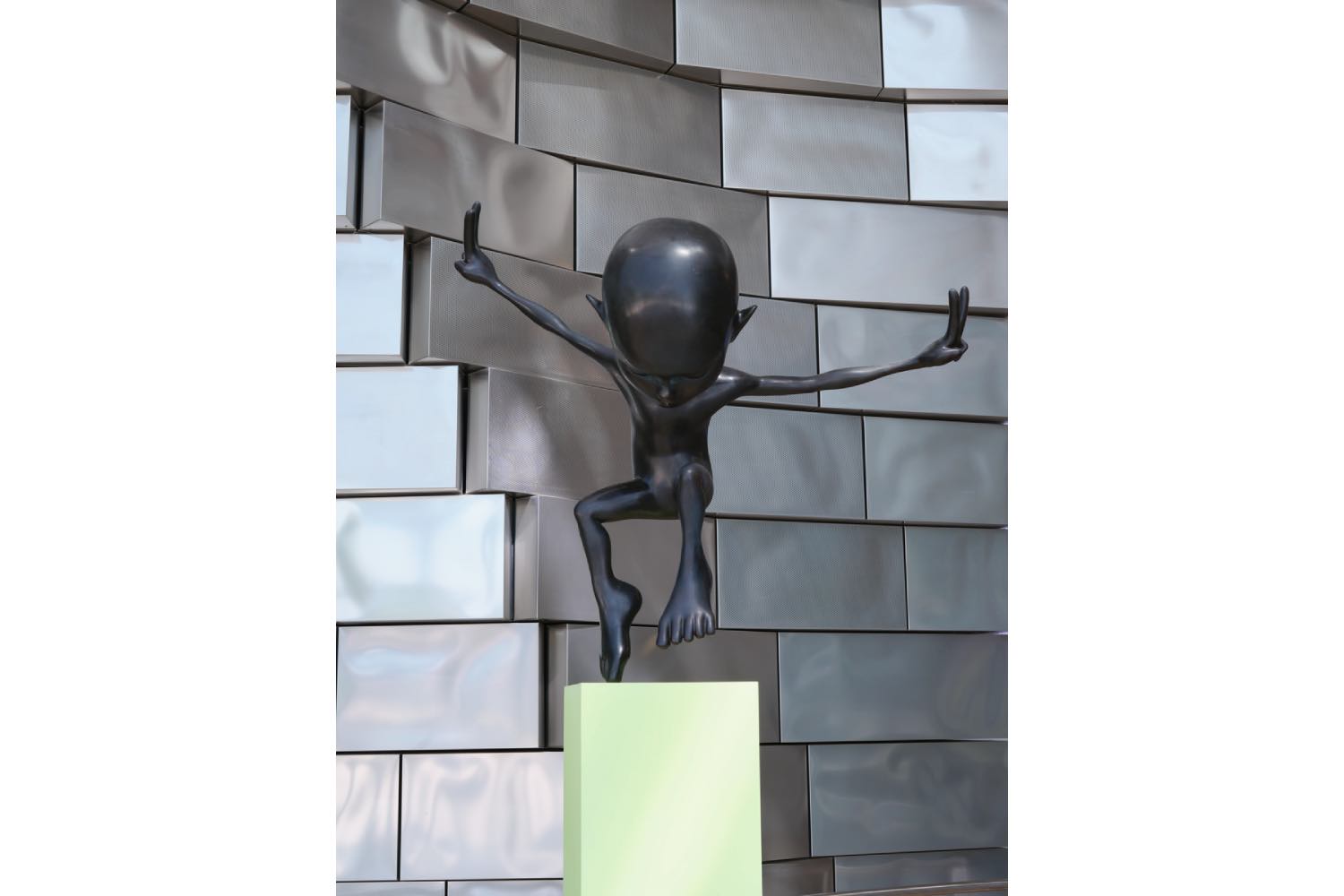
Visitors entering the ground floor of the Frank Gehry-designed main building are met by a peculiar figure, seemingly hovering over a lime-green plinth. In reality, it stands precariously on one toe —quite the balancing act, given that the dark sculpture is made of heavy, polished bronze. Both hands are raised, fingers forming the letter V. The artist says it’s a reference to rock, paper, scissors, but it reads more like a gesture of victory. The character’s name is Kangse, a recurring presence in Koo’s videos, renderings, and drawings. This particular sculpture previously appeared in the Korean pavilion at last year’s Venice Biennale.
At intervals, Kangse’s embryo-like nostrils release twin streams of fine mist from hidden jets. The scent carried by the mist is based on a survey Koo conducted in preparation for her Venice show. It translates olfactory memories of people from the Korean peninsula, visitors over decades, and members of the Korean diaspora — an inclusive idea of the nation. Acacia trees, sea air, goat milk, burning wood: the resulting scent is soft, creamy, sandalwood-like, and undeniably pleasant.
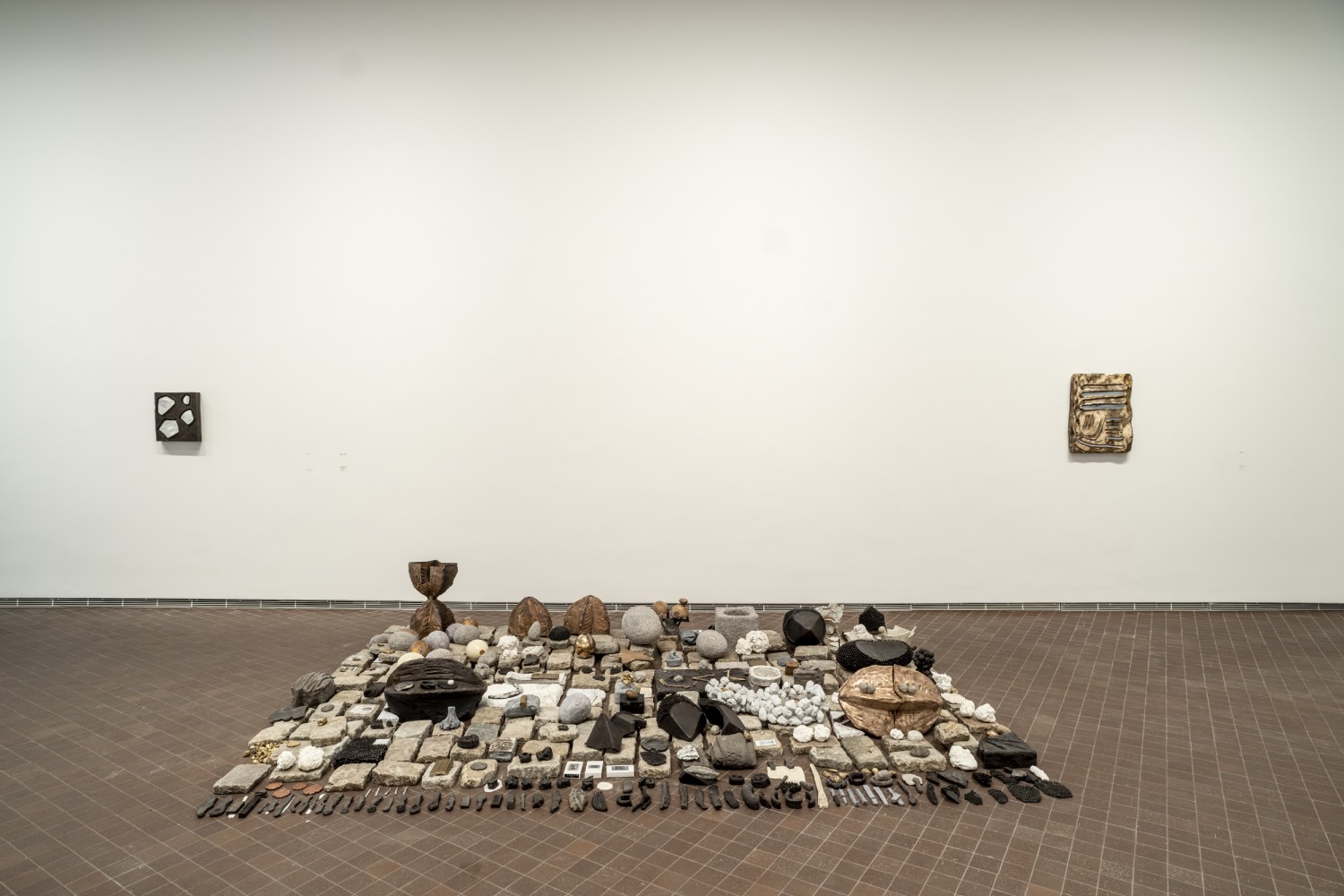
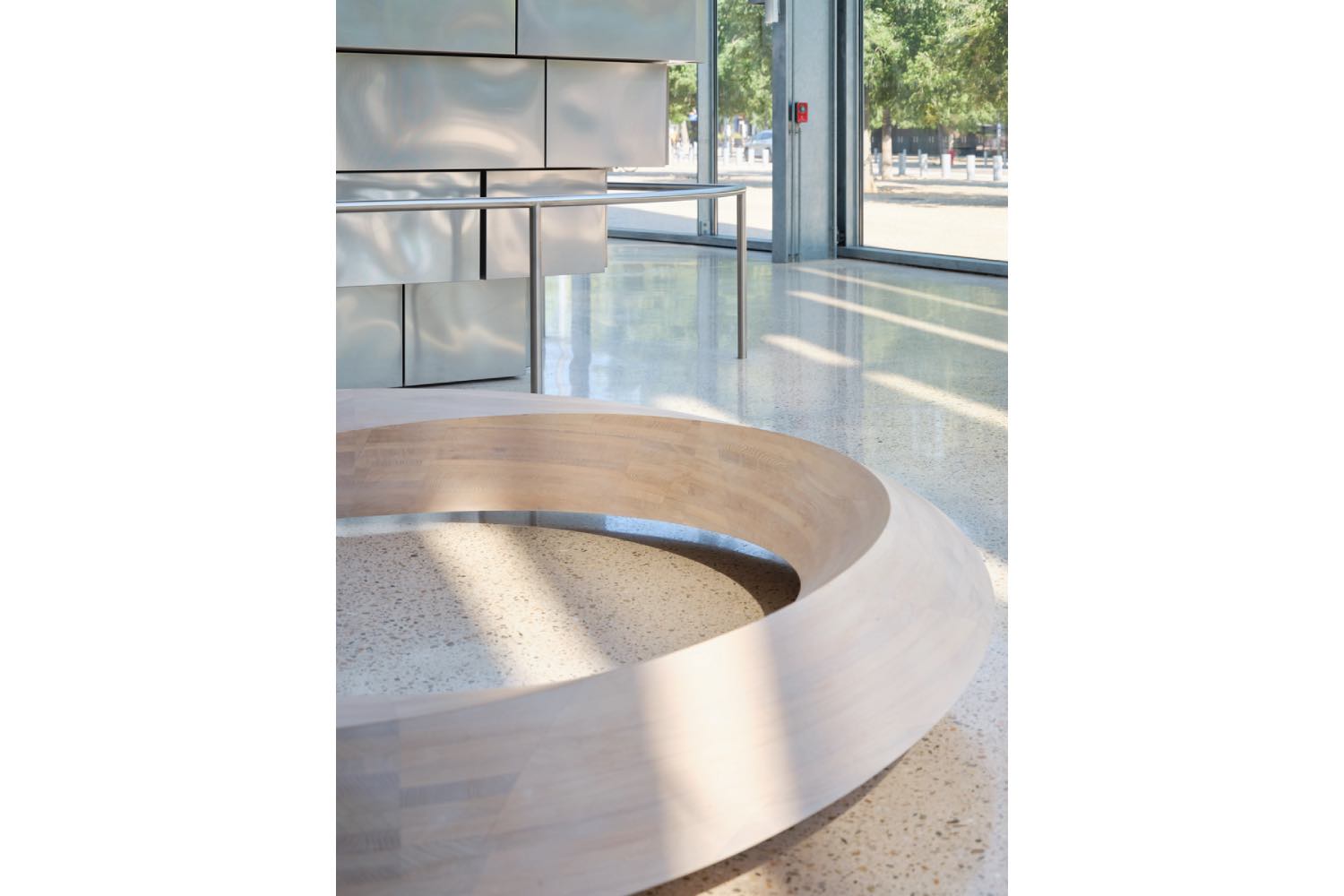
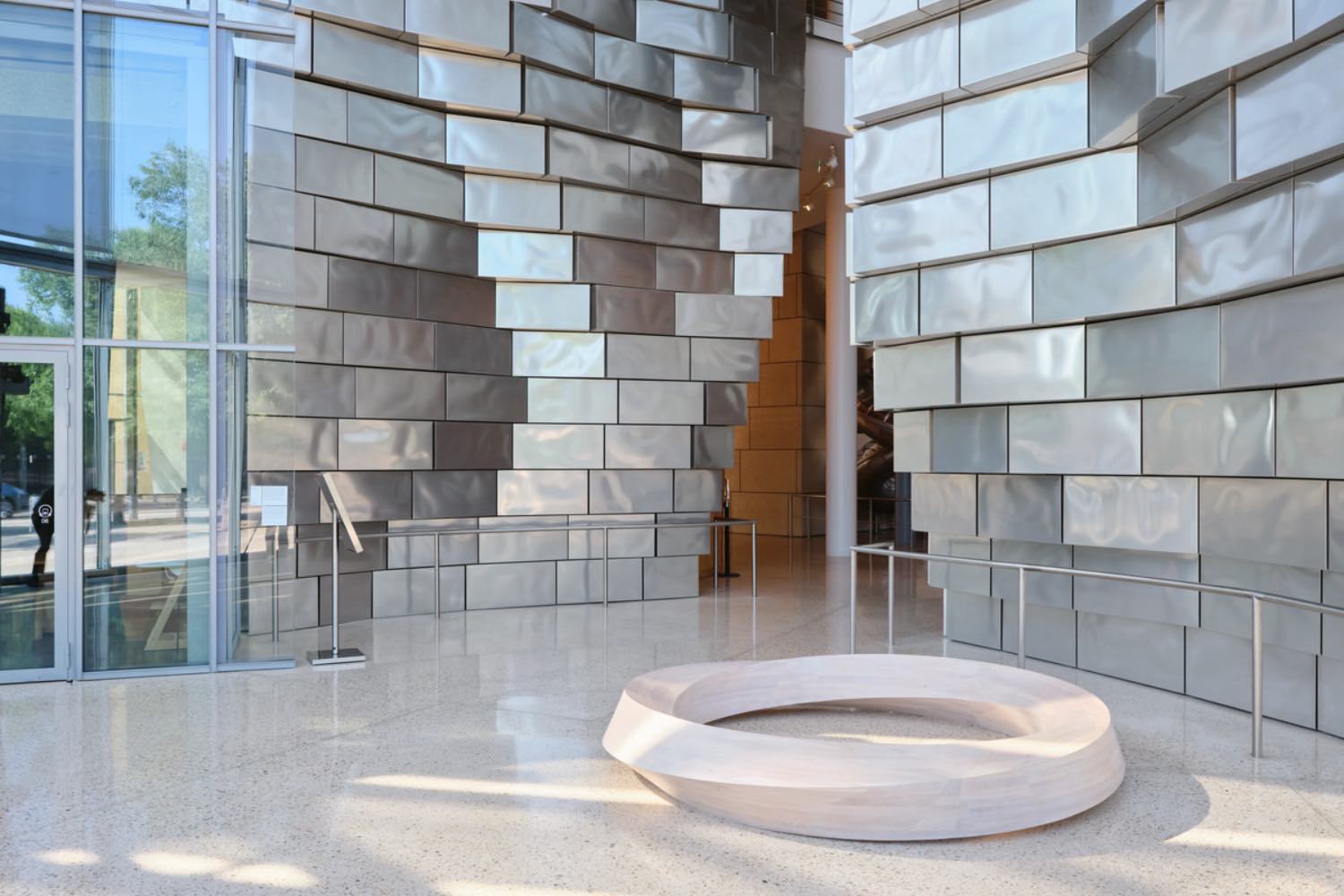
Presiding over the lobby like an alien, an embryo, or a high-tech deity that is entirely new to this world, Kangse is joined by other works. On the floor, Moebius strip-shaped sculptures crafted from oiled grey oak show off virtuoso woodworking. Up high, hefty bronze pieces are embedded in Gehry’s idiosyncratic architecture, which itself echoes the rocky formations of southern France. These sculptures mimic craggy rocks as well, their visible welds resisting the building’s polished surfaces, refusing to blend in too seamlessly.
It’s difficult to say what is at the heart of Koo Jeong A’s exhibition, but a strong contender lies in the basement installation: [SEVEN STARS] (2019). Heavy, undulating felt curtains seem suspended in a blackened room. They engulf the viewer, muffle any sound, they soothingly smell of fire retardant, and create a maze-like space with two tracts. Hung in the Twin Peaks-esque room are monochromatic canvases which seem to hover off the wall too, only suspended with two nails each. At regular intervals, the lights cut out, revealing that the canvases are painted with phosphorescent pigment. There is something where there was seemingly nothing before, a void filled. The stylized stars and splatters could be galaxies and nebulae, they could refer to Vincent van Gogh’s paintings of night skies, but they mostly testify to Koo Jeong A’s fascination with what’s hidden behind the quotidian, the invisible, and with secrets.
Upstairs, the installation [ROSSOR] uses minimal intervention to create an altered spatial reality. A linoleum floor coated in fluorescent ink transforms the room, filling it with an eye-watering hot pink haze. Reflections shimmer in glistening glass drops – described by the artist as teardrops. The series, actually titled “[SUBTLE MINDS],” stands in stark contrast to a grid of 222 small, whimsical ink drawings on a nearby wall. Begun in 2007, they feature small animals, people, dogs, and include a sketch for the glow-in-the-dark skateparks Koo designed in the 2000s for cities around the world. Many of the works in Arles situate the show within the arc of the artist’s broader practice, and the title draws on “The Land of Ousss,” an exhibition and a book from 2002.
Framing the exhibition is an image of a yacht – it appears on the poster and on the doors for the installations, acting like an emblem for a peculiar sense of dislocation. The photo is seductive, just like all the objects, scents, and spaces in the exhibition have an immediate material charm. Set against a hazy millennial pink sunset and the powder blue sea, and it is difficult to pair the boat with what is on view in the exhibition. While it seems like a luxury yacht, in fact, it is a cruise ship. Reference to the deterritorialized nature of capitalism—for example—is absent, so the hints we are left with point to the deterritorialized nature of the subject, of us, and the ease with which the more privileged traverse borders and oceans.
Void and nothingness aside, there is a strange placelessness about this show, in spite of its attempts to bring the local into the gallery. In fact, Koo Jeong A usually produces her work with local artisans and manufacturers. While apparently concerned with the idea of home — the scent of Korea, the rocks of Provence, the wood of Arles, locally produced glass — the pieces seem to say that home can be anywhere.