Michael Abel: I wanted to speak with you because you’re the only person I know who engages with culture in relation to architecture in such a unique way. I didn’t want this issue to turn into a reaction to only economic and ecological crises, when the reality is that there are more, sometimes stronger cultural forces at play. I’ve already spoken to you about the Kaiping Diaolou towers in China that first sparked my interest in this idea of what we’re calling Crisis Formalism. These towers embody many influences: they reflect Chinese identity, were once remittance housing, and curiously emulate affluent Western architecture. At the same time, they were shaped by geopolitical consequences, such as the Chinese Exclusion Act, as well as economic conditions, construction materials like concrete, monsoons, and wars.
Mahfuz Sultan: When you first mentioned crisis, my reaction was personal and a bit idiosyncratic. My contribution to CLOCKS, with Chloe Wayne, and my own practice emerged from a personal crisis, both creative and intellectual. I stumbled into studying architecture by accident. At the time when I decided to go to school, I was working on a very regrettable adaptation of Oedipus Rex for mime. I was really obsessed with mime, but found a text-based libretto to be inadequate. Of course, I didn’t know any of the physical or gestural grammars that are a part of mime training; all I had was what the performer claimed to construct. Mime engages with an invisible architecture — doors, windows, walls — so I began focusing on what the mime was creating rather than how they suggested it. Much of my work became drawing and sketching, and eventually, a good friend of mine, Nico Hartkopf, suggested that I should study architecture.
I’d always been obsessed with architecture – I read naively. I read monographs cover to cover. I immersed myself in the work of Lebbeus Woods, Raimund Abraham, and John Hejduk. Zaha Hadid was also very important to me. Their influence eventually led me to study architecture more formally, largely shaped by the drawings I was making. But when I got to school, the curriculum and the discourse were completely different from what I had imagined: I came from an environment where people were shooting videos or negotiating with dance and installation. I felt like an outsider at Harvard – I needed a different approach, a personal one. It didn’t make sense to me to leave things like literature, film, dance, etcetera, behind. I didn’t believe in abandoning the process.
Chloe, who didn’t study architecture, provided that perspective. When we started working together while I was still a student, I felt that within the crisis, there was a way forward – another path where I could simply finish things. Virgil Abloh once told me something really profound early on when we first started working together: “When you finish stuff, even when it’s really small, like the scale of a T-shirt, or the scale of a little zine, you generate momentum.” It really was that for me. For V, one T-shirt became several. Several became a collection. A collection turned into multiple collections. Eventually, collections became a brand. It all started to accelerate. You have to believe in the value of what you are doing at a given moment in your journey irrespective of its scale or perceived significance.
MA Yeah, we’ve talked about this before. I remember you saying back in school that this isn’t your club –– You were referring to race as a heavy factor in that. One thing that you have taken extremely seriously is developing new design languages –– not through technological advances, but by deeply engaging with histories of Blackness, both historical and contemporary. You’ve found ways to reinterpret and flip those histories into something that doesn’t exist in architecture. And that’s largely because of who gets to practice, who has access, and how exclusive the field can be.
How do you create architecture? How do you build languages based on these histories? That’s powerful. And right now, it simply doesn’t exist in architecture the way it does in the art world — or in so many other spaces.
MS I don’t think there was ever a self-conscious program. I think we draw on our experiences, our milieu. We’re Black, we make things that read as Black. I think the biggest influence on our work so far — beyond contemporary art — has probably been film. Our practice has always been about exploring genre and forcing genre collision, particularly genres like action, the western, etcetera. Genres with really clean and legible edges. When we worked with Virgil at Louis Vuitton, we worked on two show films that replaced the fashion shows for two seasons. LV6: Peculiar Contrast, Perfect Light and LV7: Amen Break. We asked ourselves: can we push the fashion show — the photo shoot — to take on the depth and resonance of narrative film, of epic cinema, of myth? Chloe took James Baldwin’s seminal essay “Stranger in the Village” as the departure point for the films. This became this kind of “man with no name” played by Saul Williams, that wandered through the worlds we created.
For LV6, director Wu Tsang and her collective, Moved by the Motion, jammed the language of the heist into the fashion show. We followed a three-act structure, incorporated dancers and choreography, and sampled elements of modernist architecture – like the Barcelona Pavilion and the Seagram Building, but there was also a Mos Def rap video as its crescendo. And it was all natural, not theoretical or programmatic. For LV 7: Amen Break, which I directed, we tried to force the Samurai epic and the Western into the shape of a fashion show. All set within a rap and drum & bass framework; all set within Black narrative forms.
Looking back I can see we started using genre as a way to activate things that we thought weren’t being talked about in the space, like race, gender, sexuality. And if they were, they certainly weren’t being discussed the way we discussed them. And of course, I am describing the work of large diverse collectives — that’s another part of the politics of the work, the people who are doing it. I’m not sure any one person can make something as sophisticated and, frankly, ahead of their time as those short films were. They were the products of a collective. Virgil obviously, but also Benji B, Ib Kamara, PlayLab, Wu, Asmara, Josh Johnson, Tosh Basco, and many others… Too many to name.
I think we found a lot of opportunities in spaces like fashion that perhaps didn’t exist in architecture. There’s an obvious discussion you and I can have around type — we knew about typological friction, like the brewery inside the former church or a gymnasium inside a tower — but there wasn’t much cultural friction. I don’t know how to articulate it in a sophisticated way yet, or how to make it programmatic, because it’s instinctive, but it’s something we return to again and again.
A lot of these elements — these strategies — are definitely Black. They’re drawn from Black culture, from rap, jazz, Black literature, and from Black artists that we admire. I think that was more important to us than worrying about whether the final product would be a building or a video. There’s so much research involved, and so much of it ends up on the cutting room floor. In the end, the finished product is kind of mute in a certain sense. That’s why we’re super interested in process. Process is where you can house a lot of politics…
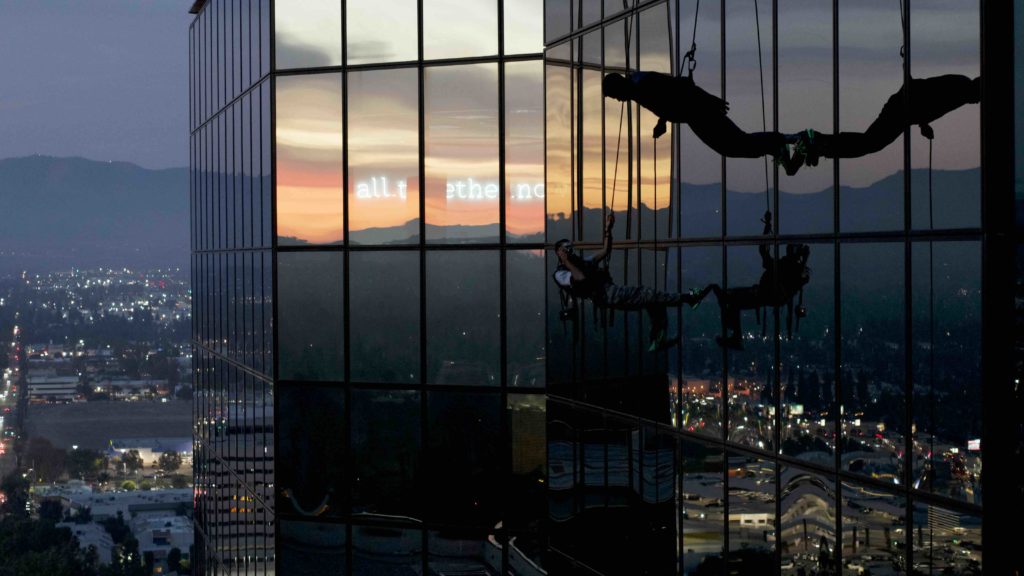
MA I want to go back to your comment about how it didn’t matter what you were making. In a way, of course, it does –– but I appreciate the bravado in your statement, in how it fundamentally challenges what architectural discourse is and how it reacts to the histories that we’ve been told. There are certain outlets that are more or less conducive to a particular design discourse, and I think your work directly pushes against that. I also question people who dismiss popular culture as serious discourse. I don’t believe you would approach, say, an airport, any differently than anything else you work on.
MS Over the last two or three years, I’ve been really obsessed with Álvaro Siza – which isn’t exactly unique. But what excites me is how his architecture feels – as if an entire civilization has been condensed into form. His works carry the history of architecture, which is actually quite challenging to do. I don’t think it’s methodological – it’s just Siza. You can sense Portuguese painting, literature, and poetry in his buildings. You can feel traces of classical music, and you can see it in his drawings –– especially in his sketches, which treat buildings like nudes. I was looking at his plans and could almost track the movement of a family through the house as the sun shifted and pockets of shade appeared. Just from the house’s orientation to the street, you could tell the prevailing political climate of the city –– whether these were wealthy people trying to hide themselves. A lot of the facades were barren save a small balcony. You can almost imagine the family gathered there with a flag on parade days. He captures all of that in the architecture.
When I was in school, I wasn’t taught architecture as a cultural form, despite all the discussions linking it to history, texts, etcetera. Instead, in practice, there’s this very pragmatic separation — work is work, and interests are interests. Eventually, your interests drop away, and the building just becomes the building. It’s kind of fatalistic. But Siza doesn’t leave anything behind – everything stays in the building. So whether it’s an airport or anything else, the ambition is always to carry all of these ideas forward into the final thing.
I think Norman Foster certainly did this, too. You can walk into UK airports and feel the muscularity of the 1980s – the rise of contemporary finance culture. You’re certainly able to see traces of science fiction in those monstrous columns and the emergence of finance noir as a Hollywood genre. I almost expect to see Michael Douglas pacing in front of a gate in Brooks Brothers, talking on one of those giant cell phones.
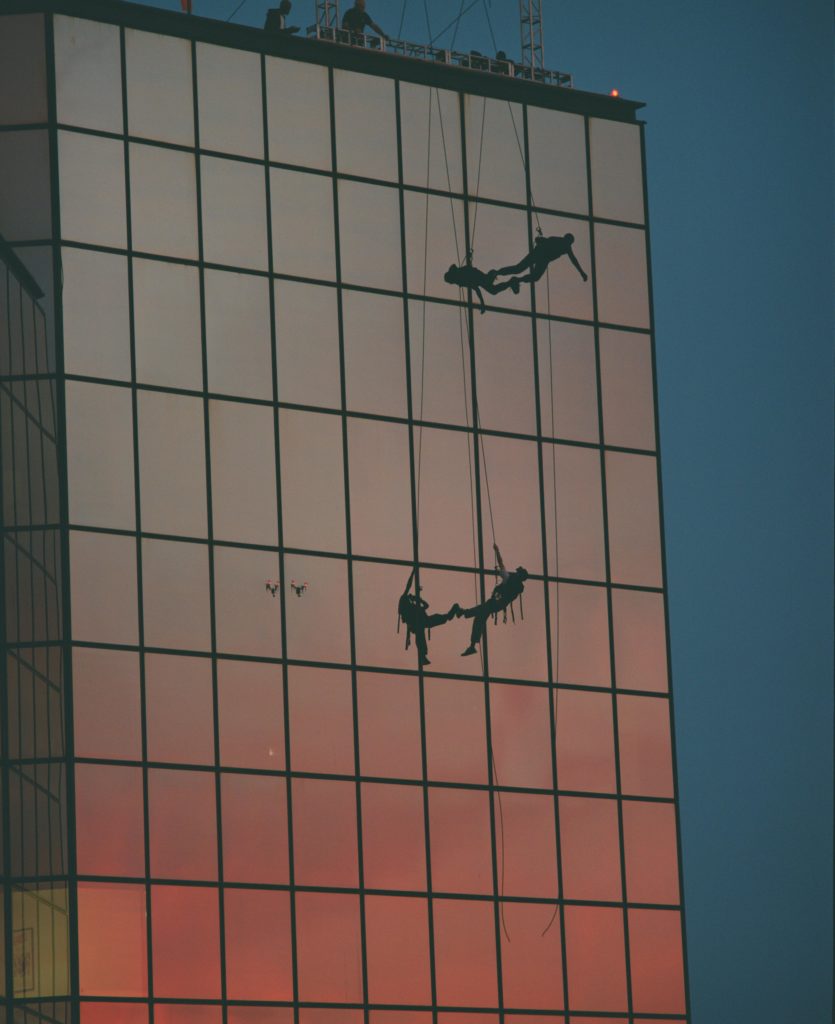
The other day, an architect came into the bookstore. He looked around and asked me, “So do you think you’re eventually going to do architecture?” – like it was 1988 or something. I was completely baffled. On one hand, I thought, “Do you think we abandoned our entire practice to become small-business owners on Melrose and sell books?” The journey of a practice is not that sequential, right? But that’s not the point of the story.
The point of the story is that I found myself thinking about Kathryn Bigelow and Liz Diller.
So many artists — in quotes — don’t begin their careers in a single, fixed discipline. Bigelow’s earliest feature was TheLoveless (1981), and then she spent the ’80s and ’90s investigating genre: Near Dark (1987), a vampire movie; Blue Steel (1990), a police-thriller-meets-stalker noir; Point Break (1991) is a Western, a surfer flick, and a heist film all crammed into one. But before that, she was in the UK, involved with the Art & Language movement. In fact, she was working as an artist. If her first capstone work, a work that ended her “early” period, had been a big exhibition that gained traction in the art world, maybe her trajectory would have been completely different.
I think about that with Liz Diller, too – up until Diller + Scofidio, before Renfro came in and they became the architecture office we know today. If they made a movie or started making exhibitions instead, it would have been totally logical at the time. You would have thought they were an art collective. But now? That kind of pivot is seen as a swerve.
In a lot of ways, the heterogeneity of Chloe’s and my practice also has a tradition – it has its own trajectory. Many architects aren’t comfortable with that, which is bizarre because so many of them don’t build their first major work until their forties, sometimes even later. Architecture careers are long, but the window in which you actually get to realize projects is relatively short compared to any other disciplines – whether it’s fine art or film. A lot of those folks make stuff from forty-five to seventy-five.
I find it really fascinating that architecture doesn’t embrace the scatter as architecture, as constitutive of it. So much interesting work by architects before they build is overlooked, under-theorized, and under-discussed.
MA Yeah, every trope that we associate with Diller Scofidio was essentially developed before they ever built a building. And they’ve continued to explore those same tropes to this day. I actually asked both of them about intention – because they were very heavily involved in performance, working far outside the realm of traditional architecture. That early work didn’t just lead them to designing performance centers and shaping contemporary architecture — it also kept them making performances themselves. They were literally making movies out of their architecture – staging scenes, recording people as they walked through spaces, then playing it back with a five-second delay. They invented something new because they took their other interests seriously, and they took them seriously as an architectural project. Their entire body of work deals with visuality in a fundamental way. But I don’t know how their work was perceived when they were developing ideas at Cooper [Union].

MS From this vantage point, it’s easy to romanticize Cooper at a certain period as if it constitutes a movement, when in fact each one of the figures we’re talking about — Woods, Hejduk, Abraham, Scofidio, Diller — were actually radically different from one another.
What was interesting, though, was the culture of experimentation there –– it was super vibrant. I love Diller. I love DS+R. I don’t know if I’d be working on any of the things I’m working on, or in the way that I am, if I didn’t. Liz Diller is a huge influence on our practice. And for a while, it wasn’t even considered cool to like them, right?
I think people like to have their cake and eat it too. At first, the claim was that they weren’t “making architecture.” People dismissed their work as “something else.” It’s art by other means. It’s a form of installation. Something that involves architectural thinking, but it’s not architecture. Then all of a sudden, they were designing major institutional buildings – becoming the definitive East Coast institutional office, literally building New York City. And that’s when everybody flipped, claiming they became part of the establishment, that they were complicit somehow. But the methods haven’t changed to my eyes; questions have evolved, but the attitude that I felt was there in the early ’90s is still there now. I find their trajectory really fascinating. If Liz started directing operas — which I believe she wants to if she hasn’t already — it would be completely logical to me.
MA Their latest book, Architecture, Not Architecture (2025), has two sections – one called “Not Architecture” and the other called “Architecture.” The book unfolds in a way that lets you view both sections simultaneously, with markers connecting related projects. They took the Rosalind Krauss thing very literally. I found it interesting that they made such a statement: “Half of the work we do is not architecture, and half the work we do is architecture.” Maybe this is their end-of-career reflection. I mean, Scofidio is in his nineties!
MS Yeah, he’s a GOAT. I mean, it’s interesting because in their first monograph, Flesh, there was never a clear delineation between disciplines. Even the graphic design of the book reflects that, with overlapping elements and no strict genre specificity. Maybe, after doing so much, it’s meaningful for them to draw that line – but for me, it’s not architecture alone that makes the Lincoln Center expansion interesting.
MA I know. I do a lot of different things too – jewelry, movies, painting, whatever. Five years ago, I psychologically needed to separate them completely. I would tell myself, “I can be a painter and it has nothing to do with the architecture I’m going to make.” And that somehow freed me to make paintings.
Before that, back in school, whatever interested me in architecture would inevitably show up in my paintings. It was very much in the tradition of architectural painters, like Zaha Hadid or others. It may have had nothing to do with the architecture I was making, but in my head, the connections felt overwhelming. Of course, if you step back, there areoverlaps – but I had to compartmentalize them to move forward.
It seems like you’ve taken the opposite approach. I don’t know if the actual output is different, but the way you define what falls under “architecture” seems fundamentally different.
MS Yeah, the question of what a creative director does is interesting –– if the term even has salience anymore. I admittedly feel a bit ambivalent about the term and a bit of cringe using it with respect to our work, not that there’s anything wrong with creative direction as a practice. But Chloe and I certainly have worked as what people would conventionally term creative directors. And some part of that necessarily involved me letting go of some of the concerns that I would have if I were hired to work on something as an architect, which has to do with agency. If there are sets I sketch, I have to work to develop the entire framework through which the sets are output, but I’m not the set designer. I may work on a script, visuals, framing, storyboards. I may work on a wide variety of things, but also I may not be the director of the video. I think it wasn’t ideological; it was just how it worked, especially with Virgil, who was a massive influence on me.
Some part of that process required the sacrifice of certain forms of disciplinary agency that you would otherwise really want, given what you studied. Letting go of that, I found other ways of working that were, nevertheless, architecture. It found me in the end.

MA Sure, we’ve both worked in film, stage design, and traditional architecture. And I can safely say that my brain when working on these things is on a high level. You have an idea, and then you also need to manage a team to execute the idea, and work through budgeting and consultants and a hundred other people. It’s often not different from an architecture project. Film, too, is very hierarchical – not to diminish all the important roles in a movie, but the person that holds the overall vision is the director. The director is, in effect, the architect. I came up with a term: a definition of architecture to me is “the coordination of the measurable into something immeasurable.” Coordination is the key word there, because that’s where the agency and all the tension comes from. It’s not a solo act.
MS I agree with you completely about certain forms of disciplinary specificity. I would find it really gratifying to focus on only designing a set. I rarely have the opportunity to do that, because for a lot of things that we come up with, we also have to figure out how to make them, and so there’s a feedback loop. In a certain sense, I abandoned architecture psychologically. I’m referring less to methods and processes, and more to a form of design that is in dialogue with its own history.
MASo, when you mention your work’s history, it seems like you’re referencing a blend of contemporary influences, like Bernard Tschumi and DS+R?
MS I wouldn’t say my method was, “Okay, I’m going to focus on painting and not think about architecture.” It was more about abandoning thinking about what it is that we’re doing, and just get in the flow rather than create territories between different disciplines. We operate at the scale of projects, and so, doing whatever is necessary to realize them. The completion is everything.
For years, we’ve been encouraged to make a website and list our projects – “List your projects!” And I remember Chloe was like, “We shouldn’t make a website. We should open a bookstore.” We shouldn’t open a website for projects. We should just open a bookstore, because that’s really what we do, right? Everything is really research driven. So now there’s a bookstore, and we have this studio called CLOCKS, sometimes called Architecture, which is itself a project. And then, we were like, “We should name the bookstore ‘Architecture.’”