“Intimacy builds worlds; it creates spaces and usurps places meant for other kinds of relation,” wrote the late theorist Lauren Berlant.1 By “other kinds of relation,” Berlant refers to conventional and heteronormative social structures that organize intimacy around family, marriage, and ownership. Brooklyn-based photographer Zora Sicher is for intimacy; not one limited to familial or romantic attachments but the kind that is everywhere, “inferred and explicit,” as Berlant says, that passes “across people, groups and movements,”2 blurring the line between public and private and its associated forms of social division like male and female, work and family, colonizer and colonized.


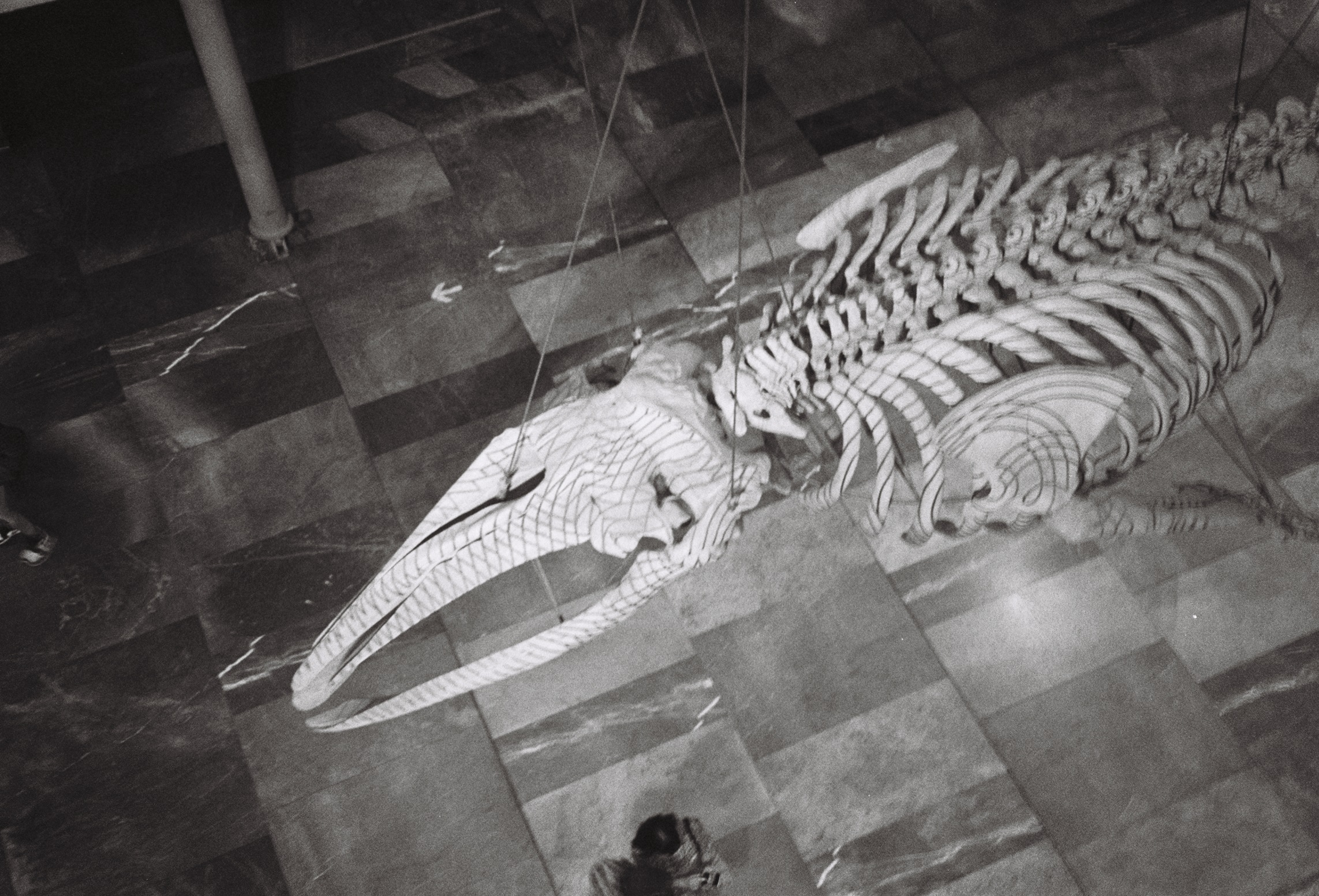
For her first monograph, elliptically titled Geography (2025), Sicher gathers photographs from her personal archive to map how bodies move through space and time. But these photographs — taken when she was between fifteen and thirty years old — are hard to pin down: specific coordinates are eclipsed by their transitional quality. Moving between black-and-white and warm color film, Sicher imagines what is impulsive and precocious about early adulthood: burgeoning sexuality, mistakes, betrayals, germination, and a kind of flux state. She moves with the teenage friends, the pregnant friends, the people she once knew, or knows, and others she doesn’t; and through the concrete megaliths of highways and road systems, the bedrooms, the beaches, the showers, the squats, the refuse sites — and as viewers, we move with her. Rather than organizing the images chronologically, she sorts them by subject: a particular friend, or a certain kind of landscape becomes her organizing principle; a series of people, perhaps lovers, float in bodies of water; no two bodies are the same, but they share a shimmering and mercurial surface.
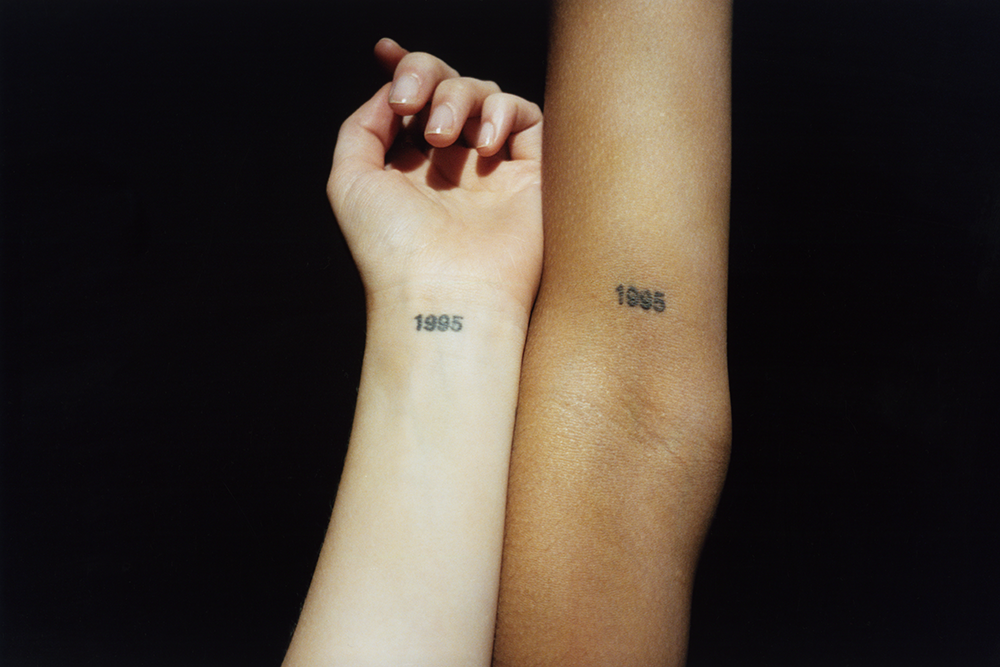
Suddenly, the concrete girders of a highway give way to the pliable edges of a human body — of women and girls, occasionally a guy. The scars, stretch marks, inked traces and incisions of her subjects — ones she also traces across the tagged and graffitied walls of city streets — intuit that merely having a body propels a form of daily intimacy. For Sicher, as for Berlant, the work is also an exploration of queerness, and queer intimacy as a capacious space full of possibility. Breasts, hair, mouths, and arses — in swimsuits, through curtains, in showers slick with water — are not intended for heterosexual arousal, but merely as the consequence of looser, social forms of intimacy. Sicher depicts someone — topless, coded masculine in sports shorts, with short hair — lying on their front in bed, thinly veiled, and thus softened, by a diaphanous curtain. The composition recalls classical statuary, but its detail — the three stripes on the shorts, the hand slipping toward the crotch — makes the sitter ill-defined, almost iconoclastic. Elsewhere, a neon sign flickers: EXILE; two arms are impressed with the same tattoo, reading: 1995, placing this intimacy around the late noughties and teens, through which Sicher grew up.

“The intimate is everywhere: you bring it everywhere and it circulates everywhere,”3 writes Berlant, something Sicher impresses in her photographs. They intimate, like a verb — social structures are inferred rather than neatly defined — while reimagining intimacy itself as a state of being.
1 Berlant, Lauren. “Intimacy: A Special Issue.” Critical Inquiry 24, no. 2 (1998): 281–88. http://www.jstor.org/stable/1344169
2 Lauren Berlant on Intimacy as World-Making, by Hans Demeyer, https://extraextramagazine.com/talk/lauren-berlant-on-intimacy-as-world-making/
3 Lauren Berlant on Intimacy as World-Making, by Hans Demeyer, https://extraextramagazine.com/talk/lauren-berlant-on-intimacy-as-world-making/