What’s most striking about “Die Bleche und ich gehen heim” at Contemporary Fine Arts in Basel is how the show handles motion and stillness. This solo presentation, curated by Cyprien Gaillard, assembles drawings and sculptures by Walter Pichler, born in 1936 in South Tyrol, now part of Italy. Pichler graduated from the University of Applied Arts in Vienna in 1955 and started exhibiting with Hans Hollein, who would become a prominent architect in the latter half of the century. In 1967, Pichler showed in New York with Hollein and Raimund Abraham, another architect, and in 1968 he was included in Documenta. His work at that time was futuristic with a lower-case “f”: he used new materials like polyester, integrated media, and created forms that appear influenced by bubble-shaped sci-fi architecture designed for life on other planets. Take TV-Helm (1967), a wearable sculpture made of white varnished polyester with an integrated functional video monitor and an attached antenna. When worn, the piece blocks outside sensory impressions, and it protrudes bulbously at the front and the back, not unlike a phallus or a rocket. It looks even less practical than modern VR goggles, and Pichler’s sketch for the device betrays his sense of humor: a figure wearing the device stumbles forward, arms outstretched. A later variant that only includes audio seems less cumbersome, more beehive-shaped; both are in line with Space Age design — though perhaps not for other planets but instead a future with unlimited media consumption and screen time.
The decade was marked by early success, but the pressure of having to produce did not suit Pichler. He retreated to the country, first for a summer, then permanently: for space, access to materials, and financial independence. In the early 1970s, the region Burgenland was the cheapest place to buy property in Austria because of its proximity to the Iron Curtain. Pichler bought a cottage in this unremarkable rural landscape and decided to set up a studio there. Soon, other artists followed, among them, later, Martin Kippenberger.
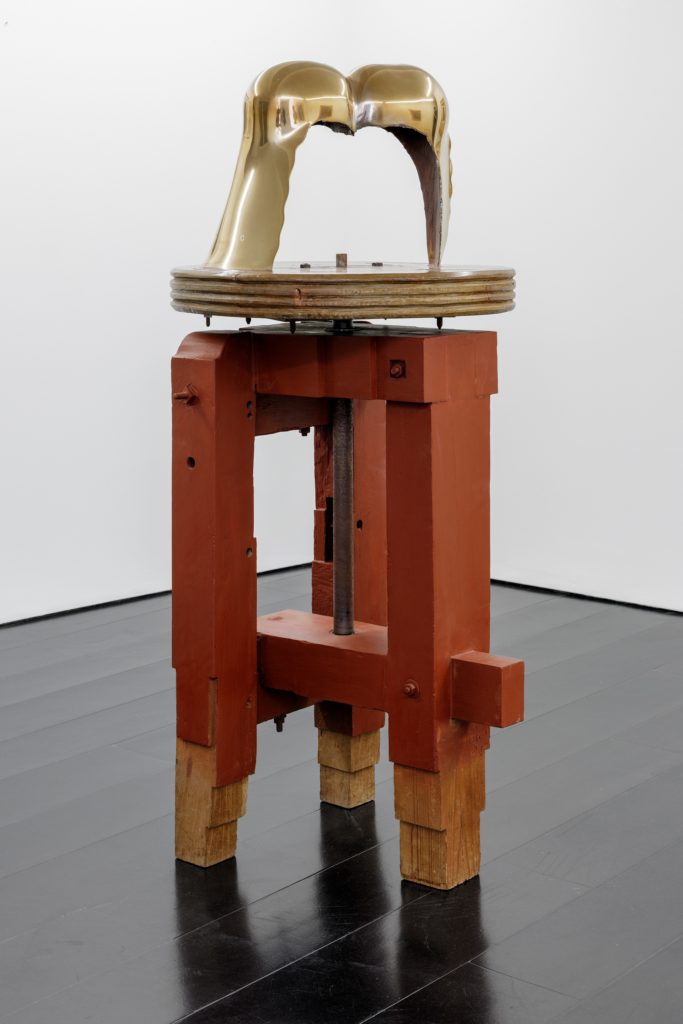
Pichler started working differently, and more slowly. It is tempting to read his development as a step away from the industrial materials of the previous decade toward something more archaic, just as it is tempting to interpret it as a move away from early fame and the constraints of institutional art-making. Wood began to feature prominently in his work, alongside clay and straw. The only thing that remains is his obsession with helmet-like hoods, executed in metal, the Schädeldecken, which gleam from his assemblage-like sculptures. For each piece, Pichler constructed a house, making them site-specific. He would draw on local building techniques, and he would enlist local artisans to craft the frames for his drawings.
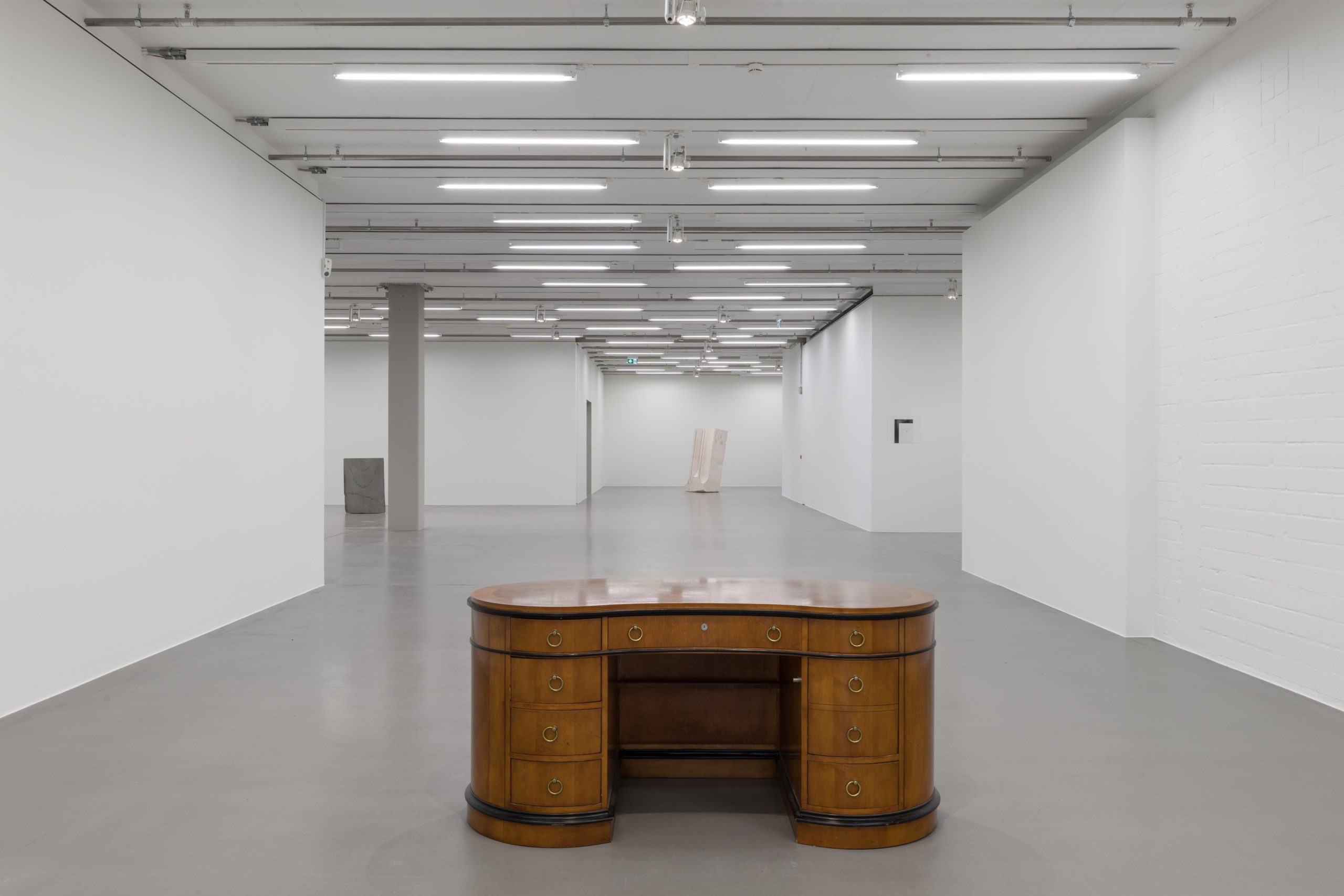
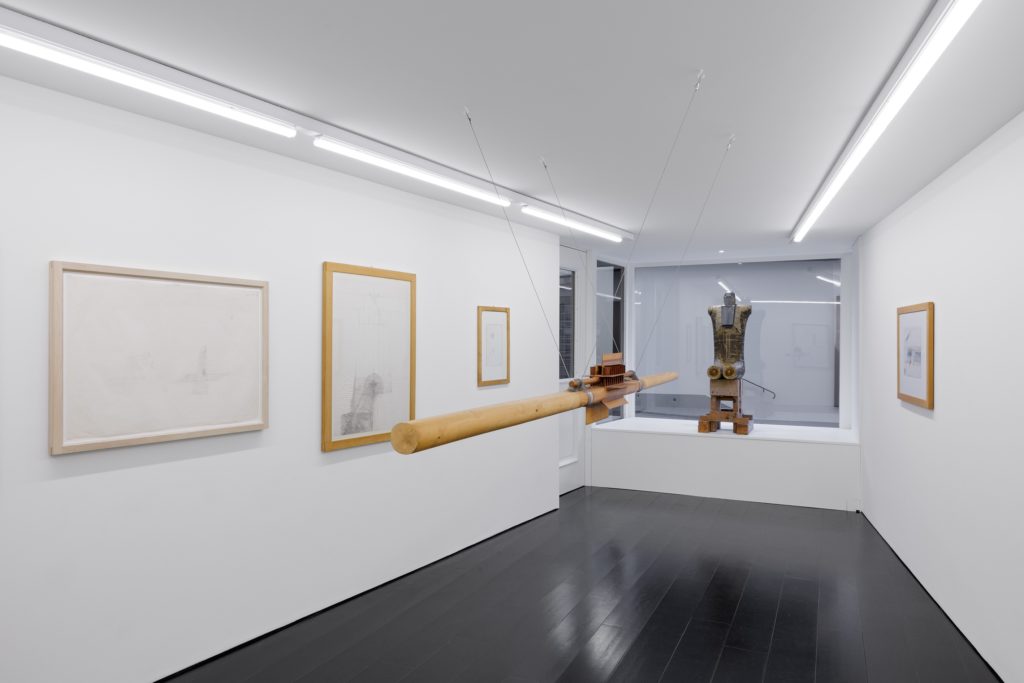
The gallery’s Basel location is tucked away in a narrow alley in the medieval city. The exhibition, which occupies a modest space in a low-ceilinged old building, draws on the second phase of Pichler’s oeuvre. In fact, the artist Cyprien Gaillard, who curated the show, picked drawings made soon after Pichler’s move to the countryside, as well as three sculptures. Pichler is considered an artist’s artist, perhaps not the most widely collected — in spite of his early success — but quietly influential. This prompted Gaillard to travel to the Burgenland region on a gray November weekend to select the drawings and sculptures.
The first piece visible through the window is Kleiner Rumpf (1997) — small torso — a figure, sitting on a stool, whose limbs appear to be chopped off, made from wood, straw, clay, lead, and tin. Further into the space, there is Der rote Stab (2003), suspended at eye level from the ceiling, like a projectile in mid-air, maybe designed for flight into outer space, and possibly a reference to Pichler’s work of the 1960s. Atop the wooden rod there are small encasings, like the model of a futuristic city. If the show were a narrative, this would be a violent introduction, one that is in stark tension with the tender drawings on the walls.
Pichler was an accomplished draftsman. Not only did he conceive plans for his buildings with architectural precision, but he also made many studies for his sculptures, as if the drawings were essential to the process of finding a form. Some of them were not intended as autonomous works, and in the first room of the Basel exhibition some are executed on thin tracing paper. One, dated 31.1.1973, shows figures in faint pencil, once in an embrace, then, bigger, in the process of coming apart. The reddish brown ink has wrinkled the paper, highlighting its fragility.
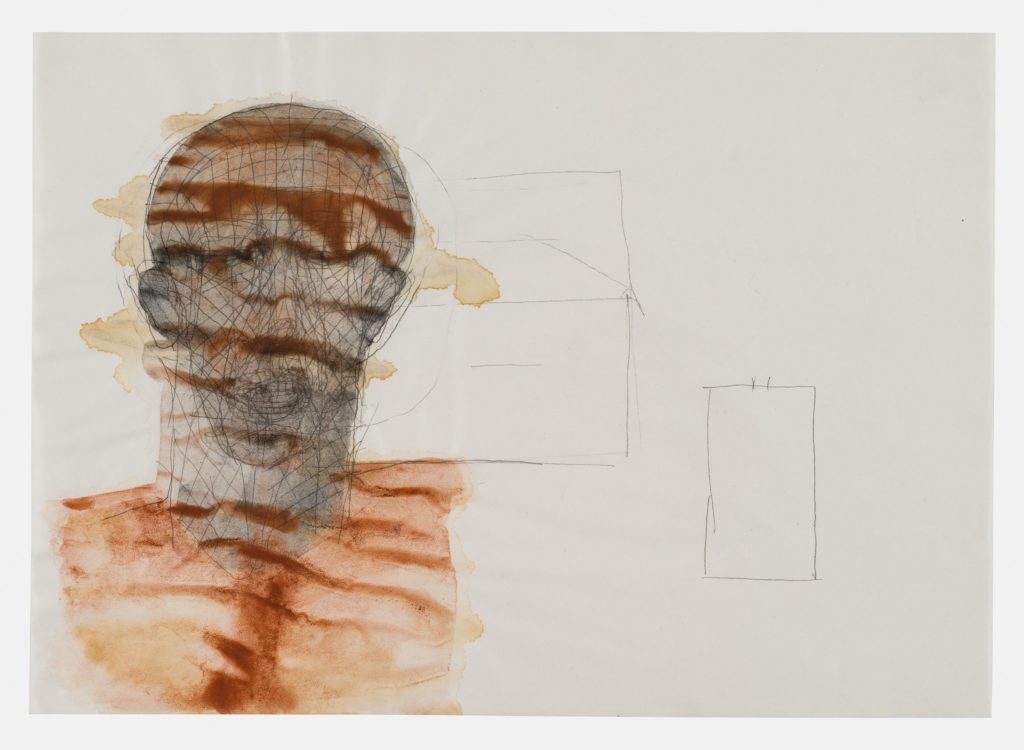
The artist seems drawn in two directions: sculpture and architecture, human and urban, exemplified by organic pieces in earthy materials, and contrasted by his early sketches of bubbly capsules for living. Small receptacles for sculptures, drawings of — possibly — agonized figures and then spherical architecture, designs for fantastic cities: somehow they all collapse into one another, rendering everything at a human scale. Pichler, who passed away in 2012, was averse to ideas, but he has a strange preoccupation with heads, helmets, and skullcaps. In the preface to a 2007 catalogue he admitted that he was surprised how often heads appear in his work. One of these pieces — Doppelkopf (1987), which means double head, but is also the name of a card game — takes center stage in the second room of the gallery. Sculpture and pedestal are indistinguishable, as if the skull is a primary piece of architecture, with the empty area under its cap holding space for what?
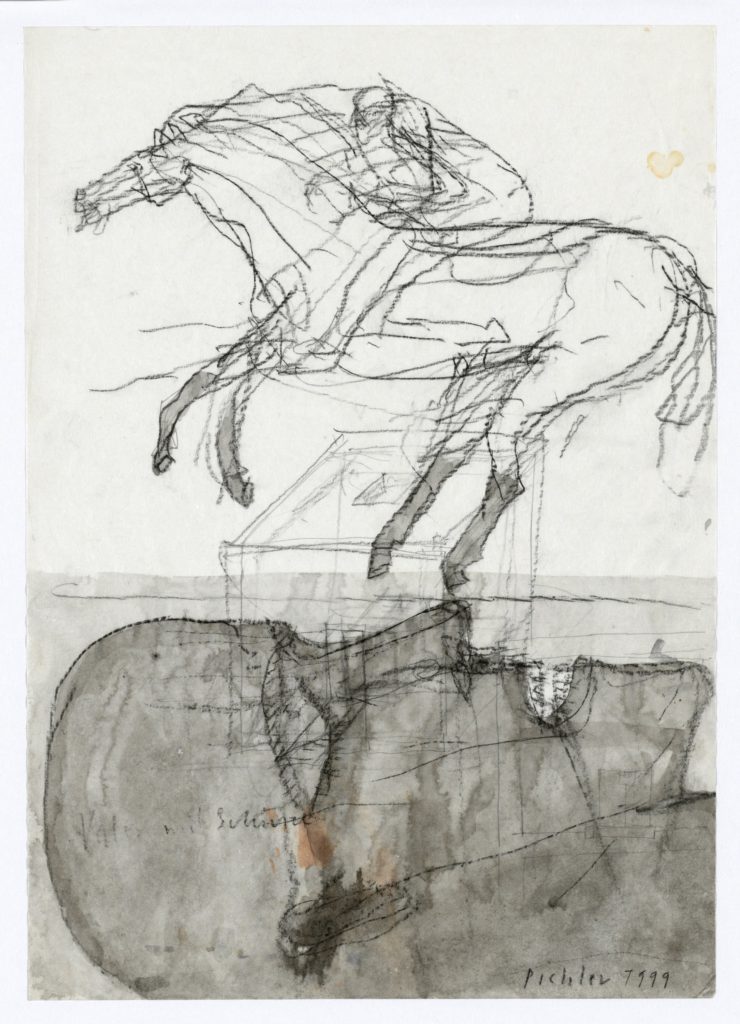
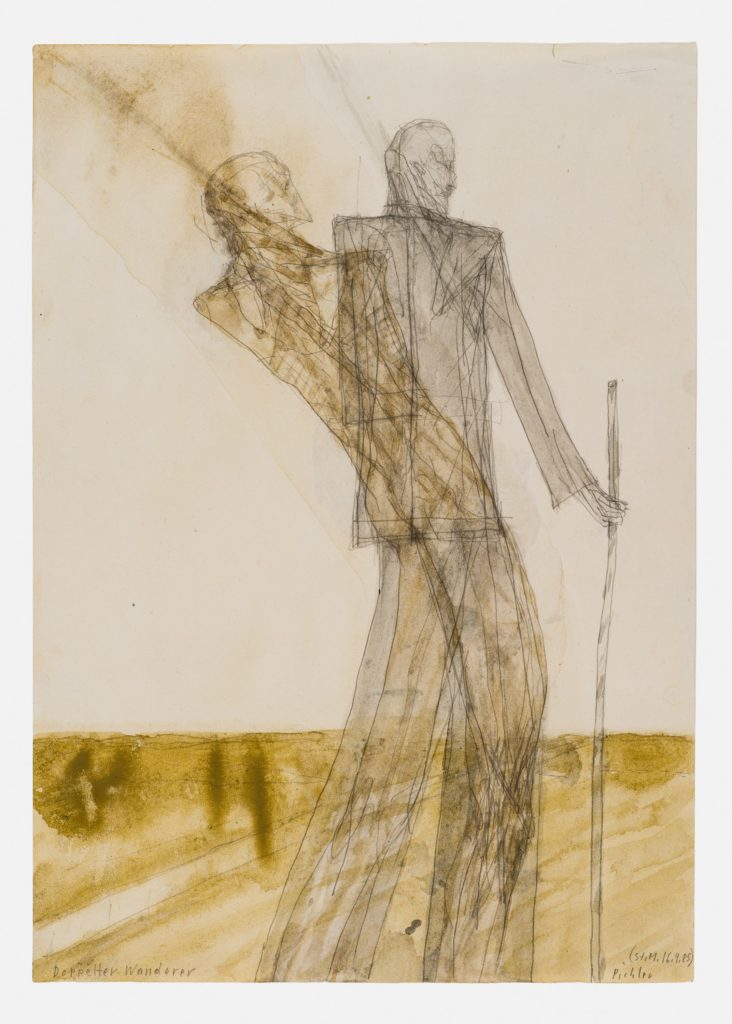
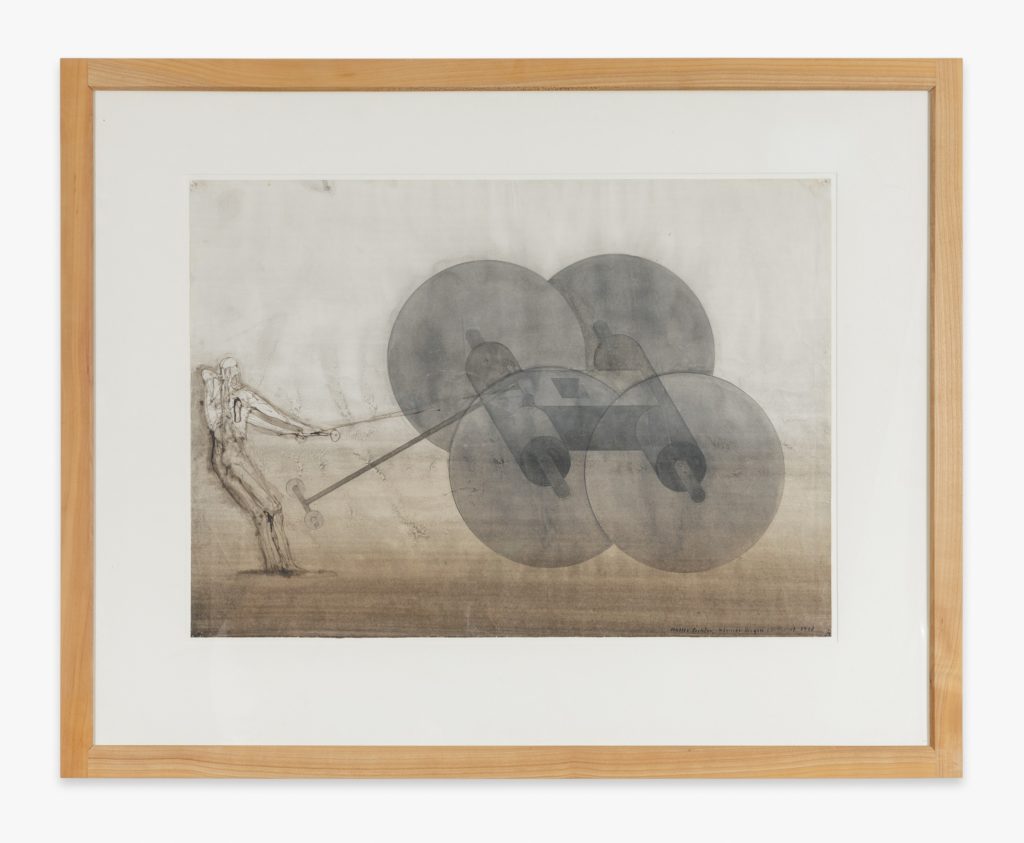
This obsession and his fascination with the archaic and the rural may make him seem like an outsider artist, but he remained in close exchange with the art world, not just in Vienna but internationally. He showed in New York in 1977, this time with Leo Castelli. In 1982, he represented Austria at the Venice Biennial, but he had to ask for the deadline to be extended. Pichler’s slow pace, approaching stillness, is often mentioned, as is the situatedness of his sculpture. In the Basel show, however, a number of works deal with motion and its representation: Kleiner Wagen (St. Martin) (1978) is a drawing of a figure pulling an oversized cart composed of four precisely rendered wheels, while the figure consists of nervous pencil lines; others are populated by figures whose movement is broken into different frames, suggesting a preoccupation with motion like a capital-“F” Futurist painting.
The work of Pichler and Gaillard is specific to a place. Gaillard, however, is itinerant, and he is quick to adapt to the deep history of a place, while Pichler’s work is connected to a single place. Gaillard neither reveals his curatorial concept for this show nor explains how he selected the works. He opted for a through-line that works by association and formal similarity, not unlike his own work.