To speak of vulnerability as soft power is to encounter its double. Hidden agency, bare desire, and quiet possession take form in Chaozhou-born, London-based artist Tommy Xie’s figurative imagination. His paintings allow ambiguities to exist in stillness yet retain their full affective power. In melancholic hues, Xie builds a queer relationality where each body, at once tender and self-possessed, inhabits a near soft-power-mania. He constructs the psychic architecture of his inner worlds through a narrative that is both sensual and surreal. The silent eroticism of his figures evades sexualization, as their intentions, emotions, and environments remain imbued with contradiction. I first encountered Xie’s work in an exhibition at an artist-run studio space in South London back in 2021. Xie’s presence in the room stood out. Much like in his paintings, he has an attuned, radiant, and emotionally vivid approach to both art and life. Ever since, our conversations have never truly stopped. This time around, we met up shortly after his return to London from his most recent solo show “The Chasing Game” (2025) at Tureen in Dallas, Texas. Marking the so-called “darker turn” in his paintings, we unpack the dualities of soft power, the concept of “mother” in his work, the potential of melancholy in queer world-building, and his meticulous, highly skilled approach to painting.
Moa Jegnell: I’m curious about the title of your most recent show, “The Chasing Game.” It has a playful element that creates a contrast with some of the more melancholic tones of the show.
Tommy Xie: Since the motives of the show were already leaning into the deeper psychological side of things, I wanted the title to be lighter and, honestly, just a bit more fun. The show is about playfulness, but also violence in power dynamics and how the actions in chasing and being chased complicate questions of agency. What has been described as a “darker turn” in my work is not about a demonic evil, but about this interplay of desire and its residues. I was trying to accept, or embrace, inner psychological tensions that I have always tried to reject. It connects to what you might call the self-destructive nature of queer coping mechanisms, or survival tactics: ways to temporarily exist in spaces or situations where morals, ethics, or legitimacy are blurred. I was exploring the different ways violence can manifest itself quietly in day-to-day life. The violence I’m talking about is mostly psychological. The paintings in the show come from a place of introspection focused on exploring “violent residues.”
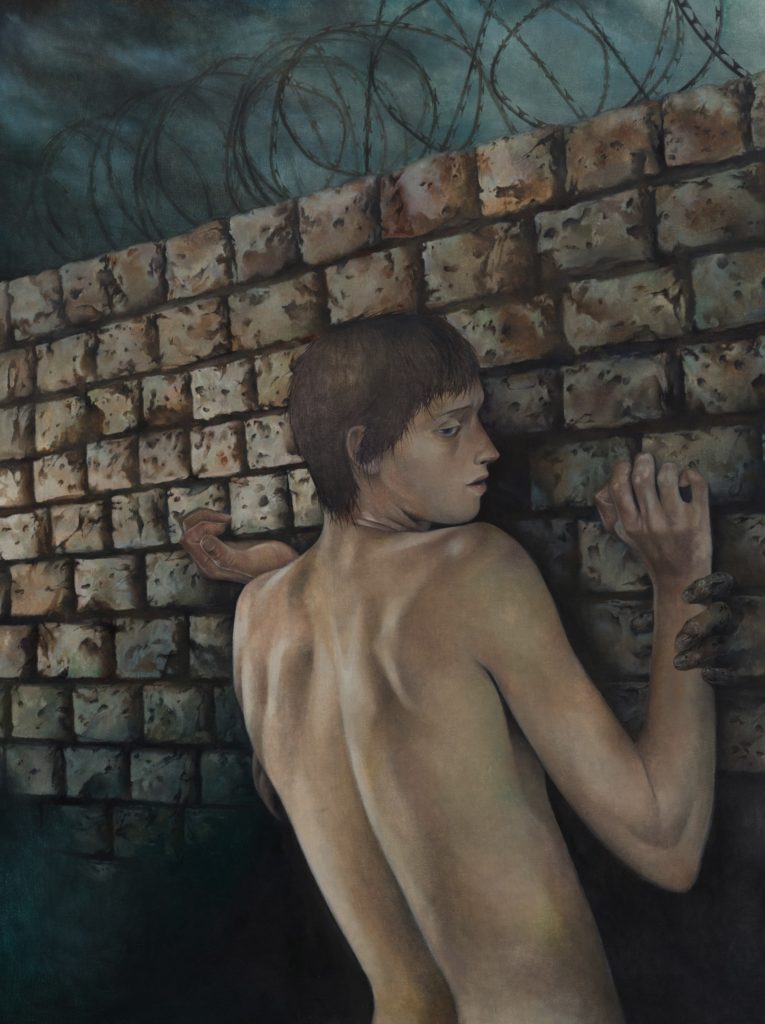
MJ: There’s a sense in this show that the pain isn’t just internal, rather, it’s relational. Were you thinking of how these inner tensions play out between people, or within intimacy itself?
TX: My paintings are not indulging in the cute-hurt, sad-boy-room type of sentimentality. The exploration of darker psychic elements, where legitimacy is blurred and melancholy is present, is meant to give fuller volume to queerness. Not seeing self-destructive behaviors simply as trauma responses to be rejected, but to understand them as coping mechanisms, survival tactics, and sometimes as forms of agency in hostile environments. These gestures, however messy, can reveal how desire, shame, power, and intimacy are negotiated in the private sphere. By acknowledging these contradictions, queerness is allowed to exist in unruly and unresolved ways. That’s important to me: to blur the boundaries, to show that softness can also be power.
MJ: The figures all have an intense vulnerability, yet they’re full of contradictions.
TX: Totally, their vulnerabilities are not passive; they are strategic. I explore this in the curves and postures of the figures, trying to find that balance between strength and vulnerability. But it’s also why I focus on the facial expression; to create these subtleties. Some of the figures might be smiling, some scheming, others more withdrawn, uncertain, even relaxed. The figures are mostly based on myself, but I alter them to build different scenarios. It was when I read theorist Amber Musser, when she described something like plural selfhood, that it gave me the language to explain why. For example, in The Possession (2025), both the figure in the terrarium and the one underneath it, are extensions of myself. The idea of the plural self is about creating capacity within yourself for contradiction and letting many different parts of you coexist.
MJ: As my “homework” for our conversation, you gave me the book Closer (1990) by American novelist Dennis Cooper. It’s a fragmented novel from 1990, part of his series drawing from his friend and later lover George Miles. In this book, you follow a group of teenagers drifting through fantasies of desire and destruction. You’ve often referenced Cooper, and I can really sense his way of depicting psychological tension in your paintings. How does his writing translate into your visual language?
TX: I think when I was reading Closer and the other novels in Cooper’s “George Miles Cycle” (1989–2000), it gave me the language to describe some of the feelings that I can’t express. Obviously, there are a lot of apparent acts of harm in his work. But I’m drawn to the imaginative connections and delusions; the push and pull around the act of violence. There’s a craving in all the characters; they just don’t know the right way to approach it. And when they see possibilities, they also reject themselves from having them. I feel like violence in this context, whether on receiving or giving end, comes from the failure of love. I also love his way of depicting the limits of bodies. There’s this quote from his other book Frisk (1991) that I always come back to: “I want him, specifically his skin, because skin’s the only thing that’s available. But I’ve had enough sex in my life with enough guys to recognize how little skin can explain about anyone. So I start getting into this rage about how stingy skin is.”
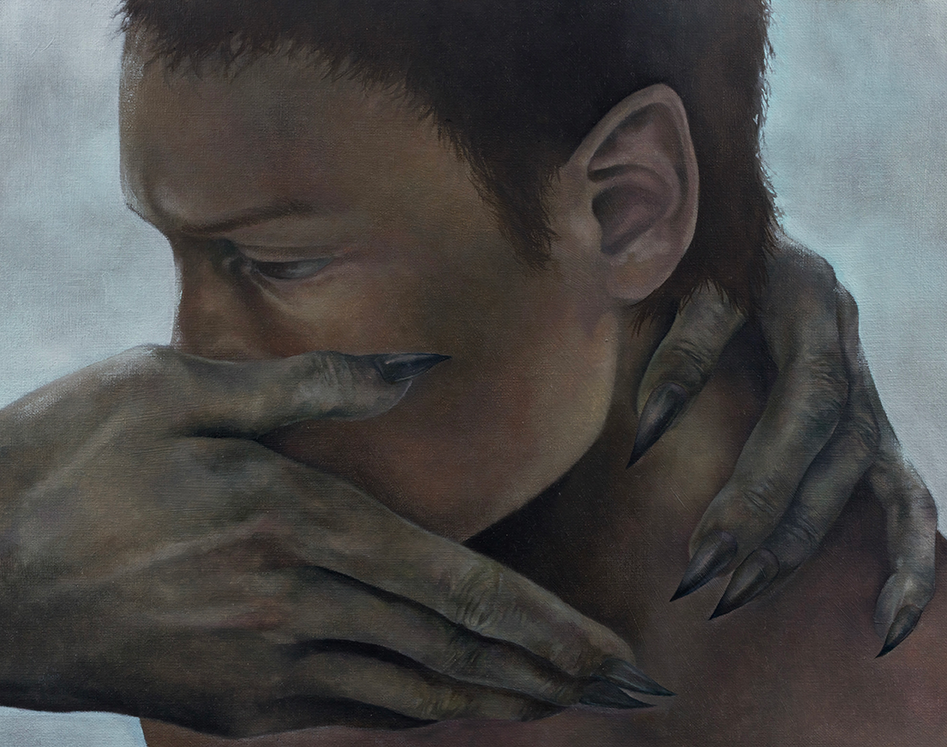
MJ: Is this what you are trying to understand through your painting?
TX: Yes, it’s a contemplation on the multiplicity of ways that love can exist in places we don’t expect.
MJ: For the Tureen show, Dennis Cooper was a big inspiration, but how would you say that you generally navigate a new phase in your work. What helps you articulate its form? Where do you draw references for painting?
TX: For me, finding new language to describe things that are often ineffable is almost a passion. Recently, I’ve been reading Robert Glück’s book About Ed (2023). When reading, the discovery of new feelings becomes an attempt for me to try new things in my painting. Adjusting postures, adding furniture, or experimenting with textures on the wall and the floor. It’s similar for film and music. When I listen to certain songs on repeat for a long time, the image will just show up in my head. And then I will start to draw it out. When I was making The Possession, I was obsessed with the album “Portishead” by Portishead. It’s very eerie, and dystopian, but has this dreamy dimension as well. And so, listening to music translates emotions and brings them into visuals in my painting. For theory, it’s more in positioning myself and my practice in the world. Like with theorist Amber Musser, who I keep referencing in my work, it is more to help me navigate and understand my place as a POC queer person in larger political and social contexts. I guess it helps me feel not only valid, but braver in my feelings as I navigate my identity within a larger context. I feel like theory is for me a kind of skeleton and then fiction and films are like the heart.
MJ: Besides text, your work also draws from personal reflections and broader cultural ideas around family, sexuality, nationality, and especially masculinity from your hometown of Chaozhou, China.
TX: For sure, there’s a specific type of masculinity that has always been part of my work. In my hometown, men are emotional, but their expression is constrained by expectations and the Confucian patriarchal ideals that shape what they can or cannot be. Growing up queer in this environment, I learned to exist within those restrictions, but also to recognize the limits they impose. Moving to London and being in predominantly white spaces made me more aware of how race intersects with these expectations. How stereotypes about Asian masculinity interact with my sense of submission and desire, and how that has shaped my relationships and self-perception. Navigating that complexity has informed the emotional core of my paintings.
MJ: I’m curious about how this relates to your attentive relationship with your mother or the idea of “mothering.” The title of your show at Silke Lindner last year in New York was even “M/other.” How has this evolved?
TX: I have a complex relationship with my mother, in which pain and care, love and cruelty have often blurred. So, “mother” forms both as a figure and an idea in my painting where I allow opposite emotions to co-exist. My first solo show at Ginny on Frederick in London was almost an attempt to forgive her, or to understand her flaws. My second solo last year at Silke Lindner carried on exploring the relationship to my mother, but “mother” also developed into a verb for queer friendships based on writer Alexis Gumbs’s idea of “mothering” as a method for sustaining life and queer collaboration. I realized that all the different conflicting emotions my mom introduced me to, which I didn’t yet have the language for, actually built my resilience as a queer person. It made me tougher, but also more emotionally attuned.
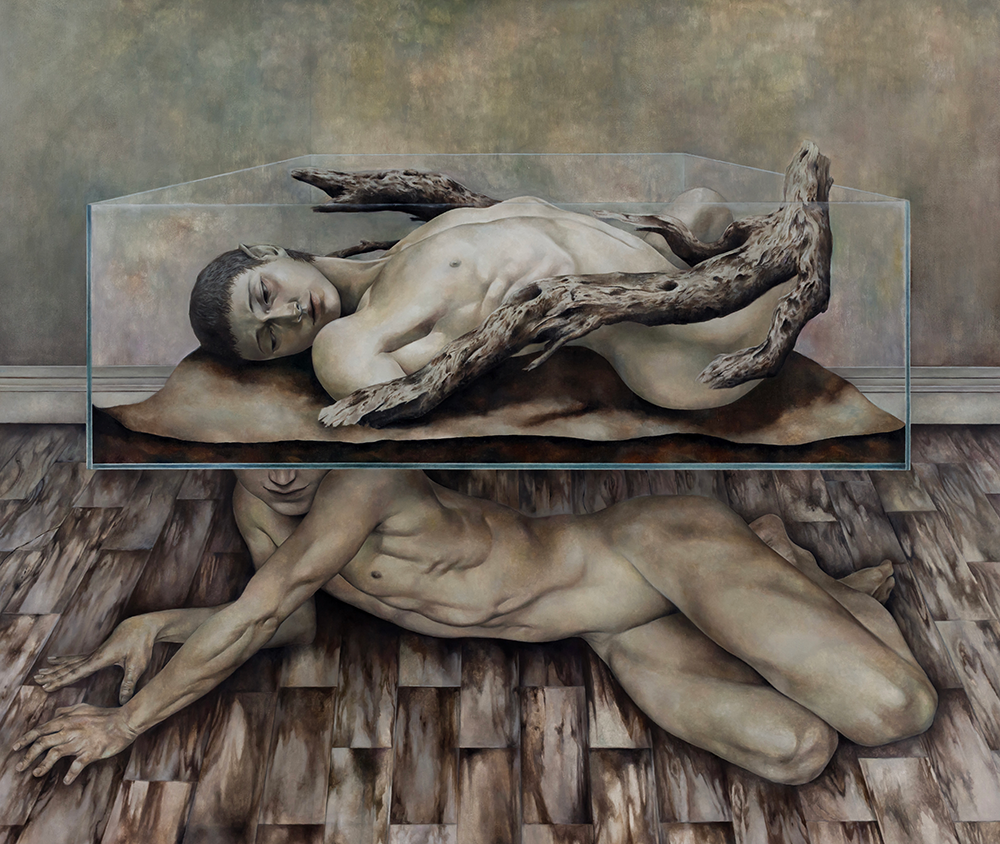
MJ: There’s often a surreal quality to the environments and objects in your work. Objects feel almost animate or imbued with energy, the branch engulfing the figure in The Possession, the brick hand in Risk (2025). There’s a quiet eeriness in the figures’ surroundings, a sense that these environments are alive and responsive. Where does that sense come from?
TX: The environments of my paintings often act as an external projection of the figures’ interiority. I’m influenced by the spiritual and cultural presence of Buddhism in my hometown and upbringing, where every object has its own spirituality. I always aim to make environments responsive to the figures, so even a single figure can feel complete. I’ve also been exploring “less is more,” without it being a “cheat code,” focusing on experimenting with textures, more fleshy aesthetics, and how postures in relation to their surroundings can embody spiritual dimensions. The rooms and environments in my paintings are for my viewers too. It’s a space for them to project their own emotions onto the canvas.
MJ: That sense of animation and quiet spirituality is very specific to your work. You’re a very skillful and technical painter as well, which probably adds to this livingness. You said once that you view your process of painting more like craftsmanship.
TX: Yes, more recently I’ve been inspired by documentaries or videos on specific cultural craft practices in Japan or China, like ceramics or wood carving. It takes ages and a lot of dedication and effort to perfect an outcome that’s so stunning and impressive. And I do see my painting as craftsmanship because I’m dedicated, and I want to create something that is not only emotionally effective but also something people can appreciate for its skillfulness.
MJ: Beyond technical skill, what do you hope people really see when they look at your paintings?
TX: One of my goals with painting is for people to stand in front of it — there’s no movement, no audio — but it gives the similar narrative depths as film. I think a lot about how images speak and paintings’ potential for world-building. It’s about creating a sense of suspension, of what might happen next, or what has happened before. I want my paintings to exist within the continuity of a narrative.
MJ: Lastly, what is it about the act of painting that keeps you going?
TX: It’s going to be quite cringe.
MJ: Just say it.
TX: It makes me feel less lonely.