Yaxuan Liao’s work borrows the aesthetic regime of information to construct an electric dreamscape. In his recent work, Entropy Atlas (2026), the visual field is composed of images commonly associated with analysis and control–graphs, medical scans, cellular simulations, and signal diagrams. These information-dense images ostensibly promise clarity, legibility, and diagnosis. Yet, Liao twists and warps the visuals, preventing images from becoming legible; data in the images is hijacked, never delivered. At fleeting moments, the viewer is teased with seconds of recognition, only for the image to collapse back to morphing abstraction. What appears to be an ordered system persistently refused to perform as one.
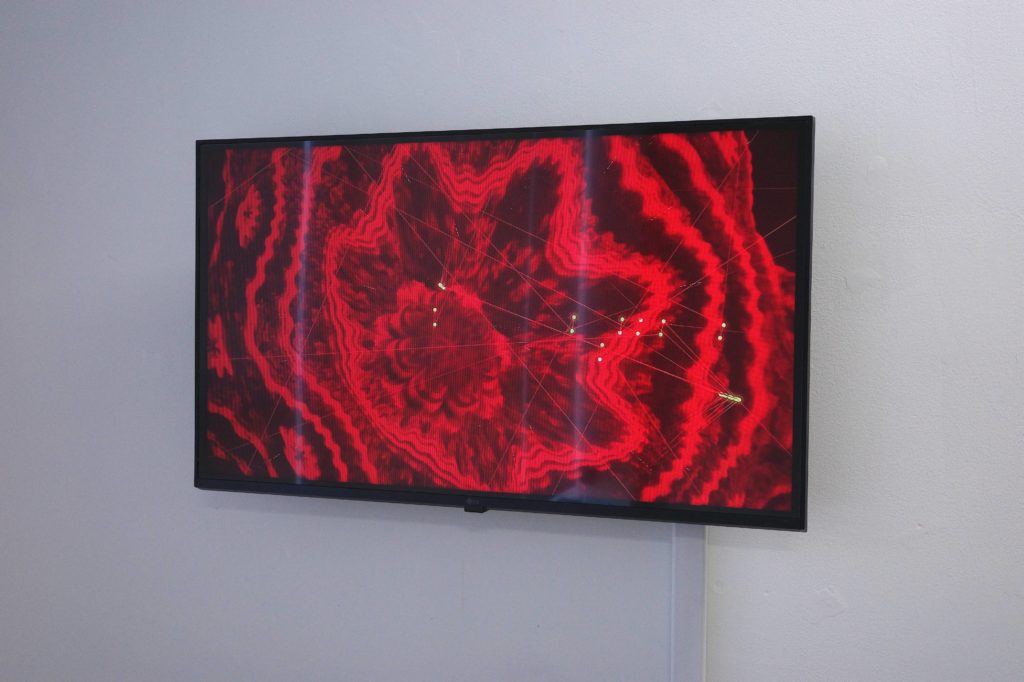
The synchronisation between the sound and image is central to this act of refusal. Visual pulses are tightly synced to the audio track; the audio emits repetitive mechanical beats rather than a melody. The sounds resemble Morse code, hospital equipment, radio transmissions, and the sonic markers that were made to transmit information. However, the signals in Liao’s do not carry messages but circulate endlessly. In the absence of a linear narrative, the rhythm takes the lead. The repeated pulses draw the conscious and unconscious body into alignment with the tempo.

The artist experiments with exposing the tension between the promise of order of systems and the raw, unorganised chaos that accumulated data culminates in. Liao’s piece creates a liminal, almost sublime space where the entropy plateaus instead of exploding. Breaking away from a common five-act structure of a narrative–exposition, rising action, climax, falling action and resolution–Entropy Atlas dives in and lingers in a prolonged state of instability. The effect is oddly hypnotic and numbing. Without catharsis or a moment of release, the piece maintains sustained oscillation. The logic is not applicable to the Entropy Atlas, not because it is not irrational, but because it destabilises the system of logic, allowing sensations to surface.
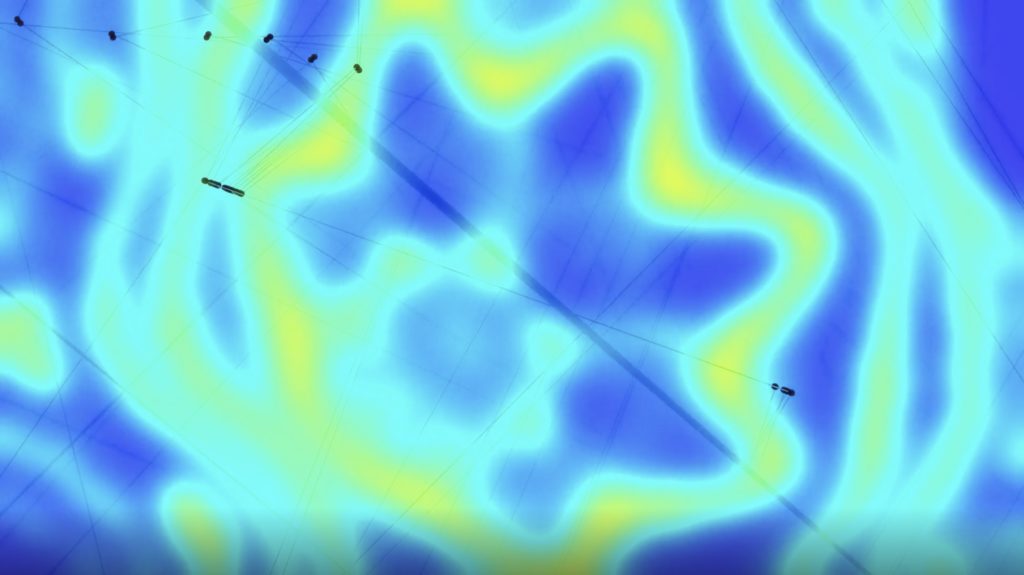
Entropy Atlas presents a poignant commentary on the contemporary world saturated by data at every scale, from quotidian life to the operational infrastructure governing society. Liao articulates the pervasive psychological condition that is shaped by continuous exposure to information streams mediated through multiple screens and smart devices that are always within reach. In such an environment flooded with data, attention is often dispersed and suspended, rather than consolidating into knowledge. Liao’s structure of loop echoes the mechanism of doomscrolling, a semi-compulsive and aimless wandering across vast fields of information where orientation is perpetually deferred. The abundance paradoxically depletes the cognition and tethers the perception to a feedback loop of processing. Ultimately, Entropy Atlas materialises the friction between systemic order and noise from surplus data in the digital age, rendering the exhausting cycle of information palpable.