It feels appropriate to approach Tasneem Sarkez’s work through the seed of language. The word, as a manifold concept, laces itself into Sarkez’s objects across several forms: in sculpture, book-making, and painting. Language does not materialize in her objects solely through the linguistic vector but also through composition: even the purely visual, the purely depictive, takes on a form akin to a speech act. The selection of reference material (mundane consumer goods, tchotchkes, vehicles, portraits) is pulled from the rubble pile of images and compressed through composition to achieve a morpheme-like quality. That is to say, her paintings begin to act like language, act as the basic semantic units which bear meaning. And it is through this process — of redeploying language itself or using the image as a kind of language — that the question of how the minutiae of cultural material come to bear meaning becomes a productive site of inquiry into transculturation, nationhood, and the politics of language. And it is this figure — translation — that becomes of interest, precisely due to the gap between the native who recognizes its original form and this original quality which is lost to the subject for whom it was translated.
Sarkez was raised in Portland by Libyan parents who immigrated in the 1970s. Growing up in the predominantly white city meant that access to Libyan and Arab culture came through gleaning fragments — not only via books, but also by and through the internet, rather than the familial. Now based in New York, Sarkez has encountered a much larger Arab community. But as is the hallmark of all processes of immigration, it is a community whose signifiers have been filtered, translated, diffracted, a process analogous to the translation process of the internet. This newfound environment has become integrated into Sarkez’s work — imagery and objects from vendors, smoke shops, and delis all become re-articulated in varying ways in the artist’s oeuvre. This is not to suggest the erroneous possibility of a “pure culture.” Aside from culture’s ontological status of constant bleed and flux, cultural translation on the part of the colonized Other does not necessarily entail a loss. Although the expression of one’s culture under empire can become a source of danger, its withholding, its tactical mobilization, and re-interpretation can constitute a space of agency, a space where power can be exerted.
What often happens in Sarkez’s work is an investigation into these cultural signifiers to ask how these signifiers acquire cultural meaning, particularly along the lines of media, and how they contribute to the composition of identity. In an interview with Keshav Anand on the topic of uncanniness in her paintings, Sarkez noted: “My approach to communicating these ideas is a reflection of how technology and media have the power to dictate what is considered ‘normal.’ In imitating this sense of an ‘existing image’ or ‘generated’ to an Arab framework, it informs the audience of the work through a sort of art-traditional way, without compromising the inclusion of Arabness.”1 This arguably speaks to what is compelling about Sarkez’s work — the ability to take abstractly generic forms (cars, shoes, perfume, etc.) and place them in a state of constant flux, hovering between cultural specificity and universalism. This shifting state is underscored by the medium itself — that is the use of art’s Promethean medium of painting in service of articulating these dynamics, without prioritizing the digital over the analog, or vice versa.
1 Keshav Anand, “In the Studio with Tasneem Sarkez,” Something Curated, December 30, 2024, https://somethingcurated.com/2024/12/30/in-the-studio-with-tasneem-sarkez/.
In one work, First Lady (2024) a small portrait of one of Muammar Gaddafi’s so-called “Amazonian” female bodyguards (according to American media) is rendered in a paparazzi fashion. The subject is seemingly imaged from afar and looks to the right of the frame. Indiscernible shapes frame the female figure, cut off from the chest-down with a framed text executed in two shades of green which reads, “First Lady,” which brings to mind American patriotism via its evocation of the president’s wife. Speaking to Dazed MENA on the work, Sarkez explains: “The painting about Gaddafi’s women bodyguards is definitely a lot about the power of how they were perceived,” she says. “It’s a weird phenomenon — here’s this group of women paraded by a dictator, but then they’re some of the best-trained military women in the state, and they define gender norms in that way,” she explains, throwing the masculine-feminine binary into scrutiny. “But then, at the same time, there were crazy rules for being one of them. The most extreme rule was that you had to be a virgin. So in those paintings, I paired text from soap packaging — virginity soap, skin-bleaching soap — playing with the language of products that sell you this idea of being ‘pure.’”2
2 Sarra Alayyan, “Tasneem Sarkez’s Algorithmic Still Lifes,” Dazed MENA, March 29, 2025, https://www.dazed.me/art-photography/tasneem-sarkezs-algorithmic-still-lifes.
Another work, Good Morning (2023), is an oil painting consisting of a cropped view of a Jeep or 4×4. The composition is largely awash in neutral hues — a dusty road, the background car a kind of nondescript silver-gray, and the architectural structures in the back almost dissolving into abstraction. The work, executed in smoothed-out brushwork, echoes Gerhard Richter’s formal tendencies in the 1960s, a quality that likely emerges from Sarkez’s frequent use of found photographic imagery as referents for her paintings. The largely muted palette is broken in the middle. The spare-wheel cover is plastered with a vibrant rose (a popular symbol and frequently reproduced form in the Arab world). Overlaying the composition is a section of Arabic text in lime green, which translates to the painting’s title: “good morning.” The text troubles interpretation of the image — floating atop the scene, the impressionistic naturalism of the environment becomes unreal. Concurrently, the text no longer becomes self-contained — what must now occur is a conjugation.
When considering Sarkez’s mode of frequently drawing images pulled from Arab social media or WhatsApp chats, a dialogue could be drawn between her and the late Michel Majerus. As Daniel Birnbaum discerned in an essay on the artist in Artforum in 2006, his work articulated early on the ways in which digital media affected not only painting’s content but “the very space of representation itself”3 in Majerus’s use of lurid colors, schizoid mashups of images and text, and the depiction of seemingly unrelated objects within the space of the same canvas.
3 Daniel Birnbaum, “Search Engine: The Art of Michel Majerus,” Artforum, February 2006, https://www.artforum.com/features/search-engine-the-art-of-michel-majerus-173355/.
Akin to Majerus, Sarkez’s paintings bear a similar quality of being inscribed by the digital’s effect on representation. It is not only that the kind of imagery (at the level of composition) that Sarkez pulls from is native to, and a product of, the web as a kind of medium, but also its form and texture: smoothing and blur as a product of quality loss or filters, crops and zooms as the digital native’s bread and butter.
A perhaps more productive comparison here would be Ed Ruscha’s mountain works in which paintings or prints of sublime, snowcapped mountaintops are troubled by the layering of words or, on occasion, solid abstract forms that almost appear as logographic characters. The affinity here is worth mentioning in the sense that words, in their disjunction with the painted landscape, begin to destabilize one another rather than cohere into a larger meaning. A similar operation occurs within Sarkez’s works, particularly Good Morning. The sentence, unreadable to anglophone audiences, makes the composition either read as Arab, exotic, or Other by default. Conversely, the use of “good morning” can function as an inside joke, as a meme category in West Asia and North Africa. In this sense, Sarkez’s use of language points to how the form of language itself comes to signify something, outside of semantic meaning.
Outside of the deployment of language, she also instigates investigations into symbols — namely consumer goods and luxury objects. Oftentimes these objects have a veneer of ostentatiousness — such as Golden Gun (2025) — a painting of a pair of stilettos in a gold material whose heels have been replaced by pistols, or G-Class Dancing with the Shah (2024), which consists of another pair of modified heels, this time emblazoned with the Mercedes-Benz logo. This type of subject belongs to a term she calls “Arab Kitsch.” Clement Greenberg’s 1939 disavowal of kitsch as a degraded form of culture meant for soothing, easy consumption, Arab Kitsch turns the ways in which consumer objects produced in the Arab world and by its diaspora constitute a complex form of hybridization that serves a role in both constituting the self and navigating new homelands. By extension, Arab Kitsch is a form of object that is abstractly mundane as a consumer object but is wrapped in a (subtle) veneer of cultural specificity, such as the omnipresence of roses imprinted on many of these goods. In other cases, it is an instance of a bittersweet move toward fitting-in, such as hyperbolized forms of Americana — bald eagle keys as materialized in Sarkez’s The Real Superhero Key (2024) or the litany of tourist goods stores in New York hawking Trump memorabilia.
The engagement with language and cultural articulation and translation emerges in her sculptural work Heart Notes No2 (2025). Formally, it combines found objects and reappropriation — generic perfume bottles, common in Arab neighborhoods, arranged on a metal cart. The original bottles are labelled both simply and abstractly — past versions found by Sarkez include “Obama,” “Come to me Again,” and “Just For You.” The artist then reapplies her own labels in the same linguistic register — teetering between the generic and the specific. Her iterations continue along this vein, with bottles reading “Coney Island Sand,” “Sexy Girl,” and “Soulmate.” When speaking to Sarkez, she articulated that what was of interest for her in the bottles was that it articulated an attempt on the part of the producer to capture some market, articulate a desire via text, before even knowing what it is. They are a consumer good that arrests to the process of acculturation halfway — in between a constructed exoticism in order to sell it as an object of desire and an attempt at capturing or articulating what desire is in America.
Often, when thinking through Sarkez’s work, one recalls Homi K. Bhabha’s words on mimicry. This term speaks to the ways in which the colonizer attempts to compel the colonized into mimicking its habits, customs, and cultural practices. However, there is always a gap in the act of translation, an “ambivalence of mimicry, almost the same but not quite.”4
4 Homi K. Bhabha, The Location of Culture (New York and London: Routledge, 1994), 86.
This becomes a threat to the colonial authority; the maintenance of power, which hinges on a distinction between us and Other, becomes destabilized as the signifiers that articulate this distinction become undone. Sarkez’s work, in some sense, has this quality, in its underscoring of the ways in which culture is always already becoming hybridized. But furthermore, the articulation of one’s culture is held between two poles, in which part of the articulation is always visible to the outsider, and the other is withheld for those in the know.
The above is playfully articulated in the car — a recurring motif in Sarkez’s work, loaded as a symbol of success but also aspirational, suggesting more ephemeral qualities of speed and power. But a particular engagement with the car that Sarkez has mentioned in past interviews is worth noting. In Libya some young men (mostly in their twenties) import and modify cars. Not necessarily for collection or preservation, but rather to ultimately drift them into oblivion, to take pleasure in their breakdown.
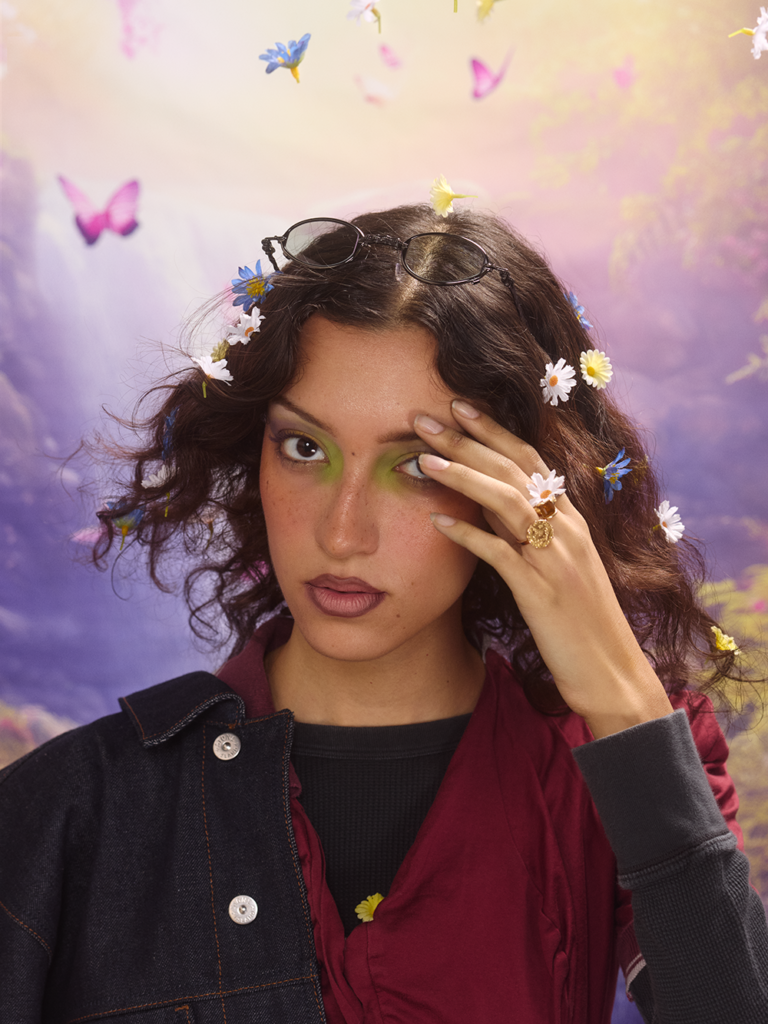
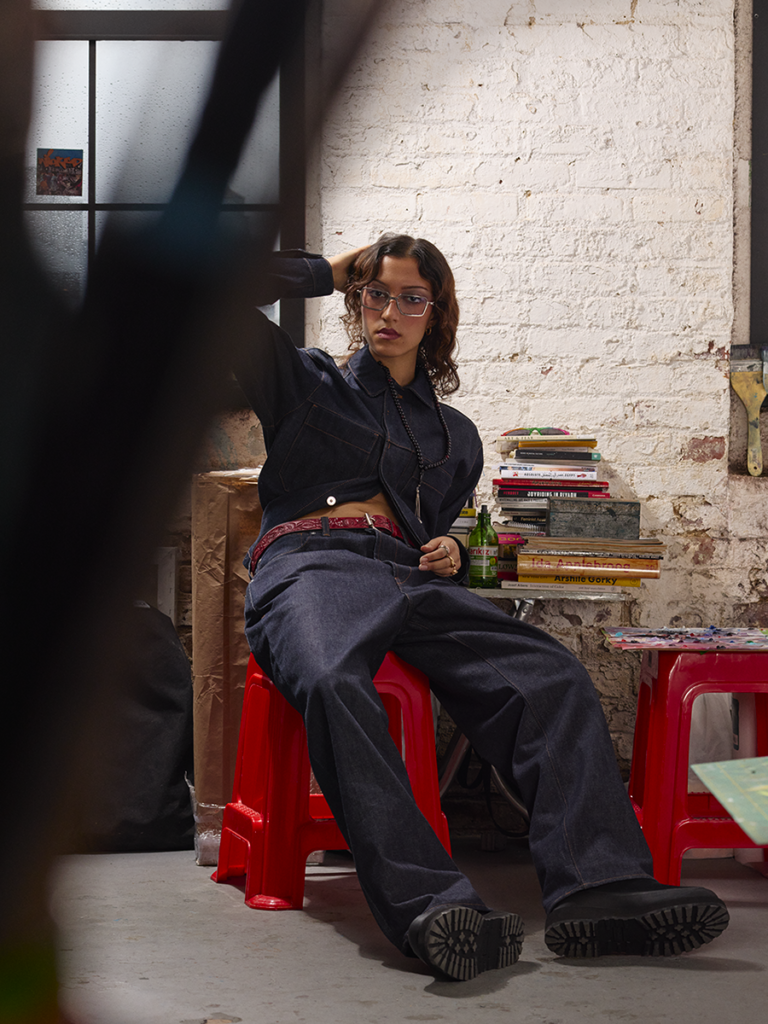
Artist: Tasneem Sarkez
Photographer: David Brandon Geeting
Creative Direction: Alessio Avventuroso
Stylist: Cece Liu
Makeup: Isze Cohen
Hair: Shin Arima
Clothes: Stone Island
Eyewear: Kuboraum
Location: Artist’s studio, New York City