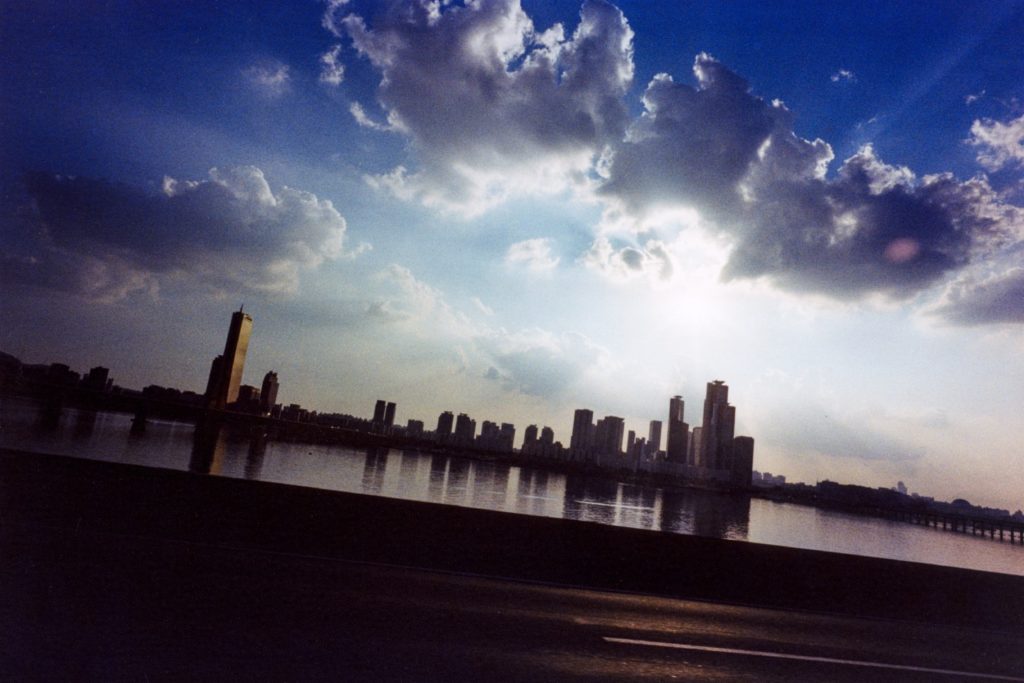
Plans are always copy-pasted. There is no planning, no imagination. Seoul is not built; it is generated through calculation. Buildings follow buildings, slabs stack upon slabs, and space ceases to be an assemblage — it becomes a matrix. This is not a story about the “Typical Plan,” the American invention Rem Koolhaas once diagnosed.[1] It is something more radical. In Seoul, not only offices but churches and houses are replicated according to identical schemas. The signifier precedes the typology; only numerical datasets — surface areas — determine reality. Context dissolves. Virtual images and charts replace physical form. Seoul operates like an autonomous algorithm, endlessly reproducing itself. Any attempt to intervene — whether by will or design — results only in illusion.
[1] Rem Koolhaas and Bruce Mau, S, M, L, XL (New York: Monacelli Press, 1995), 335.
Koolhaas once described the “Typical Plan” as “a segment of an unacknowledged utopia, the promise of a post-architectural future.”[2] In Seoul, that promise reached terminal fulfillment: no possibility remains open, and even the future is deferred — only endlessly regenerated plans persist. He observed that “business can invade any architecture,”[3]but in Seoul, only business remains — architecture itself has disappeared. Every building conforms to the same diagram; architecture has been reduced to mere numerical entries. Apartments are not conceived through architectural drawings but via sales charts. Koolhaas also claimed “the center is no longer a place but a conditionon,”[4] yet in Seoul, even that has collapsed into nothing but replicable data. This is a city without qualities.
[2] Koolhaas and Mau, 336.
[3] Koolhaas and Mau, 337.
[4] Koolhaas and Mau, 345.
This endless self-replication erases the ego. The subject — once tasked with creating difference — loses its identity. Seoul is already a city where the order of signifiers has overtaken the real. Platonic Neutrality — “where pragmatism, through sheer rationality and efficiency, assumes an almost mystical status”[5] — has decomposed into anonymity and decay. Plans without qualities create men without qualities.[6] In response, art and architecture begin to negate themselves — paradoxically — as a way to reclaim identity and resist absorption into the system, distorting the urban fabric in the process.
[5] Koolhaas and Mau, 338
[6] Koolhaas and Mau, 346. “Did the plan without qualities create men without qualities?”
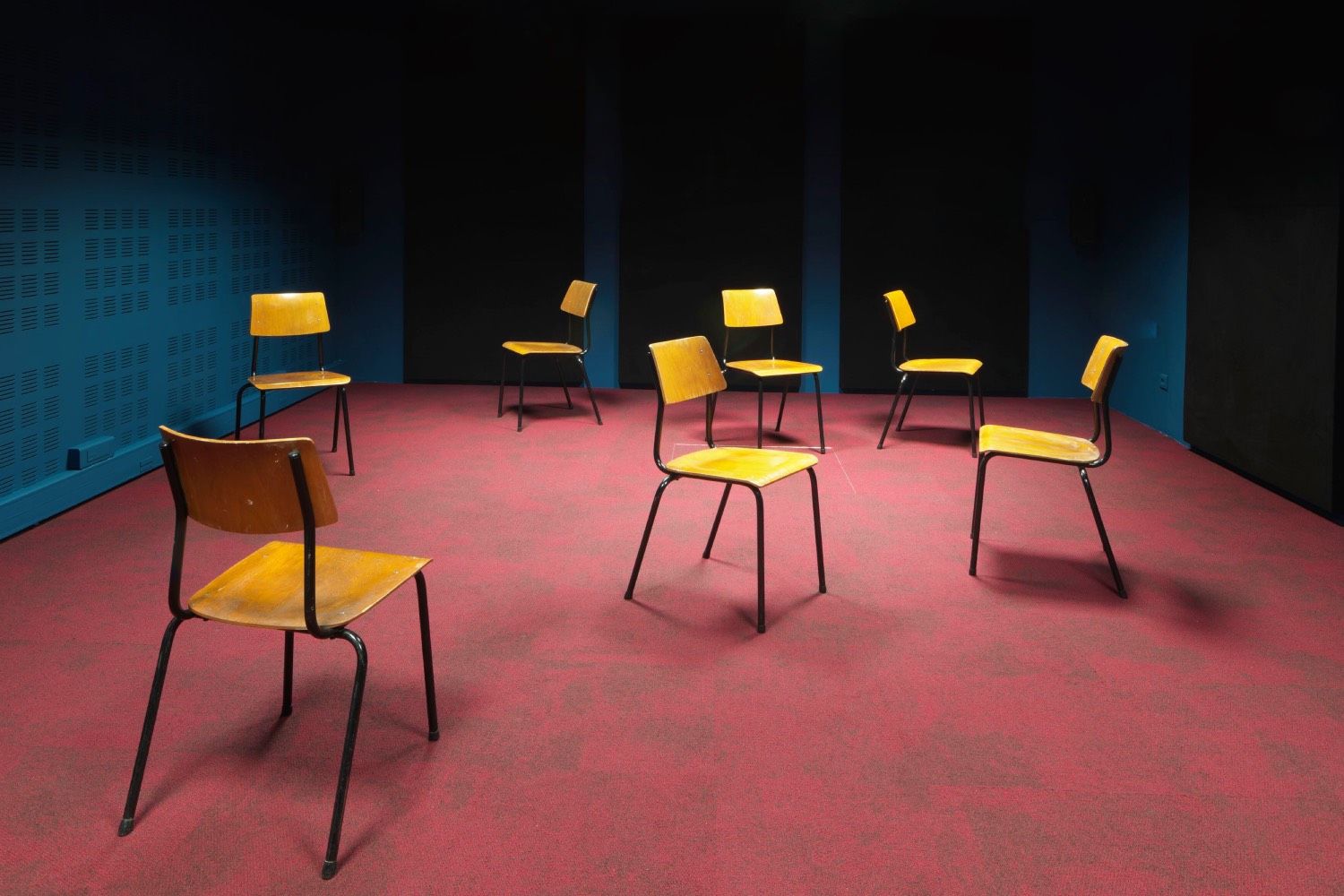
TINC (This is not a church), in Samseon-dong — an intimate neighborhood of human-scale buildings — is a space for exhibitions and performances. The building itself resembles a typical 1970s residential villa, the product of a replicated plan. Once a church, the weathered blue sign of the former Myeongseong Church still hovers as an urban signifier, embedded in the city. This ambiguity produces two distinct realities: for passersby, it remains a forgotten church; for visitors, it transforms into an exhibition space. Like a rogue program hiding within the Matrix, TINC itself becomes a glitch — a corruption of meaning that rewrites reality. Similarly, IMF Seoul, in Ssangmun-dong, distorts the spatial logic of the city. Purchased during the 1997 IMF Asian Financial Crisis and left unoccupied, this unit in Ssangmun Hanyang Apartments was transformed into an exhibition venue. Each visit requires a different door code, turning access into a secretive ritual. For a fleeting moment, it becomes both the most mundane and the most exceptional domestic space. These acts of self- negation become a final freedom: generating urban glitches to explore new architectural possibilities.
Seoul is a dogmatist of the bundle theory. Today’s city and tomorrow’s are not the same, yet the difference has no author. The delusion that one can transform the city is akin to the graph blaming the graph paper for its lack of character.[7] The messianic impulse to save architecture by reclaiming architectural essence — its truth or reality — is an illusion. In the end, that desire, too, becomes part of the algorithm: just another predictable result.
“This is not architecture.” Architects in Seoul must begin by declaring they are no longer practicing architecture. For those who fail to exit the system, the outcome is inevitable: they either become fuel for the city or loop in endless cycles of self-replication. The Oracle’s words to Neo in The Matrix Revolutions remains prophetic for Seoul’s architects: “You have already made the choice. Now you have to understand.” The paradox of becoming “Architects Without Architecture”[8] is not an escape, but the last strategy — a means to insert internal errors. It is about seeding the system with inexplicable 100 glitches: dismantling function, distorting signifiers, and designing exceptions.
[7] Koolhaas and Mau, 346.
[8] Bernard Rudofsky, Architecture Without Architects (New York: Museum of Modern Art, 1964).
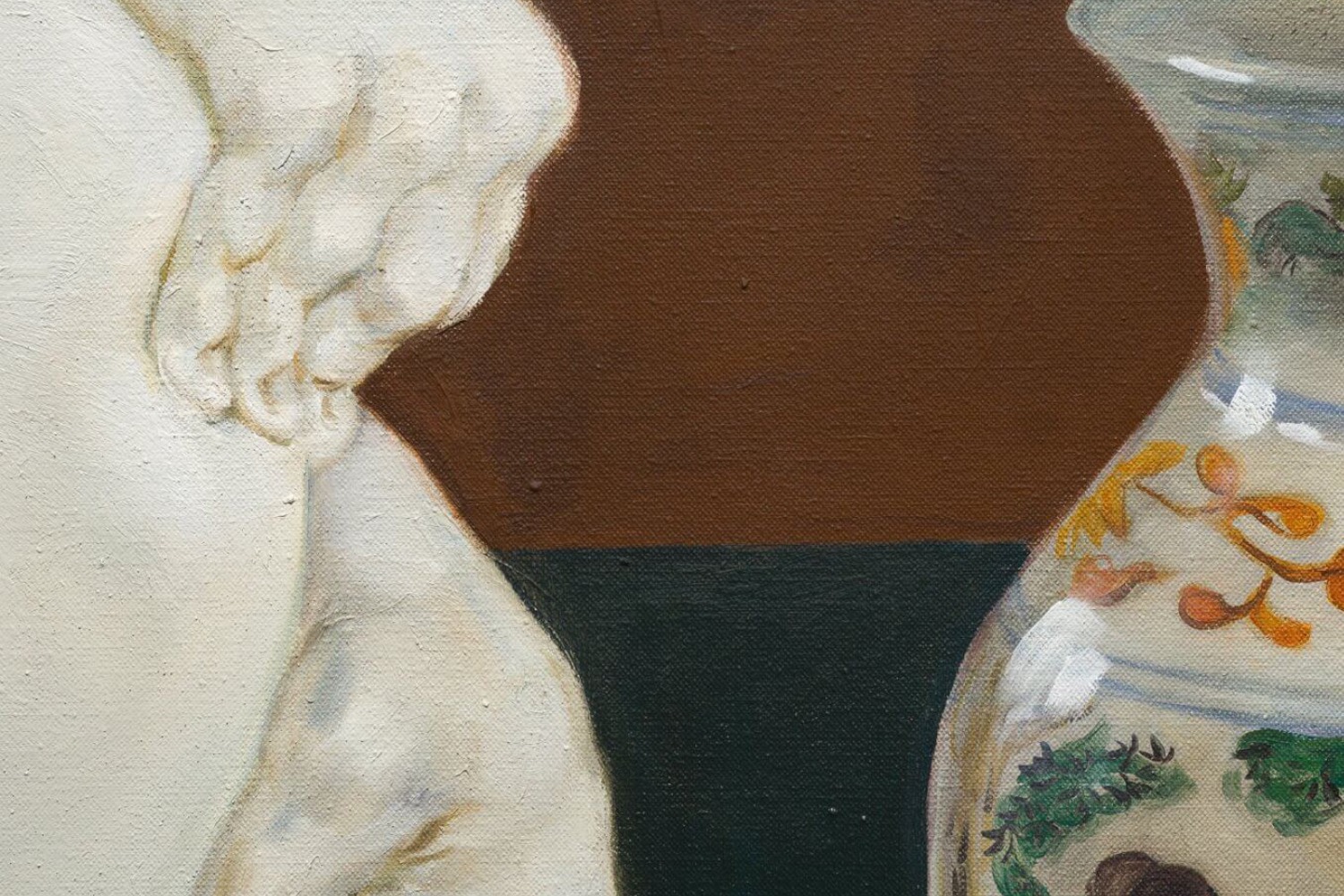
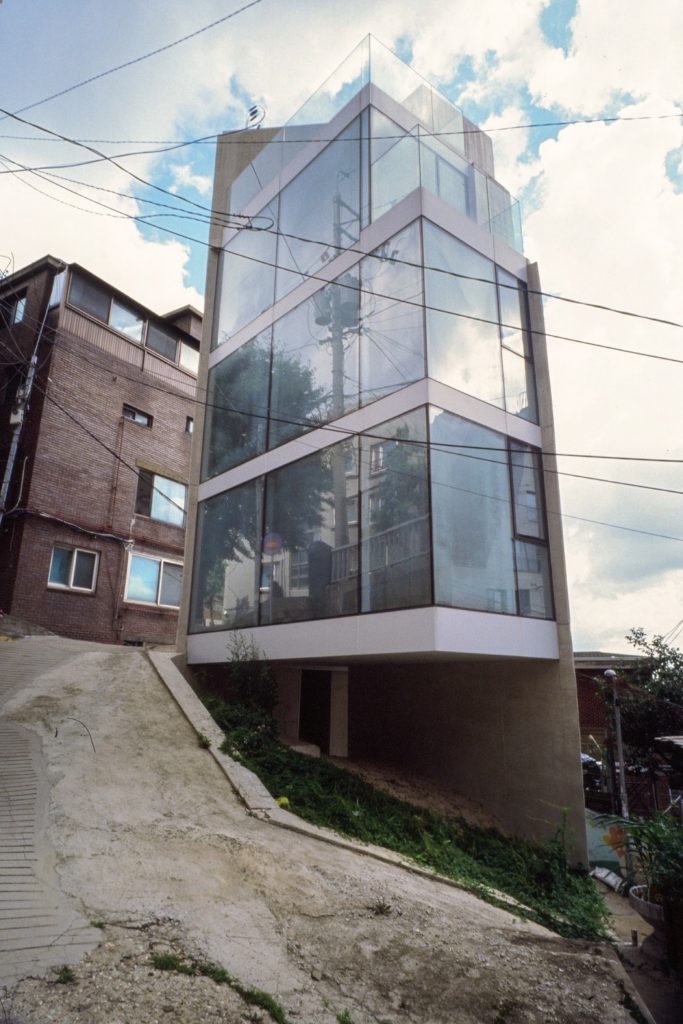
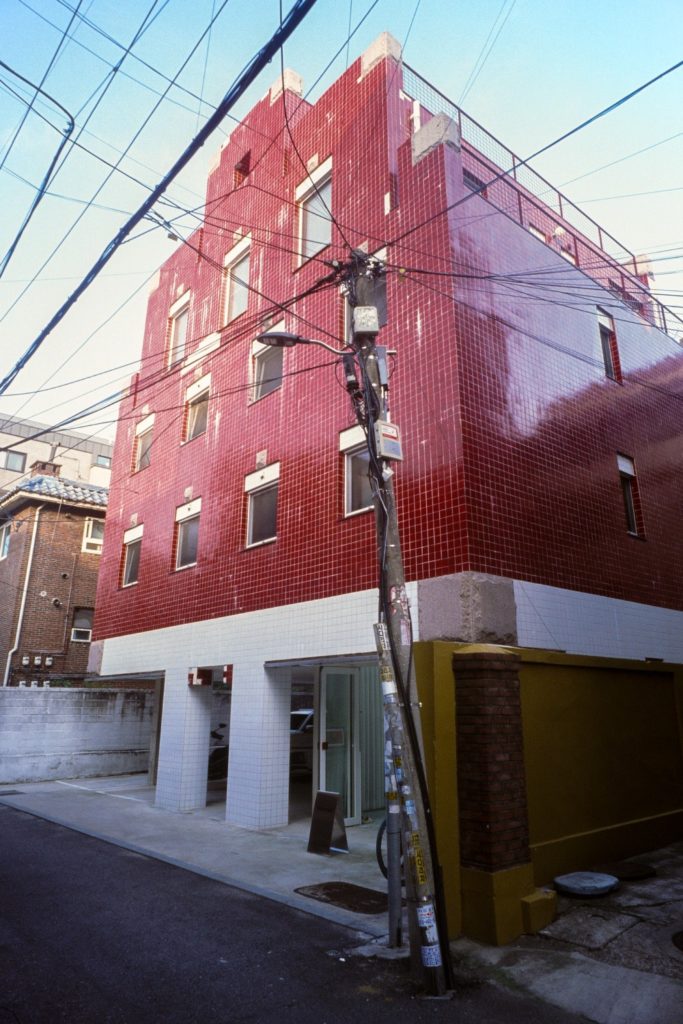
Among the architects exploring glitch as a strategy of spatial contradiction is Dami Lee of Flora and Fauna, a practice based in Seoul and on the internet.[9] Her project The Pillar Suit (2021) is described as “a certain impure and surplus need.”[10] Renovating a former middle-school ping-pong room, the project inserts exaggerated volumes into the repetitive neutrality of institutional architecture. Even where no columns existed, she clads the void — floating between the real and the virtual. The columns hesitate: Should they be ashamed, or should they dance? No longer structural supports, they become ambiguous agents. Lee states, “The column [is] transformed from the purest element into the most impure possibility. It becomes exaggerated, differentiated, and precedes the whole.”[11]
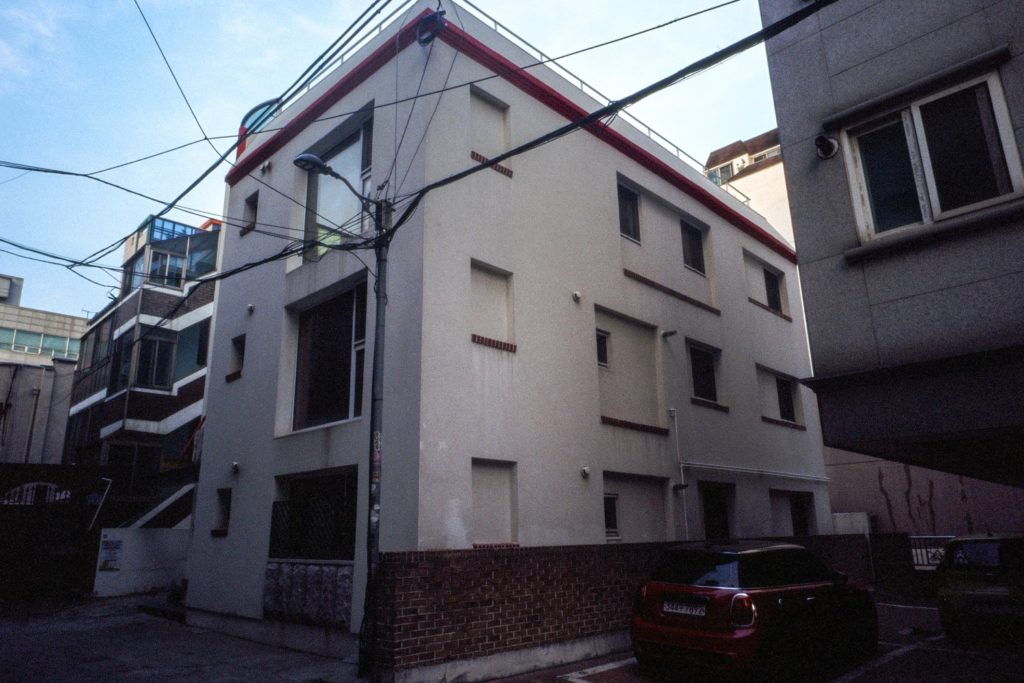
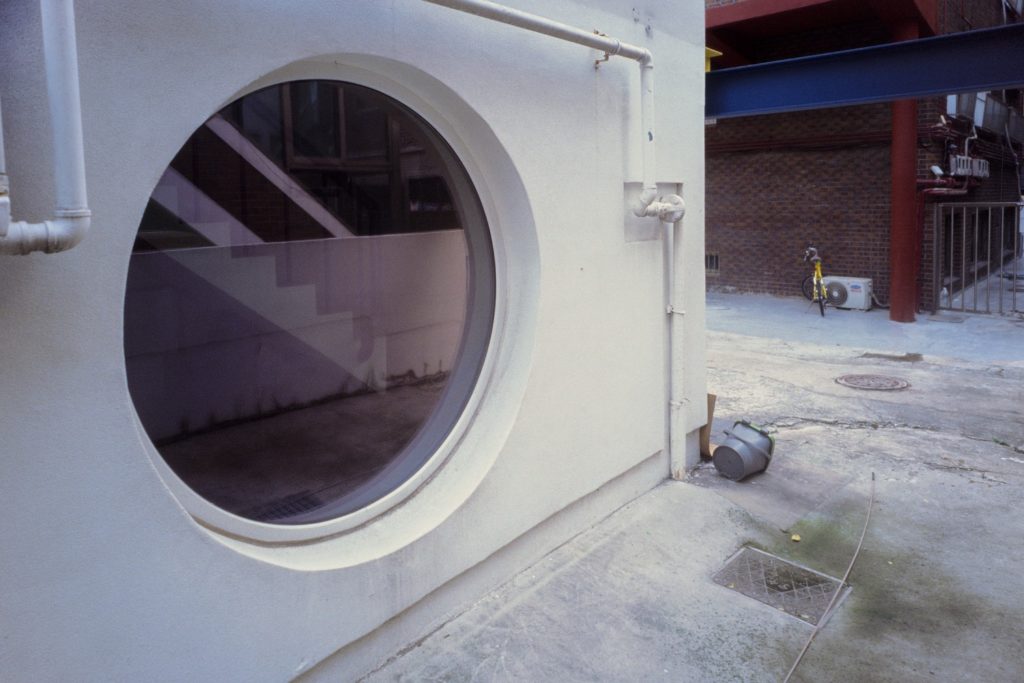
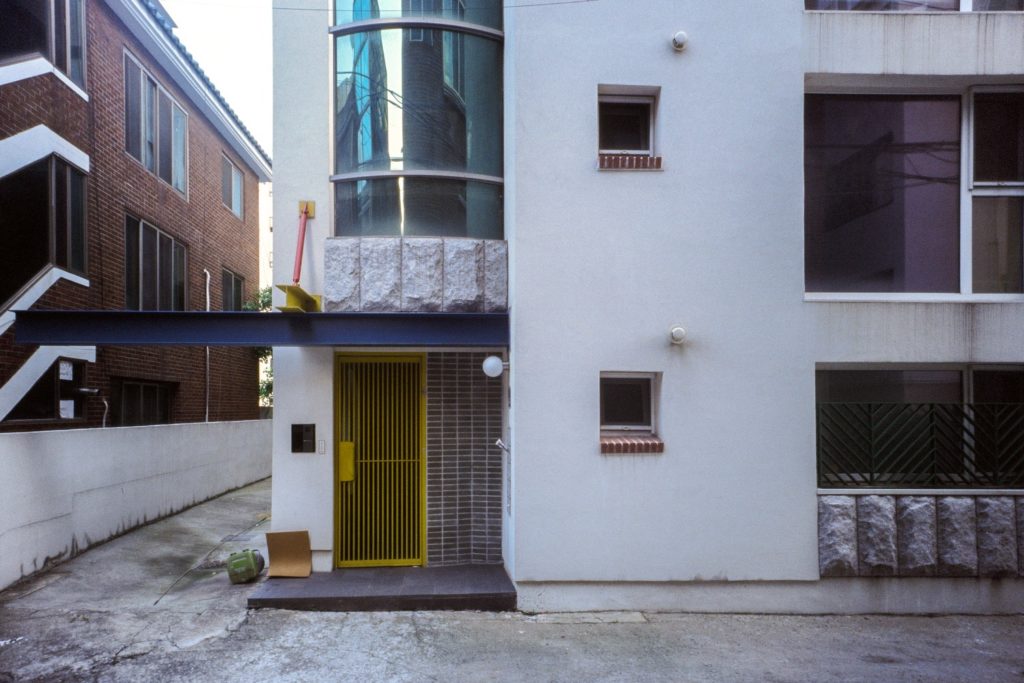
While Flora and Fauna injects ambiguous excess into banal institutional architecture, aoa architects finds surreality in functional overdrive. For Cascade House (2019), architect Jaewon Suh of aoa responded to a client’s request to “make as many doors as possible.” A marble column at the center divides the living room, kitchen, and bedroom. This spatial juxtaposition — where all rooms are visible from the center — offers a surreal, set-like domesticity. Diagonal height restrictions shaped the elevation; the symmetry was predetermined by cost. Urban constraints were met with cheap ornamental stone (hokdugi) and uniform square tiles, constructing a humble yet economical virtuality. Mangwon Villa (2021) is a renovation of one of the most common types of rental housing in Seoul: the low-rise villa. Through the architect’s intervention, the white stucco walls begin to function like a museum backdrop,[12] effectively erasing the architecture itself. While certain original features — like the rounded window frames — are preserved as a gesture of respect, the oversized canopy is defended with a shrug: “The entrance has to look great!” The “part” is exhibited, while the “whole” disappears — as in a museum.
With the project Like reality, unreality (2022), FHHH friends position themselves as devout followers of Seoul’s dogma. The client literally requested “a solid, well- centered building in Seogyo-dong,” and they obeyed. As with any typical commercial building, the floor area is maximized, and the circulation efficient. “We didn’t plan it,” they confess. “It felt like reading a prophecy. This site, they felt, was destined for this outcome.”[13] A large central column is not a column — it is a convex wall. The repetitive openings are not windows — the convex wall itself becomes a skylight.
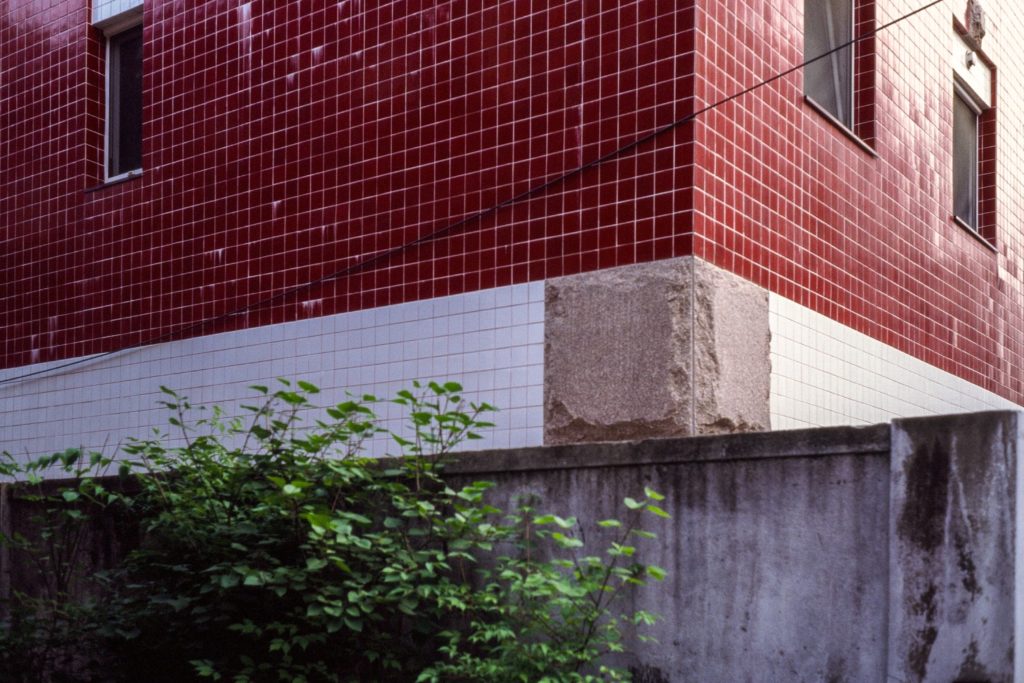
Hyo Young Kim of KHY architects explores structural precarity using minimal means. In Neighborhood Living Facility, Hyehwa (2022), a thin stone beam floats on the façade, while the guardrail is merely painted — emphasizing flatness like wallpaper rather than material specificity. The sagging reveal wall was the most abstract and intentional element in the project. Yet immediately after completion, signage was installed, and the building was subsumed into the city. In this way, “real” architectural approaches in Seoul often fail.
These nonarchitectural gestures are not meant to correct the system but rather to insert deliberate malfunctions into it. They do not aim to resolve contradictions — they amplify them. They do not propose a new utopia — they reveal how absurd the existing reality already is. Their architecture does not demand attention. It hesitates, glitches, and stutters, producing fleeting ruptures in a city that prefers smooth repetition. To practice architecture in Seoul now is not to design but to distort. Not to propose form but to misalign it.
Seoul dreams of a perfect, consistent world — the vision of David Hilbert (1862–1943).[14] It is an algorithmic city, seeking to prove the proposition: “This plan is perfect.” Yet, Kurt Gödel (1906–78) and Alan Turing (1912–54) demonstrated that algorithms inherently possess incompleteness and contradiction due to self-referentiality. What they revealed is that any complete system must inherently contain a void, a flaw.
The architects of Seoul are those who discover those voids — they are The Ones. They harbor doubt toward this hybrid city where virtuality and reality blur. Like Morpheus in The Matrix, many believe a “real” space must still exist somewhere. But even that belief is overwritten by the system’s programming. Most architecture merely functions as a variable used to stabilize the Matrix. As the Architect says to Neo: “Your life is the sum of a remainder of an unbalanced equation inherent to the programming of the Matrix.”
The Architect who demands Neo’s sacrifice to preserve Zion — the awakened city — is a portrait of Seoul. The city pursues flawless algorithmic control, yet cannot resolve the human imperfection that always returns as a variable. In the film, the Merovingian, an older program, tried to build a utopia that satisfies all desires — and failed. The same is true for Seoul. To design this city — where countless, conflicting desires intersect — as a single utopia is pure fantasy. From the third Matrix onward, the Oracle, having studied the depths of the human psyche, realizes that most people accept choices when they believe they’ve chosen. But it is precisely the errors that emerge from the so-called choices that accumulate, and from that accumulation The One emerges. This reflects the role of Seoul’s architects, who, by declaring “There is no architecture,” produce urban glitches that resist the system. Like Spoon Boy who learns: “There is no spoon.”
[9] Flora and Fauna, https:// floraandfaunaseoul.com/about.
[10] SPACE, no. 665 (February 2025): 51. ISSN 1228-2472.
[11] SPACE, 51.
[12] aoa architects, “mangwon villa,” https:// www.aoaarchitects.com/mangwonvilla. “The white wall of the Mangwon Villa is a kind of background of art museum that isolates the original remains of the cornice and brick and turns it into an extraordinary object.”
[13] FHHH friends, “Like reality, unreality,” https://fhhhfriends.com/seokyobuilding.
[14] David Hilbert (1862–1943), a German mathematician who sought to establish a complete and consistent foundation for all of mathematics. His formalist program aimed to prove that every mathematical truth could be derived from a finite set of axioms without contradiction. This ambition would later be challenged by Kurt Gödel’s incompleteness theorems.
Rem Koolhaas once claimed that the “Typical Plan” marked the end of architectural history. For him, it was therapeutic — a cure for “hysterical fetishization of the atypical plan.”[15] Though his diagnosis was limited to acupuncture — pinpoint interventions on the office building typology, it was surgically sharp, precise, and penetrating. But Seoul is a city of “Typical Plans” taken to the extreme — an amplified algorithm that now demands not acupuncture but infinite psychotherapy: not localized treatment, but the recovery of primitiveness extending endlessly outward. Koolhaas called plumbing the last vestige of the non-abstract — the proof that we are still animals. Toilets, urinals, mini-kitchens, service stairs, and loading docks: once hidden, they were primitive parts slated for deletion. But in Seoul, these fragments must instead function as urban glitches capable of transforming the whole. Only by embracing contradiction can the city begin to loosen its grip. Only then, paradoxically, can it inch toward completeness. In that moment, “This is not architecture” becomes a quiet declaration of freedom. Seoul is the most human city — not because it eliminates its flaws, but it shelters them.
Are we still waiting for the sixth One — the heroic Neo — to wake us up?
[15] Koolhaas and Mau, 336.