
of the artist and Museo delle Civiltà, Rome.
of the artist and Museo delle Civiltà, Rome.
Recalling, remembering, collecting, and dealing with questions of cataloging, preservation, expertise, musealization, and public presentation with a gaze and a “touch” that are less objective and more personal. All this is contained in the installation by the Colombian-Korean American artist Gala Porras-Kim, Recollection Returns with a Soft Touch at the Museum of Civilizations in Rome, presented after her two-year research fellowship and realized in collaboration with MAO – Museo d’Arte Orientale in Turin, where she was an artist in residence.
The installation was inaugurated together with the first presentation of the ongoing revision of the museum’s “EUR_Asia” section, dedicated to Asian art and culture, which plays a central role in the current overall restructuring of the museum’s collections. The Asian collection was first assembled in Palazzo Brancaccio, in the center of Rome, at the MNAO – Museo d’Arte Orientale Giuseppe Tucci, originally opened to the public in 1958 and transferred to the Museum of Civilizations in 2016.
Porras-Kim’s invitation to study, reflect on, and reconsider this heritage is almost perfect, as the core of the artist’s research lies in the importance of what it means to preserve and present collections today. It is not a simple institutional critique. Having been surrounded by history and archives since childhood (her parents are both historians), she has learned to understand the very meaning of an object and the act of collecting it. What makes an object special is always our projections onto it – whether personal or professional. To not preserve an object, for most of us, is to destroy that special living connection between us and the object, or between our hands and those who created and used it.
It is the pervasive fear of losing something by letting it go, or simply letting it be, which for Porras-Kim means remaining in the cycle of life – turning back to dust and transforming into something else. This “anxiety” of preservation is something that conservators, curators, and museum staff share in their constant act of caring.
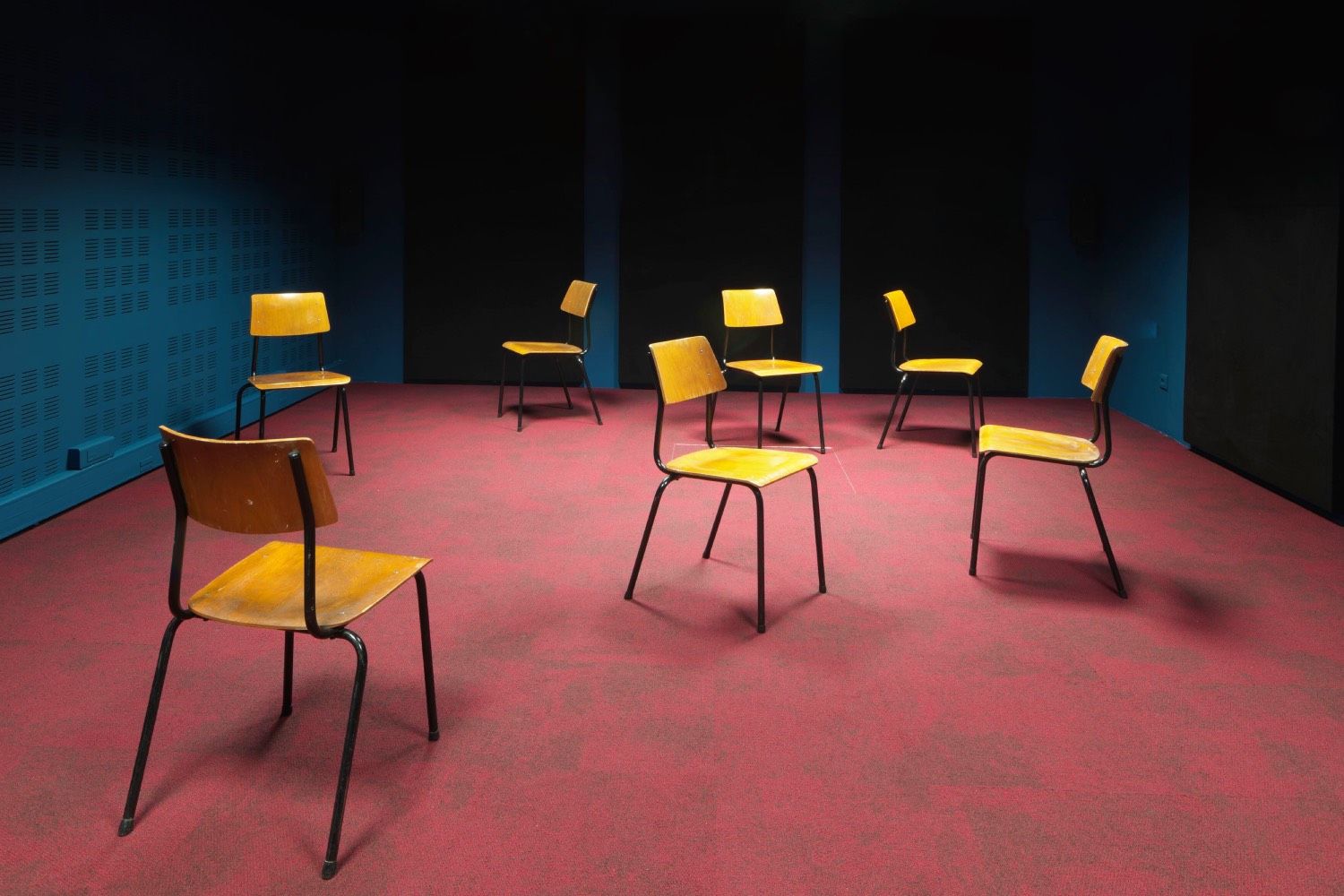
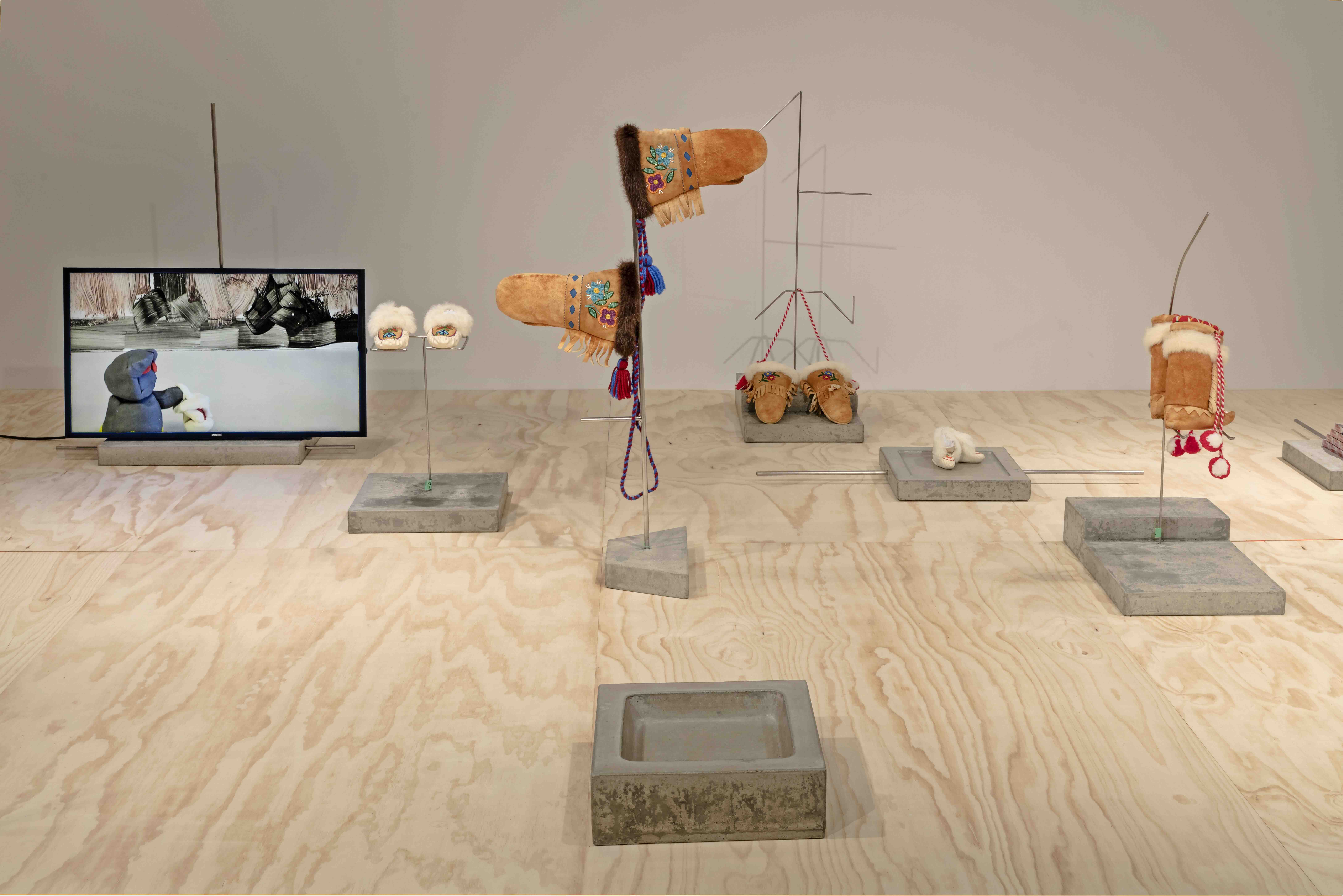
Recollection Returns with a Soft Touch consists of four vertical single-channel videos, installed in the four corners of a specific environment. At the center stands a totemic structure composed of four display cases (each corresponding to a video) arranged around a central column. At the top of this column stands an eighteenth-century sculpture from northern Thailand – Standing Buddha in the gesture of reassurance (abhayamudra) –– dominated by Ritual Umbrella (2024). The latter was conceived by Andrea Anastasio and realized thanks to a collaboration between the Italian Institute in New Delhi and the Insha-e-Noor Women’s Association. The mashrabiya pattern of the hand-carved petals is the formal representation of the peaceful coexistence of Islamic and Hindu cultures at the Mughal court in Delhi.
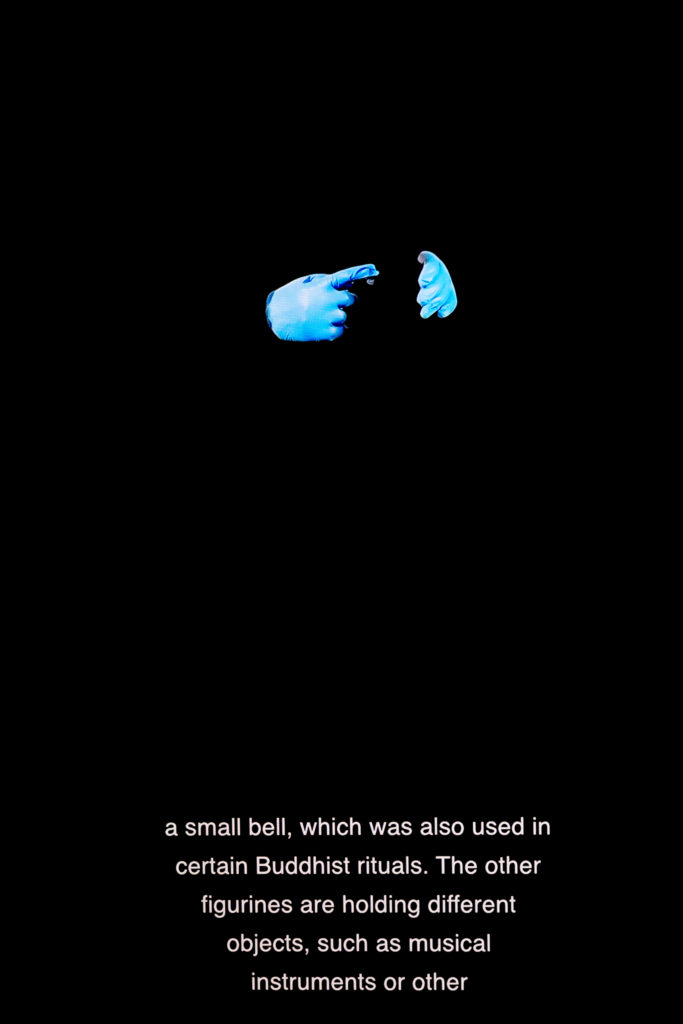
The four videos provide the visitor with all the necessary information about the objects on display in the vitrines. We stand with our backs to the objects and in front of the monitors, watching gloved hands move to the rhythm of the narrations of invisible speakers. The words come from six curators of the former MNAO and are subtitled in Italian and English. We follow the story of the objects that the speakers/narrators/caretakers present to us. The objects lie in front of them but are black on black, only partially visible when the hands take or touch them.
The curators tell the story of the objects — their use, their journeys from their original location, their materiality, how they were and are preserved — but also why they chose them. Despite their great connoisseurship and a description so detailed that it is possible to visualize the object perfectly, the personal connection to each piece is obvious.
Whether it’s because of the initial restoration work they carried out, or — as in the case of the first MNAO inventory entry from 1957 — because the curator visited the site to which it originally belonged (the Tianlongshan Grottoes in Shanxi, China), which was almost completely devastated between the 1920s and 1940s, the emotional connection comes through clearly. Her voice trembles with genuine grief, which she still feels, and she notes that this Bodhisattva sandstone head has “such a sweet expression.”
To such an extent do we see and project into objects; so much are objects also subjects.