A memory: Before reconnecting with them a few days ago in preparation for this text, I had last spoken to Cécile B. Evans among some mutual friends at a cafe in Aldgate, London. A cafe that was okay, not great, but convenient as it was adjacent to the art gallery where we were all either on our way to or from. I don’t remember what year that was, only that it feels long ago. I also remember that my enthusiasm for the group conversation expanded once we started to discuss whether or not those around the table had ever tried out “schedule send,” an email plug-in tool that was then rather new. I can imagine that many now will be familiar with the ability to schedule a message to be sent to a recipient’s inbox after a prescribed delay. The progression of internet technology tends to mark, at the very least, distinct phases of our collective experience in Amer-Europe, if not linear time itself — which is only one type of time, and I don’t wish to take time to defend that if it’s controversial to you. But I can with confidence say that the last time I saw Evans, seated around that gallery-adjacent cafe table, we were living in a different world, even if I can’t remember the calendar date.
Back then, the world we inhabited was shaped by the tools we used — just as today’s is. In my ideal world, I would construct this text using tools of analysis that remain complete abstractions. I feel most comfortable with archetypal discussions. And while this resonates with how Evans is working now — their recent film installations are titled RECEPTION! (2024) and MEMORY! (2025) — I can imagine an editor, working dutifully on behalf of you, imagined reader, asking: What am I referring to when I mention the world that we are in?
The world we inhabit is structured iteratively through temporal rhythms — the workday, the weekend — ritualized by commutes, shaped before we even leave home by renters and landlords, by legal structures like mortgages and property ownership, by familial arrangements, whether nuclear, ancestral, or chosen. Art offers one lens into this construction, where a pipeline from education to cultural labor mirrors and sustains capitalist industry. Art is not separate from the systems it critiques — it co-creates the capitalist world even as it imagines alternatives. Under heteropatriarchal racial capitalism, people work because they must, often in systems built on domination, where no labor in Amer-Europe is untainted by the suffering of others — whether in Palestine, Congo, or elsewhere. For those of us who reject a world rooted in ownership, violence, and extraction, the contradiction is visceral: we feel one truth while our practices often sustain another. We still work, still scroll, still dream — seeking rupture within complicity. Even as we participate in what we hope will end, we seek relief and resolve in the words of Ruth Wilson Gilmore, Sylvia Wynter, Octavia E. Butler, June Jordan — voices that refuse despair and name the possibility of abolition, a world beyond domination. We read them at home, lit by the glow of screens, aching for a world not yet here.
In our conversation about these future worlds that are struggling to be born against the materiality of what is happening now, Evans, who identifies as a compassionate pessimist, refocuses my enthusiasm out of a haze of exasperation for what has gained popularity in the art world right now: the practice of imagining other worlds. The italics should indicate my mocking tone. I’m exasperated because we keep failing to bring this imagined world off the airy plane of conversation and into a concrete realm that I can touch with my material body, i.e., I do not want to have to go to work tomorrow. Evans brings their compassionate nature to this discussion, not so much in any particular work but in their way of being that produces all of the work (“My work is my brain,” they note). This compassion acknowledges that world-birthing is painful and hard, and we’re probably going to fail, and the pessimist says we are more likely to die than to see it come to concrete fruition. That this work, of building another reality that we believe in, is iterative, and we may not be ready to actually live in the worlds that we are imagining, but we might be able to make them possible for other people. Reaching toward this new reality entails an understanding that worlds are always changing; there is no final perfect world.

Evans and I discussed this peculiar and enduring crest point in which we both are trying to feel calm, this reiteration of passing through violence in order to reach the pleasure of loving and failing to build something else. Loving the work of making something else, ever arriving. I found that Evans espouses a similar relationship to what I’m now referring to as the tools. I’ll summarize our shared ground with an adage that is a tautology: One cannot change a system from within a system that is comprised of the tools that build it.
My inner editor asks: What are the tools? The tool could be an email plug-in that allows your email to conceal your nocturnal strain at 2:30 AM and instead arrive in a curator’s inbox at a respectable time that seems effortless: 9:07 AM, obviously. A tool could be access to a white-walled room in a gallery, or it could be a grant from Arts Council England. Audre Lorde has already said it clearly, and we, the art world, have already run it dry, but I’ll play it again because these are the tools I’m talking about: The master’s tools will not dismantle his house. And I can’t remember if I thought this myself or I saw it on the internet, but the postscript is: But will the master’s tools help us build anything else we can use? I wonder if a tool can help build the new world, even if it can’t finish the job.
On the subject of using tools, parts, and detritus from the violent and dying empire, Evans cites Marcel Raymaekers, Belgian architect and antiques dealer. His work looks like an unhinged Charles Jencks. Raymaekers uses junk to create shelter: for example, airplane parts repurposed to make roofing for middle-class housing. His methodology of recycling decorative materials into construction elements for residential architecture yields some unsightly maximalist and untasteful anti-modern homes. And his description of his own practice is to call it “ad hoc baroque.” While drawn to the term, Evans’s manner of citation even embodies an adept deployment of ad hoc as method. Evans doesn’t use the concept of ad hoc because they love Raymaekers’s work but because they find the concept useful – and pilfered it. It’s a proficient and indifferent approach to citation that I think leaves emotional space available to create something new, because it doesn’t waste emotional energy on critiquing something that is part of a world that we’re not interested in.
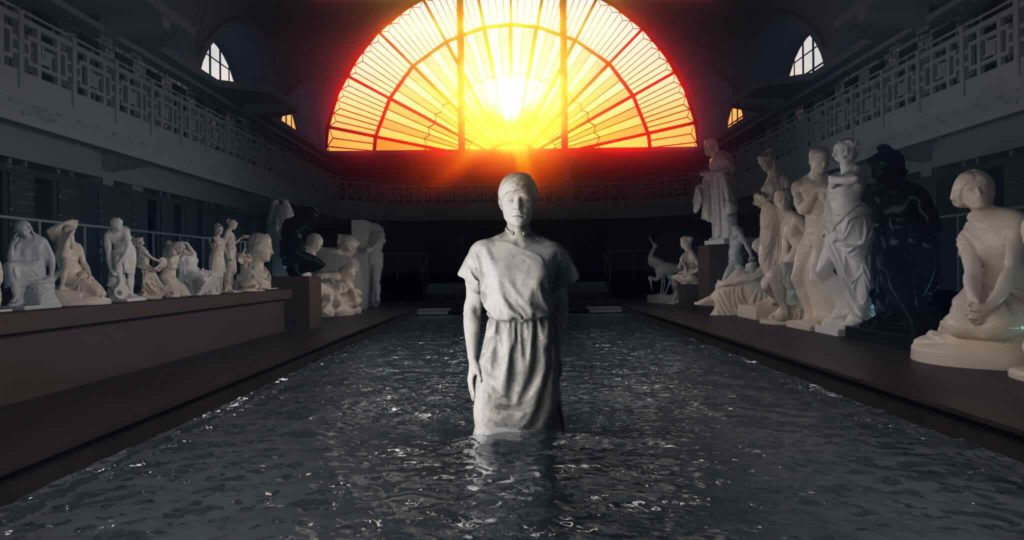
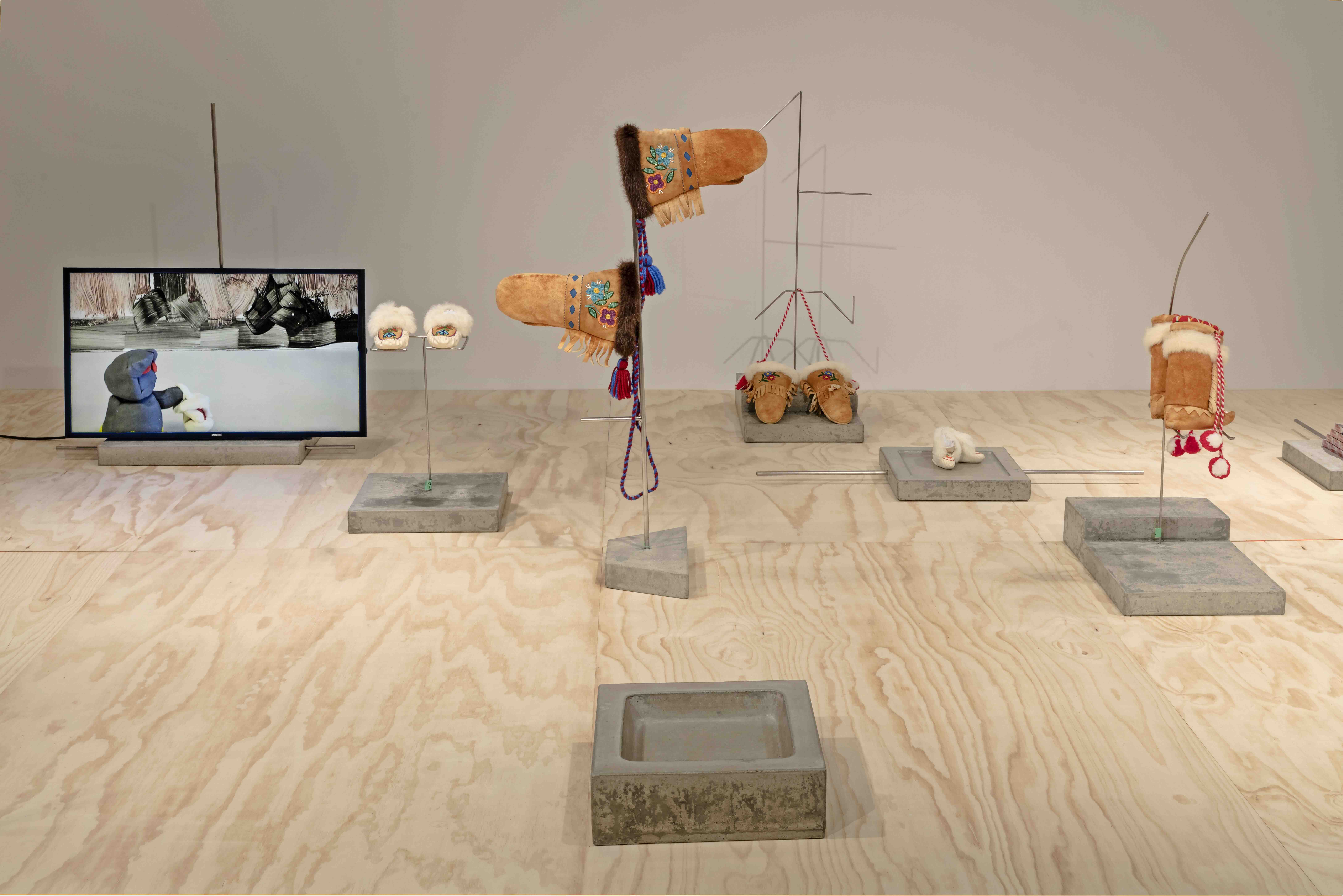
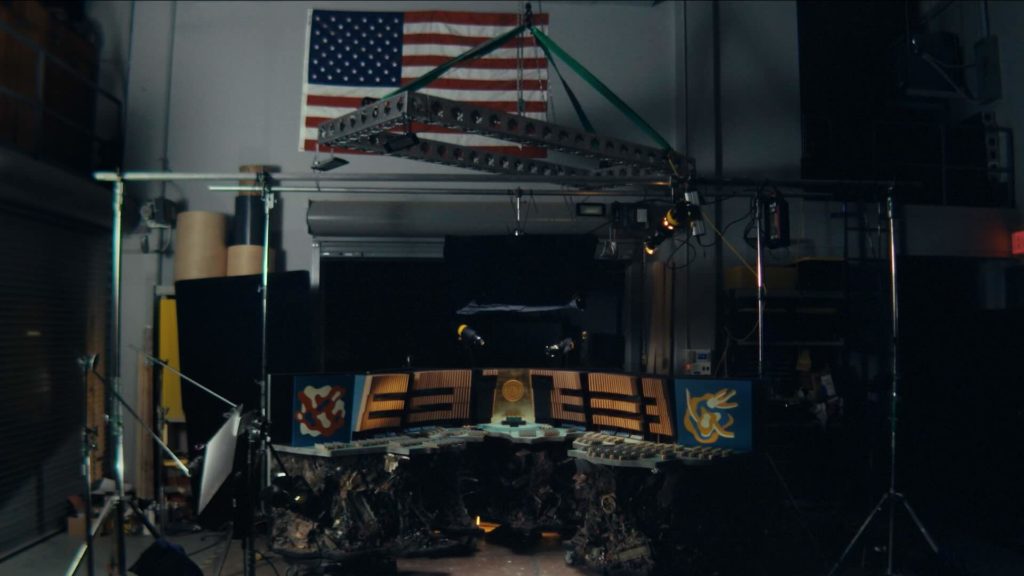
Evans’s recent installation at the Sharjah Biennial includes several sculptures that appear as a ground-zero damage overview of rubble, stockpiled under the remains of a sort of global international peacekeeping organization’s main auditorium. On the back edges of the sculptures are hand-scribbled notes, signed by “XOXO Ad Hoc Order,” which reads like a hypothetical and violent Gossip Girl, who not only spies on the hyper-rich New York elite but collects their failures in order to turn detritus into building blocks for something else. Understanding that Westernized colonialism is a dying machine, a dying order, this XOXO nudges the West toward its decline, if in no other way than by refusing to try to reform it. Just short of ignoring the tantrum of the dying colonial world, the XOXO is simply watching for how the tools of its collapse might become useful. This anonymous proto-terrorist that pens notes on the backs of these sculptures built out of the ruins of a destroyed New York City writes: “Your Failure was recorded, your chaos archived under the debris of the promise that was meant to restore you. The dust will be reconstituted to make shelves. XOXO Ad Hoc Order” and “The ruins of your shattered promises were salvaged and stockpiled in the cellar of the progressive framework that was meant to fix you. A holiday will be established to commemorate their conversion into coffee mugs. XOXO Ad Hoc Order.”
What is ad hoc about this order? The phrase “ad hoc” suggests a paradox in that the order is not planned, that it is not aesthetic as such (although it does have an aesthetic, obviously), which is to say it does not come into being because it is tasteful; it comes into being because it simply had to happen. Yes, the ad hoc could and often is critiqued for being done in haste and with short-term aims and goals. The ad hoc is something that got done without the luxuries of linear time — oh linear time! Like the English who invented it, for the luxuries that are their addiction, at the expense of the entire Earth! Despite its unthinking haste, something must be said for the fact that ad hoc constructions change the stakes. The ad hoc is a Cardinal, as in, it is a Pivot. It is change concretized, and if we, ad hoc constructionists, string that together with Octavia Butler’s adage that “God is Change,” we can emerge with a sense of what the ad hoc is doing in the work and in the world.
I will try to access what can result from the pivot by doing something a bit ad hoc, using these tools: Evans’s compassionate pessimism, their conviction that institutions have failed and that one cannot change the system from within the system. If our energy could be better used to build a new world, we get some clues as to how that might happen again through Sylvia Wynter, who writes often about using work to rehearse new worlds. Evans cites Wynter’s approach as a guiding principle for their own work. So I’ll end with an ad hoc analysis of Wynter, and Evans, which I hope could quickly demonstrate what the ad hoc can do, rushed as it may be, to end this world on the way to the next.
Evans said to me that it is a privilege to think in a divested way, and I think this is echoed in Wynter’s 1984 novel The Hills of Hebron, in which critical distance allows characters to appreciate art. This happens in the section of the book where the protagonist, Obadiah, uses the detritus of a hibiscus tree to carve a toy. He carries it with him through an incredibly violent uprising in the coastal Jamaican town where he is looking for work. Not finding work, he tries to sell the wooden toy to his peers. None of whom are interested. Only a German man, in Jamaica because he is fleeing the Nazi government, takes an interest in the wooden toy, as it reminds him of his sculpture collection back in Germany, and he buys it for today’s equivalent of a hundred euros. His critical distance is afforded by wealth and also the sheer fact of being a foreigner in that land. Together, the German and the Jamaican co-create an artwork, making something else that, I would argue, came together in the ad hoc manner of their chance meeting. Alas, Obadiah said that after he had carved the wooden thing, he felt closer to God. If God is Change, could he also mean that he changed something about his world, his condition, his relationship to capitalist structures, through the ad hoc transformation of material into an artwork? I think this might be the beginning of understanding what Evans might be rehearsing in the work: using materials (whether they be concrete or social or technological) not for the sake of exalting them aesthetically, but to access the metaphysical pleasure of a newly changed circumstance.