“I like the term pervert or perversion,” says Diego Marcon, speaking to me during an early June heatwave, his Italian rrrrrs rolling deliciously. He’s in Milan, I’m in London, we’re both hiding in our apartments. I have asked about the ways in which Marcon’s work makes strange, subverts reality by disrupting it ever so slightly, what some people might describe as a kind of “queering” of imagery, narrative, materiality — all the expectations we so unconsciously bring to art, and in particular moving-image works, which automatically pose the question of verisimilitude.
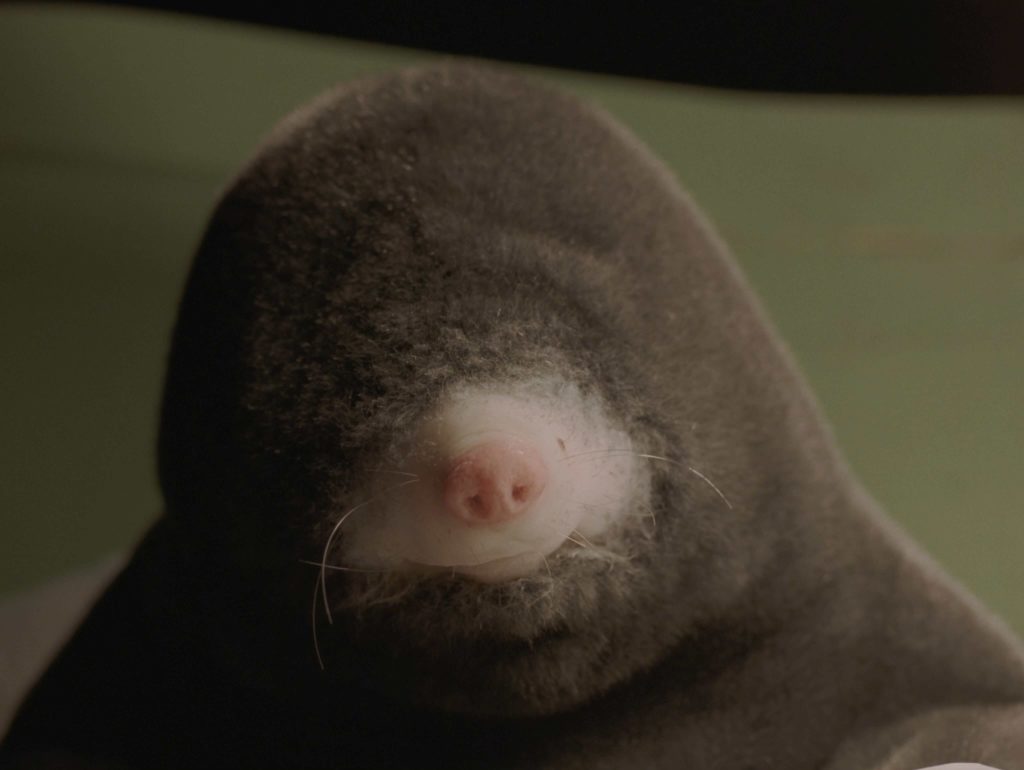
A thing that is and is not itself. A side-step, a shimmy-shake, a strategy of grammar and displacement, a metonymy, synecdoche, metaphor, like but not like, a tell everything but tell it slant, as Emily Dickinson encouraged, a story within a story within a story that might be about childhood or violence or desire or longing or disappointment, but might equally be about genre, style, artistry, imagination, fantasy, how we can still surprise even ourselves by catching something from another angle. A horror film that is also a musical. A musical that is also a requiem. A requiem that is also a childish complaint. A childish complaint that is uttered by a deceased daughter. A face that is not a face. A mole that is not a mole. A pair of dancing trousers. Gesturing gloves. A cavorting pullover. A fluttering foulard — acting of their own volition, empty of body or host, but still animating a narrative at once funny, humbling, sinister, fantastical. A cartoon but not a cartoon, an animation — as in something bestowed with life, from animare, “give breath to” and “to endow with a particular spirit, to give courage, to enliven” — that is also live action, a boy who is really a girl hounded by clothes who are really now-invisible dancers singing a song about a pastry that is really a song about, well, whatever you want it be, but not just an apricot-flavored delicacy, that’s for sure.
“In Italian it means,” Marcon says, holding up a piece of paper, “the other side, to turn something around. This is recto,” pointing at the front, “and verso,” pointing at the back. Something perverse, perverted, a perversion, is something whose underside is showing, flashing here and there, bubbling and burbling under the surface, turning over momentarily in a gust of wind, through a glass darkly, or brightly, depending on your mood, the back, the usually unseen, the world beyond (inside, next to, underneath) this one.
When Marcon gestures with his hand, verso, an image flashes into my mind of what is fondly known, to David Lynch fans, as “dumpster man” from Mulholland Drive (2001): a strange creature, body blackened and ragged, who leers out from behind a dumpster and scares a man — who has already dreamed prophetically of this dark figure — to death. Later, I ask about the artist’s cinematic favorites, directors and films that he admires, and am surprised when Lynch, the master of uncanny darkling pop surrealism, is passed over in favor of Adrian Lyne, American auteur of cult classics like Flashdance (1983), Fatal Attraction (1987), and Indecent Proposal (1993), and Paul Verhoeven, the naughty Dutch filmmaker whose genre-bending work is so bizarre and varied it defies pithy description. These are directors who live on the campy, B-list, noir side of things, wearing style like a rubber mask so well-made you watch it rapt from the uncanny valley, not quite sure what’s going on.
“Camp is a vision of the world in terms of style — but a particular kind of style. It is the love of the exaggerated, the ‘off,’ of things-being-what-they-are-not,” writes Susan Sontag in her essay “Notes on Camp” (1964). She notes, too, that “to camp” is a verb, a relishing of style, a way of offering in both art and life “a different — a supplementary — set of standards.” To camp, she says, “is a mode of seduction.“[1]
[1] Susan Sontag, “Notes on Camp” (1964), Against Interpretation and Other Essays (London: Picador, 2001), 27-30
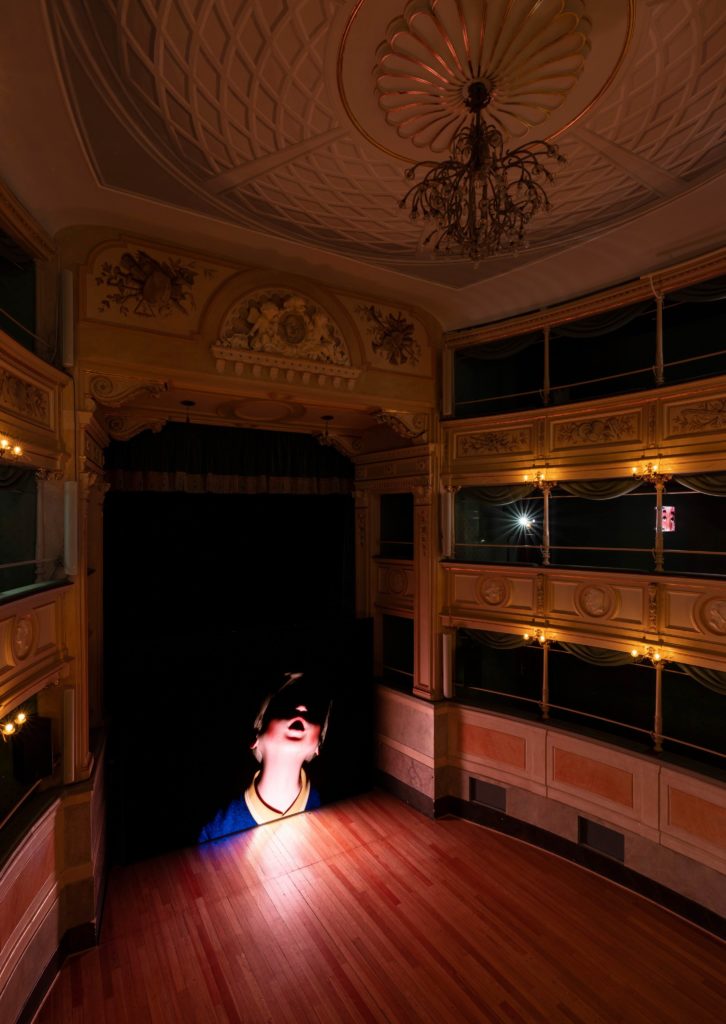
What’s more camp, more deliciously, beautifully earnest and hopefully foolhardy, than a musical? A musical, for instance, in which a boy hangs from a rope noose tied to the ceiling of a stone passageway, a green field just visible beyond. Fritz — whose name we infer from the title of the film, Fritz (2024) — dangles limply, swings and sways, rotates as the rope around his neck twists and untwists, its movement encouraged by the fact that though he appears deceased, every so often Fritz stretches out a leg to push off the nearby wall, to keep his body swinging, to ward off stillness, as if the absolution of movement might be what finally ends it all. Film is a machine that defies time – and with it death. It loops and plays again and again. The dead boy never really dies, keeps swinging and keeps singing, an ethereal chant, a yodeling requiem, while the chorus of an invisible choir rises and falls, stops and starts endlessly. A mass for what? Life? Animation? The profoundly useful uselessness of time and what it can and cannot ward off? Stay a while, Fritz offers, and maybe he’ll come back to life. If not, we can keep listening, waiting, knowing he’s there swinging and hanging and warding off death for a moment longer, for eternity, whether we are there with him or not.
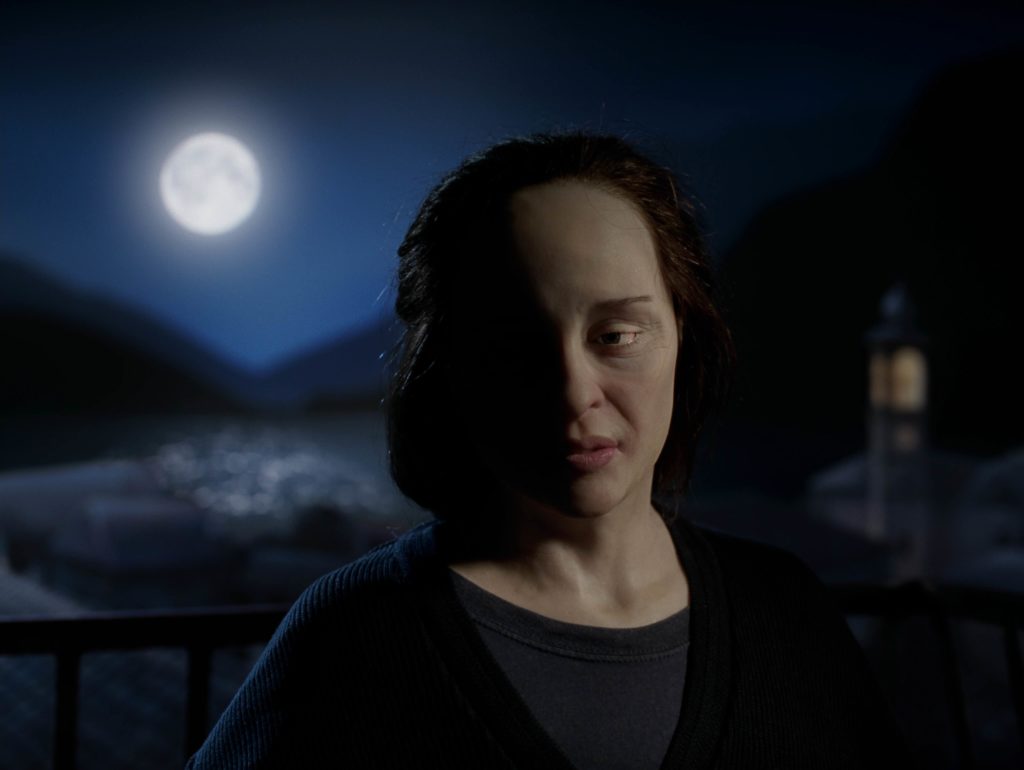
Fritz, it should be said, is a CGI, as is his background. But while the young boy in soiled gray sweatpants and scuffed shoes is not “real” looking, more like an animated character, the scene around him is based on real images from the woodshed at Marcon’s country house in Brinzio, north of Milan. The more you watch, the more you notice, the more you wonder: What happened here? What am I looking at? What am I hearing? What world is this that is and is not the world I live in? There’s no stool or chair, no stand knocked over to indicate that Fritz hung himself, an act of self-harm. Nor can we see how high the ceiling is. How is the rope fastened? How many people would it have required, to hoist it up there, tie it tight, lift Fritz’s body and do the deed that remains not quite, never to be, done? Who did this to Fritz and why? The simple answer to the first part of that question is Marcon, but why is not the kind of question his work is interested in. “We murder to dissect,” writes William Wordsworth in his poem “The Tables Turned” (1798) of the human tendency to be overly analytical, to seek answers in intellect. Marcon murders Fritz, hangs him outside the artist’s own house in perpetuity, and brings him to life in the same act, defers dissection, no autopsy will be had, Fritz is in our hands now.
The same is true of Ludwig (2018), another single-character film in which the titular young boy sings plaintively, frustrated by circumstances that repeat diegetically within the eight-minute film and then again and again and again. When it loops, poor Ludwig begins his tortured musical solo once more, inside what appears to be the darkened hull of a boat tossed on stormy seas:
O Lord am I exhausted
I feel so low and blue.
I’d like to kick the bucket
Then it would all be through.
And yet
A container (the boat) inside a container (the film) is further contained by a rule that Ludwig, with his cherubic blond-haired aspect, seems to have self-devised: He can only sing if there is illumination. However, his only source of light is a book of matches, and each only burns for so long. His face glows, spotlit, and he opens his mouth to pour forth his song of lament, only to be cut short each time he is plunged back into darkness.
He strikes another and starts again as we pitch and heave around him. He doesn’t speed up, simply does everything the same, and so we understand that Ludwig is looped in a loop, a vicious cycle, an ouroboros doomed to his Promethean task, with its shades of Mickey Mouse as the sorcerer’s apprentice in Disney’s Fantasia (1940), mops and brooms multiplying beyond control (it seemed like a good idea at the time), unable to ever finish his song, whose chorus (or is it the verse?) will always end with a conjunction whose rejoinder remains ambiguous: and yet.
And yet — what? Narrative is implied by chronology, and chronology is propulsive, riddled with expectations that are difficult to shrug. In The Emergence of Cinematic Time (2002), the scholar Mary Ann Doane argues that filmic time is not a reflection of real time but a very specific representation of it that has nonetheless had recursive effects: cinematic time is constituted by the medium, but has also come to shape what we understand of time in general, though it may pass much differently, with varied properties, outside the life of moving images. Marcon’s films tease out (pervert, we might say) the underside of psychological time as a site of intense internal and external contradictions. As his films loop-de-loop, they become protracted arenas in which the rules of time and space, life and death, expand and become something new.
This might be through structural play, as in Monelle (2017), in which characters, once more enclosed within a very specific architectural space — the Casa del Fascio in Como, formerly the headquarters of the local National Fascist Party branch — do not exist as characters per se, but as figures strategically illuminated — not unlike Ludwig — by flashes of light. In between, we hear sounds of action — a body being dragged, a body falling, footsteps — but our mind fills in the rest, like Michael Haneke’s Funny Games (1997/2007) meets Hitchcock’s Rear Window (1954) meets Stan Brakhage’s early experiments in collage film, jump cuts, and in-camera editing.
It might also be through a kind of fairytale narrative, as in Dolle (2023), about a family of moles, which quickly turns out to be a kind of nightmare (as fairytales often are), in which we wait for stasis to be broken, for action — an event, the defining aspect of film — to occur, only to find our expectations drawn out interminably so that we begin to read anything and everything as a sign. Will the thundering footsteps overhead cause the ceiling to cave in? Will the inchoate burrowing sound turn out to be an animal intruder who will turn their tidy burrow into chaos and carnage? Will the little baby mole become sicker and sicker until the parents, immersed in tallying a kind of Kafkaesque accounting ledger, have to intervene, call for help, leave their little mole world in the middle of the night and grope blindly toward a mole hospital, or to wherever sick moles go? Will their counting ever add up to anything at all? Do they need a calculator? Given moles are blind, can they even see the numbers they’re reading?
For the literary theorist Paul Ricoeur, the fairytale is the genre that does mischief to narrative space and time. It is a primordial, oneiric realm of dream rather than a sphere of action. It is a timeless but not an atemporal space or place, a kind of limbo (once upon a time, in a land far, far away) that is nonetheless recognizable — even more so for its strangeness, its perversion, which shows us what we know but perhaps do not often see. We might describe this as a kind of poetry, like the singsong nursery rhymes of Sylvia Plath, who delivered brutal truths in spare lines filled with internal rhymes and playful rhythms, as in her poem Daddy (1962), in which the speaker addresses her deceased father as a fascist, a vampire, a killer: “There’s a stake in your fat black heart / And the villagers never liked you. / They are dancing and stamping on you. / They always knew it was you. / Daddy, daddy, you bastard, I’m through.”[2]
[2] Sylvia Plath, “Daddy” in The Collected Poems, ed. Ted Hughes (New York: Harper and Row, 1981), 224
We might think of it as durational performance, like Yoko Ono’s 1966 Film No. 14: One (a.k.a. Match), which shows a match burning down: filmed with a high-speed camera and projected back at normal speed, time becomes meaningless, manipulated, uncertain, much like life.
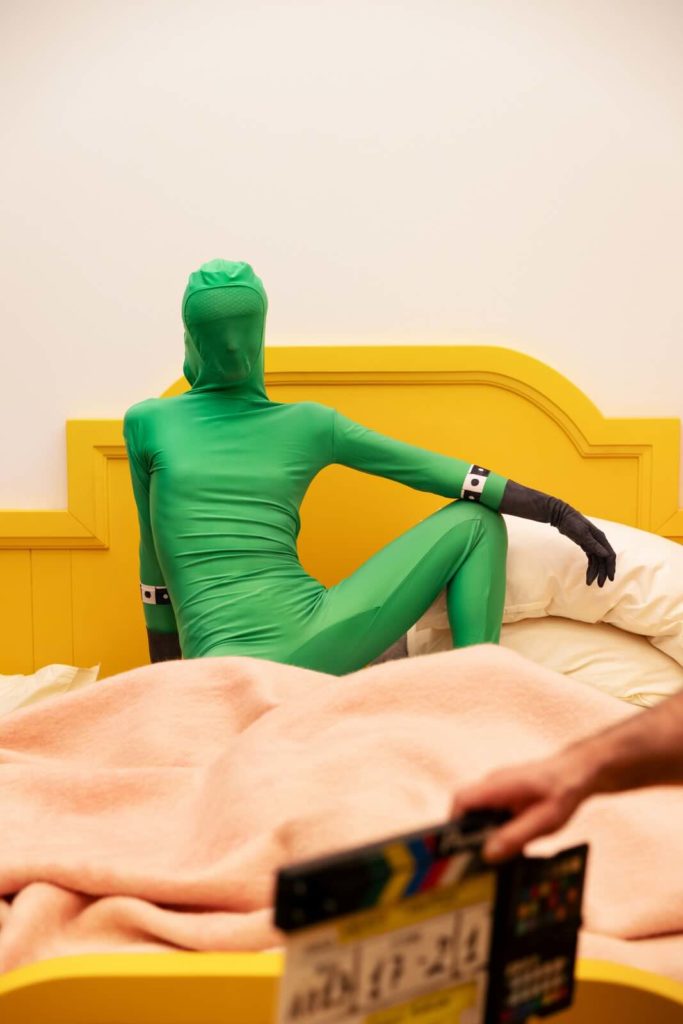
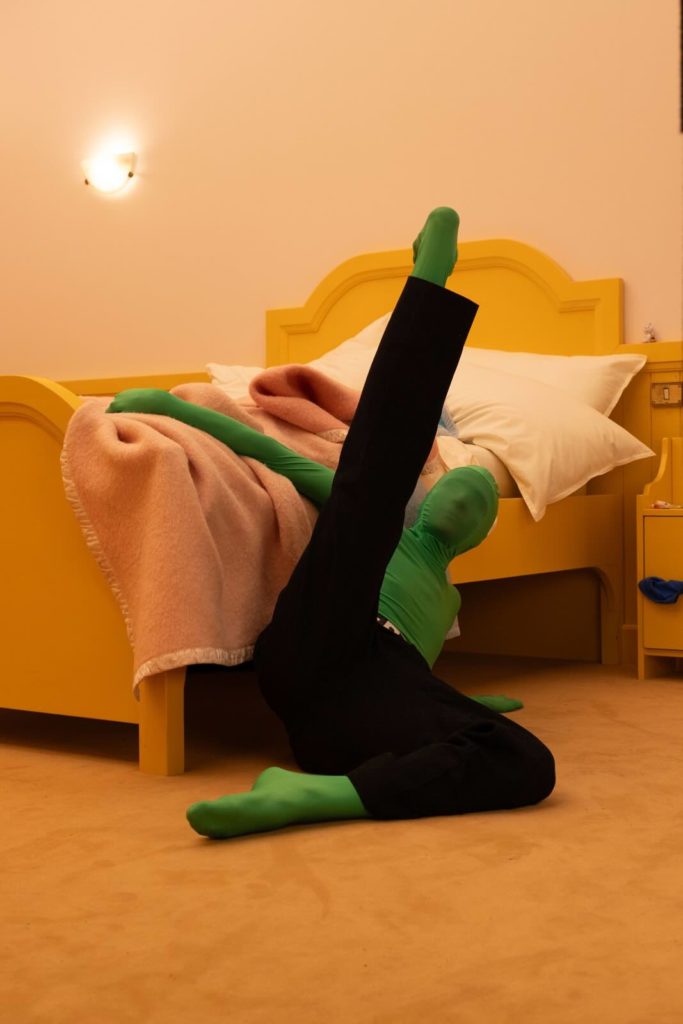
Or we might find its twisted, magical, beautiful logic in Marcon’s most recent film, Krapfen (2025), in which an androgynous kid (played by a preternaturally youthful looking performer) is harassed, plagued, prodded, some might say tortured, by a team of flying clothes: trousers, gloves, a foulard, a pullover with a collared shirt underneath, who demand to know why they do not wish to eat their formerly favorite treat, an apricot-filled donut called a krapfen, a traditional Austrian delicacy. The kid resists, runs around the yellow room, is forced into cavorting dances with the clothes who — though bodiless — possess voices that hector, as in Marcon’s other films, in delicious and beautifully scripted song. (The musician and composer Federico Chiari is Marcon’s frequent collaborator.) The kid ends up hiding in the closet, where the voices continue, demanding to know why their childhood delight has been forsaken.
Marcon tells me that when he was working on the film, he knew, all of a sudden, it would end with the voices reciting the not-uncomplicated recipe for the krapfen. Now the child can make it himself; all they have to do is leave the closet and follow the rules. But before we know if the kid accedes, or stays in the closet instead, or, who knows, decides they wants to only eat poutine from now on, or Portuguese cheese buns, or something different every day — being a kid is hard enough as it is — the film ends and begins again. And of course, the krapfen is not just a krapfen. But it’s we who are now the perverts, waiting and watching, again and again, to glimpse the other side, the back side, the verso, oneiric and vivid, camp and realist, with Marcon our cineaste of the in-between.