In collaboration with Galleria ZERO…, Milan, Brunette’s Coleman’s CONDO 2026 presentation begins with a slab of stone deposited at the gallery’s door. This is the doing of artist Paride Maria Calvia, who introduces the river-worn lump not as a work in itself but as a testament to his own art-making methodologies. The artist explained to me that the rock is one of many that he took from the banks of the Thames, carried home, washed, and subsequently displayed in his own living space. This process of accrual occurs for no consolidated reason, but the arduous ritual of collecting — an undertaking that the artist shoulders once or twice a week — is indicative of Calvia’s approach to his making.
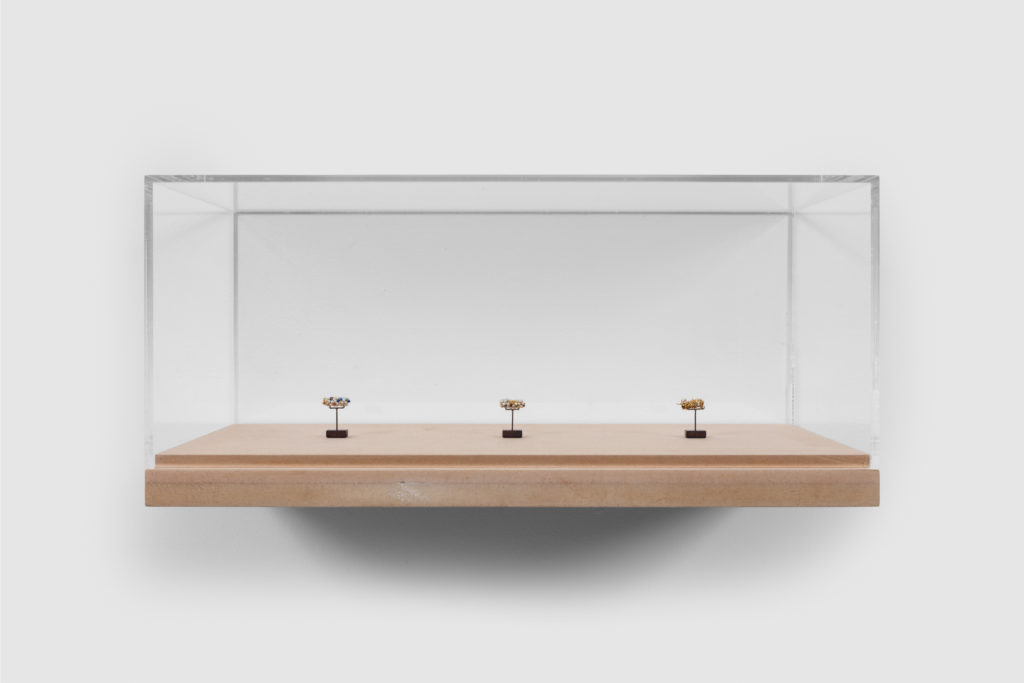
Inside, Calvia joins Hubert Duprat and Irene Fenara — both artists who, in different ways, perform their own rituals of accumulation. A trio of works from Duprat’s iconic series “Tube de tricopthère” (1980–ongoing) sit, sheltered by acrylic, on a basic MDF shelf. The series has been exhibited at Turin’s Castello di Rivoli, where its unusual mode of authorship becomes immediately apparent: the artist authors these works but their fabricators are caddisfly larvae. These water-dwelling pupae are known for creating tubular protective structures made from sand, stones, and organic debris. Duprat’s intervention is to provide only gold, pearls, turquoise, and other precious gems as building materials. The resulting miniature sculptures — true collaborations between the artist and nature — present as priceless artifacts from antiquity, glimpsed through glass in a museum. The ritual here exists in the artist’s laboratory where Duprat creates the perfect conditions for the caddis larvae to unwittingly assemble these treasures, manufacturing more than one hundred and fifty “tube de tricopthère” sculptures over the last fifty years.
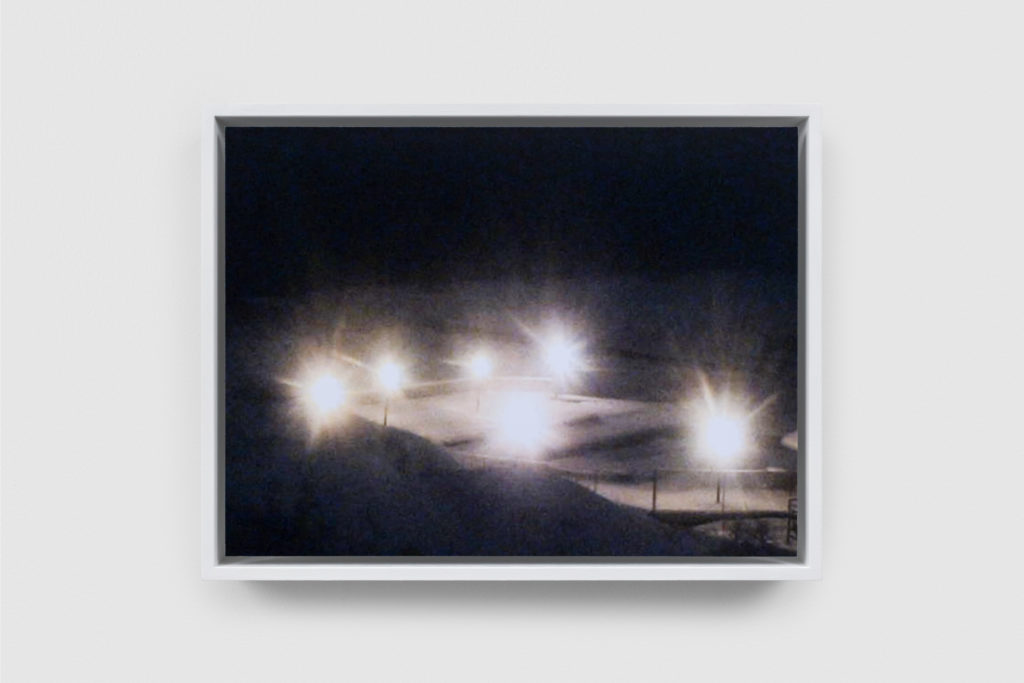
Irene Fenara’s accumulation comes in the form of intercepted CCTV footage, screened on an LED monitor in the far corner of the gallery. Supervision (Afterglow) (2025) appears to be a still image at first glance — a rural skyline at dusk — but its liveness reveals itself as car headlights punctuate the serenity, creeping forward in cycling still images until a line of traffic forms. The eleven minutes of looping footage is not Fenara’s own but found through publicly accessible CCTV livestreams. Little of note happens in the grainy recording and it stands to reason that, if it weren’t for the artist’s act of archiving and screening, this snapshot in time and place (the details of which we are not privy to) would have been disregarded and/or never remembered. Fenara’s “Supervision” series — a body of work defined by the artist’s meticulous assembly of media — acknowledges the impermanence of the digital image: the surveillance footage she collects would be wiped after twenty-four hours if it weren’t for her interference. By compiling these often arbitrary recordings en masse, Fenara is able to consider the relationship between us, the viewer, and the surveilled subject in a contemporary society where notions of privacy are becoming increasingly fictionalized.
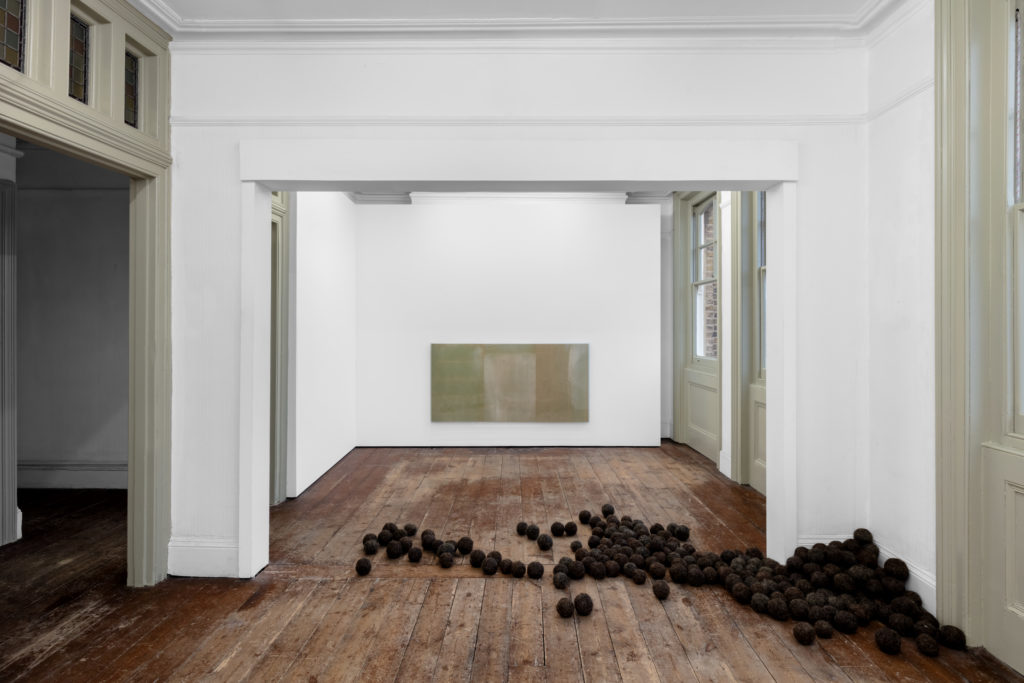
Calvia’s interior offerings follow the same obsessive practice as his stone collecting, only utilizing another of nature’s raw materials. The spongy brown spheres that litter the space in Blowing Coat (2023–ongoing) are formed from coalesced pig hair that the artist has rolled by hand. Calvia collects pig hair from local farms not because it has a use, but because it doesn’t — the hair’s texture and formlessness are attractive enough. These too seem to have become a kind of time-based work for the artist: each ball is representative of the fifteen to twenty minutes of rolling required for its creation, an almost daily practice that populated the artist’s own home with organic spheres long before they entered the gallery space. Fundamentally, river rocks and pig hair are readily available materials with no inherent value that allow for the artist to “translate obsession into object.” When these series have reached their natural conclusions Calvia will no doubt apply this same obsessive and durational approach to a different set of materials.
Hung low at waist height, Calvia’s Sottostrato (2026) comprises a triptych of weathered fiber boards recovered from a friend’s home during renovations. Sun bleached lines run across the panels where cracks in the floorboards let in strips of light. Framed in a sleek acrylic box, these fragments of a domestic interior already read as minimalist painting and would qualify for readymade status if it wasn’t for the artist’s slight intervention: the addition of calcium carbonate dust brushed across specific areas to highlight their natural weathering. Their display here calls attention to their aged patina as a visual log of time passed.
Collectively these three artist’s works concern a reframing of processes: natural, manmade, and digital. A material amassing exists at the core of what’s on show, with the work’s eventual assembly in an exhibition context almost a byproduct of the artist’s compulsions. At Brunette Coleman we are witnesses to a perpetual assembly that feels as innate as it does exceptional.